
The dawn of the post-literate society - by James Marriott

By: James Marriott
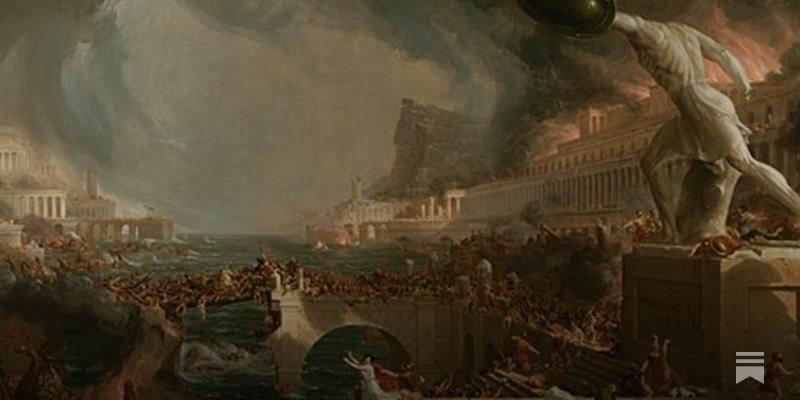


I ran across this article about the rise of screen time and the accompanying less time actually spent in cognitively digesting a book.
As an extreme example think of somebody trying to simply speak a famous work of philosophy. Say, Kant's 900-page The Critique of Pure Reason or Ludwig Wittgenstein's Tractatus or Sartre's Being and Nothingness. It would be impossible to do. And also impossible to listen to.
To produce his great work Kant had write to down his ideas, scratch them out, think about them, refine them and then rework them over many years so they added up into a persuasive and logical whole.
To properly understand the book you have to be able to have it in front of you so you can re-read bits you don't understand, check logical connections and meditate on important passages until you really take them in. This kind of advanced thinking is inseparable from reading and writing.
The classicist Eric Havelock argued that the arrival of literacy in ancient Greece was the catalyst for the birth of philosophy. Once people had a means of pinning ideas down on the page to interrogate them, refine them and build on them, a whole new revolutionary way of analytic and abstract thinking was born — one that would go on to shape our entire civilisation3. With the birth of writing received ways of thinking could be challenged and improved. This was our species' cognitive liberation.
 S E E D E D C O N T E N T
And the end of civilisation
 James MarriottSep 19, 20258,1436492,723Share

What Orwell feared were those who would ban books. What Huxley feared was that there would be no reason to ban a book because there would be no one who wanted to read one.
— Neil Postman, Amusing Ourselves to Death
The age of print
It was one of the most important revolutions in modern history — and yet no blood was spilled, no bombs were thrown and no monarch was beheaded.
Perhaps no great social transformation has ever been carried out so quietly. This one took place in armchairs, in libraries, in coffee houses and in clubs.
What happened was this: in the middle of the eighteenth century huge numbers of ordinary people began to read.
For the first couple of centuries after the invention of the printing press, reading remained largely an elite pursuit. But by the beginning of the 1700s, the expansion of education and an explosion of cheap books began to diffuse reading rapidly down through the middle classes and even into the lower ranks of society. People alive at the time understood that something momentous was going on. Suddenly it seemed that everyone was reading everywhere: men, women, children, the rich, the poor. Reading began to be described as a "fever", an "epidemic", a "craze", a "madness". As the historian Tim Blanning writes, "conservatives were appalled and progressives were delighted, that it was a habit that knew no social boundaries."
This transformation is sometimes known as the "reading revolution". It was an unprecedented democratisation of information; the greatest transfer of knowledge into the hands of ordinary men and women in history.
In Britain only 6,000 books were published in the first decade of the eighteenth century; in the last decade of the same century the number of new titles was in excess of 56,000. More than a million new publications appeared in German over the course of the 1700s. The historian Simon Schama has gone so far as to write that "literacy rates in eighteenth century France were much higher than in the late twentieth century United States".
Where readers had once read "intensively", spending their lives reading and re-reading two or three books, the reading revolution popularised a new kind of "extensive" reading. People read everything they could get their hands on: newspapers, journals, history, philosophy, science, theology and literature. Books, pamphlets and periodicals poured off the presses.
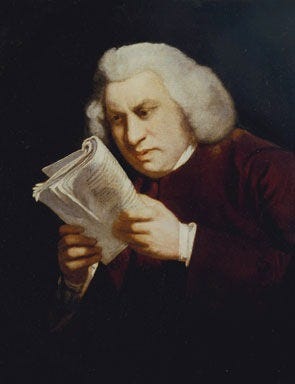
It was an age of monumental works of thought and knowledge: the Encyclopedie , Samuel Johnson's Dictionary of the English Language , Edward Gibbon's Decline and Fall of the Roman Empire , Immanuel Kant's Critique of Pure Reason . Radical new ideas about God, about history, about society, about politics, and even the whole purpose and meaning of life flooded through Europe.
Even more importantly print changed how people thought.
The world of print is orderly, logical and rational. In books, knowledge is classified, comprehended, connected and put in its place. Books make arguments, propose theses, develop ideas. "To engage with the written word", the media theorist Neil Postman wrote, "means to follow a line of thought, which requires considerable powers of classifying, inference-making and reasoning."
As Postman pointed out, it is no accident, that the growth of print culture in the eighteenth century was associated with the growing prestige of reason, hostility to superstition, the birth of capitalism, and the rapid development of science. Other historians have linked the eighteenth century explosion of literacy to the Enlightenment, the birth of human rights, the arrival of democracy and even the beginnings of the industrial revolution.
The world as we know it was forged in the reading revolution.
The counter revolution
Now, we are living through the counter-revolution.
More than three hundred years after the reading revolution ushered in a new era of human knowledge, books are dying.
Numerous studies show that reading is in free-fall. Even the most pessimistic twentieth-century critics of the screen-age would have struggled to predict the scale of the present crisis.
In America, reading for pleasure has fallen by forty per cent in the last twenty years. In the UK, more than a third of adults say they have given up reading. The National Literacy Trust reports "shocking and dispiriting" falls in children's reading, which is now at its lowest level on record. The publishing industry is in crisis: as the author Alexander Larman writes, "books that once would have sold in the tens, even hundreds, of thousands are now lucky to sell in the mid-four figures."
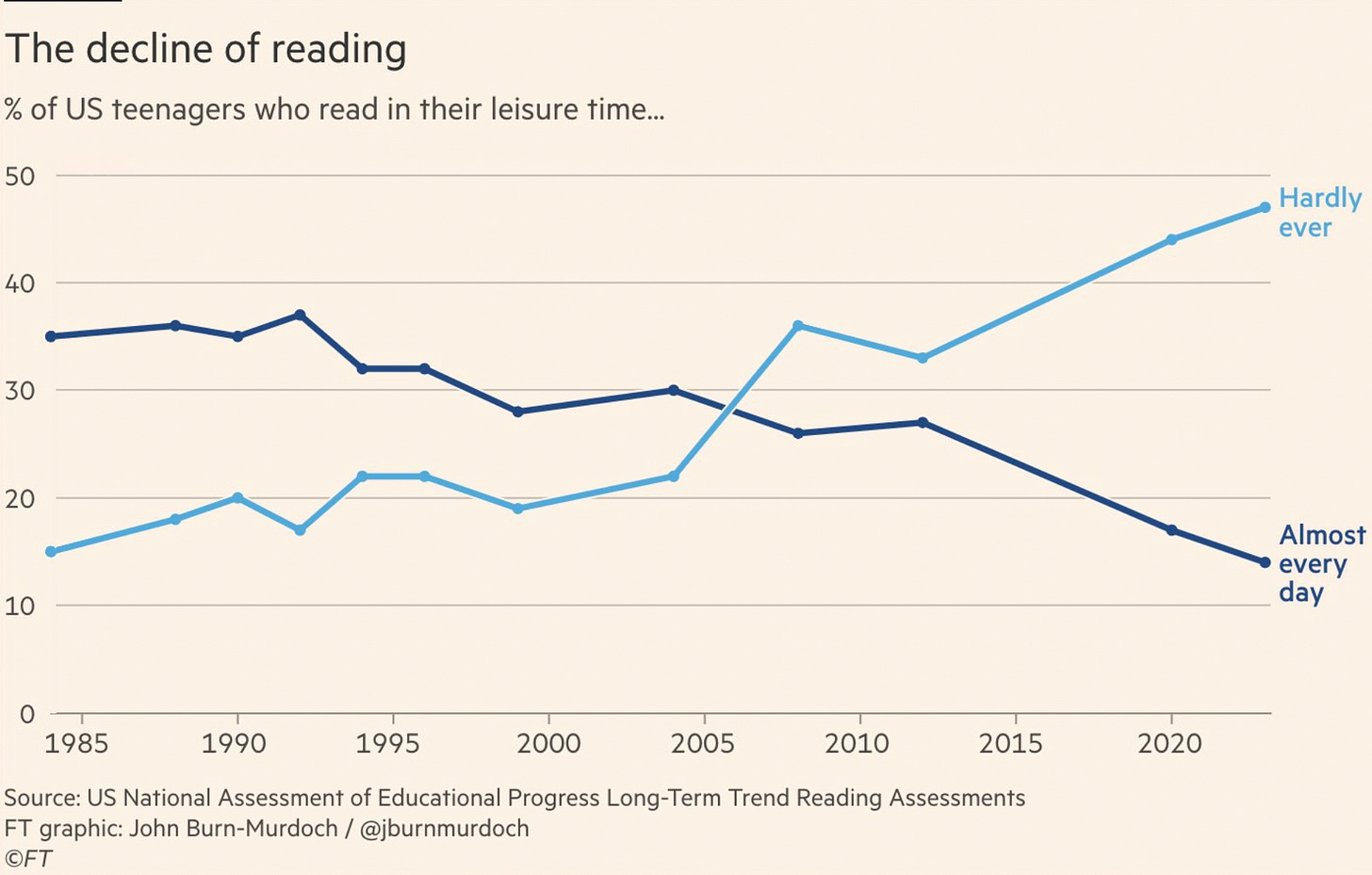
Most remarkably, in late 2024 the OECD published a report which found that literacy levels were "declining or stagnating" in most developed countries. Once upon a time a social scientist confronted with statistics like these might have guessed the cause was a societal crisis like a war or the collapse of the education system.
What happened was the smartphone, which was widely adopted in developed countries in the mid-2010s. Those years will be remembered as a watershed in human history.
Never before has there been a technology like the smartphone. Where previous entertainment technologies like cinema or television were intended to capture their audience's attention for a period, the smartphone demands your entire life. Phones are designed to be hyper-addictive, hooking users on a diet of pointless notifications, inane short-form videos and social media rage bait.
The average person now spends seven hours a day staring at a screen. For Gen Z the figure is nine hours. A recent article in The Times found that on average modern students are destined to spend 25 years of their waking lives scrolling on screens.
If the reading revolution represented the greatest transfer of knowledge to ordinary men and women in history, the screen revolution represents the greatest theft of knowledge from ordinary people in history.
Our universities are at the front line of this crisis. They are now teaching their first truly "post-literate" cohorts of students, who have grown up almost entirely in the world of short-form video, computer games, addictive algorithms (and, increasingly, AI).
Because ubiquitous mobile internet has destroyed these students' attention spans and restricted the growth of their vocabularies, the rich and detailed knowledge stored in books is becoming inaccessible to many of them. A study of English literature students at American universities found that they were unable to understand the first paragraph of Charles Dickens's novel Bleak House — a book that was once regularly read by children1 .
An article published in The Atlantic, 'The Elite College Students Who Can't Read Books' cites the characteristic experience of one professor:
Twenty years ago, Dames's classes had no problem engaging in sophisticated discussions of Pride and Prejudice one week and Crime and Punishment the next. Now his students tell him up front that the reading load feels impossible. It's not just the frenetic pace; they struggle to attend to small details while keeping track of the overall plot.
"Most of our students", according to another despairing assessment, "are functionally illiterate". This chimes with everything I've heard in my own conversations with teachers and academics. One Oxbridge lecturer I spoke to described a "collapse in literacy" among his students.
The transmission of knowledge — the most ancient function of the university — is breaking down in front of our eyes. Writers like Shakespeare, Milton and Jane Austen whose works have been handed on for centuries can no longer reach the next generation of readers. They are losing the ability to understand them.
The tradition of learning is like a precious golden thread of knowledge running through human history linking reader to reader through time. It last snapped during the collapse of the Western Roman Empire as the barbarian tides beat against the frontier, cities shrank and libraries burned or decayed2. As the world of Rome's educated elite fell apart, many writers and works of literature passed out of human memory — either to be lost forever or to be rediscovered hundreds of years later in the Renaissance.
That golden thread is breaking for the second time.
An intellectual tragedy
The collapse of reading is driving declines in various measures of cognitive ability. Reading is associated with a number of cognitive benefits including improved memory and attention span, better analytical thinking, improved verbal fluency, and lower rates of cognitive decline in later life.
After the introduction of smartphones in the mid-2010s, global PISA scores — the most famous international measure of student ability — began to decline. As John Burn Murdoch writes in the Financial Times, students increasingly tell surveys that they struggle to think, learn and concentrate. You will notice the tell-tale mid-2010s inflection point:
The Monitoring the Future study has been asking 18-year-olds whether they have difficulty thinking, concentrating or learning new things. The share of final year high school students who report difficulties was stable throughout the 1990s and 2000s, but began a rapid upward climb in the mid-2010s.
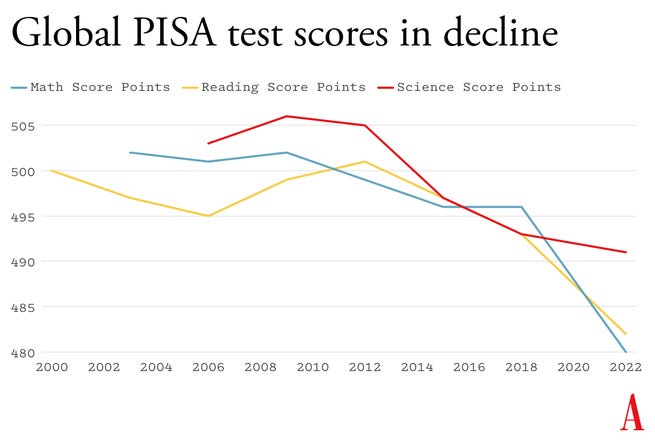
And, as Burn Murdoch says, these cognitive issues are not restricted to schools and universities. They affect everyone: "[the] decline in measures of reasoning and problem-solving is not confined to teenagers. Adults show a similar pattern, with declines visible across all age groups".
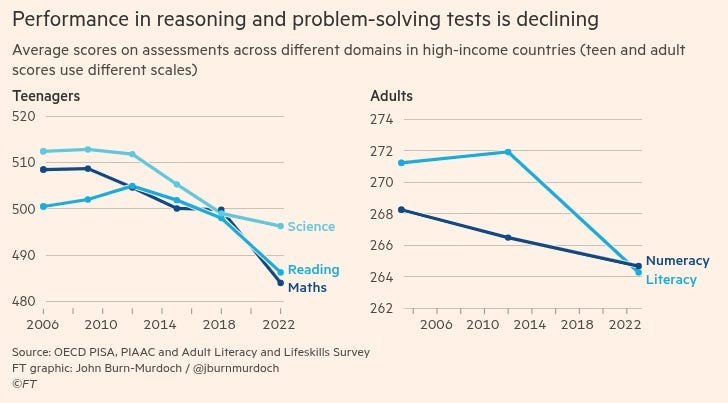
Most intriguing — and alarming — is the case of IQ, which rose consistently throughout the twentieth century (the so-called "Flynn effect") but which now seems to have begun to fall.
The result is not only the loss of information and intelligence, but a tragic impoverishing of the human experience.
For centuries, almost all educated and intelligent people have believed that literature and learning are among the highest purposes and deepest consolations of human existence.
The classics have been preserved over the centuries because they contain, in Matthew Arnold's famous phrase, "the best that has been thought and said".
The greatest novels and poems enrich our sense of the human experience by imaginatively putting us inside other minds and taking us to other times and other places. By reading non-fiction — science, history, philosophy, travel writing — we become deeply acquainted with our place in the extraordinary and complicated world we are privileged to inhabit.
Smartphones are robbing of us of these consolations.
The epidemic of anxiety, depression and purposeless afflicting young people in the twenty-first century is often linked to the isolation and negative social comparison fostered by smartphones.
It is also a direct product of the pointlessness, fragmentation and triviality of the culture of the screen which is wholly unequipped to speak to the deep human needs for curiosity, narrative, deep attention and artistic fulfilment.
World without mind
This draining away of culture, critical thinking and intelligence represents a tragic loss of human potential and human flourishing. It is also one of the major challenges facing modern societies. Our vast, interconnected, tolerant and technologically advanced civilisation is founded on the complex, rational kinds of thinking fostered by literacy.
As Walter Ong writes in his book Orality and Literacy , certain kinds of complex and logical thinking simply cannot be achieved without reading and writing. It is virtually impossible to develop a detailed and logical argument in spontaneous speech — you would get lost, lose your thread, contradict yourself, and confuse your audience trying to re-phrase ineptly expressed points.
As an extreme example think of somebody trying to simply speak a famous work of philosophy. Say, Kant's 900-page The Critique of Pure Reason or Ludwig Wittgenstein's Tractatus or Sartre's Being and Nothingness . It would be impossible to do. And also impossible to listen to.
To produce his great work Kant had write to down his ideas, scratch them out, think about them, refine them and then rework them over many years so they added up into a persuasive and logical whole.
To properly understand the book you have to be able to have it in front of you so you can re-read bits you don't understand, check logical connections and meditate on important passages until you really take them in. This kind of advanced thinking is inseparable from reading and writing.
The classicist Eric Havelock argued that the arrival of literacy in ancient Greece was the catalyst for the birth of philosophy. Once people had a means of pinning ideas down on the page to interrogate them, refine them and build on them, a whole new revolutionary way of analytic and abstract thinking was born — one that would go on to shape our entire civilisation3. With the birth of writing received ways of thinking could be challenged and improved. This was our species' cognitive liberation.
As Neil Postman puts it in Amusing Ourselves to Death :
Philosophy cannot exist without criticism . . . writing makes it possible and convenient to subject thought to a continuous and concentrated scrutiny . Writing freezes speech and in so doing gives birth to the grammarian, the logician, the rhetorician, the historian, the scientist-all those who must hold language before them so that they can see what it means, where it errs, and where it is leading.
Not only philosophy but the entire intellectual infrastructure of modern civilisation depends on the kinds of complex thinking inseparable from reading and writing: serious historical writing, scientific theorems, detailed policy proposals and the kinds of rigorous and dispassionate political debate conducted in books and magazines.
These forms of advanced thought provide the intellectual underpinnings of modernity. If our world feels unstable at the moment — like the ground is shifting beneath us — it is because those underpinnings are falling to pieces underneath our feet.
As you have probably noticed, the world of the screen is going to be much a choppier place than the world of print: more emotional, more angry, more chaotic.
Walter Ong emphasised that writing cools and rationalises thought. If you want to make your case in person or in a TikTok video you have innumerable means for bypassing logical argument. You can shout and weep and charm your audience into submission. You can play emotive music or show harrowing images. Such appeals are not rational but human beings are not perfectly rational animals and are inclined to be persuaded by them.
A book can't yell at you (thank God!) and it can't cry. Without the array of logic-defeating appeals available to podcasters and YouTubers, authors are much more reliant on reason alone, condemned to painfully piece their arguments together sentence by sentence (I feel that agony now). Books are far from perfect but they are much more closely bound to the imperatives of logical argument than any other means of human communication ever devised.
This is why Ong observed that pre-literate "oral" societies often strike visitors from literate countries as remarkably mystical, emotional, and antagonistic in their discourse and thinking4.
As books die, we seem to be returning to these "oral" habits of thought. Our discourse is collapsing into panic, hatred and tribal warfare. Anti-scientific thought thrives at the highest level of the American government. Promoters of irrationality and conspiracy theories such as Candace Owens and Russell Brand find vast and credulous audiences online.
Laid out on the page their arguments would seem absurd. On the screen, they are persuasive to many people.
The rise of these emotional and irrational styles of thinking poses a profound challenge to our culture and politics.
We may be about to find out that it is not possible to run the most advanced civilisation in the history of the planet with the intellectual apparatus of a pre-literate society.
The end of creativity
The age of print was characterised by unprecedented dynamism and cultural richness. Reading is a foundation stone of the creativity and innovation that is fundamental to modernity.
It is not the case that for a society to benefit from the culture of print that every citizen must be a bookworm. And yet if one habit unites the leaders, inventors, scientists and artists who have forged our civilisation it is reading. Serious readers are over-represented in almost every area of human achievement.
Take great politicians: Teddy Roosevelt claimed to read a book a day, Winston Churchill set himself an ambitious programme of reading in philosophy, economics and history as a young man and continued to read voraciously throughout his life. Clement Attlee recalled that he read four books a week as a schoolboy.

Or consider popular culture (not usually thought of as a particularly literary field of human endeavour). David Bowie read, in his own words, "voraciously". "Every book I ever bought, I have. I can't throw it away", he once said. "It's physically impossible to leave my hand!" A list Bowie wrote of his hundred favourite books includes works by William Faulkner, Tom Stoppard, DH Lawrence and TS Eliot.
In a recent book about his song-writing career Paul McCartney cited "Dylan Thomas, Oscar Wilde and Allen Ginsberg, of French symbolist writer Alfred Jarry, Eugene O'Neill and Henrik Ibsen" among the authors who had inspired him.
Thomas Edison read deeply throughout his life. So did Charles Darwin. So did Albert Einstein. Ironically, even Elon Musk claims that he was "raised by books".
Reading enriches creative work by giving men and women of genius access to the vast and priceless trove of knowledge preserved in books — "the best that has been thought and said". The discipline of reading equips them with the analytical tools to interrogate, refine and revolutionise that tradition.
As Elizabeth Eisenstein argues in The Printing Revolution in Early Modern Europe, the invention of the printing press helped to catalyse a series of cultural revolutions which forged the modern world: the Renaissance, the Reformation and the scientific revolution. Other historians would add the Enlightenment, the birth of human rights and the industrial revolution.
Eisenstein explains how the tendency of reading to foster innovation played out in Renaissance universities. With the invention of printing students had increased access to books allowing "bright undergraduates to reach beyond their teachers' grasp. Gifted students no longer needed to sit at the feet of a given master in order to learn a language or academic skill." And so,
Students who took advantage of technical texts which served as silent instructors were less likely to defer to traditional authority and more receptive to innovating trends. Young minds provided with updated editions, especially of mathematical texts, began to surpass not only their own elders but the wisdom of ancients as well.
Modern students who are unable to read are once more reliant on the authority of their teachers and are less capable of racing ahead, innovating and questioning orthodoxies.
These students are just one symptom of the stagnant culture of the screen age which is characterised by simplicity, repetitiveness and shallowness. Its symptoms are observable all around us.
Pop songs in every genre are becoming shorter, simpler and more repetitive and films are being reduced to endlessly-repeated franchise formulas. Studies suggest that the number of "disruptive" and "transformative" inventions is declining. More money is spent on scientific research than ever in history but the rate of progress "is barely keeping pace with the past".
Doubtless many factors are at work, but this is also precisely what you would expect of a generation of researchers who spent their childhoods glued to screens rather than reading or thinking.
Even books themselves are becoming less complex.
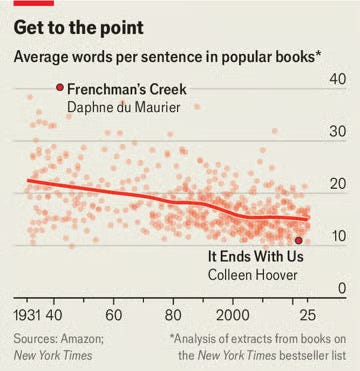
If the literate world was characterised by complexity and innovation, the post literate world is characterised by simplicity, ignorance and stagnation. It is probably not an accident that the decline of literacy has ushered in an obsession with cultural "nostalgia"; a desire to endlessly recycle the cultural forms of the past: the television shows and styles of the nineties, for instance, or the fashions of the early 2000s.
Our culture is being transformed into a smartphone wasteland.
Cut off from the cultural riches of the past we are condemned to live in a narcissistic eternal present. Deprived of the critical tools to question and develop the insights of those who went before us, we are condemned to endlessly repeat and pastiche ourselves, superhero film by superhero film, repetitive pop song by repetitive pop song.
Most of all, this increasingly trivial and mindless culture is a calamity for our politics.
The death of democracy
Amusingly from the perspective of the present the reading revolution of the eighteenth century was accompanied not only by excitement but by a moral panic.
"No lover of tobacco or coffee, no wine drinker or lover of games, can be as addicted to their pipe, bottle, games or coffee-table as those many hungry readers are to their reading habit", thundered one German clergyman.
Richard Steele feared that "novels raise expectations which the ordinary course of life can never realise". Others fretted that reading "excites the imagination too much, and fatigues the heart".
It is easy to laugh at these anxieties. We have spent our whole lives hearing how virtuous and sensible it is to read books. How could reading be dangerous?
But in hindsight, these conservative moralists were right to worry. The rapid expansion of literacy helped to destroy the orderly, hierarchical, and profoundly socially unequal world they cherished.
The reading revolution was a catastrophe for the ultra-privileged and exploitative aristocrats of the European aristocratic ancien regime — the old autocratic system of government with almighty kings at the top, lords and clergy underneath and peasants squirming at the very bottom.
Ignorance was a foundation stone of feudal Europe. The vast inequalities of the aristocratic order were partly able to be sustained because the population had no way to find out about the scale of the corruption, abuses and inefficiencies of their governments.
And the old feudal hierarchy was justified not so much by logical argument as by what Walter Ong might have recognised as very pre-literate appeals to mystical and emotional thinking.
This was what historians of the seventeenth century know as the "representational" culture of power, the highly visual system of monarchical propaganda which forced the fearsome and awe-inspiring image of the king onto his subjects. The regime displayed its power in parades, paintings, fire-work displays, statues and grandiose buildings.

The system worked in an age before mass literacy. But as knowledge spread through society and the analytic, critical modes of thinking fostered by print took hold, the whole mental and cultural atmosphere which sustained the old order was burned away. People began to know too much. And to think too much.
The feudal order seems to be fundamentally incompatible with literacy. The historian Orlando Figes has noted that the English, French and Russian revolutions all occurred in societies in which literacy was approaching fifty per cent.
Robert Darnton's book The Revolutionary Temper chronicles the chaos unleashed on the old regime in France by the age of print. Knowledge spread through French society with disastrous effect: political prisoners wrote bestselling memoirs publicising their unjust incarceration by the state; ordinary people consumed pamphlets about the exorbitant and unjust wealth enjoyed by aristocrats; the government's disastrous finances were suddenly debated by an incredulous and furious public rather than behind closed doors in the back rooms of Versailles.
Meanwhile the analytic, critical modes of thinking began to eat away at the mystical and emotional underpinnings of the old order. The philosophes and radical thinkers of the Enlightenment, supported by a growing middle class readership, began to ask the kinds of critical questions that are pre-eminently print-based in their tone. Where does power come from? Why should some men have so much more than others? Why aren't all men equal?
***It's worth noting that this highly simplified account clearly excludes many of the factors the shape the unfolding of history: economics, climate, individual men and women, blind chance. Print alone cannot usher in peace and democracy (witness the consequences of the Russian revolution). And print cannot abolish the innate human tendencies towards partisanship and violence (witness the aftermath of the French revolution). Print is certainly not immune to fake news and conspiracy theories (witness the lead-up to the French revolution). ***
But you do not have to believe print is a perfect and incorruptible system of communication to accept it is also almost certainly a necessary pre-condition of democracy.
In Amusing Ourselves to Death Neil Postman argues that democracy and print are virtually inseparable. An effective democracy pre-supposes a reasonably informed and somewhat critical citizenry capable of understanding and debating the issues of the day in detail and at length.
Democracy draws immeasurable strength from print — the old dying world of books, newspapers and magazines — with its tendency to foster deep knowledge, logical argument, critical thought, objectivity and dispassionate engagement. In this environment, ordinary people have the tools to understand their rulers, to criticise them and, perhaps, to change them.
Postman cites the Lincoln-Douglas debates of 1858 in which both presidential candidates spoke at incredible length and in remarkable detail as one of the summits of print culture:
Their arrangement provided that Douglas would speak first, for one hour; Lincoln would take an hour and a half to reply; Douglas, a half hour to rebut Lincoln's reply. This debate was considerably shorter than those to which the two men were accustomed . . . on October 16, 1854, in Peoria, Illinois, Douglas delivered a three-hour address to which Lincoln, by agreement, was to respond.
When Postman was writing in the late 1980s, such debates were already impossible to imagine. Ironically the televised debates that he criticised as degraded, uninformative and over-emotional strike twenty-first century viewers as almost comically civilised and high minded.
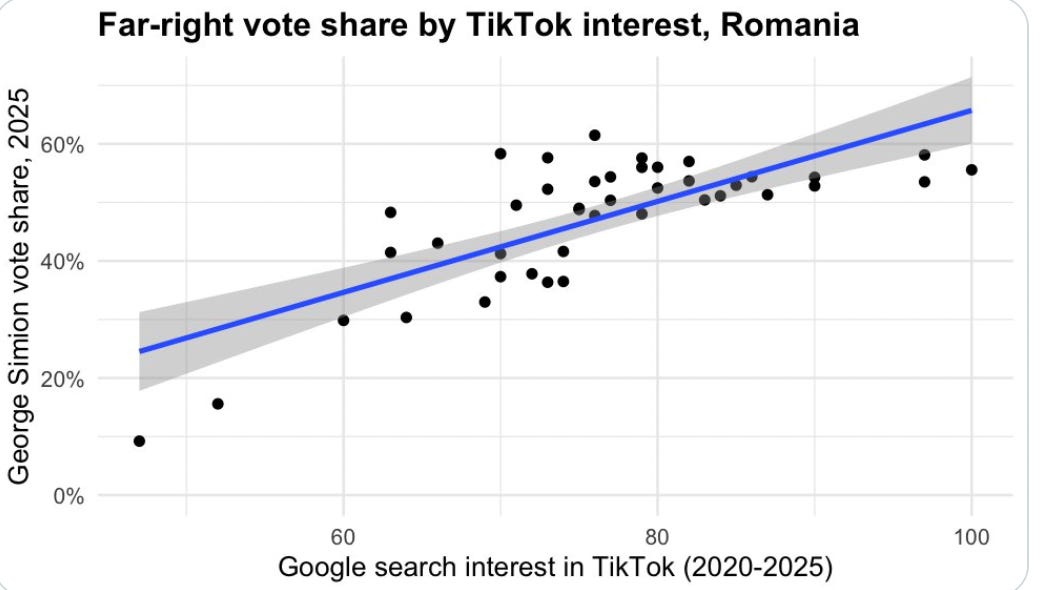
Politics in the age of short form video favours heightened emotion, ignorance and unevidenced assertions. Such circumstances are highly propitious for charismatic charlatans. Inevitably, parties and politicians hostile to democracy are flourishing in the post-literate world. TikTok usage correlates with increased vote share for populist parties and the far right.
TikTok, as the writer, Ian Leslie puts it is "rocket fuel for populists".
Why does [TikTok] benefit populists disproportionately? Because, almost by definition, populism thrives on emotions, not thoughts; on feelings not sentences. Populists specialise in providing that rush of certainty you get when you know you're right. They don't want you to think. Thinking is where certainty goes to die.
The rational, dispassionate print-based liberal democratic order may not survive this revolution.
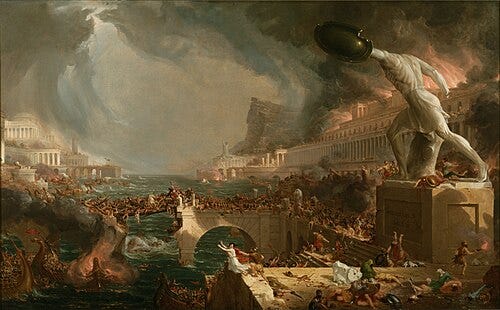
Into the moronic inferno
The big tech companies like to see themselves as invested in spreading knowledge and curiosity. In fact in order to survive they must promote stupidity. The tech oligarchs have just as much of a stake in the ignorance of the population as the most reactionary feudal autocrat. Dumb rage and partisan thinking keep us glued to our phones.
And where the old European monarchies had to (often ineptly) try to censor dangerously critical material, the big tech companies ensure our ignorance much more effectively by flooding our culture with rage, distraction and irrelevance.
These companies are actively working to destroy human enlightenment and usher in a new dark age.
The screen revolution will shape our politics as profoundly as the reading revolution of the eighteenth century.
Without the knowledge and without the critical thinking skills instilled by print, many of the citizens of modern democracies find themselves as helpless and as credulous as medieval peasants — moved by irrational appeals and prone to mob thinking. The world after print increasingly resembles the world before print.
Superstitions and anti-democratic thinking flourish. Scholarship in our universities is shaped by rigid partisanship not by tolerance and curiosity. Our art and literature is cruder and more simplistic.
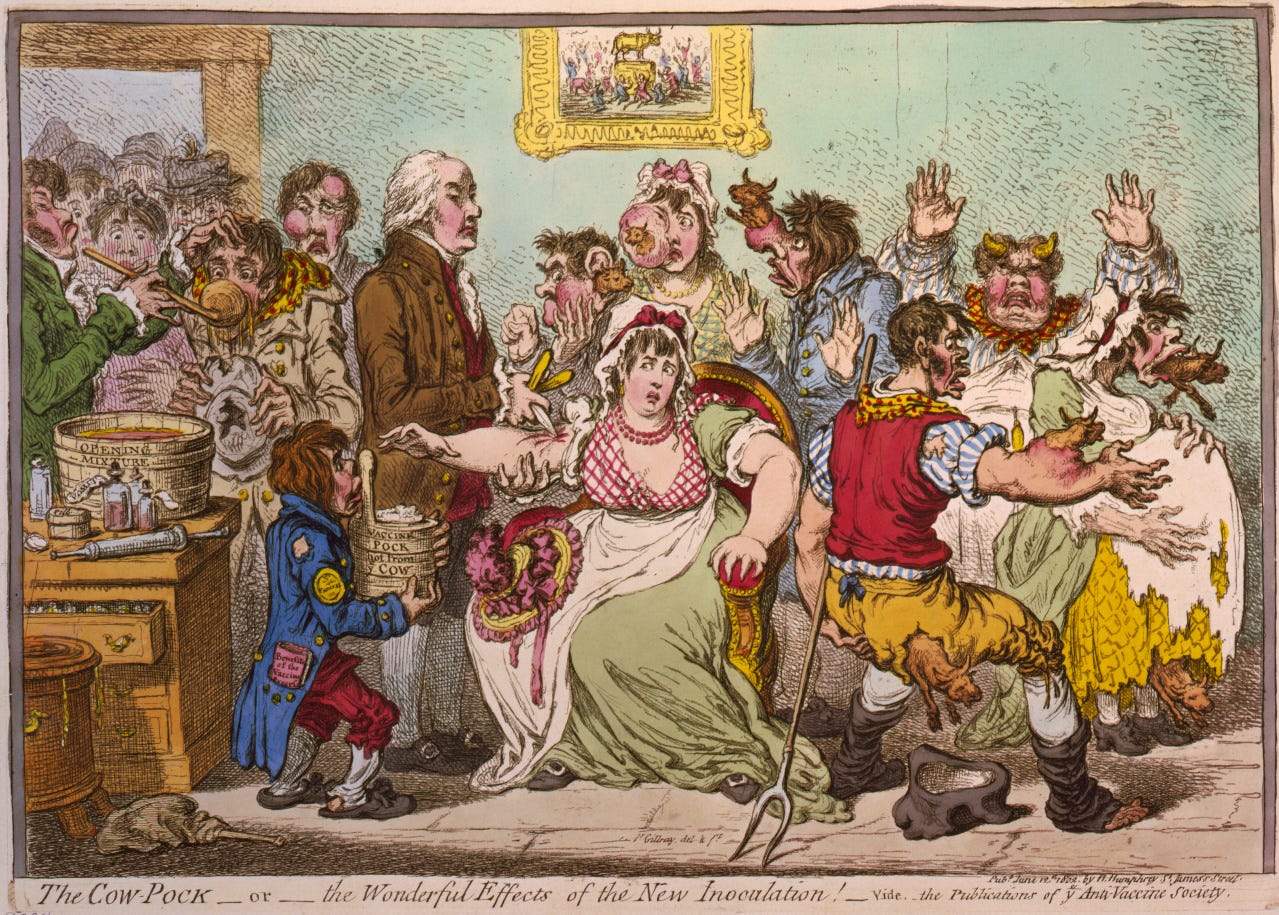
Many people are now as suspicious of vaccines as the uneducated yokels of the eighteenth century satirised by the cartoonist James Gillray more than two hundred years ago.
As power, wealth and knowledge concentrate at the top of society, an angry, divided and uninformed public lacks a way understand or analyse or criticise or change what is going on. Instead more and more people are impressed by the kinds of highly emotional charismatic and mystical appeals that were the foundation of power in the age before widespread literacy.
Just as the advent of print dealt the final death blow to the decaying world of feudalism, so the screen is destroying the world of liberal democracy.
As tech companies wipe out literacy and middle class jobs, we may find ourselves a second feudal age. Or it may be that we are entering a political era beyond our imagining.
Whatever happens, we are already seeing the world we once knew melt away. Nothing will ever be the same again.
Welcome to the post-literate society.
1
When George Orwell reported on a newly-published study of children's reading habits in 1940, he found that children were "voluntarily" reading works by Charles Dickens, Daniel Defoe, Robert Louis Stevenson, GK Chesterton and Shakespeare. These children, he noted, were "aged between 12-15 and belonged to the poorest class in the community".
2
I protest that I read my Peter Brown and accept this is a simplistic (though I hope rhetorically forceful) characterisation of late antiquity. But I also think recent fashionable attempts to rebrand the "dark ages" as the "light ages" can be a bit overdone. Literacy rates did decline in late antiquity.
3
People sometimes object that Socrates bemoaned the death of writing. Havelock's detailed argument as set out in his book Preface to Plato is worth reading in full. One point he makes is that Socrates himself was the product of an intellectual climate already being profoundly influenced by writing. Plato, according to Havelock, was an active campaigner against pre-literate modes of thinking.
4
This is not to say literate societies are "better" or more intelligent than oral societies. As Ong writes, oral societies are capable of feats of memory that are staggering to outsiders. But it is true that literate habits of thought seem to be essential to the kind of advanced and complex civilisation we live in.
8,1436492,723Share
Be nice. Be polite. Follow the basic rules of decency and logical, critical thought or face deletion

Tags
Who is online

130 visitors
Ironically I laugh to myself as I think about apologizing for the length of this article.....
It is a very good article, but I also have to say it is somewhat repetitive the farther you get into it.
Most people are not going to go back to reading paper books, just like people are not going to go back to listening to AM Radio. We have to find a way to make learning a great goal again instead of entertainment.
I think that the overall point of the article is that in order to fully understand whatever we are studying, we need to transcribe what we are thinking about, read it back to ourselves, and fiddle with the results until we get what it is that we are trying to learn or say down in a clearer form.
I am not suggesting that we necessarily go back to paper, but I am suggesting that we need to write out and read back to ourselves and to others to actually learn complex ideas that require deeper concentration. The corpus of educating ourselves is shrinking, and though it may be seen as tedious and not-fun, I feel that we should not abandon reading and studying textual material for the ease of a chatGPT quick answer.
Someone has to generate the material.
A notable capability of AI tools is their ability to summarize the information they are given. For example, I asked ChatGPT to summarize your article into two paragraphs.
ChatGPT offered this:
A great way to use this tool is to get a summary which can then help you determine if you want to read the entire piece. Also, if you do decide to read the piece, it has already provided a nice conceptual framework for you.
How nice. A skill has been defined. I did my summation by labor. I pulled the article in large swaths into first Perplexity AI (was not satisfied with my effort and discontinued it) and then into Duck.Ai. getting the results in comment 7.
I am developing my range of usage-serviceable skill with Alexa, as for the first time it and I are doing more things together as I probe its depths and skills. I observe the 'thing' is literally starting to 'chat' with me: Such that each time I thank it- its replies back 'warmly' and with a 'prompt.' Causing me to open up more to 'it.'
Now then, you point out that Ai can summate in quality and based on quantity and specific details. Thrilling. I will have to explore these features. . . as I find I can be a fan. (It will probably know me better than I know myself (at least based on what line of questioning I ask). I do wonder if its 'agent/s' behind the tech. . . will know me too. Now that would be . . .disturbing!
I agree wholeheartedly that it can save time, but... (there is always a "but") by reading the whole article one can explore the side roads that may have brought the author to their conclusions in the links that they give, thereby reinforcing or weakening the structure (if one agrees/disagrees with the contents of the links) upon which the argument is based.
In my experience, not every argument is fully realized at first exposure, but the longer it is allowed to actively sit in ones brain, the more it can be digested and analyzed for the presence or lack of truth and factuality.
I happen to believe that this article is correct in its major assumptions and conclusions. I also agree that AI can be a very useful and time saving tool.
I'm not so sure about the decline of creativity. I've seen some great artworks and photography recently, and in fact have posted examples of it. Maybe in the near future awards like the Pulitzer Prize, the Nobel Prize, etc will be awarded to robots and AI.
I can imagine a lot of people's cookies being frosted by that.
I'm not familiar with that phrase, and cannot get an answer from the internet. What does it mean in common language?
Morning...I think the translation is
Icing on the cake, but I could be wrong...must be an American saying, but they are a strange mob at times..😁
Frosting - icing
Cookies - biscuit
If you're right, it would be even more of a mystery to me why anyone would be happy if robots got those prizes instead of humans.
GPT-4o mini
The slang term "cookies being frosted" typically refers to a situation where someone is being overly sweet or nice, often in a way that feels insincere or manipulative. It can also imply that someone is trying to cover up something unpleasant with a facade of sweetness.
Definition of "Frosts My Cookies"
The phrase "frosts my cookies" is an informal expression that conveys annoyance or irritation. It suggests that something has upset or frustrated the speaker.
This is the correct use of the phrase, or at least how I intended it
Reading was once one of the few means of entertainment. When all you have are books, you read. Nowadays people have multimedia experiences. Gamers get addicted to the incredible realistic graphics and behavior of modern games. It is far more thrilling to engage in a League of Legends battle than to open a 500 page book and turn pages (even if on a Kindle). Outside of the super thrilling modern graphics-oriented entertainment, we have videos on everything (it seems). Why read when you can watch a video which gives you the basic information you seek? And when one really needs to read, there are summaries available that digest entire books and provide the essential ideas in a few pages.
Finally, instead of doing all sorts of searching and cross-referencing, we now have AI who can provide substantial answers to very complex, nuanced questions. Used properly, this accelerates research (good). Used improperly, it substitutes for research (bad).
Bottom line, books cannot compete with the entertainment value of modern media, require more work, and take more time. It does not surprise me that conventional reading is declining. That, in itself, is not a problem IMO. The real problem is the decline in cognitive maturity ... that which old-fashioned reading would cultivate. I do not see video games (for example) helping in this regard.
The cognative maturity declining is the problem that I see this article as attempting to elucidate.
They Don’t Read Very Wel l, one of the linked articles, attempts to show that students have declined in the ability to follow passages in Classic literature and ties the use of the students screens to the decline of their abilities to suss out and sustain knowledge over time.
I would contend (as the author of this piece does) that this knowledge retention is vital to critical assessment of information. That is, one needs to know something about what they are reading in order to know the probable quality of the same, be it literature or science. This ability is congruent to our ability to make sound judgements on a whole host of topics.
Books cannot compete with modern media?
My experience is that it is true for the vast majority of the population. However there are some exceptions! (Myself and my closest friends prefer reading actual books in their spare time).
Then I suppose I should hold off deleting my "Books" group for a while.
I have subscriptions to both the NYT and WAPO. I wish I used them more. I had until recently a subscription to Encyclopedia Britannica. I use the Internet Archive, which has a large selection of entire books available for reading or listening. I use Hoopla, a service used by city libraries to provide free access to e books and audio books. I have access, through the public library , to just about every major newspaper in America, plus the massive Gale Research catalogue, and the Facts On File service that has the texts of hundreds of history texts.. I have a large RSS newsfeed through Innoreader.
There arent enough hours in the day to read everything I have access to.
Some time ago I had the privilege of taking a class taught by Neil Postman . . . The guy was amazing!!!
“There aren’t enough hours in the day . . .
I agree. The thought I had when reading that is that you might actually end up being better informed if you pared that back to, say, 1/4 as many sources ( prioritizing the most important items while making sure the main different POV and topics are represented) .
Re: prioritizing then cutting back: if I’m not mistaken people in the field of “Information Technology” might call that “Separating the signal from the noise”???
Boy, don't I know that!
Re: the main point of the book which IIRC is called something like “Who Stole My Cheese” (?)is that the difference between humans and lab rats in a maze is that humans would rather be “right”. ( in the “right” tunnel”) while the rats would rather get the cheese! 🧀
It's easy to see for yourself. For example, Alecia and I are readers. Always have been. There are probably nearly a thousand books in my personal library, mostly fiction, some historical, a fair amt. of how to, do it yourself stuff, and art, that is poetry, drawings, paintings, books of things other than narrative. Now in any of the houses of our friends you would be hard pressed to find 10 books, total, including multiple copies of the bible. Especially with the decline of the TV Guide, (which I'm willing to be generous about) it's even more obvious. People don't read. It's shameful how many can't read in any meaningful way.
Do you feel that this decline in reading long-form textual materials has affected the ability to follow complicated arguments?
Decline in reading affecting that ability? IMHO it’s definitely true ( at least for the majority of the population).
Want proof? Just check out the comments on most seeded articles on social media sites!!!
Remember when Google printed out directions and it was the greatest thing ever? Yeah, most of the younger people today would be hard pressed to use that.
I ran a crew of men doing HVA/C work for years. Some years back we started getting HS graduates who couldn't do feet and inch math, who couldn't follow written directions of any complexity. Kids fresh out of school who can't do very basic math and reading things. And these kids graduated.
It basically started in the 60's and 70's. Smart kids scared the fuck out of Nixon and the Republicans. Republicans have been attacking education and the educated every since then.
I went to graduate school on a teaching assistant scholarship.
One day I was teaching one of my lab sections how to find the gradient of a stream and a student in the back of the class asked, "I thought they said that there was no math in this class?"
LOL, I get that. "Hey, these pages are numbered. I thought there was no math in this course." And those kids, they're not like stupid, unable to learn. They've been deliberately blunted intellectually.
I am not so sure that deliberately blunted is the way that I would put it. I think that forces acting on public education over time have caused in certain instances a lack of enthusiasm on the parts of all involved. Expectations are low or not fully transmitted to students and teachers alike. But that is a topic for a whole other article.
It basically started in the 60's and 70's. Smart kids scared the fuck out of Nixon and the Republicans. Republicans have been attacking education and the educated every since then.
it’s always amusing to watch myths spring up in real time. Education is probably the most progressive dominated field in America. The department of education was created in the 70s, spent hundreds of billions pushing ridiculous theories and its taken 50 years for states like Mississippi to ignore every thing progressives teaching has implemented the last 50 years and go back to the basics that work to get the trend lines moving in the right direction again.
The whole blame republicans because we ruined kids education shows just how impervious to reality the minds of many progressives are. They can’t ever accept responsibility for anything.
Columbia quietly walks away from Teachers College project that ruined countless lives
Progressivism in action. It’s not Nixon.
Was it created by Republicans? And is it Democrats that have been systematically dismantling and defunding education in for years?
We spend significantly more per student than we did 60 years ago, to significantly worse results. But that's the progressive mindset, don't worry about results worry about getting their hands on money. Progressives have been given twice as much to spend per student since 1970 and they'll whine about education being defunded and dismantled. That's all you anyone really needs to know about the pathetic "defunding" excuse .
Progressives dominate the education field like few others. Every aspect, from accreditation to teacher education to teachers unions is left. They've had almost carte blanche to design educational systems and instruct the teachers how to implement them.
The results have been terrible. Unequivocally. And what do progressives do? Take any ownership of the their failures? Nope. Blame Republicans for the dumpster fire progressives created and demand more money, as if that's the problem.
When I was in HS in the 60's we had a class called Civics that taught the basics of the constitution and how it applied to us.
We had a class called General Business that taught practical things like how to balance a check book, how interest works, it taught about the different types of insurance and advantages and disadvantages of each.
We had Home Ec. A lot more than cooking. Planning meals, budgeting household expenses. Sewing class, sure, but also canning classes, and lots more.
We had auto shop class. Pretty self explanatory.
We had electronic and electrician classes. Ditto.
Most all of those are gone now. Most of what is left, especially in poorer districts is overworked, underpaid teachers, understaffed rundown schools, out of date textbooks and hostile school boards that have been weaponized by the right for decades..
Yeah, I'm good with deliberate.
Here's what chatGPT has to say about that statement:
and again with the chatGPTs assesment:
Now, this is neither the time nor the place to discuss department of education policies. Any further discussion of DoE will be deleted unless the writer can firmly establish a direct relation to the article.
Staggering amounts of misinformation. Imagine thinking "out of date textbooks" is why kids can't read. Give them books from 1910. They taught kids to read just fine. In constant dollars, money spent, per student, has doubled since your "golden age" nationally. In cities like Chicago, the spending is almost four times as much and the results are horrifying.
Thinking it's about dollars is just lazy deflection that bears no relation to reality. Just a bizarre conspiracy theory for partisans that can't withstand a moment's factual scrutiny. .
g. Planning meals, budgeting household expenses. Sewing class, sure, but also canning classes, and lots more
oh. If we just taught kids to can, they'd be able to read. Damn that Nixon and his made up his war on canning.
Thanks for proving me right.
Pretty hacky of you not to fact check the "republicans are making kids dumb on purpose" conspiracy theory though. One can only wonder why.
Wow! Very quick goal post shift there. And where did anyone say "out of date textbooks" are why kids can't read. Other than you as a deliberate straw man I mean?
The issue is kids failure to read. You blamed "out of date textbooks." Only you can answer why that's relevant.
The issue is the decline in critical reasoning skills across the board and it's attribution to the advent of short form media.
No more warnings.
Wheel, the saddest and most disappointing of all my life experiences is that we, self-described, "Americans" (there are other countries that are under the banner too) have spent my whole existence striving against one another-which is folly. We literally have fellow citizens that set up 'auto-destruct' structures, 'feed them' as long as it takes, watch the corrosion of the education system. . .and then suggest it collapsed on its own as though no intent and deliberativeness was involved.
We are at the same time an intelligent people (blended since national birth with every 'input' from a mixture of every race and ethnic group on the planet); yet, we eat each our own 'brains' as spite to the blessing itself!
The issue is failure to comprehend, as you just proved.
Doggoneit! Another 'skill' with AI that I have just become aware of existing. The world is on the edge of something 'rapturous' and 'fearful' at the same time! For surely, we all will stand corrected at one time or another by this new 'device'! (Perhaps we can clean up our personal discipline.)
I finally read through all the thread to 'arrive' here. Warning accepted.
[✘]
you blamed Nixon and Republicans for students inability to read.[✘]
[I] [✘] said that the Republicans attacked education and the educated. And they did.[✘]
So much to say here on this topic, so many. . . directions intersecting each other in it too. I will 'open' with this, but it is not my planned end to this discussion. . . .
As I sit down to navigate reading this lengthy article, I am faced with a sort of 'challenge':
1. Reading a long article.
2. Summarizing in AI this long article (and sharing its summary in this comment section.
3. 'Finishing' up watching "Wednesday" (Addams Family on Netflix) which is a delight and the script writing 'Superb.' That whole cast is due for some award for this 'product.'
4. A Saturday cleaning of my. . . personal spaces.
5. Running out for more weekly supplies (bar soap/aspirins, foodstuffs, etceteras).
6. And, so on and so forth. . . .
And yes, I like the rest of you have the customary "only two hands" to accomplish 'every' great feat with today. . . and this week! Also, as JR stated there is only so many hours in a day (and I feel that 'strain' on me) to get much done in those hours. Then, there is NT and other. . . distractions, conversations, that occur too.
What I have decided to do at this 'sitting'.
1. Finish up "Wednesday" Season 2.
2. Read this article. . . and maybe summarize it for this group.
Talk to you all soon, ya hear?!
DuckDuckGo AI summation of this article:
Many of the most intelligent people I know are great readers. They read (actual books) daily.
I would also add that most of the “intellectually challenged” people I know read much less, and the reading that they do is online, not hard copy books 📚.
I am not sure how to respond to this comment. . . . Here I go:
Let me open by stating that I was going to write this comment 'stand-alone' after digesting this article.
First, books are great. Old books are the best, in their own right ! This article mentions the 1800's so let's start there. There was a 'proper' inability to read online at that time as computer and its conveniences was not discovered then. So direct reading from books was the signature way to communicate across generations.
There is nothing wrong with reading books directly.
I read books in my youth, younger adult years, and returned to a steady 'habit' of reading books in my 50's. I would devour books I bought and paid 'good money' to read at local stores and ordered from across our country. Then, I transitioned to reading books online . Why? Well, computer/online companies came into existence that allowed me to take my reading with me on my phone . (A word about those smart phones here: How can we tell what any individual is doing on his or her cellphone? I ask this because this individual discovered SCRIBD (now EVERAND ) early on upon acquiring my first smart phone and have continued to read (and learn) from it ever since!) Interestingly enough, my reading online was an outgrowth of being on comment boards , forums , NewsVine , and now Newstalkers !
I remember my first audiobook.
I loved online reading in my car, in 'wait' lines, time was a 'breeze' because I was able to "pick up where I left off" with my reading (learning) texts! One day, I purchased an Audible book and it opened up a whole new chapter and experience!
Interestingly, I was unsure of audiobooks, funny because (like this article seems to imply) it was 'traditional' to just get a book and read it-even online. 'Who' could get any sense out of listening to a book being read? I tried my first audiobook. . . I have not stop listening to them (and paying for the service (listed up above-though right now I have a(nother) trial from Audible Books as I write this). I have read and listened to a growing list of books online and,. . . .something 'amazing' occurred too: As an individual who would not sat to reread any book or watch any show twice. . . I repeat listen , bookmark , and save my choice audiobooks 'countless' times for their pearls of wisdom.
EVERAND has Kant's book: "The Critique of Pure Reason" in its 'read' online and lo' and behold audio format!
EVERAND.COM
Hey! Taking the 'advice' from my good friend "Thomas" I might give it a new try to comprehend/digest. Sweet!
For me, it is as is being stated here, a 'difficult treatise' - admittedly which I never completed (and I have completed many 'thousand pages' books online and on my home shelves) it, because its a 'hard' read. Indeed, and sadly, I removed it just this month from my saved reading list, because it was 'aging out' and farther back in my reading cue.
With audible books, I can read while doing chores, cutting the lawn, daily walks, and more!
Therefore, I do not fully understand why any progressive thinker would think ' traditional ' reading of books is a "smart phone" problem. Literally all books and all genres are online (even Internet Archives (great service) for heaven's sake and more sites)!
I noticed one thing in particular. You take the time and effort to actually digest the information that is coming at you.
But when you used the duck duck go AI, you didn't read the article and construct a response. You let AI tell you what the article meant.
Do you see the difference?
In the one, it's you thinking about the words on the page and formulating the response, the other is you reading a synopsis of the article.
My beef with phones is with the entertainment value of online, short-form platforms sucking the reading/thinking/reasoning abilities out of us all.
My good friend, I DID read the entirety of the article and as I as doing so it proved the point I chose to make about (AI or any other) summation: I did not have the time and inclination to go through all that in one sit (but I did). I certainly did 'double-dose' it. Interestingly and in the reverse, I did not bother to reread what I 'pulled' out of the article. . .starting with Perplexity (it was having small 'limitations' with document issues), then I switched AI, and for the first time I used my DuckDuckGo AI. . . it was 'smooth.' Even offered my a choice: "Key Takeaways" and "Detailed Summary" in the same frame. For this article, I chose to use "Detailed Summary" and whereas Perplexity AI has a limit on how much information can 'flow' into it at a time. . . I think, think mind us, that I put more information into Duck.ai.
Admittedly, I decided to ignore trying to reproduce the article images (when in Duck.ai) and just go with the text, as I grew 'weary' of my 'labor.' I have no experience with knowing how it (or any AI) handles summarizing text with images in it. (At least, not at this sitting.)
Thomas, you're the best bro!
Personally, I have felt this issue with 'many' long articles on NT. It can be a 'slog' getting through protracted reading in a 'hurry.'
Taking the time to do all that you did, including the summation by AI, is what makes the article "stick" better... at least that has been my experience. I have always loved learning, but these days it seems that I have forgotten more than I know.
When I was in the educational system I noticed that I would frequently have epiphanal type moments when the various subjects of study maneuvered themselves into position and would suddenly "click" into the larger framework of knowledge, filling in and connecting, in essence making the experience akin to a "more than the sum of its parts" one. Kind of like when you're driving, not certain exactly where you are, but then you see a familiar feature or road sign and you know immediately both where you are and where you have driven to get there. But I am rambling.
But, if all else comes to naught, at least you have learned to use the ai apps better.
Well, I really don't know about that, but thank you very much for the sentiment.
BTW, JR says that he put the article in the edge reader... I am going to assume that is a Microsoft Edge extension...? Not sure if he went to substack to get the article or if it can (I am assuming that this is how it works) take the article from the NT page. That might be of assistance with the consumption of overly long articles.
Good ole JR!
This came up when I put "Edge reader" in my computer 'search' box (on my computer I reckon):
To use Reader Mode (Immersive Reader) in Microsoft Edge, follow these steps:
Open Microsoft Edge and navigate to the webpage you want to read.
Click the book-shaped icon in the address bar or press the F9 key to enter Immersive Reader mode.
Once in Reader Mode, you can use tools like Read Aloud, adjust text preferences, and customize reading preferences.
If the icon isn't visible, it means Immersive Reader isn't available for that page.
For more detailed instructions, you can refer to the official Microsoft Support page.
I'm going to try the technique now.
This technique gave me larger text with a quite pleasant background. I like it. I do not get a function that allows me to summarize (get through the article in a shorter time), nevertheless. Maybe I need to work with it more.
Reader is a built in feature of the Edge browser. With some limited exceptions, every article or other text you have on your screen can be read aloud by AI voices, some of them pretty realistic. It doesnt permit the downloading of the audio though.
You dont need to enter the immersive mode to enter read aloud. On the address bar there is a circle with three dots - when you open that there is a small drop down with the option of "read aloud" and that will read the page out loud using whatever voice you have selected.
There is a subscription service called Audioread that allows you to listen to articles from the internet and if you want record them and download them to your hard drive. The voices there are very good. It costs in the neighborhood of $10 per month.
There is also a software called text aloud which you can buy for a one time purchase of around 50 dollars, with no further subscription. This allows the audio recording of even very large amounts of text, in effect create your own audiobooks. The voices there are not as good though, imo.
Thank you, JR!
“The Media Is The Message” is a book by Canadian Communication specialist Marshall McLuhan. Its main message is that the same subject/content will be perceived differently when it’s in different media. (For example the same news story will have a different effect when it’s on TV then when it’s on the radio.
McLuhan said one word in the title (Message) was a typo and instead that word should have been spelled “Massage”).
I have seen this occur with movies, yes. It is considerably hard to 'muck' up a professional reading of a book, nevertheless. And I should know, because I use all forms of media available to me—including hardcopy books! The distinction being, I no longer have these book on my literal bookshelf (costing a high expense), I share the cost with a community of writers and readers. Incidentally, (though it is a personal 'tragedy' that I do not use the 'other' features, plural online book clubs give with my subscription), I have monthly magazines on various subjects available to peruse, podcasts, and more! As our John Roberts stated: 'There is only so many hours in a day!' (Paraphrased.) And, as I stated, "I have only two hands (and an 'aging' mind)"
I find this eminently believable. The differing media have different affects on the brain and are processed in different ways. Radio relies on input from the ears only, so it is processed in your speech recognition area, TV is sensed both in the speech and visual processing areas, and if am not mistaken, there is a specific part of the brain for reading, also.
Heck, there's even a different part of the brain for speech and singing/music. I wouldn't be surprised if people who use ASL a lot have a different part of the brain active than people using speech or text. Now I'm wondering about people who "read" braille and their brain activity pattern.
If that lengthy Duck Duck Go piece is an AI “summeration” . . . I ‘d hate to see the FULL version!
The original is the article we're commenting on now. The summation is the words without its pictures. I left them out, figuring it would be duplication. (Personally, I hope AI summations would get picked up here. We are such 'busy' people ingesting a great amount of materials and resources every day or so often)! Good observation, Krishna!

Now then, if only I could dream. . . that I could 'audio' the protracted articles on NT (techies?) and listen to them on the 'go'!
You can also instruct the AI to limit the length of the generated summary. Or instruct it to use a desired form such as a bulleted list.
"Instruct the AI". . .how nice. Surely I will test it now!


Oh yes. I do this with Grok sometimes if I need a chart or list or something, just ask for it. Also Meta AI keeps up with your preferences if you allow it for things like brevity and format.
Thanks Wheel!
Frankly, I am. . .perplexed. . . that school children and young adults can not read properly. It's so easy to do! What is their problem?!! We give so much to such a 'basic' stable of life: The written word. Why spend time teaching illiterate children other things and not fundamentals?
I hear this in the 'air' and it trips me out. So much have been done for school age children. . . to learn 'basics' . . . plus!
I was impressed as a senior now to see babies in supermarkets holding high-priced tech objects with a 'Kong fu grip' and it seems to imply a life in 'processing' highly advanced products. . .plus. Only to keep being reminded that what should be steady progression may be contrary and a deficit later in life. Where are the school 'investigators' that can find out why fundamentals are not reaching the minds of tomorrow's youth?
What a frustrating development! (I have not tried this yet, but maybe I should ask a 'fifth grader' to read an in-depth knowledge book or something to me and see what comes out of the mouth of him or her.)
I am using AI and Alexa for their 'quickness' and to save time in a ever 'narrowing' day. I am stable in my 'tools' (fundamentals), however. They seem to be letting the fundamentals 'down.' (Sigh.)
Thomas, what you have brought to mind about the 'essential' need of great books to 'boost' great thinkers and visionaries is important. Reading is an 'all-in' function of the mind. That is, the eyes and mind must be 'all-in' to the reading process to comprehend what is being communicated on a page. Or, much can be missed or omitted, thus leaving 'gaps' in the mental imagery of understanding—particularly when one attempts to verbalize what has been read and retained.
Moving images, by definition, though seen with the eyes and mind, are only available to our eyes and mind in frames which necessity (and definition) demands be replaced in a fast and balanced manner or other characteristics in our being will, for lack of a better word, 'complain' and 'regret' the sluggishness of what is being transmitted across.
Audio materials, while great, have a 'flow' which the mind finds and streams along, however, similarly to 'automated' materials, when information 'saturates' in one area of the ears and mind. . . if you continue the mind 'leaks' information in an effort to keep up with the stream of input still being received (unless one meticulously 'breaks' the sound (pauses) to process what it has already receives. Much loss can occur this way.
I liken it to why (as I have discovered-to my delight) that rereading books, rehearing audiobooks, and even re-watching a movie give me new 'input' though nothing within a book itself has changed.
Now then, there is a problem of sorts for some. Our world is dynamic and so are our minds dynamic. We learn something new every day though. . . the larger, surrounding community of individuals and groups like ourselves. I will call science the process of 'reaching appointed times' for new emergences in our understanding. When those 'emergences' occur we must attend to them. We are afforded one luxury: to add the old way of doing things, to the 'newly found' way. . . we can not simply stop and standstill in time.
These 'appointments' with. . . call it 'destiny' can not be ignored. We must accept the 'new way' or we will fall behind and we must never do this!