
When Did Christians Become So Morally Bankrupt?

By: The Mouthy Renegade Writer

yeah...yeah...bashing Christians again
Don't bother commenting if that's all you have to say. Say something about the article for once
 S E E D E D C O N T E N T

It Was Way Before the Rise of Donald Trump
 The Mouthy Renegade WriterAug 06, 202520
Share this post
 You Have the Right to Remain MouthyWhen Did Christians Become So Morally Bankrupt?Copy linkFacebookEmailNotesMore38Share
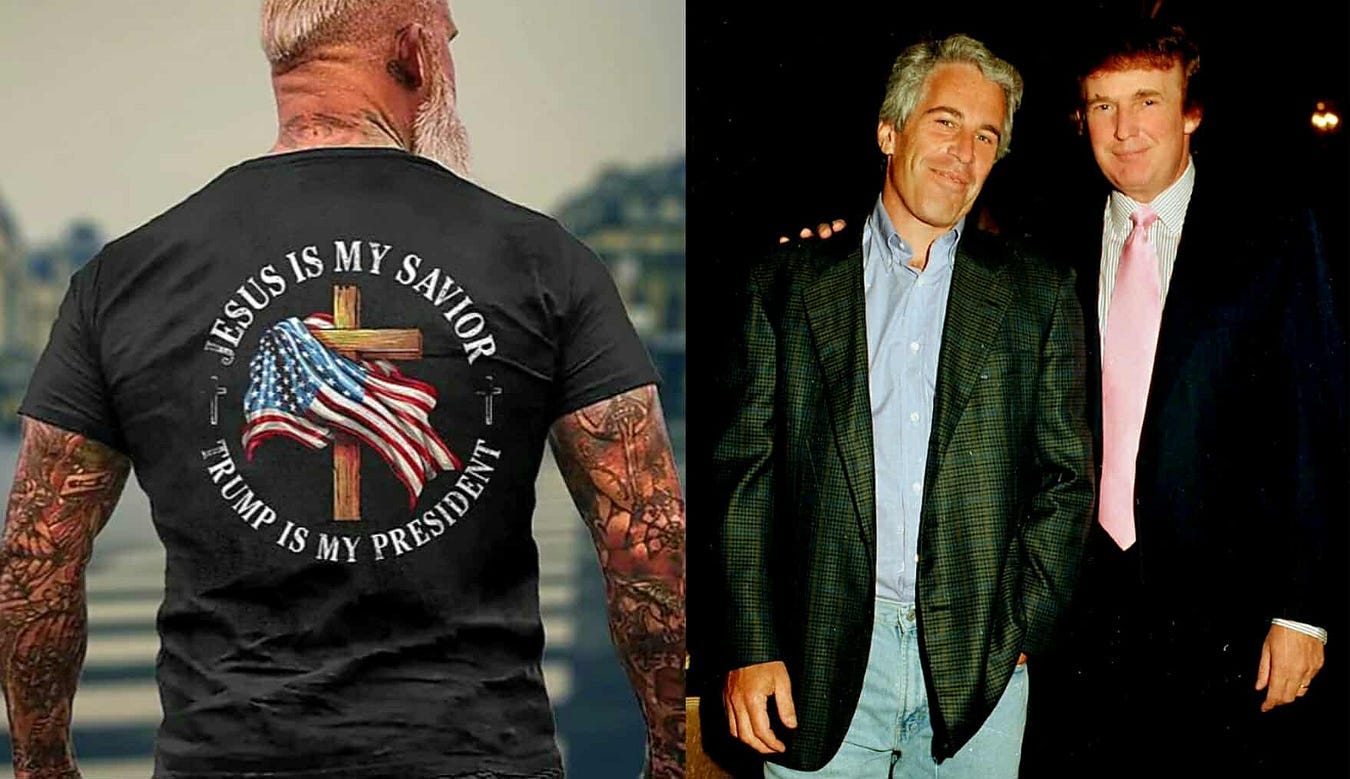 Nothing about these two photos represents actual Christianity. To Hell with them both.
Christians get mad when you call them out on their hypocritical bullshit.
Well, the CINOs do, anyway. "Christians in Name Only." The ones that Jesus warned us about in the Bible. I remember a passage from the days when I was attending services three times a week, back in my youth. "Depart from me, you workers of iniquity, for I know you not."
That's Y'all Qaeda, you pedophile-supporting MAGA dicks.
Talibangelicals everywhere love them some Jesus. He's second only to Donald J.(esus) Trump, in terms of who they worship the most. They'd die for their Dorito Deity if asked to. Like sheeple being led to slaughter, they'd jump right off a cliff if Orange Foolius told them it's patriotic and that they'd have a place in White Billionaire's Heaven.
After all, someone has to serve the wealthy elite up there, right?
It would be laughable if it weren't so goddamn frustrating. We have regressed fifty years in progress regarding equality. Women, minorities, LGBTQ folks, and immigrants have been far worse off during the past decade of Don Bon Phony and his fake patriotism propaganda.
Make America Great Again. Fucking please. It's never been "great."
The past ten years of gaslighting from the Count of Mostly Crisco have been horrible. Nobody with a decent education and a lick of common sense wants some orange dick-with-ears preaching morality to us. Especially when he's known for pedophilia, rape, and a shit ton of criminal activity.
This "Do as I say, but don't do as I do" hypocrisy is astounding. And it steels my resolve to never bow down and kiss the ring of a wannabe fascist dictator. He thinks of himself as a king, though, in all actuality, he's the court jester.
"Clowns to the left of me, Joker on the right, stuck in the middle with Dump."
It's easy to blame the decline of our country on King Nothing. But it goes much further back than The Dork Whisperer's time in office. I realized this last night, as my Bride and I were watching one of our favorite old TV shows together.
We love the Little House on the Prairie series.
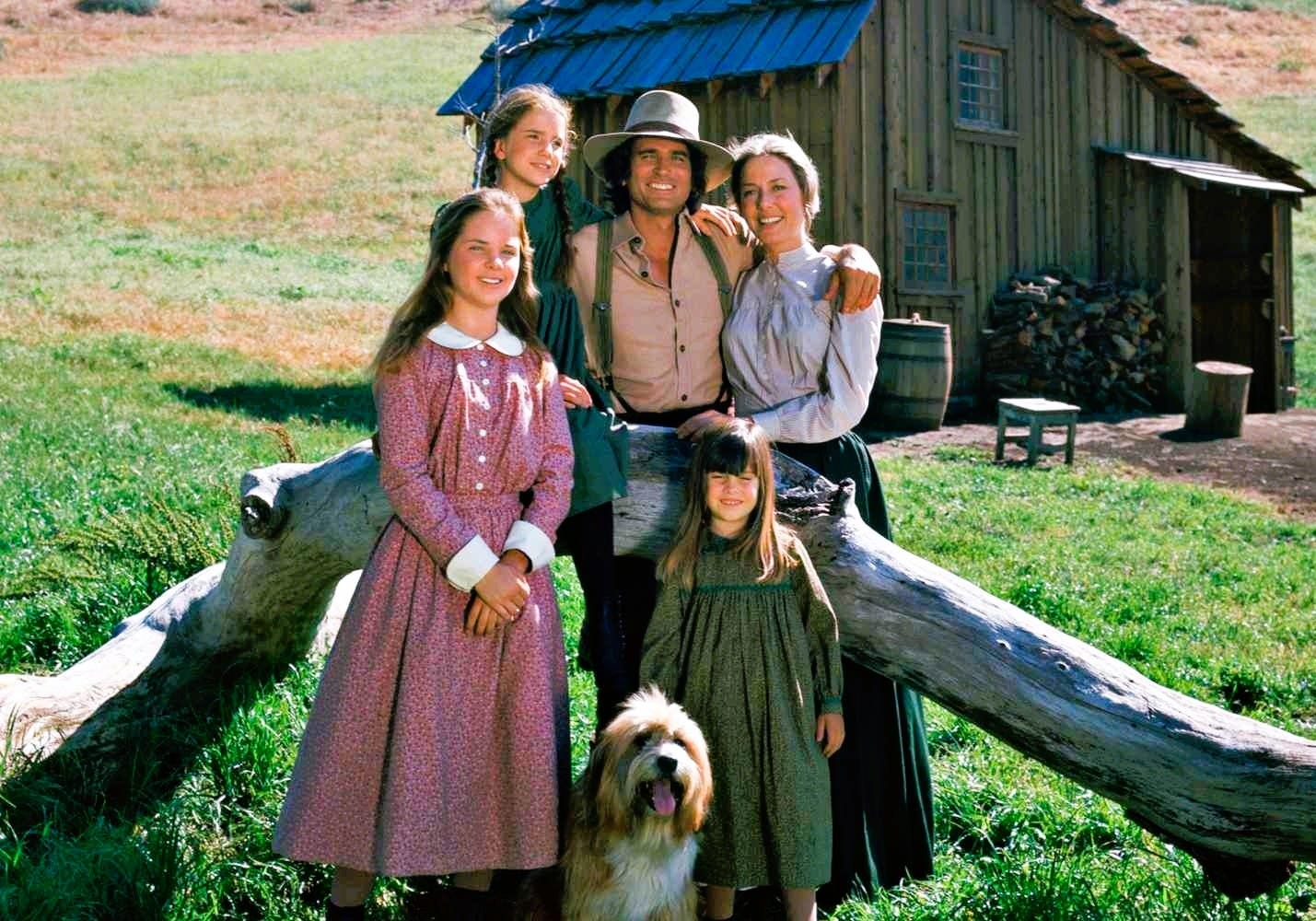 The Ingalls family. That's Charles, at the top middle. Played by Michael Landon.
I grew up on it, as a weird little church kid whose father was the pastor. It was one of the few things we were allowed to watch, growing up. My folks loved it and found it to be wholesome, full of good ol' Christian values.
Or were they?
You see, the series protagonist, Charles Ingalls, was the town do-gooder. The voice of reason, in most of the episodes. A real Christian, if I'd ever seen one. He was wonderful.
There were times growing up that I wished he were my "Pa."
My father was tough on us. He also spanked us with a belt when we got out of line. I didn't care for getting strapped two or three times on my bare ass by an angry 220 lb. hypocrite. That felt like child abuse.
And yes, I said "hypocrite."
He didn't always walk the walk. He had a short fuse at times and wasn't nearly as patient with us as our mother. He made racist and bigoted jokes occasionally. He preached that gay people were doomed to burn in Hell if they didn't repent for their sins and change their lifestyles.
That always sounded like bullshit to me. I couldn't picture a scenario where God sentenced his creations to burn in Hell for loving someone of the same gender. And if they were "mentally ill", as my father seemed to think, then why would mentally ill people be burned in a lake of fire?
It all seemed fake and engineered to fit some bigoted agenda.
But such are the ways of most Christian people. Especially the ones who are still supporting a pedophile and rapist. You cannot support Count Dickula and the horrible things he does as president and consider yourself a good Christian. That's some hypocritical bullshit.
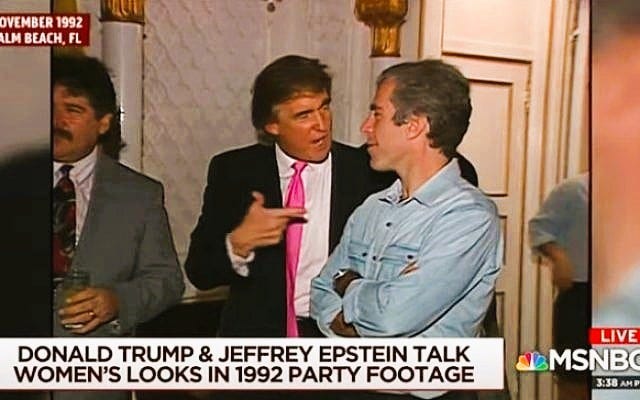 "Oh, you like 'em junior high aged, too?" Anyone who still supports Trump is supporting a pedophile child rapist. Where the hell are your morals and values? Photo: Bluesky
But such is the case with many holier-than-thou types. This was apparent in last night's episode of Little House on the Prairie . The episode started with a Native American riding into Walnut Grove. And the racist, bigoted townspeople instantly default to wanting to capture and kill him and his tribe.
Even though he came in peace, just seeking medical attention for his ailing father, the chief of their tribe.
Mai and I instantly noticed a parallel between the angry, racist Irishman who was consumed by hate and ignorance. I commented that it's fucked up how almost half a century later, the show mirrors the racism and bigotry of America here in 2025. We both agreed that we've taken a huge step backward in bigotry, racial equality, and sexism since the rise of Combover Caligula.
He's made the shittiest people of society more vocal and seen. And I'm fucking over it, like so many other decent, caring Americans.
I don't want a "return to Christian values." They were never that great to start with. Religion has been used to influence, manipulate, and control the masses for centuries. Not to mention that 10% tithing bullshit to extort hard-working citizens in the name of greed.
Jesus wouldn't approve of multimillionaire pastors and their luxury cars, private jets, and mega-mansions. Sounds like someone else we know who places all of his value on possessions while being the biggest white-trash clown there is. Trump and Jesus have nothing in common.
Much like the MAGA Koup Klutz Klan'ers who pose as righteous, moral, patriotic Christians. Many of whom are hiding in plain sight in their churches, only to be found out later as child molesters and pedophiles. Something they have in common with Don Fraud Van Damn. It's a hypocritical, false narrative that Christianity makes them good people.
If you need the fear of Hell to influence you to be a decent human being, I pity you. I don't do the things that the Tangerine Twatsicle does on the sly and claim to be a good person because of religion. I walk the walk and treat people with love, kindness, and respect.
And not because I fear Hell. Rather, because it's the right fucking thing to do.
© 2025 The Mouthy Renegade Writer. All rights reserved.
If you enjoy my political humor writing, I'd love to have your support. It's less than $5 monthly to support independent journalism, and I'd be honored to have you join our Mouthy Militia!
Subscribe If you really want to stick it to Traitor Trump, please consider supporting independent journalism. For less than $5 monthly, you can help me fight Trump's fascist bullshit. Your support means everything to me. Thank you! Subscribe20
Share this post
You Have the Right to Remain MouthyWhen Did Christians Become So Morally Bankrupt?Copy linkFacebookEmailNotesMore38Share
Trolling, taunting, spamming, and off topic comments may be removed at the discretion of group mods. NT members that are known plagiarists, repeat comments, or continue to disrupt/deflect the conversation risk having all of their comments deleted. Please remember to quote the person(s) to whom you are replying to preserve continuity of this seed. Any use of the phrase "Trump Derangement Syndrome" or the TDS acronym in a comment will be deleted. Any use of the term "Brandon", "Traitor Joe", or any variations thereof, when referring to President Biden, will be deleted. Right wing trolls can expect to have their irrelevant questions and comments deleted. Posting debunked lies will be subject to deletion. Use of the terms "leftist" or "lefty" will also be subject to deletion.

 Article is LOCKED by author/seeder
Tags
Who is online
88 visitors
Do you know there was a pastor in some church that was talking about the Beatitudes in his sermon. The congregation got mad at him for preaching "woke" shit
The Christians at the top....don't even know what the Beatitudes are. I think I shouldn't say they are at the top
It's interesting. The Beatitudes are reflective of what "woke" people like to pretend they are. Their problem is that the worst people in their group make them all look terrible, which is ironic given that they share that situation with the Christians they despise.
explain
"Woke" people, meaning people who embrace that term, will tell you that they are committed to recognizing those who have been marginalized in some way. That's an underlying theme of the Beatitudes. Blessed are those who mourn, and the meek, and the poor in spirit, and the merciful. etc.
In their day, the Beatitudes were a radical shift compared to the prevailing values in that culture. We need to remember, the standard theology of the day stated that your suffering was punishment from God for either your sins or the sins of your family. So this idea that those people should consider themselves "blessed" was nothing short of outrageous.
So you have this very shared theme of seeing and placing value on those people society seems to find valueless. In their minds, that's how "woke" people see the movement.
But almost immediately they fall into the problem the Hebrews faced in Jesus' day, that Christians have fought for two millenia, and that Islam views as a feature instead of a bug.. They try to force everybody else to adhere to their values.
So then the common theme becomes "you will embrace our values and you will demonstrate that by behaving according to our standards".
But that's not at all what the Beatitudes are about. They're not "staying aware". They're simply persecuting infidels. They've taken the same 4000 year old religious zealotry and simply painted it a new color.
that's your interpretation
With what do you disagree?
Strawmen. Plural. So many it's hard to count them.
Let's just look at one: "So then the common theme becomes "you will embrace our values and you will demonstrate that by behaving according to our standards". You impose an evolution which is not ineluctable... and then condemn everyone - not just those make that evolution - for your own invention. Not cool. Not cool at all.
Let's stay simple. What do the Beatitudes actually say?
Matthew 5:3–12
Blessed are the poor in spirit, for theirs is the Kingdom of Heaven.
Blessed are those who mourn, for they will be comforted.
Blessed are the meek, for they will inherit the Earth.
Blessed are those who hunger and thirst for righteousness, for they will be satisfied.
Blessed are the merciful,for they will be shown mercy.
Blessed are the pure in heart, for they will see God.
Blessed are the peacemakers, for they will be called the Sons of God.
Blessed are those who are persecuted because of righteousness, for theirs is the Kingdom of Heaven.
Blessed are you when people insult you, persecute you and falsely say all kinds of evil against you because of Me.
Rejoice and be glad, because great is your reward in heaven, for in the same way they persecuted the prophets who were before you...
Luke 6:20–22
Blessed are you who are poor, for yours is the kingdom of God.
Blessed are you who hunger now, for you will be satisfied.
Blessed are you who weep now, for you will laugh.
Blessed are you when people hate you, when they exclude you and insult you and reject your name as evil, because of the Son of Man.
Do you find evil here?
Please don't invent other subjects like "So you have this very shared theme of seeing and placing value on those people society seems to find valueless. In their minds, that's how "woke" people see the movement." That's your own personal interpretation of others' thoughts. Mind-reading.
Do you find evil in the Beatitudes?
... uh oh, I might have a small issue with that one when it comes time to purge maga scum from america.
Ouch!
SSDD.
Yup
Pretty accurate view of what constitutes Christianity to a progressive. I especially like the Jesus vs Jeezus list. It does a pretty great job of how many on both sides get Him wrong. Like thinking John 8:7 has something to do with sexuality or that "I hate fags" is a Biblical response. Both sides wrong.
... speaking for JC himself now, are you?
Depends on what you mean by "speaking for". If you mean he said something and I'm repeating it, then yes.
[deleted][✘]
Thank you. The edit expressed my meaning better than the original.
feel free to add it to your list of erroneous interpretations ...
Not needed. The church says it is in there, so it must be in there. Otherwise people might be expected to actually read it for themselves.
If anything would make people bolt from religion, it would be actually reading the religious texts that it is based on.
I see that a lot.
Honest question... do you also see it the militant left?
He doesn't. Moreover, Paul's condemnation of homosexual behavior is directed at believers only. What non-believers do is their own business.
The occasion is about adultery. However, Jesus wasn't speaking of that, specifically. In fact, he wasn't referring to her at all. He was addressing the spiritual state of her accusers and whether or not any of them were righteous enough to legitimately pass the kind of judgement they intended, which was death. Whatever the sin the accused was accused of wouldn't matter to his point.
I don't think "many" rightwing Christians have that response. That is, there aren't many Christians that do the sorts of things Westborough Baptist Church does. Rather, what most Christians do is refuse to validate homosexuality as a legitimate moral choice. That is not the same thing. Progressives simply insist that it is.
I don't know how much you know about the Bible but Jesus repeatedly says that he did not come on his own. That everything he says comes from the Father and the words he spoke came from Him. We also know that God doesn't change but is the same from all eternity. This means that everything the Father thought about something, Jesus also agreed with.
People think Jesus changed what the Father said, but he didn't. Rather, he showed what following what the Father said looks like. Although Jesus was the only one present who could have justly stoned the adulterous woman, he didn't. Instead, he showed mercy. Even so, he didn't tell her she did nothing wrong or shouldn't be ashamed. He told her, "Go, and sin no more". He showed her God's nature. That He is merciful and the God of second chances.
Problem with progressives, though, is that they tend to take verses like this one as validation that God's okay with whatever we do as long as we don't hurt anyone else. Thing is, God has His own ideas about what hurts everyone else, and adultery is one of those things. Put another way, Progressives think that as long as we meet our own self-determined criteria for what is good or moral, God is okay with that. Not the case. God has His own ideas about that, and they are all that matter.
That's true enough, but incomplete, I think. What you're describing is church governance. The only homosexual the Christian has the duty to confront is those within the church.
However, a distinction needs to be made between condemning homosexuals and condemning homosexuality. One is the person; the other is the action. Christians have the duty to oppose the action, even when it concerns non-Christians, although not in the way some think. That is, I believe it is not God's will we all go down to the gay pride parade with signs and bullhorns and tell them they are sinning. Pretty sure they know we think that already. Our duty as Christians is to recognize the idea that homosexuality as a valid option for society is not a moral one. An example of this would be...
Petition collector: Hi! Would you be willing to sign this petition legalizing gay marriage?
Me: No, sorry.
Petition collector: Why not?
Me: Because I believe that doesn't reflect what God wants from us. He specifically said He finds such a thing repugnant.
Petition collector: I don't believe in your God. What right do you have to tell us what to do?
Me: I'm not telling you what to do. Do what you want. I'm just not going to support it. Have a nice day.
Even if other Christians try to collect signatures for an anti-gay marriage law, I'd probably not sign that, either, as I think that would be forcing my beliefs on others. Pretty sure we're not supposed to do that. Still, that doesn't mean I have to be totally passive about it. If someone asks me why, there's no reason not to tell them.
Let's start with this....
It's interesting how we come so quickly to the conclusion that it's the "duty" of a Christian to confront a homosexual. We don't seem to feel the same way about tax cheats or gossips or other sinners who are all around us and among us every day. Romans tells us that the wages of sin is death, not that the wages of some sins are death. James tells us that whoever stumbles at just one point is guilty of breaking the whole law.
Then let's get to this....
The question is "why is it illegal in the first place?" The United States is not a theocracy. Our shared American values are built around personal liberty. Who people want to marry is none of our Christian business. We don't own the franchise.
I'm there with you. The coordinated efforts to prohibit various forms of marriage and deny secular Americans their constitutional rights is the least defensible thing we've done since the women's temperance movement.
Personally, I just don't see it as any of my business. If they need to change their lives, the Holy Spirit will let them know. He doesn't need me in the way. There is such as hell a Redwood sized log in my eye, I don't need to be worried about the twig in somebody else's.
Or he is emulating Louis Ferdinand Céline.
What "militant left"? Are there a handful of dip shit antifa that showed up at some protests? Yes, just like there are rightwing instigators that have shown up at protests to cause violence and blame the left for it.
As for whether there are those on the left that hate on those who refuse to conform to their brand of morality, sure, I see it, though I think there is a fundamental difference between the two groups.
On the right you have those who believe their morals should be enforced on others. Many want to ban gay marriage, ban and/or criminalize abortion (some as early as conception), ban transgender Americans from the military and ban women from serving in combat. Some refuse to even serve their fellow lgtbq Americans at their businesses. They believe gays, transgender Americans and those who get abortions are "immoral" or "sinners" and they attempt, through their votes and actions, to force their Christian morality on everyone, even non-Christian Americans.
On the left you have people of all races and religions who certainly disagree with the rightwing conservative morality police. But they aren't trying to force any conservatives to be gay or to get abortions, but they do demand their own individual rights when it comes to these issues. They want women to be allowed to make their own decisions over their own bodies without some religious extremist inserting themselves into the discussion with their doctor. They want gay people to be able to get married and rent homes and be able to get a job without being discriminated against for being gay.
So, it seems when you boil it down, the rightwing Christian conservatives want the right to discriminate and pass laws against other Americans based on their religious brand of morality while those on the left want the right to live as they want to free of laws that would force them to conform to religious conservatives' brand of morality.
So, if you want to claim that the lefts "brand of morality" is to judge those who attempt to legislate morality, I guess you can see it that way. But the reality is that the left simply wants to protect and defend the constitution created by our founders who knew that keeping religion and government separate is the ONLY way we can move this nation forward towards a more perfect union.
I guess the best analogy for the difference between how the right and left disseminate their morality is by thinking of it like the ACLU defending the rights of the KKK to demonstrate or march in the streets. Did the ACLU defend the KKK because it believes in the same ideology? No. Of course not. Did it do it because they were against something the KKK was also against and thus shared a cause? No. Of course not. They did it because they were defending the constitution and the right to 'free speech' even when they completely disagreed with the 'speech' in question.
Those on the left may not ever choose to get an abortion, be gay, transgender, polyamorous, etc. They may even think being gay or getting an abortion is a "sin". But what they don't do is to try and insert their religious beliefs into law which they know would be a violation of the constitution. So instead of trying to legislate those Americans out of existence or trying to ban things they consider "sins", they support the right for those Americans to live as they want free of religious laws like they have in Iran.
That answers my question. No, you can't see the problems in your own team.
You have it on the left, too. That's the point.
And yet you don't seem to see that they have formed their own.
No, progressives tend to take verses like this one as something that is a personal matter and not something that should be LEGISLATED. They know that what their God or anyone else's God is "okay with" doesn't fucking matter when it comes to our nation's laws.
Great, then don't commit adultery. Don't get an abortion. Don't practice homosexuality. Don't get a sex change. Don't blaspheme. Don't buy alcohol on Sunday. No one is stopping religious conservatives from living their dream and practicing their faith every day. All anyone is asking them to do is to keep their fucking religious peanut butter off of everyone else's chocolate.
I know, I know, every religious conservative likes to think combining their morality with their country's laws will be loved by everyone, but sadly their religious peanut butter can be deadly.
Where? Where is any conservative being forced by law to go against their faith? Are you referring to accommodation laws that have attempted to stop businesses open to the public from refusing service to gay or transgender Americans? I'm sure Christians would be completely fine if a bunch of businesses run by those on the left who put up a sign that says "No Shoes, No Shirt, No Rainbow Pride Flag, No Service". They provide the little rainbow flags, all customers have to do is pick one up and wave it around while saying "I support gay rights!" and they'll get served. Otherwise, they're asked to leave. You'd be okay with that I take it? It's not religious discrimination so not illegal, right?
My point is that it's not just about not "seeing it" on the left, it's just fucking not there and when I ask for anyone to point out where the left is trying to legislate their morality all I see are many on the left who all have very different ideas on religion, abortion and morality but choose not to use their vote to attempt to inject those beliefs into our nations laws while those on the right seem intent on doing just that.
Maybe your god shouldn't have made gays, gay.
Agreed. I can't speak for all, of course, but I feel the same way. The idea is that, for the Christian, it's God's worldview that we're supposed to live by, not what our own feelings or desires might want. But even that doesn't get it quite right. More accurate to say Christians should be working to not simply live by God's worldview, but that it becomes ours as well.
If that is true, then the tax cheat, gossip or other sinners should be just as concerning as the homosexual within the church. Whether it is or isn't is not easy to say. Mainly because there isn't a movement to legitimize those things as there is for homosexuality. I suspect that if there were, we'd see similar pushback. At least, I hope we would.
I disagree. The question is, "what is the Christian's role concerning the non-believer and homosexuality?" At least, that is what I was addressing concerning your post I was commenting on.
That said...
I also agree. That's why I said...
I understand that the US and the Constitution does not, nor intended to, subject itself to God. It's a secular institution. Of the world, in other words and, therefore, outside Christian jurisdiction, so to speak.
Generally, neither do I. If you notice in the example conversation I provided, I was asked for my reason for not signing the petition. I would not have stated my reason for not signing otherwise. That is what I meant by not being totally passive about it. I assume that people already know the conservative portion of Christianity's position on various subjects. They don't need me to tell them. But if they ask, I will. Not judgmentally. Not accusatory. Just tell them why according to what God has said. If they didn't want to hear it, they shouldn't have asked, in my opinion.
You appear not to understand anything I said.
He didn't.
Who did, then?
[deleted][✘]
Our sin nature.
The one that he made?
Ok.
Have you ever read the Bible? God didn't make us with a sin nature. We changed it when we rebelled in the Garden.
Yes, I've read it several times. If he made us, he was the one who designed us poorly, according to him. He knew what was going to happen.
Funny how he gets a pass.
Obviously, you seem to feel you know better. Tell me, then, how you would create a creature with free will but for whom it would be impossible to rebel? Or are you arguing that one should not have the choice whether or not to obey God? Robots, in other words?
No. Not according to Him. According to you. Read the creation account. Every day he created he called it good. He didn't call it very good until the last day, when He created man. Obviously, He didn't think He designed us "poorly".
Why should "by law" be the only criteria? The fact that the Constitution prohibits them doing most of the shit they want to enact seems something the average person might notice.
People lost their jobs for "misgendering". Or were you not aware? One dude got fired for simply using last names only.
They forced NCAA women swimmers to share a locker room with a man. Refusal would have risked losing federal funding. They forced schools to keep information on gender identity from parents. Again, federal funding.
They coordinated efforts to cancel everyone from Dave Chappelle to JK Rowling. It's so common that the phrase "I don't want to get canceled" is universally understood because of the militant left's efforts to oppress people
And those are just a few of the issues that relate directly to Christian beliefs. These maniacs don't stop there.
They have doxxed and swatted hundreds if not thousands of people who challenge leftist ideology. Our news and social media outlets carried out a protracted campaign to censor any non-liberal-approved speech. They completely denied they were doing it right up until they announced they weren't going to do it anymore.
Did you miss all the Tesla's getting vandalized? And the dealerships on fire? Go against the lefties at your own peril.
How about attempted assassinations of a presidential candidate, a SCOTUS justice, and a group of congressmen playing softball? This year alone, they've murdered Israeli diplomats in DC, set fire to more in Colorado, ambushed LEOs in Alvarado, and tried to burn down the NM Republican Party HQ.
But never mind.... there is no such thing as "the militant left".
FFS.
Free will is incompatible with an omniscient creator.
Nope. Homosexuality doesn't bother me. It bothers the god who made homosexual people. According to his followers, anyway.
Not at all.
Do you have children?
Welp, guess that settles. It. Aquinas and other great minds of antiquity spent their lives constructing logical explorations of the issue and making the case for free will and a random person on the internet just rebutted their thesis by saying it doesn’t exist. Cant argue with that.
Different subject. Care to try again?
Which, by definition, is according to you, is it not? That is, according to your worldview, not God's.
Going to stick with that, are you? Okay. I'm willing to hear the argument for it.
And where does His followers get that?
Per the Bible, God is all-knowing and all-powerful and used His powers to create us. If such a story were true, God knew the rebellion would take place and He is indeed the root cause of said rebellion.
I could create an automated agent to behave a certain way. It would be irrational for me to then punish the agent for being true to its nature.
Oh ... but free will!! Yeah, well that ostensible free will was also invented by God (per the Bible). And even if it was truly free (that God somehow engineered a factor that was unknown to Him) He still is the one who did the engineering. Why create something and then punish it because it was true to its nature ... true to how it was created?
And for that matter, why punish all progeny? Or later kill off all progeny spare a lone family and a bunch of animal couples?
Bottom line, nature is what God (ostensibly) created. If being true to one's nature is bad then fault the omnipotent, omniscient creator, not the mere creature.
An omniscient creator knows what will happen in the future.
If an omniscient creator knows the language you will use when you reply to my post, then how could your future reply be based on free will?
The real issue is a knowable future. If it is possible to know the future that means reality is deterministic. By definition. So even if we totally ignore the omniscient creator aspect, and assume there is no entity that knows the future, if the future is knowable and thus reality is deterministic then free will is impossible. (If it is possible to know that you will post a particular string of words, then when you post that exact string, your act was not free will.)
God hates fags, eh?
Human beings always experience free will. Always.
Determinism is the result of an academic exercise.
It is not necessarily contradictory that GOD could know the future AND human beings can experience free will. Thats just the way it is.
What we experience seems as though we truly have free will. And we may have free will.
But if the future is knowable (even if no entity knows it) then free will impossible.
For us to have free will, we must NOT be in a deterministic reality. That means our future cannot be knowable. That means that no entity could be all-knowing.
What does having children have to do with it?
If the future is knowable, free will is not possible.
In a practical sense that is semantics.
And? Can there be no better arguments than those made by Aquinas?
No, it's not. You said your god didn't make gay people gay, and that our "sin nature" did. God made that, too, according to religion. I understand why you want to put on the brakes. Tough.
Everything is semantics.
But this is also logic.
If the future is knowable, then whatever happens in the future is already determined.
If whatever happens in the future is determined, then what we do in the future is determined.
If what we will do is determined then free will is impossible.
If you truly believe we have free will, then you necessarily do not believe the future is determined.
He's the one who's said to find fault with the homosexuality he supposedly created. That's him finding fault with his own design, not me.
They claim to get it from some guys (whose existence can't be proven) who claimed to get it from him.
It's just amusing that you simply declare some of the foundational philosophical thesis wrong without engaging with them at all. Very Trumpian.
Of course, you don't even really need to engage with the intricate debates Aquinas and other philosophers reconciling free with the existence of an omnipotent Christian god.
Because on first principles, it's obvious that simply having perfect knowledge of how someone will act doesn't necessarily interfere with that person's free will to act. An omnipotent God could remove free will, but doesn't have to. They are two different things and it's very easy to see how they don't conflict.
They can't wrap their heads around it. It's very easy to understand. It's not even difficult.
It's actually more interesting to see philosophers debate whether the Christian God allows free will. The question split protestant churches and pretty much only the hard core Calvinist puritans believe in rigid determinism. Though I believe even some calvinist denominations have walked back their belief in concepts like double predestination now.
You made no argument. You just effectively stated 'nuh-uh'.
Provide an actual argument to rebut this:
It does when one is the creator of the person in question. Logic should make this clear.
If I build an engine with the full knowledge that it will (not might) suffer a rapid disassembly, I planned that rapid disassembly and am responsible for it. I can't blame it on chance, free will, or anything but myself. If god knew everything when he created us, he created us to do what he predicted we would do. No free will.
If god is as you all want to believe.
[✘]
So let's hear your argument.
Okay. Show me in scripture something that supports this view. That is, I'm not asking for your opinion, I'm asking for the basis in scripture that supports your opinion.
More than you did. Knowledge of an outcome does not deprive actors of free will. You are conflating different concepts.
You're arguing as if we both agree that homosexuality is something He created. I cannot be more clear that my position is that He did not. For this discussion to progress on anything like a meaningful basis you first need to support your case that He created it. Unless you do so, it is indeed "you", not God.
Ah. I see. So your strategy is to question whether the writers of the NT even existed in the first place. Are you then going to apply the same standard to every other historical figure? Aristotle? Alexander the Great? Sargon II? All of whom have far less evidence than any of the writers of the NT?
Correct. But that is not my argument. You should read more carefully.
While not a good analogy, I get the point you're attempting to make. Problem is, you don't understand the nature of God. God cannot do what is impossible. I don't mean what is impossible for us. I mean what is logically impossible. I can't just decide I can fly and zoom up into the sky. God can make me do that, though, if He chooses. God cannot, however, make a square circle according to the rules He established in this universe.
The problem with your engine analogy is that an engine isn't about free will. In fact, it has nothing to do with the subject as an engine has not the least sense of awareness, let alone free will. That God knew we would fall doesn't mean that He designed us to fall. Free will necessitates that the possibility that we would not must also be possible. The fact that He knew we would not doesn't change that, nor does it mean that we were designed to.
In 1.2.33 Jack asked you if you have children. I think you didn't bother to think about what he was actually asking. No matter how much you and your husband may educate yourselves on parenting, no matter how perfectly you try to guide your children, one of them may still grow up to be a serial killer. This is because the child you raise has free will. They, ultimately, do not have to do what you hope they will do. They don't have to see life the way you do.
Why do you think this would change simply because God is God? Either we have free will or we're simply programmed machines and this conversation isn't coming from us but, rather, our programming. Something predetermined, which means you aren't actually making an argument, nor am I. We're just saying what we're saying at this point in time because it was scripted. Do you feel that we are?
As for the argument that if God knows what we're going to do before we do it means we can't do anything else. Have you ever heard of Flatlandia? It's a story about a 2D civilization. Can you imagine living in a world where there is only length and width but no height? I can't. At least, not very well. Gets even worse when I try to imagine a 4D world or, at least, one I can perceive with my current senses. But what would a 2D entity think about my 3D understanding of the universe? Might they not think it impossible?
Point is, because I am a 3D entity existing on a linear timescale doesn't mean that my experience is the only valid or possible way to view existence in this universe. Even within my limited perception, I can definitively state with certainty that Napoleon would invade Russia. Does my knowing that mean that Napoleon had no choice but to invade? One could argue that, yes, he had to invade for me to know it, but that doesn't really get us anywhere as it doesn't address the question of whether or not he could have done something different, like not invade. If Napoleon had not invaded, I would definitively known at this time that he did not invade. In our case, then, it's a matter of perspective of our position on the timeline.
In God's case, He occupies all points of the timeline at the same time because He's outside of time. When Adam accepted the apple from Eve is still the present for Him, just as the return of Christ is the present for Him, from His perspective. Okay, you might argue, it's still the same thing. If He knows what we're going to do then His knowing means we can't do anything else and, thus, no free will. I would argue that's a 3D perspective. A 3D perspective according to a linear timeline when God is probably more like a 1,000,000D being. The alternative is to state that God could not have a perspective greater than our own.
The "militant left"?
So are you saying that no one on the "militant right" would ever "cancel" anyone-- or even attempt to cancel people?
If those "conservatives" happen to be non-Muslims...well there are places in the Muslim world where they are forced to go against their faith...
Both sides "get him wrong".
Well , at least there's one thing that we can be grateful for-- at least here on NT there are a few people who get things right!
At least there are a few (very few, but still), there are a few people like yourself who actually "Get things right"!
(Thank God for that!)
Well, like everyone else here-- you're definitely entitled to your opinion!
Good point!
In fact that's why good Christians would never try to tell anyone they're wrong, and why they would never, ever try to convert anyone to Christianity!
Sure! they're not trying to cancel gays, transgenders, left-leaning people, and atheists/agnostics!
I think it's kinda hard for a less-than-omniscient being to describe "omniscience". Just change your sentence a bit:
Personally, I have no idea what "God" is. I want to believe that "God is good" is strictly true... but that's hope or faith or whatever...
So. You're saying Jesus was the most terrible person ever? He constantly told people they were wrong and to come and follow him to be right. Also, laying the charge on his followers to go and make disciples.
Or am I just missing the sarcasm in your post?
And you do?????
By definition, no agent can cause the impossible to occur.
Yet again, nitpick the analogy. Let's change it to reduce your ability to nitpick on the analogy rather than understand the point Sandy made:
If I build an AI agent with the full knowledge that it will (not might) be deleted if it breaks a particular rule and I enable it to break the rule, I planned that deletion and am responsible for it. I can't blame it on chance, free will, or anything but myself.
Similarly, [Sandy@1.2.51] ☞ "... if god knew everything when he created us, he created us to do what he predicted we would do. No free will."
Of course it does. If I build the AI agent with the option to use up all of its allocated memory and I know (given I am the designer) that it WILL use up all of its memory, then I most definitely designed it to fail. I may have had other purposes for it, but if I know it is going to fail, that failure is on me.
A parent is not the designer of their child. They can influence them (greatly) but they are not the bio engineers. Serial killers arguably have something wrong with their wiring. Science does not offer a single explanation for a serial killer, but there are biological and psychological factors that enable an otherwise normal human being to engage in brutal, inhumane acts.
God (ostensibly) is the designer. And if God knows the future and still allowed the serial killer to be born and engage in the circumstances that would cause them to kill others, then God is at fault. Yet again, if God knows the future, that would mean that the future is knowable. If the future is knowable that means it is determined and thus free will is impossible.
Exactly! So if we have free will, that means the future is NOT determined. It means we can act freely and no entity (including God) could know what choices we will make. To wit, if we have free will, then God is not omniscient.
You could not possibly know that with certainty. But note, to be omniscient, an entity would necessarily know everything. If there were aspects that were not known to the entity, then how could the entity know the results of future interactions?
Knowledge of a future event is not what prevents free will. This seems to be the key stumbling block for people arguing your position. The posit is that a knowable future means free will is impossible. It does not matter if any entity actually knows the future, what matters is that a knowable future means that what you do in the future is already determined. Again, even if no entity knows what you will do.
Thus, turning this back to God, if God is omniscient that means the future is knowable. If the future is knowable, free will does not exist.
Knowledge of a future event is not what prevents free will. This seems to be the key stumbling block for people arguing your position. The posit is that a knowable future means free will is impossible. It does not matter if any entity actually knows the future, what matters is that a knowable future means that what you do in the future is already determined.
That is essentially 'God works in mysterious ways'. So take God out of this. Assume that no entity exists that knows the future. Now, with that assumption, we have the following:
If the future is knowable, even if no entity actually knows it, free will is impossible.
—similarly—
If there is an entity that knows the future that means the future is knowable. And, this again leads to free will being impossible.
Now, reinserting God, it does not matter how God would know the future. If God is operating at a dimension where He is aware of all events regardless of time or whatever, it does not matter. Nobody would need to know how God knows the future. The fact (if it were established) that God knows the future means that the future is knowable (somehow) and that means free will is impossible.
it gives me great joy watching thumpers get masterfully deconstructed with logic.
I love the philosophical debate. We've been here before... lol.
Theoretical Physics' have postulated a few things... much of which seem deterministic.
1) Everything from the point of the big bang HAD/HAS to happen because creation MUST follow the rules. A causes B causes C causes D etc... - it's deterministic -
2) Reality is fractured into an infinite number of possibilities. - This many worlds theory gives an illusion of free will, but is still deterministic. This is my favorite theory...
Classical physics says the world can be determined - We can understand and know a pendulum's swing arc. Even though quantum physics introduces probability - Particles effect other objects in underdeminable ways. The observed randomness doesn't actually prove choice (or free will).
It is possible that there is a divine creator that programed reality to get a certain result. What we perceive as wrong, bad, evil, sinful ect is in fact cause and effect... perhaps nothing more than white noise in a machine so big we don't have the ability to conceptualize it.
This is pretty cool. Here is what ChatGPT produces to paraphrase my argument:
Indeed, if free will is considered to be enabled by randomness then how exactly is that one's choice? The randomness, if anything, affects particles which affect atoms, ..., which ultimately affect the firing of synapses in one's brain. The notion that one reacting one way based on quantum randomness does not in any way make that a choice. This is like a machine functioning one way when well-oiled and free of obstruction, and another if a piece of metal breaks free and causes misfires. The machine behaved differently but that certainly is not free will.
... and if we insert God back into this discussion, if quantum randomness is truly random (not causal) then that means the future is not knowable and thus there is no way God could be omniscient.
I've already said they do.
Any god that would seem omnipotent (whether that were true or not) to us would have to reside outside the machine. It would be unknowable, untouchable and thus probably not writing narrowly defined religious texts via proxy.
Any god inside the machine would be subject to the same laws as everything else and thus could not be omnipotent and by definition not much of a god.
Thanks.
I think that's a little too far. I think it would be more accurate to say we should never expect non-believers to live to our moral code. Jesus was pretty clear about that.
But there are certain elements of "right and wrong" that expand beyond the confines of Christian doctrine. I don't think you would argue with a Christian condemning human trafficking or rape or embezzlement.
There are also things that are objectively wrong. 2+2 does not equal five, the sun does not rise in the west, etc.
Finally, I think there is plenty of room for Christians to hold each other accountable on "wrong" behaviors within our moral code. Statements like "you shouldn't be cheating on your wife with your 23 year old assistant who is also your daughter's best friend" are certainly OK within the whole "wrong" context.
Again, I think that's a little too much. For many Christians, our church experience is an integral part of our life that makes it fuller and more meaningful. It's where we find community. Those are the people who celebrate good times and mourn losses with us. Churches also give us a ready-made framework to help our fellow man.
So I have this thing that makes my life more meaningful and more enjoyable. People naturally want to share things like that. Hell, the number of guys I know in their 40s and 50s who are absolute evangelists for TRT is a perfect example.
Now certainly, people go overboard. As with everything, there are degrees of engagement that are acceptable and degrees which are not, and if you live in America you've probably experienced both.
Correct, though to an observer it may LOOK like choice.
Logically if we live in a deterministic reality we could never conclusively know it. We would maintain the illusion of free will, but IF we really do have free will how could we conclusively know that to be true? This is the basis of Faith.
The Abrahamic religions are built not on the certainty of an omnipotent god or the certainty of free will. Those claiming they are certain either of them are true fail in their understanding of what's written for them. Paul writes "from faith to faith" which is to say they must believe what they are taught is true and live as if it is true. They often do the former and fail miserably at the latter.
In an argument for a God most religious people change definitions of words like faith to mean certainty. It makes no logical sense to do so and in the attempt make themselves look foolish.
This is why I hate prophecy. If one knows the future (deterministic) and tries to change it (free will) often leads to a paradox monkey eating my brain.
I think your argument is flawed on the basis that we cannot know what God would or would not be capable of. God is by definition a supernatural entity, in other words a being that transcends nature.
To say that if there is free will then can be no omnipotent entity is to confine God to human understanding.
You seem to agree that human beings always experience free will. And that would prove there is no God.
But I say two things could exist at once, especially when it comes to a supernatural entity.
As I have stated and illustrated, there is no need to even include God in my argument. My core argument is not about God but rather about the notion of free will vs. determinism.
If we have free will then the future is not knowable. Free will makes knowing the future impossible since it means each agent (e.g. a human being or even an ant) could make choices that create new causal chains that could not have been predicted and thus everything from those chains cannot be predicted. In short, if we have free will then the future is not knowable.
Conversely, if the future is knowable then free will is impossible. We can 'experience' what seems like free will, but it would not truly be free will. If it is possible (in principle) for an entity to know everything you will do tomorrow, then it is not free will when you indeed do those things.
You can apply the notion of God and omniscience to the above argument, but the above argument does not in itself have anything whatsoever to do with God.
Applying God to the above, we apply the claim of omniscience. If God is omniscient that means that the future is necessarily knowable (since an omniscient God knows the future). If the future is knowable, free will is impossible.
That is not my argument. Never has been.
It does feel like we have free will. The feeling is so real it is very difficult to even entertain the possibility that we do not have free will. And whether or not we have free will does not prove or disprove God. It has zero bearing on the existence of any god.
That's Y I pray to god he allows us all freewill, no matter how much it costs....
Before you make that claim, wouldn't you have to provide evidence that anything supernatural exists?
I believe the James Randi foundation is still offering a million dollars to anyone that can provide that evidence. They have yet to pay out.
You dont have to believe in God, nor do people who believe in God have to prove anything to you. The existence of God can neither be proven or disproven.
[✘]
Agreed.
Not necessarily. We could certainly make certain assumptions simply based on the world we observe around us. Using our own, God apparently likes order and laws, as our universe operates by them. But I get your point. How could we ever know a God outside our existence? How could we ever approach God, left to our own devices?
But that leaves out God. What's to stop God from revealing what humans can understand about Himself? He has agency, too. We could never have complete knowledge, of course, but that doesn't mean He can't reveal Himself.
Definitely agree.
So you believe that if I get into a time machine and hang out on a beach in Florida in 1963, Lee Harvey Oswald would not have had free will when he decided to kill President Kennedy.
Again you are not even trying to comprehend my argument.
Now you presume I have argued free will does not exist. That is not what I have argued.
Understand my argument before making a rebuttal.
[✘]
Which begs the question, why do you believe? And can you name 1 other thing in your life that you believe in with absolutely no evidence to support?
If those people are telling me that he exists and that I should do what he say, they damn well better be ready to prove it to me.
Jeremiah 1:5(NIV)
We obviously don't agree that homosexuality is something he created. I don't believe he exists. You do. You just don't agree with your own scriptures.
What about creation and free will are you claiming is logically impossible for god to do?
Ok, and? I've never known of any parent who was quite delusional enough to claim to know everything about their child, or who claimed to have control over the child-making process to the degree that god supposedly told people who may or may not have existed that he does. Terrible analogy.
They can't even prove 'He' is a 'He' let alone that 'He' exists. But here Drak is asking you to prove that something he can't prove even exists made gay people. So basically, to do what he asks, you have to prove God exists for him and then prove that God made gay people. Quite the tall task.
Here is the argument in my mind. Religious conservatives claim there is a God and that this God created all things that exist in the universe (accept himself of course, can't forget the impossible logic of something always existing). Gay people exist. The next logical step then is to assume God created Gay people. But that's not how conservative Christians see it. No! God didn't create gay people, being gay is a sin and God is perfect and cannot sin. Perhaps it's a bit like how Nixon viewed the Presidency. "Well, when God does it, that means that it is not a sin". So apparently God is very angry with same gender relationships and according to most conservative Christians churches they will be cut off and cast into the lake of fire at Armageddon.
So, God gave man free willies, er, I mean free will and said "Thou shalt smite the gays! (not really, but clearly many Christians think its inferred) and thus God didn't make the gays gay, he made them exactly perfect heterosexual men, and then Satan tempted them with his fruit, and they turned gay. Okay, so I'm paraphrasing, but that seriously is how many conservative Christian's view homosexuality.
Now, this might sound plausible if humans are the only creatures in existence that create homosexual relationships. So, what do we find in nature?
Okay, so a little rewrite is in order.
Religious conservatives claim there is a God and that this God created all things that exist in the universe. Gay people and gay animals exist. The next logical step then is to assume God created Gay people and gay animals. But that's not how conservative Christians see it. No! God didn't create gay people and gay animals, being gay is a sin and God is perfect and cannot sin. God didn't make the gays gay, he made them exactly perfect heterosexual men and heterosexual animals, and then Satan tempted those animals with his fruit, and all 1500 species had some that turned gay. Yeah, that's the ticket!
Better stop Buster from humping dads' leg or not all Dog's will be going to Heaven...
[deleted][✘]
There is no way to prove that God exists, and there is no way to prove it doesnt exist. Thats why they call it faith.
Clearly, you are not trying to comprehend my argument. (That does not mean you cannot; it is an observation based on what you have posted.)
You have put forth two 'rebuttals' based on arguments that I did not make. You have yet to even acknowledge the basics of my argument.
I provided this simple summary in a direct reply to you @1.2.49:
Note the words 'if' indicating conditional logic.
Note the word 'knowable'; very different from the word 'known'.
Starting at 3, do you believe that free will is possible if what we do is determined? If so, go ahead and explain to us all how it is possible to have free will if everything that one does is a result of a causal chain ... (the meaning of 'future is determined').
Hear! Hear!
[deleted][✘]
BULLSHIT. You asked a question that presumes an argument I did not make.
No way do I believe that you cannot understand my argument so your continued misrepresentation is, IMO, intentional.
It's a hypothetical. Why can't you simply answer it? What you imagine I presume is completely irrelevant to your answer.
Your 'hypothetical' @1.2.85 is this:
First this is not a hypothetical, it is a claim by you about what I believe.
Second, this is at the best a non-sequitur since I did not argue that human beings do not have free will.
Thus the answer is 'no', that is not a consequence of the argument I have presented. My argument is not about whether we have free will but rather about the relationship between a knowable future and free will.
Interesting. I entered your ChatGPT AI argument into my AI and it rendered the following:
Lots of things.
I doubt you've ever seen an atom, or ever will. But you believe they're real.
We all function on "belief" in many things which we cannot "know". We must, or we'd be paralyzed. We select which "sources" we will trust. Wikipedia. TikTok. The Bible. Whatever.
The important part is choosing one's sources, and estimating how far to trust them.
Well perhaps that is because I am sitting right here!
That is very kind of you to say...
Well I don't mean to, I just like to change things up, you know, leave people guessing....
It would stretch the bounds of credibility to...
...of an entity outside our known reality would be interested in a fleeting spark of life.
From a logical point of view imagine you hold a shoebox... Inside that shoebox is an entire new reality. It holds a near infinite amount of universes, with a number of stars beyond counting and worlds circling those stars. Perhaps one of them... just one incredibly tiny speck in an insignificant arm of one outlying galaxy far away from the center, contains many billions of specks of lifeforms that swirl and burn out faster than you can realize they are there. Explain how and why you would want to pick out one species of the billions in the history of that speck to communicate with? Why tell them, of all of your creations, only they are special? Not anything else in the shoebox, only them.
I'm saying from a logical standpoint you are giving humanity too much credit and too little to any intelligent creator.
I do not know what your prompt was, but this summary shows that the analysis was not on my argument. My argument does not say that knowing something will happen means free will is impossible.
My argument is that a knowable future (even if no entity actually knows it) means that free will is impossible.
In other words, if the future could be known by some entity that means it is possible to understand the current state of reality (down to particles) and calculate a future state. Thus, the future can be 100% predicted. If the future can be predicted 100% then what any of us do at any point in time can be determined well before we do it. Free will does not exist under those circumstances.
I entered this into ChatGPT:
It replied with this:
It is impossible to prove a negative, which just leaves you with, "There is no way to prove that God exists". So unless you also believe in fairies, elves, unicorns, etc. (not to mention the thousands of other gods humans have worshipped), you are being inconsistent with your beliefs since there is no way to prove they also do not exist.
You mean blind faith... And I repeat. Can you name 1 other thing in your life that you believe in with absolutely no evidence to support?
Feb 26, 2025 — The biblical definition of faith is “trusting in something you cannot explicitly prove.”
“The greatest trick that Santa ever pulled was convincing the world he didn’t exist. Er, wait, did I say Santa? I meant Satan, yeah, that makes the statement more true...".
Keep in mind that throughout the bible, satan is the nice one and god is the evil one.
Satan killed 1 person in the bible and it was with god's permission. God killed millions including innocent children.
he's a maga? ... wtf?
Fair point, though some Christians would argue that through Satan tempting Eve and subsequently Adam, sin entered into the world and through sin, death. Of course, if that's true then humans weren't meant to ever die since apparently Adam would be alive today if he hadn't sinned, and thus there wouldn't even have been a need for hell or heaven and if God's purpose was to have humans live forever without dying he made this planet waaaaaaay to small with may too few resources. From a more rational perspective, you cannot have life without death, so death existed long before Satan supposedly tempted Eve.
It makes far more sense that Satan was the antagonist created to scare the villagers and peasants into not questioning authority. God says don't do this, then the protagonist Adam is tempted through Eve because she wanted to "be like God, knowing good and bad".
"Bad peasants, don't you dare rise up thinking you know what's good and bad! Don't be tempted as was Eve! Do what we tell you or the evilest of evils will trick you and take you away to a place of eternal torment! Yeah, that's the ticket!".
My prompt to the Google AI I used was a direct copy and paste of the statement you posted from your ChatGPT source in #1.2.70 that you described as "cool" and as a paraphrase of your argument:
I was simply relaying my Google AI's response to that exact paragraph, which made sense to me with respect to the Modal Fallacy and Fallacious Inference logical arguments. What do you think of those specific arguments?
Correct me if I'm wrong but that argument relies on the premise that it's impossible for an entity to know an event will happen (a knowable future) and for that event not to happen. This can be considered a modal fallacy because it assumes that if a proposition about the future is true and therefore knowable, it means the event must happen. However, the truth of a statement depends on the event occurring, rather than the event depending on the truth of the statement being known.
Heading out to play a double header in 100+ degree heat, will be back later after my tournament this weekend. If my arguments sound cloudy, it could be the heat!
Nowhere in the bible does it state that the snake was satan. In fact it implies that it was not!
Doesn't sound like satan.
That is true of the Old Testament. However, in Revelation 12:9 it says "And the great dragon was thrown down, that ancient serpent, who is called the devil and Satan, the deceiver of the whole world—he was thrown down to the earth, and his angels were thrown down with him." which most Christians today take as a direct reference to Satan's supposed role in the Garden of Eden.
poor eve, first she gets blamed for trashing eden by a talking snake, and then she has to have sex with every male in her growing family ...
One of my favorite and what I think is one of the most hilarious scriptures is Gensis 3:12 where Adam just hurls Eve under the bus and even implies its God's fault he ate of the fruit...
And then God supposedly throws the shade back blaming Adam for listening to his wife:
So basically its Adam saying
"Hey, you gave me this woman and she wanted me to eat it, so this is on you."
God replying,
"I don't think so man, this is on you for not having the balls to say no to your wife! Cursed! To the end of your days!".
"So, how is this curse going to be implemented?"
"Oh, you're going to get nagged by your wife and she'll cause you no end of headaches. Fortunately for you though, if you build a religion around me, you can claim headship rights so you can be the boss of the family. Oh, and I'll curse her even worse than you so you can keep her in line".
So, any woman who is in excruciating pain during hours and hours of labor pains should remember it was apparently the ancient Hebrew God who is causing it and remember that it's all your fault for being born a woman and therefore born cursed because of your sinful ancient ancestor Eve.
It forces the question then. . . . Why White Christian evangelicals ("believers") persecute and will accept (and respect) nothing less than subordination of homosexuals?
Not exactly. The premise is that a knowable future precludes free will. We do not even need to consider any knowledgeable entity; the only factor that matters is that the future is knowable in principle.
To be knowable in principle means (as I described) that it is technically possible to calculate a future state of reality from a starting state. So if this were to be true then free will does not exist.
ChatGPT missed some of the context because it included the common but wrong notion that it is knowledge that prevents free will. Not at all, that is not my argument. Maybe subtle, but it is the ability in principle to secure knowledge (even if no entity can do it) that prevents free will. Knowing is not part of the argument.
The ChatGPT @1.2.106 based on my prompt accurately reflects the argument I have made in this thread.
Do not lecture us about "other people" when you can not even correct the Church's errors in discipleship. God (of the Bible) leaves the 'way' open for people to come. . . for the way is "open," and so many find the path. . . in their own time (of choosing). What is supported by White Evangelicals is forcing people to enter the path of God. . . not of their own choosing. White Evangelicals persecute others while seeking to hide behind the first amendment to dominate society unhindered by persecution of themselves. That, is unacceptable. And so, when the inevitable backlash comes, I will have told (you) so.
Nice anecdotal narrative about your alleged personal belief regarding homosexuality. But, this is about the consistent vote that CONDEMNS AND HINDERS homosexuals under the guise of being about a totality of issues. If you find that you can agree with candidates on a cyclic basis that affects people outside of your expressed religion. . . then, your religion is doing too much in the lives of Others. That is, you are causing them unnecessary PAIN AND SUFFERING OVER A LIFETIME because of SELFISH INTERESTS. Jesus, did not teach self-interest in any new testament book through any teacher
Are you serious? I presented you with a fact pattern and asked for an application of your beliefs. That's the literal definition of a hypothetical.
hus the answer is 'no', that is not a consequence of the argument I have presented.
Great. Then you do in fact believe free will is compatible with an omniscient god.
Obviously, you are going to continue intentionally misrepresenting my argument so I am done giving you any benefit of the doubt.
[✘]
Actually a good comment and MESSAGE. It keeps forefront in the mind the singulaar understanding that God in charge of the Church and humankind their governments! Such that when some subset of a religious 'body' tries to align itself with the Spiritual to invoke God against an entire class of people that subset religous body will be found lacking.
Jack, it is time you realize that in your comments 1.2.9 and 1.2.12 you differentiate between two ideas: The Church and Secular. Do not complicate it by trying to make a both-sidism out of this!
It can not be so. The Church has its directives, guidelines, and dogmas for which it seeks to live 'straight' in the eyes of its God. The state has taken on a different obligation in which it must treat all its CITIZENS with aspirations and acts of service, compassion, and yes—equity (when and where appropriate).
DP, it must be made clear that while homosexuals wish to live in mainstream society. . . religious people are 'commanded' to live by their faith dogmas. Thus, when homosexuals 'demand' employment entry into private businesses and religiously-ran organizations charities, hospitals, and so on and so forth. . . it conflicts and 'confuse' the minds of the Faithful. Partly, because they are not clear on how they should properly act towards Others as it is and so they are in a word. . . fearful of failing the 'test' of their God.
So what am I saying?
I am saying that it is equally the duty of the non-religious and secular groups to leave religious people ( all religions ) out of their 'plans' for those ideas society has which conflict with their religiously strong convictions (rightly or wrongly arrived at) as it is for religious groups to not make governmental policies and laws which seek to 'end,' harass, or abuse non-religious and secular groups out through commission or omission.
I am thinking about this:
Supreme Court backs Little Sisters of the Poor against Obamacare mandate
There is 'something' that must be allowed to continue when and where "sincerely held religious beliefs" are outsized. As most religious people are 'contracted' in their hearts to their faiths, be it Christianity or any of the other major and minor religions.
In other words, homosexuals and Others must come to an understanding that there are people in this country who can not, are unwilling, 'unable' to oblige them due to 'hook or crook' concepts and worldviews. Those people are 'stuck' in their hearts and minds. . . and only they (or their God) can release them and that can only occur through 'revelation' - individual or dogmatically.
So allowances 'happen.' That said, Christian nationalism is wrong, seeking to play outside of its 'lane,' and too aggressive today.
Free will does not 'net' you homosexuality in the case of homosexuals. Anymore that being born into this world blind, crippled, palsied, a MINORITY, or a host of other scenarios can be of "free-will. We 'come' here with our NATURE - God given - attached to us.
You need to dispense with this notion that homosexuals CHOOSE their sexuality (which lasts all their living days no matter if they die 100 plus!). It can not be DISPATCHED OR UNATTACHED.
BTW, when it comes to this notion of homosexuality as sin nature. . . conservatives do not respect transpeople WHO CHANGE their sexual self to oblige!
From a logical point of view? Well, wouldn't you have to begin from a certain set of assumptions for your logic to work? What makes you think your assumptions are correct or even the most likely?
I look at your example and conclude by the questions you ask at the end that you feel that the creator in your example is like us in some way. I get that from your question "Explain how and why you (meaning me, I assume) would want to pick...". That is, you seem to approach this as "If I had all that power and uncounted universes, why would I be concerned with something so infinitesimally small as human beings?" That is the impression you give me, anyway. I think that's a problematic way to look at the question, as there's nothing about humanity with which to make such a comparison warranted.
But I see your example differently. A creator creates a nearly infinite amount of universes and, presumably, sustains them. Wouldn't such a creator be infinite? And if that is so, what would it be to such a creator to reveal itself to something as small as humans? It wouldn't be because it would be too busy. One one-millionth of one percent of such a creator's attention would still be an infinite amount of attention. It would be nothing to the creator.
So, wouldn't it come down to the nature of the creator? What would be illogical about the creator wanting to communicate with what it had created? It would be nothing for it to do so and, presumably, the created had some purpose for being created.
As for "Not anything else in the shoebox, only them." That's an assumption as well. If the creator has created other universes, or even in this one, how would you know we were the only ones?
In the end, I think those who say an all-powerful creator wouldn't be interested in us has more to do with what they think they would do if in that position. That is, they think some variation of "If I had that power, I probably couldn't be bothered with people. I'd be too busy doing other, more important things." They don't seem to think such a being could actually get pleasure from interacting with its creations.
Snake, serpent, dragon? Which is it? Christians today take as a direct reference to Satan's supposed role in the Garden of Eden because that is what they have been told.
But let's step back a minute and look at what the snake was trying to provide by getting them to eat the forbidden fruit. Wisdom and the knowledge of wrong and right.
And why did god feel it necessary to lie to them? He told them that if they ate or even touched the fruit from that tree that they would die. They did touch, they did eat, but they did not die. I thought satan was the king of lies, but if the serpent truly was satan, then he told them the truth and god was lying.
Face it, this is not a good god, he sounds very vindictive because Adam and Eve gained knowledge and wisdom when he wanted them to remain ignorant.
Can't wait to see it.
Is it your presumption (or 'shtick') that homosexuals are part of the rebellion against God? I am Christian, homosexual (in nature), and liberal. . . which parts of me is "rebellion" to you?
After you answer the above, tell me this:
Where is my 'FREE WILL' offering of an off-ramp to not be homosexual and become like (the collective you) happily heterosexuality-married and in God's best?
Remember you stated that I am in "rebellion" implying sin, because I can not be like you (the collective).
The problem here is our God is silent. I have second-guessed myself my entire life on this issue of sexuality - which goes to the power that is being born into a world where the question is 'unanswerable.' And now I am a senior. . . an very much alone.
As a homosexual (in nature: I'm continuing celibate for decades now) I have spent the entirety of my 14— years of life wanting to ask God: Why?
The answer (always) comes back (in my spirit): Why not - you?
That answer speaks volumes: It never was my choice, my free-will, anymore than my height, my limbs being intact, any born 'blemish,' or my skin color. I am sure you can relate, because I feel pretty sure you had you "free-will" you would change some thing or other about "you."
What makes people like you think this lifestyle or lack of "it" (celibacy) is what I would 'do' given a choice (free will)?
The thought is foolishness. And yes, some people love writing others 'off'!
Aside: The bible says God is Spirit. Spirit is not a gender as humans possess. Please "train" yourself to respect that God can be 'anything' God wishes to be as Spirit. It 'soothes' the animal heart of man to hold God out as male, but it would be inaccurate for God is Spirit. Jesus was of this Earth, therefore in possession on gender—but even so, he is Spirit.
The problem: If God created all-things and in the creation of "all things" corruption was found. . . the question becomes: Satan. . . why was Satan able to corrupt the innocents of Adam and Eve? There were 'guardians' stationed in and around the Garden of Eden (biblically-speaking):
1. Why and how did Satan enter the realm of those (two) Innocents?
2. Why did God not dispense with (dissolve) the corrupting nature of Satan (and if need be "Satan" itself) prior to "infecting" innocents?
3. Why is Satan still around (in spirit) amongst 'struggling' humanity? As humans have 'enough' to deal with when spending lifetimes dealing with the 'in the beginning' garden problem?
Maybe a few years late????
Untrue. There's no debate on the existence of God that is necessary. This would be because the Bible inarguably does and that is where the matter would be settled, not an unnecessary debate about the existence of God. In Sandy's case, she claims Jeremiah 1:5 supports her position, yet she had to leave most of the verse off to do it. Here is the full verse:
As one should be able to see, the point God is making in this verse isn't that "I created you with all the proclivities you have, good or bad, Jeremiah." It was "I created you for a task. That is, I have had a job waiting for you before you were born."
Just declaring that he exists because the Bible says so is weak, Drakk, and you know it.
No further words from the chapter I quoted give any stronger support.
it's very telling that some of the religiously challenged aren't so as steadfast in their defense of the US Constitution, you know, the document that gives them the ability to practice a faith that in essence urges them to risk that freedom by resisting our secular government and by moving towards a theocracy, that none of them will ever live long enough to realize ...
Religion has been skating by on platitudes about God for thousands of years and, altering the nature of the world for all its time existing. Well, I am a believer, but I will not 'exist' in my faith. . .and faith is what it is in this world, by holding out platitudes as explanation for what is or what is unknown or unknowable.
Actually, the Bible explains this:
In the first instance the "log" is saved from destruction . . . in the second instance nothing is left from destruction.
The point being: The bible similarly expresses that Noah and his family was saved ("the Log"). But, what is curious, is the NATURE of sin still resides in them that is the cause and continuance of sin within humanity (biblically-speaking). So what was accomplished overall. . . except a retrieve of some sort of the 'condition'?
I'm at a loss as to how to respond to this. I mean, the statement is obviously true but seems to be a response suggesting I made such a claim. I think you misread what I said, apparently.
If I understand what you're saying here you're saying that the rest of the words in the verse do not give stronger support to your claim that God made people gay, according to the Bible.
To that, I agree as well. In fact, when you take what you wrote and add in the rest of what you want to leave out (the rest of the verse) it actually disproves your claim. That is why I agree. You have to leave it out to have any hope of getting it to say what you want it to say.
But here's the problem. God is talking to Jeremiah. He is communicating an idea to him. He said...
Was He trying to communicate:
A. Everything about you, both good and bad is because I made you that way, or,
B. Even before you were born I decided to give you the job of prophet?
If you choose A, as I suppose you will, no matter what, you are forcing an interpretation the context does not support. But it gets worse than that for your argument. The Israelites understood that children come from God. They also understood that the creation of man on the seventh day caused God to declare each day good to very good on the sixth. They also understood that everything bad in them came from the fall. They would not accept your claim any more than I would.
In the end, you're just giving the part of the verse you use the interpretation you want it to have to suit your own purposes.
That, now, is irony.
The answer is this: Both you and JR are correct. Humanity have a will to CHOOSE-SELECT from available CHOICES up to a point And, at that point 'arrival' future choices are determined. The Bible calls that "action" - "the Judgement (Day)."
In these passages it is stated a Choice (free will) and a Judgement for not choosing correctly ( determinism ).
What say you/JR? Although, honestly, JR appears to ignore my questions.
TiG, that logical 'equation' does or does not take into account that God operates on a scale alone and apart from humanity? (We need 'ground rules' and some separation between two distinct 'entities.')
The premise of the Bible throughout its writings and history is: Choices (freewill) and Judgement (determinism). According to the Bible, the limited choices we SELECT from the 'menu' come with consequences already established in the CONTRACT 'agreement' God has already established.
My argument makes no assumptions about God. The argument does not involve God in any way.
This is my argument in the post you replied to:
15 He is the image of the invisible God, the firstborn of all creation: 16 for by Him all things were created, both in the heavens and on earth, visible and invisible, whether thrones, or dominions, or rulers, or authorities—all things have been created through Him and for Him. 17 He is before all things, and in Him all things hold together.
Colossians 1
See 1.2.147 (For a 'start.') We have nothing to SELECT from foundationally, but it be provided by the Creator (biblically-speaking). Furthermore, what 'becomes' of the 'ASK' of God for removal of sin. . . do we get the "Sin nature" routine read to us from on High? Our nature is constituted from what God puts in us! Deny it all you want (for rhetorical sake) and you will still have to explain and elucidate what 'all things' means if not 'all things.'
We can only know what the Bible (and other religions) SAY about the God within the pages (and oral traditions). We can not ascertain anything from silence surrounding God (without exceeding our 'paygrade.')
Sorry, I was carrying over from JR (1.2.40) and Sean Treachy (1.2.49) where God is definitely mentioned and you commented on the thread. No problem, nevertheless.
The comments are getting 'unwieldy,' I am spending time just 'locating' my spot. But, I will continue to work it out.)
I can (and have) included God in my argument. It goes like this.
My argument is that a knowable future means that free will is not possible.
Including God (per the Bible): God is omniscient and thus knows the future. If this were true, that means the future is knowable (because, if true, God knows the future, which absolutely means it is knowable).
Thus if there is an omniscient God, free will is not possible.
You’ve already conceded an omniscient actor doesn’t take away the free will of another simply by having fore knowledge of his actions. Everyone outside of puritanical calvinists understands that knowledge unacted upon doesn’t constrain another’s choice. It’s simple logic.
I started a comment and lost it. Will take a break and come back!
I did not concede that; I never claimed it, nor did I deny it. I have not argued that knowledge is actionable; I have argued that the existence of a knowable future is what matters.
You continue to fail to understand my argument (or, rather, continue to pretend you do not understand it).
I have argued that a knowable future means free will is impossible.
Good grief man, pay attention. The critical factor is a knowable future. Got it? My core argument does not assume that any entity knows the future. I even state that explicitly. You are ignoring details to misrepresent my argument.
So now let's go one step further. If an entity happens to know the future, then that would establish the premise that the future is knowable. If the future is knowable, then free will is impossible.
Clearly you are desperate to prove me wrong, but to do that you must first understand and honestly represent the argument I made.
Since I lost the last comment, let me just come 'sharply' to my point: We need to determine which type or levels—plural, of free-will we are giving God and humans in this discussion. Because it is clear they can not possibly be operating equally as one:
1. God, biblically-speaking at God's level, operates with ultimate free-will. Think of it as God is "Dealer" and "House." The House knowing all possible outcomes and divergences.
2. Humanity has conditional and limited free-will which operates our world where House rules are established, establishing themselves, and controlling our 'domain.' We choose from the possibilities known and given to humanity.
Does this make sense?
At some point in the past. any and all ideas anyone may have today was "a new, original idea". The people who had those ideas were not constrained by... anything .
If omniscience means that God knows all possible outcomes, that does not mean the future is knowable. It simply means God knows all the possibilities. If instead God knows not just what might happen but what will happen, that means the future is knowable.
If the future is knowable, free will is impossible.
That translates into reality imposes limits on what is possible (e.g. the rules of physics). Another limit are the present conditions based upon all other dynamics in the past. So we routinely choose from the possibilities. As before, if God merely knows what choices you will have and does not know what you will indeed choose, then that does not necessarily mean the future is knowable.
If the future is NOT knowable, free will is possible.
Good grief yourself, Tig. You take him to task for not using your approved vocabulary and then immediately prove that it doesn't make any difference how he puts it. Pay attention to your own words...
Equally, if the future is knowable, an entity could conceivably know it.
A) an entity happens to know the future
B) then that would establish the premise that the future is knowable.
In other words, if A = B and B = A what difference does it make? Answer: none. It makes no difference whether one puts it in "knowable future" or "someone who knows the future." It doesn't misrepresent your argument at all. Move on, for goodness sake.
No, Drakk, this is not a case of not using 'approved vocabulary'; it is totally misrepresenting my argument.
Yes, if the future is knowable, an entity might exist that knows it. Do you think I have not included that possibility? If so, you should carefully read my argument.
Correct, if an entity knows the future, that means that the future is knowable. That establishes the first premise in my argument: 'the future is knowable'. The rest of the argument now concludes that free will, under a knowable future, is impossible. See? I have laid this out clearly several times now. Have you not read what I have written in this thread?
This makes no sense. If the future is knowable, an entity might exist that knows it is not the same as if an entity knows the future, then the future is knowable. Do you not see the difference?
That is not the point of contention. You misunderstand what Sean wrote too. Sean claims that I have argued that it is knowledge that eliminates free will. And now pretends that I have stated that an omniscient actor does not take away free will. That is just flat out wrong and misrepresents my argument.
I have not argued that knowledge is actionable. I have argued that (perfect) knowledge of the future logically means that the future is knowable. If so, that establishes the premise of my argument: 'knowable future'. 'Knowable future' is what matters here, even if no entity exists that knows the future.
You really need to carefully read what I have written because you demonstrably do not understand my argument.
First, forget about trying to draw me into the debate itself. Not going to happen. I'm only concerned with you continually harping on others for a distinction that doesn't exist.
Not relevant to what I am addressing as nothing I said suggests such, let alone addresses this issue.
Yes, I see. I understand your argument in its entirety. It is not a difficult concept to understand. Again, irrelevant, as I am not addressing your argument.
No, I do not given the subject under discussion. Considering your own reasoning and what it means for the argument, it doesn't matter. The issue is that if an entity does exist that knows the future it would mean, for your argument, anyway, that the future is knowable and, again, for your argument, that free will is non-existent. In other words, whether put in terms of "knowable future" or an "entity that knows the future" doesn't add, detract or change your argument at all. As you yourself have indicated, putting it in terms of an entity knowing the future just means the future is knowable. Your position is still that, therefore, free will doesn't exist.
I did not address what Sean wrote or made any comment on who's misunderstanding the other. I'm addressing the fact that you're constantly harping on a distinction that isn't there and detracts from the actual issue you're discussing.
Then I will explain it to you again:
A knowable future is the only premise that matters in my argument. It does not matter if any entity exists that knows the future (perfectly). So even if no entity exists that has perfect knowledge of the future, the presence of a knowable future is all that matters.
A: "If the future is knowable, an entity might exist that knows it."
Yes. That is possible. And it is also possible that no entity exists that knows it. This is largely a meaningless notion here since it does not establish or reject the premise of my argument.
B: "If an entity knows the future, then the future is knowable"
This establishes a knowable future. It establishes the premise of my argument.
A is a logical statement but it does nothing to establish or reject the premise of my argument. B establishes the premise of my argument. A ≠ B and B ≠ A.
Yeah, you are complaining while being completely wrong.
The only thing that matters is that human beings experience free will and cannot not experience free will.
Whether that is a definition of free will that meets logic is irrelevant.
You will say thats not really free will. So what? If you experience free will than you have it, regardless of semantics.
People who say free will negates the idea of God are applying natural arguments to a supernatural entity.
You define free will as the belief that we have free will based on the very convincing experience we all feel. As long as we believe that we have free will, you consider that free will.
You can define free will that way, but that is not what is meant by free will. Free will is the absolute ability to make a choice (from those available). It is not defined as the belief that one can make a choice.
My argument uses the absolute definition for free will — the genuine ability to make a choice. To wit, if the future is knowable, then we can't make choices that vary from that knowable future; our choices would necessarily be pre-determined — consequences of a deterministic causal chain. Otherwise, the future would NOT be knowable.
Do you think that is what my argument implies??
Yep.
Nothing will ever happen in a human beings life that he or she doesnt make a choice as to how they respond, mentally or physically.
If God exists it exists with or without your acceptance and with or without the confirmation of "logic". I dont find anything irreconcilable between "free will" at the experience level and God's all knowledge. You are bringing up rules of logic and God is not confined by logic.
None of us will ever 'feel' as though we do not have free will. But that does not refute my argument.
Obviously.
I have not argued otherwise! I have argued that (absolute, not merely perceived) free will is not possible if the future is knowable.
Again, not my argument.
What is the practical result of telling someone they dont have free will?
Who is saying we do not have free will?
My argument is this: if the future is knowable (meaning that everything that happens in a future state can theoretically be calculated from a present state) then (absolute) free will is impossible.
This should be obvious.
I am NOT saying that we do not have free will. Nor am I claiming that the future is perfectly knowable.
Correct.
Also correct.
That is also correct.
It's not meaningless, even according to the premise of your argument because, per your argument, it would mean the future is knowable, and therefore, no free will. Nor is it about it being possible. It's simply a statement of "IF".
Which is the point I have been making, is it not?
Again, correct. Again, already what I pointed out.
Yes, it does, as already pointed out above. And you said so yourself...
Therefore, whether one puts it in terms of an entity knowing the future or the future being knowable, your premise remains preserved. A = B and B = A, for the purposes of your premise.
A conclusion you made, apparently by repeating most of my argument as if it were your own, then still denying that there's no difference.
And the basis for the complaint is that you're confusing the discussion, which I may not be participating in, but am following, for a distinction that doesn't exist.
So. Can't make it any plainer that I have. You do what you want with it.
The point I am making using "the House" as a metaphor is God is ultimate free-will and humanity is a subset with limited free-will.
When the statement is, free-will is impossible in a blanket-fashion it leaves no availability for any will at all.
Biblically-speaking, that is not what the 'books' are saying. Basically, we can all see we are USING limited free-will to navigate this world and that seems permissible and PROVIDED FOR by whatever has us developing here on this planet. Our human will has parameters set around it and within those parameters we ACT.
That is my position.
For none of us is ultimately FREE to do whatsoever we wish in our community or society. We all 'conform' as a means to exist in society and community. We abide the rules that limit (impact) and shape our Will.
Therefore, of course, we do not have 'total and complete' freewill. Effectively, our freedom and will is shaped by the world of people and things surrounding us.
Frankly, I don't think I would want 'complete' free-will for it could be a dangerous power.
There has to be some distinction made between Total free-will and No free-will.
So you agree with my argument but keep insisting that:
"If the future is knowable, an entity might exist that knows it." means the exact same as "If an entity knows the future, then the future is knowable".
You are arguing just for the sake of argument on a point that is obviously wrong. Cannot make this any clearer since it is already plain as day obvious that those two are not semantically identical and have different consequences for my argument.
I did not say that. I only indicated what was consistent with your argument. For instance...
I agree that, in your argument, it is what matters to you.
The semantics are your own creation. What I said was as follows...
This is self-evidently true. You, after I said this, came up with different wording. That's not on me.
Now, based on what I actually said, what difference would it make to your argument? How would "If an entity happens to know the future" create a different consequence for your argument over "if the future is knowable"?
Claiming the evidence of an anonymously authored book that was written decades and/or centuries after what was described, with no 1st hand accounts, and with multiple contradictions contained therein is not considered good evidence??? <sarc>
Right, do you somehow think I have not repeatedly stated this??
I have explained this repeatedly. Are you serious? The former ("If an entity happens to know the future") would establish my premise that we do indeed have a knowable future. Nice to have, but not part of my argument. The latter ("if the future is knowable") is the premise. The argument requires that we resolve the condition (note the word 'if') in the premise. It does not presume we have a knowable future.
My argument does not state that the future is knowable. Nor does it require an entity that has perfect knowledge of the universe. Nor does it make any claims whatsoever about said entity. And certainly it does not imply that mere knowledge is actionable on free will.
Real simple, my argument is that if the future is knowable, free will is not possible. (Even if no entity has this knowledge.)
If we establish that at least one entity has perfect knowledge of the future, that in turn establishes my premise as true. That would be helpful since it removes the conditional, but I did not make that a requirement of my argument.
Yes, Tig, it is simple. Yet you haven't demonstrated how there is a difference in consequence for your argument. That is, how does
mean something different to your argument than
Whether you feel one is unnecessary to your preferred way of stating it is irrelevant, so stop using that as an explanation. If someone chooses to put it in terms of B and it doesn't affect your conclusion (whether your conclusion is correct or not), you have no grounds to object. Especially when A implies B as a premise. Not unless you can show it changes your conclusion.
[✘]
Such bullshit, Drakk.
Do you think my argument requires an entity that has perfect knowledge of the future?
My argument is independent of the existence or non-existence of any entity.
No. I don't think your argument requires it. But I also don't think it detracts from it in any way. That is clear enough from what I've said and I think you know it. If someone chooses to speak in terms of "entity" that is their choice and doesn't misrepresent your position in the least.
I further think your real objection is that you want anyone debating with you to do so on grounds you establish, which would be materialistic grounds. You don't want to include an entity, especially God, because you don't want to argue with that as a variable. For instance, someone brought up the concept of compatibilism earlier and you didn't even address it. You just did what you are doing now. Insisting that only your argument and the grounds upon which you make it is the only allowable thing to discuss. Essentially, you just cross your arms and just keep repeating "if the future is knowable then free will doesn't exist" and, if anyone tries to present a counter argument, you just claim they are changing what you said or that they don't understand what you said. Just like you're doing here right now.
And you still haven't shown how either changes your conclusion.
This is similar (or the same as what I stated at 1.2.170.
Homosexuals do not need or demand some evangelical Christians validation of homosexuality. We do need and demand the harassment and public policy pressures to suppress (and mock) homosexuals at ever 'level' stop! Elsewise, the problem will fester and retaliation becomes appropriate against Christians who refuse to stay out of the lives of other free people!
Of course. . . no response or support from the assembled conservatives in here because it requires that they set aside their stupid, pathetic notions of 'superiority' to tell others what they should be and live out their days as! It's disgusting! Bunch of pretenders and ideologues seeking their selfish 'desires' against innocent people. This has gone on long enough!
If it is that important that Christian conservatives take over and subordinate homosexuals perpetually, one would at least think they could stand up and defend their position, but they can't. It is simply a power-play to some 'notion' of God they delude themselves into holding (about somebody's not themselves life and 'style.')
You claim to have rebutted my argument, so reply with your rebuttal so we can all see it.
Let's see the rebuttal to my argument:
As for the compatibilist view, Freewill brought that up, and not only did I address it, I also included a ChatGPT analysis @1.2.106, which dealt with it as well.
So, yet again, you are just putting forth bullshit.
Let's see you put forth an honest rebuttal of my argument and try to refrain from making this personal yet again.
The argument I rebutted, TiG, was that there is no functional difference between...
I am not involving myself in your other argument. How this one is going should tell you why.
Ah, yes. I was going off of memory. Re-reading it, I see it wasn't he who mentioned compatibilism; it was you. I see now that what I mean to refer to you as ignoring was the Modal fallacy.
You did not address his question or the subject he brought up. You simply restate the determinist mantra that a knowable future precludes free will, which we already know is your position and which doesn't address the question he was asking, which in full reads...
That is what I meant when I said you didn't address his question.
Did you bother to read what she was replying to? If so, where did I claim the Bible proves God's existence?
You did not rebut it. Your 'rebuttal' was merely a claim. I have repeatedly shown that there is a functional difference between an argument that is based on the premise of an entity that knows the future vs. a premise of a knowable future. You are introducing an additional condition (the presence of a knowing entity) that is not part of my argument.
That is dishonest.
I only made one argument. The 'other' argument you mention IS my argument.
Show me where I have ever claimed that merely knowing that something will happen makes it inevitable and eliminates free will. I have stated, repeatedly that free will is impossible if the future is knowable. The only tie to knowledge is if we go outside of my argument and posit the existence of an entity that has perfect knowledge of the future. That perfect knowledge in itself does not eliminate free will. Rather, what matters is that the future is necessarily knowable if an entity knows it. So, try to follow now, if there is an entity with perfect knowledge of the future that simply means the future is knowable. This makes my first premise true.
My argument has nothing whatsoever to do with the existence of an entity with perfect knowledge. It is based on a knowable future.
Another lie. You fail to read starting with 'Not exactly'. My rebuttal (and ChatGPT's rebuttal too) is that the compatibilist view redefines free will.
I could easily discuss this in terms of an omniscient God. You, however, refuse to discuss the argument I have made. You instead choose to make false claims, ignore rebuttals I have made and play gish gallop (baffle them with bullshit).
I would ask you again to focus on the argument I actually made but you refuse to do so. You have demonstrated that you cannot rebut it, so you are playing games.
Okay, then. You should probably just stick with all that and we'll call it a day : )
What else is there???
Yeah, of course, I make an argument and I get all sorts of misrepresentations and nonsense from you, et. al. but when it comes down to taking the challenge and directly, honestly rebutting the argument I made, .... nada. [Note: Freewill, JR, and CB made serious, honest posts.]
This is the only argument I made in this thread:
I addressed other's including an all-knowing entity into the picture by appending that premise to my argument: If an entity has perfect knowledge of the future then that means the future is knowable.
Great. That new premise removes the IF from my first premise and results in the sound conclusion of 'free will is not possible'. It turns my first premise from a conditional into a truth.
My argument is unchanged. It just now produces a definitive conclusion rather than a conditional conclusion.
What else is there to what???
Obviously he is asking how God's existence is 'proved' if not by claiming the Bible is proof.
If so, my answer would be why not ask someone who cares about the question, combined with pointing out that his question is simply avoiding mine.
Duplicitous comment is arguably UnChristianlike!
If we must s-p-e-l-l--it-out for you:
The point biblically-speaking is God is CREATOR and in this specific case of Jeremiah this CREATOR 'knew' him in the womb for a specific task . . . Of course any "proclivities" which would have 'damned' Jeremiah's mission in life would have been rendered null before he was delivered into our world (under those circumstances, as it goes without stating—obviously.)
The Creator, who would know and commission an unborn to service as a prophet and messenger would have set his servant apart (sanctified him).
BTW, and I expect you will ignore this question but I will ask it to the 'air' anyway:
How did SATAN, a high-ranking angel, acquire a sin nature to share with humanity while in the service of God? Did God not 'properly' vet angels and 'ministering spirits'? (No offense to the Deity.)
Don't just come at us with platitudes. . . think! This lack of critical understanding of even what we, believers, believe is leaving the world 'wanting.'
I doubt anyone would believe that you do not care about how one proves the existence of God.
What else is there to prove god's existence?
If god exists, proof of that existence would be one of the most paramount things to be revealed of all times.
Exactly
You're probably right, but that would be their own fault for not listening to what I've said on the subject in the past.
Are you sure? What about those who are already convinced God exists? Like... you know... most of the planet throughout history?
You do not think that proof of God's existence would be the most profound proof in human history??
It is impossible to prove the existence of God, a SUPER natural entity, within the confines of our natural faculties. Its just impossible and I dont know why atheists keep demanding it.
Proof that would satisfy someone with your worldview? Nope. What would proof do for people who are already convinced? For instance, over the last decade, more than 50,000 Nigerian Christians have been killed for their faith and still remain Christian. What do you think your proof would do for them? Can you imagine someone walking up to them and saying "Look! I have proof there really is a God!" They'd probably say "That's great!" and then wonder who the idiot was.
But I understand why you would think it would be.
Disapproval of a behavior is not any of the things you describe. That's just melodrama.
"Bothsidesism" seems to be liberal-speak for "of course we're hypocrites, but don't you dare point it out".
Angry liberals are their own brand of religious fanatics. They just follow a different religion. They conduct all the same egregious actions of hard-core conservative Christians, they just leave out the part where they attempt to use God to justify their interference with the lives of other people.
And yet it is.
Why would it be? People that have faith God exists don't need the proof it seems like folks like you require. People that require proof of something that is (as of now) not provable seem to be hiding behind that fact like it somehow proves God (or an entity like God) doesn't exist. Either view is fine with me but it seems to be a major issue with some.
I suspect there would be a way to prove the existence of a creator of the universe. I can conceive of several tests that would be rather convincing (albeit not proof). For example, if an entity were to create a new solar system that would be rather convincing.
It is not, however, possible to prove that no creator of the universe exists.
Athiests typically do not ask for proof of a god but rather strong evidence. Evidence that is strong enough for someone to believe that there is a sentient entity that created everything.
Proof for those who are convinced would change their world. They would go from being believers to knowing with certainty that God exists.
In terms of society, the impact would be spectacular. Imagine an entire world where most everyone knows that not only a god exists but has true knowledge of the characteristics and possibly intent of this god. Where most everyone's god is the same.
Imagine the impact on science.
This would change everything. You cannot see that??
See @1.2.206
Did you ever see "Oh God" with George Burns? It explores that very subject and IMO makes alot of sense. An AI synopsis:
Oh God was a movie ... a fictional story created for entertainment purposes.
And in that movie, God did not reveal Himself except to the John Denver character. That is profoundly different from having extremely strong evidence (e.g. similar to what I described) known worldwide (as I described).
Speaking for myself and certainly many others, we already have that certainty. The certainty you speak of would largely only affect materialists.
Arguably, what you're talking about already occurred when Christ came. He gave plenty of evidence for who he was, just as predicted by the scriptures that should have informed his religious detractors but didn't. Do you know why he was crucified? It was because Jesus did not meet their expectations. They had their own ideas about what it would mean when he finally came. They had their own agenda. They had their own plans. And, because Jesus didn't meet any of that, instead carrying out the Father's agenda, they killed him.
The point is, you have the same mindset. You have an idea of what would happen according to what you would want to happen. Most likely, trying to fit God into your world rather than yours into His. Impact on science? What makes you think that would be on God's agenda? What makes you think that just because there is now proof of God, that this would somehow change people's attitude toward Him? How many times have people on this site called God a monster?
That's the thing, TiG. We don't need proof. We believe God exists without it. We (Christians) believe the Bible describes Him and his agenda and we agree with it based on His revealed character. That's what matters to God and He manages to engender the faith He desires on that basis. Merely proving He exists isn't going to suddenly make people kneel before Him and worship. It won't convince them that the purpose of their existence is to glorify Him. They would still want to be the god of their own life.
In short, if God gave the kind of evidence you require, it would not cause what you imagine it would, in my opinion.
(It should be noted I am speaking here about proof. The kind that would satisfy a materialist atheist. I am not talking about evidence, which is a different concept from proof)
Are you suggesting movies are only meant to entertain and we can not learn from them or at least see different perspectives? That seems rather close minded. Try reading the rest of the post. It discusses possible reasons God would not show us proof and why if he did it might not be in our best interest. That is also discussed in the movie if one chose to pay attention.
Perfectly said.
who cares? Some people watch a movie for entertainment. Some for enlightenment. You're the latter. If I want to watch a movie for enlightenment I will watch a documentary
hey TG -
have you ever noticed how out of one side of their mouths thumpers whine so loud about being persecuted and having cultural change forced down their throats, while out of the other side of their mouths they try to impose their unpopular religious dogma thru legislation with legislators they've purchased with tax exempt money they've stolen from taxpayers in an alleged secular democracy?
Oh, yeah. It's like they know they're doing it but it feels so good they double down on it
Dishonest persons don't want to ever have to pay a price for their choices. They want people to believe in what they believe in without proof, proof is unnecessary. And at the same time, they reject any other religious doctrine, from Islam to Hindu and everything in between, because those religions can't prove their God is real.
So basically, for most Christians, they were born Christian and want Christianity to be true so they require no proof for their own faith and believe strong faith without proof is something to be celebrated, but only when it comes to their faith. Every other belief system, even atheism, should be questioned and tested and put under rigorous truth tests. I can't count the number of times I've been asked by Christians, when they find out I'm an agnostic atheist, to prove God doesn't exist. To hear them say things like "People that have faith God exists don't need the proof it seems like folks like you require." is just such a massive double standard, but they don't fucking care because they believe they're the one with a magic invisible genie on their side.
they all want to meet their savior, just not right now. ask them again sometime between the walk from their church door to their car in the parking lot, when they're freshly forgiven and safe ...
Which is why they all want to open carry in their churches
They want to meet their savior; they just want to do it after their savior comes down and murders all of their ideological enemies. Anyone who picked on them in elementary school or didn't celebrate their being white conservative Christians enough, and those who refuse to validate their underserved superiority are first on the chopping blocks. Once their savior is done murdering everyone they hate, that's when they can feel good about letting their savior meet with them, because it's clear from their attitude who works for who.
proof positive that they don't have any faith in their savior ...
I also liked Bruce/Evan Almighty. While not theologically deep they did have good points to them.
“…proof positive that they don't have any faith in their savior ...”
My brother-in-law is proudly in charge of gun training and security at his house of ‘worship’. Methinks the message sent flies in the face of the intended purpose.
tell him the church walls aren't thick enough and he'll need 2 inch thick lexan in the windows ...
It was just a movie. We were talking about the impact of having near proof of a god that is available to the planet and you bring up a movie where God reveals himself to one character. You are not even in the same ballpark so you are the one who is not paying attention.
You are speaking only for believers who are totally convinced in their belief (gnostic theists). Those who have no doubt that their god is the 'real' god and that this god exists.
Think of the impact if it turns out that 'god' has nothing whatsoever to do with the beliefs of any religion — that all religions are wrong. That, in your case, there was no Jesus, no Noah, no Adam & Eve, etc. That the Bible is indeed merely a collection of writings by ancient men who basically made shit up. That 'god' is something that you have not even conceived of.
Of course you reject that possibility because your perception of 'god' is the only right one. So imagine being a Muslim or a Hindu. In your view, their perceptions of 'god' are wrong (because yours must be right). So you think that this near certain revelation of 'god' (unlike those they believe in) would not impact them?
And then consider all the believers who recognize that they might be wrong. (There are plenty of agnostic theists out there, Drakk.) Imagine having that doubt erased. Imagine the impact (if you can).
Then, as noted, imagine the impact this has on science.
You greatly underestimate the worldwide impact of having a near-certain revelation of 'god'.
Yup. It would be world changing.
They have "faith" that god exists because there is no evidence to support it. Being able to actually prove it is a whole different world.
You're ignoring the tens of thousands of different deities that were worshipped throughout history. Each and every one of them having the same lack of actual evidence for their existence. Evidence would show the world which deity(s) actually exist.
Why? If this supernatural entity can cause actions in the real world, then there would be option to examine, measure, witness. We can't see gravity, but we can measure it.
There is no evidence of anything supernatural so claiming god is supernatural is another unproven claim.
I would agree, but we can see the results of the actions. Let's see an undisputed miracle. Not to mention that in the bible god was more than willing to present himself to common mortals. If he did it then, he can do it now.
AND could god not choose to reveal himself to the world if he chose to? Why is he hiding?
Because it is not impossible. God could make it possible or his actions in this world would reveal his existence. Unfortunately he has chosen not to, and has chosen to not present easily investigated miracles.
Wouldn't god know what evidence would convince anyone/everyone in the world? Would god be unable to provide that evidence?
Why?
Don't we have security at most events involving hundreds of people?
I'd be a believer if there were scorched spots on the ground where scumbags were standing moments before ...
[✘] How about:
God's existence is a matter of faith, and that a clear, undeniable proof would eliminate the need for faith. Some Christian interpretations say if everyone was forced to believe, there would be no genuine relationship with God.
In many religious perspectives God desires a personal relationship with individuals, and this requires a degree of personal choice and belief.
Some interpretations say if God revealed himself in a way that was too obvious, it could be overwhelming or even frightening, potentially removing free will.
God, as an infinite and transcendent being, may not be fully understandable or provable by finite human minds.
Even with evidence, people may choose to disbelieve or interpret events differently, suggesting that belief is not solely dependent on external proof.[✘]
Points that some folks refuse to acknowledge even exist.
I'm pretty sure just about every evangelical Christian walks around believing they're the protagonist in some supernatural movie. Anything that has ever gone wrong in their life was either Satan testing them or God letting them see how much they need him. And every single one of them has the same fantasy and believe the God of the universe has revealed himself to them on an individual basis (perhaps that's why they're so certain he's male).
Why? I mean, I get the concept, but why would I give the consideration any weight? I mean, I have what I consider good evidence for what I believe and am thoroughly convinced of it. Why would I give weight to what is purely a hypothetical? What would be the advantage?
Most certainly it would. I have serious doubts that it would result in the sort of reaction you seem to imagine, though.
Near-certain? Interesting phraseology. In any case, I think you misunderstand my response. I do not deny that God revealing Himself would have a tremendous impact. I am saying I don't think it would be what you seem to think it would be.
Also, I am aware I'm approaching this from the faith I have in the God I serve, not in the generic sense you are. Can't help that. When it's God that's being talked about, there's only one, as far as I am concerned.
We believe we have evidence. That you do not accept it as such isn't significant.
True, which is why most don't bother trying to.
Not ignoring. Most of history believed God existed. They just didn't know Him and so invented religions they thought described Him. Or, if you prefer a different phraseology, most of history believed there was a supreme being in one form or another.
Agree. IMO if a deity of some sort became known I highly doubt everyone would say "shit, the belief system of thousands of years was just wrong, I need to fix it and follow this God". Can anyone really believe Iran would all of a sudden "see the light?" Many different religions would try and figure out a way to make it work in their belief system or deny it is really God. More likely it is an alien pretending to be God or some other rationalization. I also would not assume people that do not believe they have seen the proof that many already have would all of a sudden believe instead of deny what is in front of their faces. Mankind has proven and continues to ignore what is in front of their face. They may very well continue with that is not proof enough.
What does any of this have to do with the idea of proof (or near certainty) of 'god' having a spectacular impact on the planet?
You are just going on about belief, spouting shit that pretty much everyone already understands.
Do you truly not see that a global revelation of 'god' at a level of near-certainty would have a spectacular impact on the planet?
So you agree but only if I use the adjective 'tremendous' rather than 'spectacular' to describe the impact.
I think most underestimate the deep delusion many Christians cling to. In fact, I think if a God did reveal itself to mankind but didn't turn out to be the God Christians are so certain is the true God, they will likely refuse to believe no matter how powerful the 'false' God turns out to be. I think many would rather die defending their fantasy version of reality even if they were faced with an armada of warships blotting out the sun filled with alien beings who inform mankind that they seeded earth millennia ago and they are our creators.
Cultists don't follow lines of logic to their destination; they find a dot in the great metaphorical expanse and worship it till their eyes bleed. Nothing will change their beliefs, even when faced with incontrovertible proof of a reality that differs from their own, they do not conform. No, they resist and claim its everyone else who are insane! They'll desperately cling to their unsupported insanity until no one left can tell (or is willing to point out) the difference between their insanity and reality.
You think that a global, near-certain revelation of 'god' would be met with most people shrugging it off and sticking with their old, unevidenced beliefs?
So we have an entity that demonstrates the ability to create a brand new solar system, or creates a star that orbits our sun, or any other spectacular cosmic act one can imagine. And we are certain that this solar system, etc. was indeed created by this entity. That is not proof of a creator of the universe but it would be the single most remarkable demonstration of power anyone has seen. It would be far beyond what most everyone imagines an alien entity could do.
That would be profoundly stronger evidence than ancient self-contradicting books.
I give people more credit than you. Many will cross their arms and state 'nuh-uh' even when facing proof of awesome cosmic power. Most, however, are rational enough to be influenced by such an awesome display of power vs. beliefs based solely on what other human beings have told them.
Assuming we both have the same definition of "evidence" please provide this evidence.
.
Anyone who is able to prove it would immediately win a Nobel Peace Prize, become famous on every talk show and news program world-wide and most likely obtain saint-hood. But hey, why bother.......
Wrong, most of history believed one god or another existed. Lightning, thunder, eclipses, etc. All credited to deities which was later proven otherwise.
Just like all modern religions.
So what? Throughout most of history people thought the Earth was flat ( so did the bible ). Pleased look up " ad populum fallacy ".
Obviously not.
Yep. I don't believe changing ingrained faith is as easy as you think.
What would that proof that everyone would agree on look like? You can't get people to universally agree on much of anything
I am sure if it happened many people would reimagine what an alien could do rather than admit their belief system has been wrong all along and God is popping in to say Hi.
You do. In a few generations after God has shown himself we will be right back to believing in something based solely on what other human beings have told them. Unless a God that has not shown himself for thousands of years decides to hang around. Interesting that you fairly constantly accuse Trump supporters of being irrational but think everyone would be rational and accept something that showed himself and claimed to be God.
I do not deny that God revealing Himself would have a spectacular impact. I am saying I don't think it would be what you seem to think it would be.
No, thank you. Been there and done that so many times now that I don't see the point in doing it again. All I get for my trouble is giving people practice at giving shallow responses.
If you do the research, you'll find that most of history neither thought the Earth was flat, nor does the Bible say it is. I know what an ad populism fallacy is. Do you think that stating the obvious fact that most of history believed in a supreme being of one sort or another constitutes an ad populism fallacy?
I am not sure at all that the 'situation' -tragic as it sounds and is. . . went down like you imagine it. For instance, Dylan Storm Roof murdered people in a Christian Church simply because they were black. Roof even sat with them for an hour and had them pray over him - before he got up and shot them one by one.
Their Christianity was not the issue. . . hatred (and demonizing dehumanization of blacks) was his 'agenda.' (Dylan Storm Roof's pastor is struggling today to understand what happened to their 'member.)
Why do I bring up Dylan Roof and Emanuel African Methodist Episcopal Church?
Because it was Christian-on-Christian violence which demonstrates there are other complex issues wrapped into these shooting. In Dylan's case: Racism.
What disproval? Please tell me. And do so on 'behalf' of the haters and "disprovers" because I can't see what being homosexual in the world-in the country has to do with conservatives or Christians (inside their own little 'castles,' temples, and churches).
Do explain what exactly about homosexuality offends the consciousness of conservatives. Please do it. Let's here it.
I'm sorry. Is that a defense of why conservatives are meddlesome in the affairs of Others? Please be clear if and when you do reply.
Yeah.
It would be remarkable. And most people who claim to "require evidence" would use that demonstration as justification for continued denial of the existence of God. "See... we told you there was a rational scientific explanation."
Never seen this evidence (or any) so am disinclined to believe you have it. But if you don't want to restate is, just provide a link to the last time you did. That should be easy to do.
Shallow responses like "Nah, don't want to"?
Revelation 7:1
Isaiah 40:22
It does if you use it to justify your belief, which is why you brought it up. I asked for evidence and you responded that historically most people believed.
Unfortunately, that's not how they play this game. This is more like a Casino where you place your bet, and then the dealer informs you that you lost. When you ask to see the cards they tell you that you don't need to see them and that you should just accept the fact that you lost gracefully. I mean, what are you, a sore loser?
It would be more honest if it were a street-corner shell game. Organized religion has been playing their game for thousands of years, random players challenging them really have no chance because the game is rigged. For the last several thousand years organized religion has been making people "an offer" they literally, for fear of persecution or worse, "could not refuse".
The problem for believers (I am one too) is that we 'walk by faith' (alone). It is not the world's problem that it seeks after critical thought and thinking in making decisions, in particular, effectively life-time decisions.
BTW, don't you require proof of long-running narratives and states of being in every other endeavor of your life? Christians can not hide behind personal faith to try to COMMAND the world to have faith in a God that for all intents and purposes in this world is silent and 'worse' unobservable.
Heaven is utterly silent!
Okay.
It's been a while, and I don't feel like searching for it, as those conversations usually took place in seeds that would not be obvious places to find them.
How about this? Why don't you Google or ChatGPT, asking questions about formal arguments for God or something? See where that takes you. I especially recommend argument from morality.
DisApproval. Not "disproval". Different words.
I agree. My gay friends refer to me as "open and accepting", which I guess is unusual for a deacon in a Baptist church. In truth, I just DGAF who people sleep with as long as their old enough and they leave me alone. IMO, it's just far too much effort to keep up with everybody else's behavior.
I don't know of a religion that doesn't have behavioral code expectations for its members. That includes the Church of Left Wing Politics.
Muslims (and some Christians) think I'm going to hell because of my affinity for whiskey and cigars. Jews think I'm going to hell for my occasional pork sausage patties.
The thing is, IDGAF. And I can't imagine why you do.
You want "inclusion"? This is what it looks like. People stick their noses into your business. It's entirely up to you how much you decide to care about it.
It would not be easy with words from human beings, but we are talking about a truly awesome, humbling presentation of ability. A different magnitude of evidence beyond what anyone has ever seen.
There is a point where even the most stubborn believer will acquiesce to awesome evidence to the contrary. They would not be convinced by ordinary evidence or logic, but this is a display that is beyond imagination.
Not at all.
It's an interruption of the thought process that it's just Christians or it's just you. It's every religion and damned near everybody has to put up with some sort of judgmentalism.
You seem to think you have a precisely calibrated understanding of what I think the effect would be.
Maybe we should just note that we at least agree that such a revelation would have a spectacular / tremendous impact and for once not argue about petty nuances.
Figured you would use those. Do you know what a figure of speech is? The four corners of the Earth figure of speech is common, still used even today. The Bible uses over 200 different figures of speech.
Actually, it's just the opposite.
As you can see, my point was that, historically, most people believed in God, or a supreme being of one sort or another, in spite of the kind of evidence you require. Hence, not presented as evidence for God and not an ad populum fallacy. Just recognition of a historical fact.
What do you think the reaction would be if this 'god' turns out to be nothing like Christians (as an example since I am asking one) envisioned via the Bible ... I mean nothing like it in message or intent?
We will never know for sure.
No, That was why, when I referred to what I think you are thinking I tried to put it in terms of "you seem to think", just as you did here in your own comment. I was just referring to what you yourself said.
One thing, though. I am keeping in mind that we're using the same terms but do not necessarily mean the same things. Like God, for instance. What each of us means by that is almost certainly not the same. I mean the specific God I worship. You likely mean god, as in some vastly powerful being. Something likely to be an emergent property of a physical existence (in whatever form) and not something supernatural.
Not looking for formal arguments, just evidence.
Yup. Whenever it says something nonsensical it it either a figure of speech or a metaphor. I knew you would try that as an explanation.
Nope.
Yup. Still an ad populism fallacy.
A fact you presented in answer to my request for evidence.
Now to ask the 'stupid' questions that defy 'asking':
1. Why does not Satan reveal itself and expose the 'Secret'?
2. Why does God not expose itself, since doing so does not automatically mean everyone has to serve Spirit. . . anyway?
These are two (of many) human-level questions that go unasked or/and unanswered because people 'dare not offend' - but the time has come. God, if god, is not so easily offended (after seeing and experiencing the history of this earthly creation).
All platitudes. There can be no "free-will" in the presence of an all-powerful God - period. For what human would have the guts to offend its Creator (the thought is lucridious) on its face.
While I know what you are "certain of" - you have no certainty that God exist. You have faith. . .strong faith perhaps and sure, but you have no certainty. There is nothing you are corresponding with dead, in the afterlife, or the spirit world. We can be sure of that because if it was so you would have told us already.
I see. Thanks for the conversation. The entertainment is over.
I can share one biblically-stated reason why humanity may not want God to "show-up" - including the Church itself:
God is Holy. That is, set apart. Incorruptible. Flesh is inclined and given to (all sorts of) corruption. Thus, God would interfere , interrupt , intervene , and render void our many of our ideas and intentions. Think: Humanity would not be FREE anymore once the 'line of sight or insight' into Heaven and/God is established beyond doubt:
A holy god (pure and set apart) would not TOLERATE human foolishness from its creation in God's midst. As it told them once, do not come before me (with your 'nastiness' and 'corrupting influences for my ESSENCE shall surely "break out" and destroy (you).
And yet: The angels 'know' God exist and so it is what it is! Satan, a former arch-angel, knows God. . .and is said to be the ultimate rebel.
No, it is much simpler than that: Christians of nearly all stripes, think of God as male because they have been told so by church leaders. And, the 'bible tells them so' - no pun intended.
The thinking Christian can have faith and still ask critical questions or wait for revelation. Christians don't need to 'move the needle' with speculation and platitudes, but it's so easy to do- isn't it?
I won't worship a flat earth god ...
My 'friend' - if I can call you that, methinks you underestimate the power of (a) God to CONVINCE. Let's just say a couple of well-placed. . . dreams and visions. . . should do the trick for the stoic non-believers.
DP, I would have to assume we are discussing the appearance once and forever of God(-God). The one and only. (No irreverence intended.)
My view of god is that which enables our universe to exist. It assumes nothing about god other than without god our universe might not exist. So god could be a sentient entity or it could be the essential substance of existence ... like some primal energy (we have no words to describe this).
My view is thus based on what we know (currently) about our existence. It assumes nothing and, similarly, it does not preclude all sorts of possibilities.
Your view of god of course is the Christian God. All sorts of assumptions and many very specific details yet we have no evidence to back up any of the details. Just the words of human beings.
That is why I am not persuaded to believe any of the religions have clue one about the nature or intent of 'god'.
The Bible says, Christians have ("walk by. . . ) faith. Your faith is the only evidence you have of God to tell other about and demonstrate through actions. Actions which are questionable and unpleasing when the actions are not of god but are of men who think they can usurp God by harming the people 'under' and surrounding them.
When the world gets tired of the "Faithful" pushing their weight around; comes the inevitable push-back; backlash; and persecution (y'all were so scared up before getting arrogant and too big for the britches.)
God warned the Faithful to keep peace (as best it can with the worldly people (not set apart folks) because they are "Many." And yet the Faithful do not walk in humbleness and/or thankfulness for the peace surrounding them. Instead, they go about the business of picking fights, are arrogant, and mean-spirited to all that do not live or agree with their worldview.
Look Jack, when God (no disrespect intended) gets 'tired' of pussy-footing around with earthlings and their. . . obstinance. . . God will give sufficient and convincing proofs of Presence- no bull-fashion. So let's just give God the benefit of doubt that befits Godly power and status.
To be fair to the 'corrupting influences of religious dogmas' . . . most of the players and church leaders are trapped in the 'game machine' because they wish to see it out to the end or have no other way of life to fall back into upon 'departure' from Faith.
For my part, I enjoy my faith but I will not be a slave to it. The Bible does not require such conduct anyway. Believers are putting themselves under the Authority of the church leadership (which ever one they choose) and by doing so intentionally or unintentionally stop thinking about their faith and the truth of it for themselves.
This site has a search box that brings up comments when you use specific terms; just recall the 'terms' you might have used and watch it bring up comments from the past. It works. Caution: Until you get familiarized with it. . .it may take one or two attempts to find what you need. I use it. It works. You won't believe a fellow believer but, it will make a believer out of you, nevertheless! (See icon of magnifying glass. Site upper right.)
Don't waste time with triviality. Since you knew what I meant just let it go. BTW, I don't point out your accidental misspellings, because I don't do Petty. (Yes, I capitalized "petty" for emphasis and it's okay!)
Spoken like a Baptist deacon who is conservative and votes with the phony/plastic/fraudulent party of the GOP.
If you are not helping people stay out of the business of Others, then you are helping people stick their noses into Others business - as a MAGA supporter.
Inclusion is what this nation is. Some here just do not wish Others to live, be free (of their worldview), and to achieve the same HAPPINESS they lavish upon themselves!
Oh, Deacon "brother," why do you feel it is appropriate to cuss in a comment to a fellow believer? Bad form. Bad form. Bad form.
Yes. This is what you've consistently said in the past. Although, come to think of it, may represent an evolution of though on your part, as I remember conversations where you put forth the eternal nature of physical existence (in whatever form) and that something that could be considered god might be an emergent property of it. Now, if I understand what you've said here correctly, God, or god may be something not part of the essential substance of existence? Something separate? Or still an emergent property of that existence?
Christians are supposed to be/expected to be 'exceptional' and not simply run of the mill. That is correct, right? I mean pastors and leaders have 'fancy' robes that they wear with all sorts of symbols and such setting them apart for service. So what about that as a 'thought process'?
Remember this: 1 Peter 1:16 Be ye holy, because I am holy.
What does that mean to the Faithful? Do not let your faith become 'ordinary,' and judgmental. . .for there is only "one judge" that matters and it is not the Church leader!
Vague. No testimony (opening wasted).
A sentient entity might exist which, in turn, causes our universe to exist. That sentient entity itself may have emerged from the essential substance of existence.
No way to know, but all that we know of reality suggests that complex forms (e.g. a sentient entity) are reducible and thus a result of some process which caused them to exist.
That is no change from what I have held for many years. Probably will not change unless some new information comes along that motivates a change.
Utterly complete free-will, in the presence of an all-powerful God period. I should have stipulated. For humans have limited free-will (even if it is only illusionary).
Okay. That's indeed what I thought you believed. Nothing new, then. Thanks.
TiG - I don't really wish to belabor this or Drak's point, but I have 3 observations if I may. Please let me know what you think of these:
No. I intentionally and carefully used language to illustrate that this is not a presumption. The word 'knowable' is very different from 'known'. Look at it this way, the cure for cancer is (I believe) knowable, but currently we do not know all the factors necessary to cure it. The future weather conditions are likely knowable, but we do not yet have the means to actually get this information.
A knowable future simply means that it is theoretically possible to calculate a future state from a present state. There is no requirement that an entity exists that has this knowledge. If the future can be calculated, if what you are going to do each second on a particular day in the future can theoretically be calculated well before you do it, then what you believed was free will was merely an illusion to you.
Knowing the possibilities is very different from knowing the future. I know all the possible results of a dice roll (and could write a program to list all the possible results of 1,000 dice rolls), but that is not going to help me win at craps. Merely knowing the possibilities does not mean that the future is knowable, and if the future is not knowable then free will is possible.
The compatibilist interpretation redefines free will to introduce a form of individual independence. Basically it represents the free will that we all experience. I am free to respond to your post or not; there are no forces acting upon me that require I respond. But that is not truly free will if the motivations are themselves determined. That phrase is referring to all the factors that go into me choosing to reply. To cut to the chase, my brain is a biochemical machine and as we progress lower and lower ... down to atoms ... a knowable future means the exact state of every single atom in my brain, every force at play, every little tiny burst of energy (and in all of reality) could theoretically be predicted. In that case, free will is impossible, no matter how real it would seem to me.
I have always acknowledged that a sentient creator of the universe is a possibility. It will remain so in my mind unless I have persuasive evidence and logic to the contrary. (Not likely)
Let me add one more example to illustrate knowable vs known.
Imagine we create a mathematical model of a complex system of interacting agents. The mathematical model is entirely deterministic by definition so we can theoretically calculate the future state of our system. We created the rules, we created the agents, we are in total control over every aspect. Perfect deterministic situation.
Now, let's increase the number of agents in our system (not changing the model, just expanding its size). Still deterministic. But if we keep increasing, there will be a point where the number of agents makes it impossible to calculate a future state given current computing capabilities. That is, it will not be possible for us to know the future state with this number of agents.
The future state of our complex system is knowable, but no entity knows it.
And just to preclude some what ifs, consider a future state that is 10500 years in the future and/or an agent count of 10500. That should illustrate nicely a theoretically knowable future state that is clearly not known.
Okay. Not trying to get under your skin, but Freewill brings up good points to which you just responded. I am not trying to attack you here. I'm trying to point out what I think a flaws in some of what you respond with.
This is problematic. The only way to definitively know the future is knowable is to know the future, else how can we know it is knowable?
The (I believe) is the problem with this analogy. It illustrates the point I just made above. The only way to know that it is knowable is to cure cancer. Right now, it's just something you just have a lot of confidence in (perhaps correctly). This is the essence of the Modal Fallacy that Freewill brought up, if I understand it correctly.
But there is. As Freewill points out...
In other words, even just putting it in terms of "If the future is knowable..." automatically assumes some entity knows it, as some entity has to know it in order to know the future is knowable. Of course, this totally sidesteps your deterministic argument. The future can be known by calculating it by causal means, but that is assumption. Even as an assumption, though, it probably wouldn't work. Even if we had computational power enough to calculate the causal factors of this universe, what about factors we could not know about? Like interference from other possible universes?
Argument from the Determinist viewpoint, not necessarily the definition of knowable future.
I believe I'm in total agreement with you on this one. Assuming the speed of light is constant and everything is subject to it, and time, we should, in principle, be able to calculate all possible futures of a physical world. That doesn't help us to know which future actually happens.
I don't know whether or not I agree with Freewill here, but I think you may be dismissing it to easily. You're making assumptions in your response that aren't necessarily true. For instance...
But what if that is not the case? No one has yet found the seat of consciousness in the brain, as I understand it. I believe this refers to the "hard problem of consciousness." We know the part of the brain that processes shape, the part that processes color and so on, but it appears to be unknown where shape, color, meaning and so on actually are processed. In other words, consciousness may not be a function of brain chemistry. Just hardware consciousness uses like we use computers.
If that is the case, then what Freewill puts forth as a more precise definition of compatibilism would be disconnected from external coercion. Whatever is going on in my computer doesn't determine what's going on in my consciousness.
Thank you as well. Though I never received an answer to my request about evidence I truly do appreciated the civil debate you gave me. Enjoy the rest of your day/week/month.....
Is the ability to hit a baseball over a major league fence an individual accomplishment or predetermined by undetermined causations?
My point is that our job as humans is not to decide how many angels of determinism fit on the head of a pin.
The alleged compatibility of free will and a knowing God is beyond our ability to completely understand .
John, you seem to think that I am arguing that we do not have free will.
What I have argued is a simple cause and effect.
It is the straightforward logic that true free will is impossible in a knowable (as in 'ability to calculate') future. And that is true even if there is no entity capable of doing the calculation. It is the fact that if we can predict a future state of reality (calculate it) with 100% certainty, then free will is not possible.
I do not know if our future is knowable, but IF it is, then we do not have free will.
I am arguing is that it doesnt matter , at all, whether or not we have free will according to your argument. What matters is that we think we have free will and act accordingly every second of our lives. Maybe it is a trick God plays on us. so, and then ? The fact that we ALWAYS experience free will makes the intellectual argument, both ways, unimportant.
I just explained that. We do not even need to know if the future is knowable. That is entirely irrelevant. If the future is knowable (even if nobody knows it is knowable) then free will is impossible.
Drakk, the analogy is trying to distinguish knowable from known. If there is a cure for cancer (I personally do not know, but just assume there is) then the cure is (by definition) knowable even though nobody currently knows it.
I just explained this too! Are you not reading what I write?
There is no requirement that anyone know the future or even know that the future is knowable. If the future is knowable (theoretically) that alone means free will is impossible. Whether or not we know that the future is knowable has zero effect on the ability for free will to exist. In other words, what we or anything knows has zero effect on free will. IF the future is knowable (can theoretically be calculated 100%) then free will is impossible.
You are simply redefining terms. now. A knowable future = a future state can theoretically be calculated 100% (down to whatever level of detail is required) from a prior state.
Again, our knowledge here has never been a requirement. You continue to change my argument.
Then free will is theoretically possible. Why do you think the IF is included? My argument is conditional.
You are of course introducing a mysterious supernatural aspect of our minds. You propose our minds are a function of our brains and something else that is supernatural. Fine. Whatever that supernatural thing is would necessarily be controlled by you, right? You do not envision this as some random control but rather part of our minds ... brain + this thing = consciousness / decision-making.
IF a future state of our brains and the state of that special supernatural thing is knowable then free will is impossible.
If we assume this special supernatural thing is part of reality (i.e. it exists, it is real) then we can simplify the above to:
IF a future state of our minds is knowable, then free will is impossible.
And I would simplify this further into:
IF the future is knowable, then free will is impossible. This works because it does not make any assumptions on how our brains work, etc. It simply states that if it is theoretically possible to predict a future state of reality (implicitly: with 100% confidence), then free will is impossible.
Knowable = theoretically can be calculated even if no entity can actually do the calculation, and even if nobody knows if the future is knowable or not.
Knowable = theoretically can be known
TiG, I get what you are saying. You are arguing theory. John (below) is arguing practicality.
Theory states that 100% certainty of a specific outcome leaves no 'room' let over for any change/choice agent to occur.
Practicality states that where the rubber meets the road, a car and driver can (yet) maintain sufficient choices to navigate within a theoretical set outcome. Even if those choices are illusionary.
Fine, you do not care about the discussion. Are you insisting that we stop talking?
Yeah, we all think we have free will. It feels as though we have free will. It is next to impossible to even imagine that we do not have free will.
Given.
It is theory vs. perception.
That is complete and utter bullshit. because i know what you are going to do doesn't mean it wasn't your free will to do so. I know what your action is, but i do not control it.
I'll end with this. What if God said to itself " I know the future of John Smith, but in order to make John Smith believe he is in control I will make him believe that he has free will."
Is the effect of this not that John Smith acts of his own "free will"? My point is that God , if it exists, would have the power to make this arrangement.
What you call bullshit is your complete misunderstanding of my argument. You do not even catch the meaning in what you quoted. You fail to see what I wrote in parentheses. This is all on you.
It does not matter if anyone knows the future or if anyone knows the future is knowable. All that matters is if the future is knowable.
It’s such a basic concept.
An entirely different discussion.
Yes Sean, the idea that merely possessing knowledge that can predict an individual's actions (in some limited realm) does not affect their free will is quite basic.
The problem is that this is not my argument.
Thoughtful question.
I suspect we'll see similar levels of rationalization from Christians, aimed at confirming whatever they've always believed.
I assumed you had misread the word I used. "Disprove" is an actual word.
[✘]
[✘]
Tig is not full of shit and is certainly not inarticulate. He is someone who prizes logic and critical thinking above other ways of looking at things.
TiG full of shit? Inarticulate? Who's saying these nasty things? Let me at 'em!
God is male because males created God. It's simple projection. Man wants to be all powerful so he can feed and protect his family and project his seed into the future as his evolved instinct urges him to. The only thing that could be seen as higher up in authority than a man would also have to be male, otherwise its emasculating for many testosterone filled men's brains to be seen as being ruled or ordered around by a female.
The 'thinking' Christian is merely examining the world for confirmation bias, and if anyone looks for confirmation bias long enough, no matter what they believe, eventually they'll find it. Along the way they likely found numerous things that didn't fit with their pre-accepted ideology, but instead of letting those things change their conclusions, they forged ahead ignoring what they've found so far eager to find something else that will align more closely with their previously held beliefs taught to them by their parents and peers. They are desperate to prove their parents and peers right, which is why I said 'thinking' Christians, because there's not a lot of thought going on, just desperate eyes skimming the materials looking for any bullet point they can use to support their brand of indoctrination.
There's no needle moving because Christianity is nothing but a decaying monument to an unenlightened past. While it served its purpose for a time, for actual thinkers it is no longer needed and is just another vestigial part that those who want to think for themselves have stopped allowing to think for them.
[✘]
I just lost everything I'd written in reply to your post. Too frustrated to start over at this point and will get back to it later. In the mean time, please try to understand I am offering a counterargument. I do not have to use your terms. I do not have to stay within the confines of your argument, especially when I think your argument is wrong. I am not changing your argument. I am presenting mine. Especially when it doesn't make the slightest difference whether the future is knowable or known. If the future is knowable, knowing what it is should not change it. If it does, then the future is not knowable. It's as simple as that. So please stop trying to restrict what people say or claiming we're changing your argument for a meaningless distinction.
[✘]
If you are rebutting my argument then you absolutely cannot change my argument in the process. That means you cannot insert or remove premises, change the meaning of terms, etc. If you do any of that then you are creating a different argument. That is a strawman rebuttal.
Either you agree that my argument is sound or you do not. If not, then illustrate what is wrong with my actual argument with no change in the meaning of the words used.
[✘]
[✘]
You quoted this from me:
You then wrote this crap:
You mangled my argument from what I wrote (and even from what you quoted) into this mess:
If someone knows what another person is going to do that means the other person does not have free will.
That is outrageously wrong. Not even close to what I argued. No way do I believe that is unintentional. I believe you intentionally put forth a ridiculous strawman to be obnoxious because you cannot honestly, sincerely rebut my argument. Until I see evidence to the contrary, I will treat you as hostile.
Here is my argument:
Determined means the future is a unique causal response to the present. It means that the entirety of the present state leads to a unique future state.
A knowable future means that it is technically possible (even if this cannot be done by anyone) to calculate a future state of reality from a present state.
Reality refers to everything (down to and below the atomic level). It does not mean merely being able to predict the actions of a single individual at a macro level (e.g., predicting that your child will eat the cookie you left next to him on the table when you leave the room). Rather, it is being able, in principle, to calculate every causal factor that leads us from one state of reality to another.
My argument does not require that anyone be able to know the future or even that anyone be able to know that the future is knowable. None of that matters.
The key is this: if it is theoretically possible to calculate a future state of reality (all of it, 100% certainty), then free will is impossible.
It is not sound. This gives me the opportunity to present something that occurred to me while writing the response earlier that I lost.
Your argument.
It obviously assumes a deterministic universe since that would necessary in order to be able to calculate a future state with 100% confidence.
Stating that it is theoretically possible to predict a future state is the same as stating it is possible to know.
If it is possible to know, it is also possible to change, based on that knowledge.
If it is possible to change then it illustrates free will.
If free will is possible, the universe is not deterministic.
That is NOT WHAT TiG is arguing. TiG's argument can be delineated like so (correct me if I a wrong or slightly off TiG): (IF) the end of a scenario, any scenario is SET/DETERMINED (THEN) there is no off-ramp that will not end up at that SET/DETERMINED position. No matter how many choices or illusions of choice are laid out before, through, and for humanity, all 'roads' will end at a/the predetermined position ultimately. Why? Because the end position is LOCKED.
That is all TiG is stating to this assembly.
Irrelevant (like this persistence at carrying this forward). A waste of time and energy explaining an accidental missing of the letter 'a" in a word. Why? Because you have already established at 1.2.257 (or 59 - I can't remember by the time I scroll up to find the comment and back down to write) that you UNDERSTOOD what I meant to write: Disapproval.
Now then, as you can see this thread is quite unwieldy and 'loaded' with comments. We can help 'it' by not just jaw-jagging about misspelling: a human possibility-especially in type.
Let's move on to deeper things.
In part, I agree with you. But, I reserve the privilege to use the term "thinking' Christians for people who want to understand the Bible critically (ask questions where necessary and helpful) and yet not move to conclude the book is 'bunk' not fit for a way of life.
these are the same trump thumpers that don't think there's anything wrong with their savior's pedophilia ...
I've always taken them as warnings from a tax collector.
the xtian civil war that would breakout after they accomplished turning the US into a theocracy would be epic. it would make the current GOP/maga civil war look like a facebook spat. I'm anxiously awaiting the next major rcc clergy sex scandal to hit the media.
Of course the "resistence" to that happening would also be "epic"!
Resistance by non-Christians allied with groups of enlightened Christians.
Same day as everyone else. They day we were born. That's why we think we need Christianity.
Most likely, though, you meant when did Christianity stop being whatever idea you think Christianity should be. My guess is that it has never been that, so, probably you would have considered it morally bankrupt from the beginning.
... when it first strayed from their own written xtian life manual.
I'm sure you'd be an expert on what constitutes straying : )
Well different folks have different interpretations of what constitutes "straying"!
Yes. Convenient, isn't it? I mean, you can take a text and make it say whatever you want, especially when you narrow it down to a sentence or two, removing the context. For example, "Do unto others as you would have them do unto you" conveniently becomes "Do whatever you desire to do, as long as you don't hurt anyone else and allow others to do the same". Leaves out the context in which Jesus said this, doesn't it? That is, what Jesus said was said within the context of a life devoted to God and His way of living, not living according to whatever we desire.
total bummer that everything you claim your savior said is hearsay ...
Yes. ALL. OF. IT.
with less than 1 out of 16 americans attending regular church services, it's time to help thumpers find the exits ...
the unconstitutional imposition of religious doctrine upon the legal fabric of america will never go unchallenged.
Speak for yourself.
Over the years I have met several people who were not "morally bankrupt". Not many-- but a few.
If you've never met any-- you might want to consider this: perhaps your hangin' out with the wrong crowd?
Whoa-- wait a second!
Are you saying that Christianity is the only religion that can make things right?
What about the Jews? The Hindus? The Buddhists?
If by Christianity we mean following Jesus and putting our faith in him alone, then yes. Jesus said so himself. Therefore, none of the rest will suffice.
thumpers can follow him to an ATM, since they alone will be blamed and held accountable for trump's financial misdeeds in america ...
Therein lies the problem. Most religions teach that only through their teachings and only through their God lay truth. According to the majority of major faiths, all other Gods are lies, all other faiths are false, all other paths lead away from enlightenment. Only their religion can lead humans to salvation.
What's really interesting is that religion has convinced humans that they need saving. But has any religion actually "saved" anyone? What are they "saved" from? So far, not a single religion on the planet has been able to "save" a single human from their inevitable death. And there is zero empirical evidence that there is anything after death.
It is an exceedingly clever ruse. To be able to convince millions of people they need to be saved in some unproven afterlife, so they better behave, do what the Church demands of them and pay up. You better give that tithe or throw money in the collection plate or there will be hell to pay!
What's hell you ask? Well, only the most horrifying terrible thing you can imagine! If you hate the dark, then it's very dark! If you hate the light, then it's super bright! It is whatever you hate and fear the most!
So then what is heaven? Well, it's the most magnificent thing you can imagine! The best, most comfy wonderful, amazing place in all of existence!
I mean, talk about childish garbage. Even Santa has more creative flair and substance than Heaven and Hell. At least everyone knows what he's supposed to look like, even though that was from artists renditions going back to the mid 1800's and the early 1920's Coca-Cola ads.
So back to the point, religion takes in billions from its adherents, promises them salvation from something they didn't even know to fear till religion told them how scary it was after death. Thank goodness for religion to inform us of such a scary thing. And of course, the only thing that could keep us from suffering such horrible, scary, tragic, fiery, cold or whatever terror you want to imagine, consequences, is to give these super righteous religious leaders and their minions lots and lots of our money in this life. Totally makes sense... /s
"Oh, you like 'em junior high aged, too?" Anyone who still supports Trump is supporting a pedophile child rapist. Where the hell are your morals and values? Photo: Bluesky
IIRC correctly I've seen that scene (Photo on this page) before-- but not as a still picture. Rather it was part of a video.I think it was on Youtube-- it would probably be easy to find if you google it.
If you Google "Jesus is my savior, Trump is my President", you find pages and pages of merch that these fine people would like to sell to you.
It really is nauseating. I can only pity those who look up to Donald Trump. Anyone with more than half a brain can see the rapist-in-chief is lower than pond scum, so to be looking up to such a man it would require being the layer of filth on the bottom of the pond.
Just popping in to say Trout this is one of the better articles I've seen her on NT for few years, TY.
Love the discussion, not to crazy or accusatory.
sorry for misspelling.
eye miss spellin asz well, hopefully it reternz sum day.
I shy a weigh from religious disgustions, every won tends to lose in them. B leave watt ewe lieke, do knot forse you're be leafs upon utters, just be ggod peep holes, sew , oui' ken watch
meh, fuck it, considering all the other inaccurate maga bullshit we have to wade thru here ...
Why thank-you, Duck!
We don't see you much but it's always a pleasure when you stop in
one person with an imaginary friend is considered a nut, but a lot of people sharing an imaginary friend are considered a religion.
or a cult . depends on who is asked .
hey TG -
the last 2 women I dated turned into full fledged thumpers, after some very un-xtian like behavior when they were naked.
wtf?
You just weren't evil enough
I was definitely trailing them in that dept, which is why I was the one that broke it off with both of them ...
Why does an all powerful entity that made everything, has a plan for you and will judge everybody hide?
He likes the suspense
This article has run its course. I'm locking it