
Top Five Reasons Why the Constitution Should Be Revered

By: Michael Warren
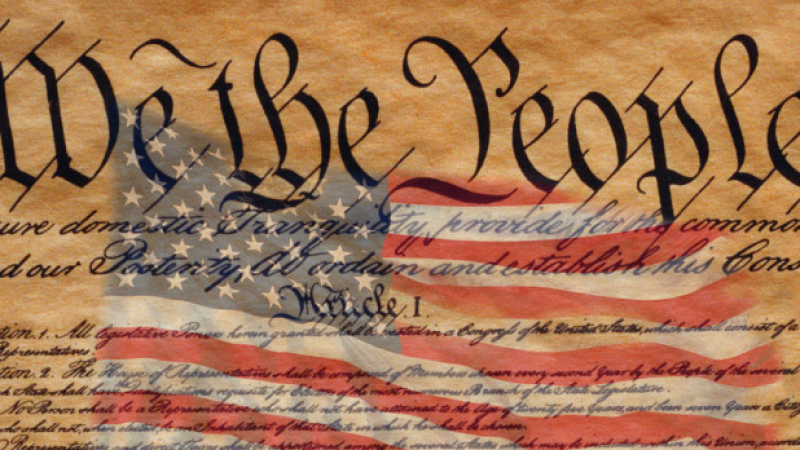

Our constitution is an awesome document. The best one on earth by far. It was written by great but not perfect enlightened people. It is the law of our land. It makes us an exceptional nation. It provides two means of legally making changes to it as a consensus to do so arises. It enshrines our founding document the Declaration of Independence which recognizes our inalienable rights, the source of them who created us equals in his sight, who’s divine Providence led to our becoming a nation.
 S E E D E D C O N T E N T
The United States Constitution is not some musty piece of parchment, written in barely legible calligraphy and irrelevant to our lives. To the contrary, it is a governing document of profound significance that all Americans should revere. If you don’t believe that, here are five reasons why you should change your mind.
1). A Written Constitution. Nearly all scholars agree that the Constitution was the first written document that established a major nation’s government. For thousands of years, mankind had been ruled by some combination of fear, force, custom, and tradition. Having a written document that laid out the powers of government and the duties of the representatives of “We the People” was a huge leap forward, both for the rule of law – that is, the idea that the law governs rather than the personal desires of those in power – and the argument that mankind has the capacity to participate in self-government.
2). Approved by the People. Until 1788, as far as we know, no major country in the course of human history put its form of government up to a vote of the people. The people in each state voted to send delegates to the Constitutional Convention of 1787, where a new governing document was created through robust debate. Unless the ratifying convention of any respective state approved the Constitution, it would not be adopted, another amazing advancement. We literally created a new social compact for the country that was agreed to by the people of each state.
3). Separation of Powers. Although England and ancient Rome had some pretense of separation of powers, it was muddled and often subverted. Until the Constitution, no major central government in world history firmly divided the three major functions of government into co-equal, separate branches. By dividing power between the legislative (Congress), executive (President), and judicial (Supreme Court) branches, the Constitution protects liberty by making it difficult for one person or group from taking complete control of the federal government.
4). Checks and Balances. Hand in glove with separation of powers, by giving each branch the ability to check the other branches, the Constitution better protects liberty. It requires that the three branches act together to enact policy and ensure that it does not violate the Constitution’s text. For example, the president can veto legislation passed by Congress, but Congress can override that veto with a two-thirds vote. The president is the commander in chief of the military, but only Congress can fund it and declare war. Even if Congress passes legislation and the president signs it into law, if it violates the Constitution, the Supreme Court must set that law aside. The president nominates judges, but the Senate must approve nominees. Again, liberty is protected by limiting the power of any particular branch of government.
5). Enumerated Powers. Most governments in human history presume that the government is all powerful, and then carves out certain restrictions where it cannot act. The Constitution does exactly the opposite. Unless the Constitution specifically enumerates – that is, lists – powers where the federal government has the authority to act, it cannot do so. By substantially limiting the reach of federal power, the doctrine of enumerated powers safeguards the people’s liberties.
There you have it, a list of top five reasons why the Constitution is vitally important today and should be revered. Whether or not we will maintain our Constitution, freedoms, and liberties is entirely up to you. Accept the challenge!
let’s explore another five reasons why we should be grateful for – and act to safeguard – the Constitution.
6). Federalism. The Constitution divides up the people’s sovereignty between two different spheres: the state and federal governments. By reserving all powers not enumerated to the states or to the people, federalism empowers the states to enact policies in light of local circumstances. The states can ensure better governance by tailoring policies to the facts on the ground as opposed to one-size-fits-all “solutions” from Washington, D.C. Federalism also empowers experimentation at the local level. People can move to states that are more compatible with their ideas of the good life. This strengthens the social compact by making state officials accountable for state policies. Additionally, federalism protects liberty by creating built-in tensions between the states and the federal government. Power is divided not just between the branches of government but between different levels of government. To have uniform, national oppression, would-be oppressors would need to take control of all three branches of the federal government, plus the three branches of governments of all 50 states – quite a tall order! The genius of dividing government vertically, as well as horizontally, is a vital protection of our liberty.
7). Unalienable Rights. Today, it appears that many have a fundamental misunderstanding of our rights. They are not given to us by government – those would be privileges. Instead, we believe that our rights come from our Creator. Each person is born with rights, because we are equally human beings. The Constitution recognizes this fundamental reality. Among the rights it protects are the free exercise of religion, freedom of speech, free assembly, the right to bear arms, due process, and the right to be free from unreasonable searches and seizures. The Constitution embodies a revolutionary understanding of our freedoms unlike any other governing document.
8). Equality. During the course of human history, inequality has been the prevailing reality. America, however, embraced equality as a founding first principle. The Declaration’s promise that “all men are created equal” is exemplified in the Constitution’s establishment of equality under the law, which is guaranteed by the Thirteenth Amendment (abolishing slavery) and the Fourteenth Amendment (ensuring equal protection of the laws and due process for all Americans). We have not yet escaped the dark shadow of slavery and other forms of discrimination based on immutable characteristics, but we have made tremendous progress because of the Constitution.
9). Voting. Today, we take for granted that all citizens have the right to vote. But that freedom was only achieved through centuries of struggle that expanded the franchise to all, which was done under the auspices of the Constitution: the Fifteenth Amendment (granting former slaves the right to vote), the Nineteenth Amendment (granting women the right to vote), the Twenty-Fourth Amendment (abolishing poll taxes), and the Twenty-Sixth Amendment (giving citizens 18 and above the right to vote).
10). Amendments. The founding fathers understood that they were far from perfect, which is why the Constitution can be amended (we have done this 27 times in our nation’s history). That a government would feature a bloodless, peaceful mechanism for change was another amazing innovation that we take for granted today. The idea that we have the right to reform our very form of government is an extraordinary detail that sets the Constitution apart from most governing documents in human history.
There you have it – another five reasons why the Constitution is essential to our freedoms and should be revered. There are many more: we could make this a weekly series for decades to come.
To preserve our liberties, revere the Constitution, and convince others to do the same.
Republicans, Trumpist fascists, radical right-wing extremists are engaged in an all out war to grab power at any cost in violation of Americans' constitutional rights. Support for the new Georgia voting laws, and the many other proposed laws restricting voting rights, is a violent assault on the American people.