
Supreme Court sides with Arizona on voting restrictions

By: Josh Gerstein (MSN)

Heads will spin in 3....2....1
 S E E D E D C O N T E N T
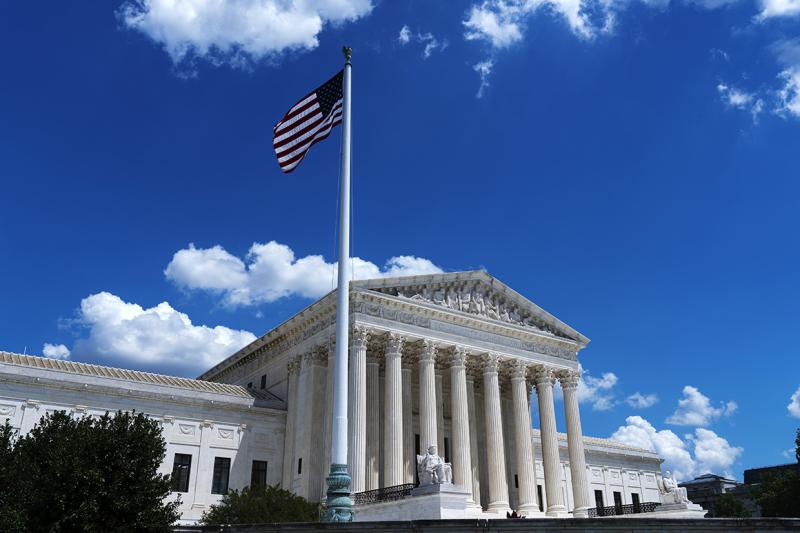
The Supreme Court ruled Thursday in favor of the state of Arizona in a high-profile voting rights case, once again reining in the impact of the Voting Rights Act by taking a narrow view of when state voting practices can be held to violate the rights of minorities.
The justices split 6-3 along ideological lines, with the Republican-appointed majority concluding that disparate impacts on minority groups would typically not be enough to render voting rules illegal under the act.
The decision, in a pair of cases from Arizona about out-of-precinct voting and collection of mail-in ballots, could make it more difficult for voting rights activists to challenge a slew of new voting restrictions Republicans are seeking to implement in states across the country.
The court's majority opinion, from Justice Samuel Alito, does not offer a bright-line test for future cases. However, he stressed that rules posing only a modest burden on voters would not usually amount to a violation of the act.
"Every voting rule imposes a burden of some sort. Voting takes time and, for almost everyone, some travel, even if only to a nearby mailbox. Casting a vote, whether by following the directions for using a voting machine or completing a paper ballot, requires compliance with certain rules," Alito wrote.
Alito also stressed that not every disparity in impact on minority voters would run afoul of the law.
"The mere fact there is some disparity in impact does not necessarily mean that a system is not equally open or that it does not give everyone an equal opportunity to vote. The size of any disparity matters," he wrote. "What are at bottom very small differences should not be artificially magnified."
All the court's liberals dissented, joining an opinion by Justice Elena Kagan that portrayed Thursday's ruling as part of a profound and ongoing curtailment of the landmark 1965 voting rights law by the high court.
"What is tragic here is that the Court has (yet again) rewritten — in order to weaken — a statute that stands as a monument to America's greatness, and protects against its basest impulses," Kagan wrote. "What is tragic is that the Court has damaged a statute designed to bring about 'the end of discrimination in voting.'"
Kagan pointedly accuses the conservative justices of betraying a principle they claim to hold dear: that statutes should be unfailingly interpreted according to the text Congress enacted.
"The majority fears that the statute Congress wrote is too 'radical' — that it will invalidate too many state voting laws," Kagan writes. "So the majority writes its own set of rules, limiting Section 2 from multiple directions."
Language added to the Voting Rights Act in 1982 prohibits states or localities from employing any election practice which "results" in the infringement of voting rights "on account of race."
Alito said in his majority opinion that practices adopted in many states at the time that amendment was adopted would also generally be permissible, even if they had some adverse impact on minority voting.
"We doubt that Congress intended to uproot facially neutral time, place, and manner regulations that have a long pedigree or are in widespread use in the United States," Alito wrote. He also noted that in 1982 most states "required nearly all voters to cast their ballots in person on election day" and had strict limits on absentee voting.
However, the court left open the question of whether a state's decision to return to the practices of four decades ago would pass muster under the VRA's ban on voting procedures that result in discrimination.
In a suit the Justice Department filed last week against Georgia over its newly-enacted voting rules, Biden administration lawyers seemed to be trying to steer clear of the uncertainty about the so-called "results" test.
Instead, the department based its suit entirely on the claim that the state's changes were motivated by a desire to limit African Americans' voting strength. The use of the Voting Rights Act to challenge practices that are intentionally discriminatory has been largely undisputed since the landmark civil rights law's passage in 1965.
The rulings come amid a broad push by Republican-led legislatures across the country to consider or enact new voting laws that would add restrictions on how voters access the ballot box, often in the name of "election integrity." The proposals follow a sustained push by now-former President Donald Trump, who continues to spread lies about the 2020 election, insisting he won an election that he lost.
The cases decided Thursday involved challenges to a 2016 Arizona law banning what critics dub "ballot harvesting" and to the state's longstanding policy allowing counties to disregard ballots cast by voters who show up at the wrong precinct.
During a nearly two-hour-long oral argument session in March, Chief Justice John Roberts and Justices Brett Kavanaugh and Amy Coney Barrett appeared to be seeking a way to allow states to maintain common, long-standing election rules while allowing suits over changes that disproportionately impact minority voters.
A lawyer arguing on behalf of Arizona's state Republican Party, Michael Carvin, contended Arizona's laws don't prevent anyone from voting — so the Voting Rights Act should only apply if someone can prove the rules were enacted for racial reasons.
"Arizona has not denied anyone any voting opportunity of any kind. It's not like a literacy test that denies you the right to vote," said Carvin. "Everyone here is eligible and registered to vote. All they have to do is utilize the myriad opportunities that Arizona has offered them."
Carvin noted that about 80 percent of Arizonans already cast their ballots by mail, but Justice Sonia Sotomayor said many Native Americans in the state don't get mail delivery at their homes, and some Hispanics in rural areas lack cars to get to post offices that are often far away.
"If you just can't vote for those reasons and ... your vote is not being counted, you've been denied the right to vote, haven't you?" she asked. "You're denied something if you're not given the right to vote, or it results in your denial from circumstances that the state could remedy easily."
Barrett, the court's newest member, also rejected the GOP lawyer's claim that time, place and manner restrictions shouldn't be subject to challenge. "I don't really see why time, place and manner really ... carries a lot of weight in your analysis," she said.
Kavanaugh repeatedly signaled that he favored an interpretation where courts would look more skeptically at changes that adversely affect minorities than at challenges that focus on existing practices. He also said rules that are "commonplace" in states that don't have a history of racial discrimination might be presumed to be acceptable.
However, Carvin cautioned that suspicion about changes to election procedures could leave politicians concerned about "ballot integrity or security ... hamstrung" by the actions of their predecessors. He warned the court that a murky standard would result in "an amorphous, manipulable situation where no one knows what the rules are going into the next election."
Even Sotomayor, who is widely considered the court's most liberal justice, suggested Arizona's newfound interest in limiting who can collect absentee ballots was more dubious than the state's well-established policy refusing to count out-of-precinct votes in counties with precinct voting.
"It's been around for a long time," Sotomayor said of the precinct-voting rule.
Arizona state Attorney General Mark Brnovich urged the justices to be cautious about using "statistical anomalies" to overturn state rules designed "to uphold the integrity of the election process." He argued that rejections for out-of-precinct voting are very rare in Arizona, given that most voters vote by mail.
While Roberts seemed generally sympathetic to the position taken by Democrats in the cases, he also made clear he doesn't think absentee-ballot fraud concerns are frivolous. He repeatedly referred to a 2005 report by former President Jimmy Carter and former Secretary of State James Baker that said such ballots have historically been the focus of fraud efforts.
Carter has broadly chided conservatives for continuing to cite the Carter-Baker report. "In the 16 years since the report's release, vote-by-mail practices have progressed significantly as new technologies have been developed," he said in a statement responding to Georgia Republicans' legislative proposals, days after the oral arguments in the Arizona cases. "In light of these advances, I believe that voting by mail can be conducted in a manner that ensures election integrity."
Under Trump, the Justice Department filed a brief that did not go as far as the state or the Republicans, but largely sided with their view. In February, with new officials in charge under President Joe Biden, the department withdrew its support for that brief.
However, at the arguments in March, Deputy Solicitor General Ed Kneedler stood by the Trump administration's position that neither of Arizona's challenged practices at issue in the cases violates the Voting Rights Act.
Continue ReadingShow full articles without "Continue Reading" button for {0} hours. Microsoft and partners may be compensated if you purchase something through recommended links in this article.

Tags
Who is online
115 visitors
Well looky there..
Good for the state of Arizona! I hope progressive libs are chewing their tongues in frustration on this.
You have absolutely no idea on this Earth what I live for or don't.
Notice how happy voter suppression makes the gop?
There is no voter suppression in that law. All it says is that to vote in person or when dropping off an absentee ballot you need to do so at your assigned polling station. And state law on who is allowed to drop off an absentee or mail-in ballot has been on the books in AZ for many years limited to family members or people who live in the same house. How is any of that voter suppression ?
Never throw logic and common sense at a progressive liberal when proving a point. They cannot take it, get frustrated, and their head implode. Poof!
If you are using an "absentee" ballot, doesn't that sometimes mean you are "absent" from where you live, so are not near your "assigned polling place"?
An absentee ballot can be mailed in, and you receive it a few weeks before the election so you really have plenty of time to mail it back. And it's postage free to mail it back so there is not even an expense of a postage stamp.
If someone cannot be bothered to plan ahead a little bit and get the ballot mailed back in time, just how much leeway are we supposed to give them? They still have their right to vote so what is the issue? Or are you arguing just to argue?
That is why the gop is dismantling the USPS.
Lamebrained is looking for nineteenth century answers to twenty first century problems.
Why not make it easier to safely vote online?
There is no way to make online voting completely safe from hacking AND make it easy to use. My office deals with an elderly customer base, some of whom don't have/use computers.
But Trump says mailing it in is bad.
In case you haven't heard, Biden does not have the ability to fire Trump's post master.
Can you provide examples of this happening?
There are no online voting systems at this time to provide you an example, but we do have plenty of online systems that get hacked every day. LinkedIn - owned by Microsoft - just got hacked with 700 million users' data up for sale including salary information. Colonial Pipeline's accounting system was hacked with ransomware. Banks, hospitals, political groups are all being hacked. I don't want my voting system where one person clicking an email link would lock everything up with ransomware or worse.
For the entire 20 years I was in the Navy, I maintained legal Arizona residency status and used absentee ballot all the time, even when overseas and never had one single problem doing so. Always mailed them ahead of time to make sure the ballots got there in time.
They're not getting hacked. They're getting phished. Hacking really doesn't happen often, it just makes for good fictional TV shows.
What does it matter what you call it? Regardless of if someone is hacking into a system or they get in via phishing, the end result is the same and the perpetrators are still all called 'hackers'.
If a state voting system gets hacked or phished , and encrypted for ransom, then the entire vote for that state is lost.
why do you throw out stuff like this and never respond? Is there some prize for the highest number of posts per month?
Seriously? It is 2 entirely different things.
Ignorant statement.
If a state's voting system gets """hacked""", then the results of the election are compromised, no matter how the votes were submitted.
I do not get paid to spew crap on various forums, I have a real job and sometimes that job keeps me extraordinarily busy, slowing down my responses to crap that others spew out.
Got it, you argue just to argue rather than defend your point. The issue is about someone illegally gaining access to an election system, does it really matter if they brute-force their way past a firewall or if they gain access thru someone dumb enough to fall for a phishing scam? It's the same thing, they have illegally gained access to an election system and can corrupt the election at that point.
lets see if you can explain yourself here. I believe you will just blow it off with some comment about how you're not gonna waste your time , bla bla...
Again, what's the difference? Election results are required to be verified by a certain date, usually by the end of the month of the election in many states. So if the data is encrypted, it's for all intents and purposes lost. Compromised is just another way of saying the election results cannot be used.
You seem to do a fairly good job of it however.
This from the turd who voted by mail in 2016.
Voting online can be "vexxed" and/or will have the appearance of tampering from Russia and China and N. Korean hackers. (Smile.) It is a real concern. And so the aspect is to keep voting de-centralized and off-line.
"The justices split 6-3 along ideological lines, with the Republican-appointed majority concluding that disparate impacts on minority groups would typically not be enough to render voting rules illegal under the act."
In other words you have to PROVE THE INTENT TO "SUPRESS."
I understand the difference between negligent homicide and murder but the victim is dead either way. In this case, legal voters are having it made harder to vote. Maybe we cannot prove restrictions imposed on voters were enacted to inhibit the minority vote YET, but we all know that they were...
Wrongo! Illegal voting restrictions are struck down by courts all the time. The US Justice Department is suing Georgia for it now...
That works in the reverse too. But it makes no sense to complain to some conservatives; just change the federal law to make voting more 'liberal.' But Joe Manchin and "the Democratic moderates" (makes me question my moderate temperament!). Always slow to see metaphorical blood dripping form their politically slit wrists.
Apparently there is proof the gop targeted the programs proven to increase black voter participation when crafting the Georgia law.
That would prove intent to suppress voters.
So what we have here is some conservatives holding progress at bay. Seems they want states to stay red that want to be blue. Clearly there are people in red-states that can't stand change. That is, of course, they bank on democrats and independents "sitting out" the mid-terms. I call on Democrats, Women, Independents, Secularists, LGBTQ, LatinX, Native Americans, APIs, and reformed prisoners to get prepared to vote NOW for the midterms 2022!
Some conservatives, with their dwindling numbers are desperate to 'magnify' their pathetic core voters.
In conclusion, I read ScotusBlog. We, have work to do, to change federal law. Furthermore, some conservatives did not need evidence to change red-state voting laws. Liberals will have freedom, same or better than some conservatives, or die in the process of striving for it.
As far as voter suppression tactics and strategies go; y'all got tricks - we got them too. And are 'bout to learn more. Buzz, buzz, buzz, that is the sound of keeping a close eye on everything some conservatives 'try-out.' When new evidence appears, since experience of voter suppression no longer factors with this new court, we will scream it from the proverbial 'rooftops.'
Ditto :To voter fraud, Trump supporter. We win some/we lose some. The Struggle continues.
And with that I'm moving on from this never-ending 'record' you are famous for 'show-casing.' Take a bow
Yes, I notice. Freedom means: living life as a conservative or some conservative.
I’m glad our fuck head politicians here in AZ have the time and resources to throw at something that isn’t in any way a problem. Maybe next those shit heads can figure out what we are going to do about water.
Not that that’s important or anything, or at least not nearly as important as combatting nonexistent voter fraud.
The liberal argument against these laws is incredibly racist. They don’t believe minorities can function as adults.
What gets me is, who cares if someone collected all the peoples ballots at a retirement home.
Easier on them.
You're right, who cares if someone collects the envelopes with the signatures and ballots, throws them into an oven for a few minutes, opens up the envelopes, change or modify the ballots, reseal the envelopes, and send them on their way.
Oh yeah, that happens all over the place all the time...
Did you try it? Take a priority envelope, pull the protective strip over the glue, seal the envelope, place it in the oven for a few minutes between 170 - 200 degrees, and then open it up, you'll find the glue has released and after it cools will reseal without evidence of it being opened.
What does that say about you?
It says I've been using my critical thinking skills and found a way that voter fraud can take place without leaving evidence.
That you believe this is happening?
If it hasn't happened already, it will happen. Would you rather I kept quiet about this or would you like to know that this information is not used to commit voter fraud by advertising it as widely as possible so that no one will attempt it, not even Trump or the republicans.
I'll let you know that you have something in common with the Q movement, I had the unfortunate visit by a Q believer, he wasted an hour of my time spouting how the vote counting machines were manipulated, how Trump was to retake power, and all that shit. I said the machines were not the problem because a simple hand count would show the discrepancies and the manufactures of the machines would be out of business so why would they do something that stupid. I told him that any fraud would be in the ability to open the "security" envelopes using heat, he said basically the same thing as your "That's fucking nuts!"
After you try what I did and find out how easy it was, could you please spread the word.
You mean like in ignoring that it is a crime to tamper with mail and vote ballots; and that ballots 'blanks' are supposed to be filled in and signed with permanent ink "visible" to damage? Now what group of scoundrels would be risking time in jail over this?
Better yet: Make a Youtube video demonstration of this 'issue' and alert news stations. . . surely they will take it from there. Incidentally, what happens to the shape and form of the return envelope and said ballot with its permanent black inked boxes? How do you fabricate removal of the blue/black ink?
This is a valuable observation. It’s always relevant to look at the circumstances surrounding the writers of a law to get at how they understood the situation. Whatever restrictions any jurisdiction might impose in 2021, they will still have election procedures that are far more relaxed than they probably had in 1982. It’s therefore hard to see most of these measures as some kind of unjust and giant backward step for voting rights.
I don't buy it. Things were stricter too when women couldn't vote. Times change.