
In a Milestone, Schumer Will Propose Federal Decriminalization of Marijuana

By: Nicholas Fandos (MSN)

I got the munchies just reading this LOL
 S E E D E D C O N T E N T
WASHINGTON — Senator Chuck Schumer of New York plans to propose legislation on Wednesday to decriminalize marijuana at the federal level, putting his weight as majority leader behind a growing movement to unwind the decades-old war on drugs.
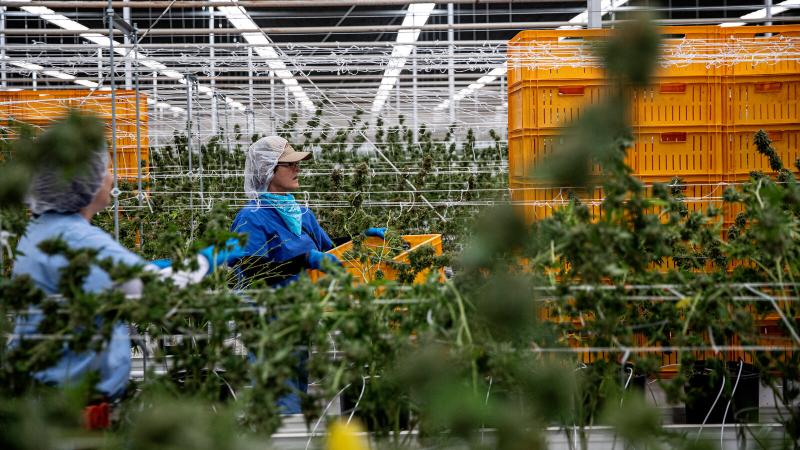
 © Adriana Zehbrauskas for The New York Times Workers harvesting marijuana in Arizona. The cannabis bill faces an uphill climb in the Senate.
The draft bill, called the Cannabis Administration and Opportunity Act, would remove marijuana from the Controlled Substances Act and begin regulating and taxing it, placing federal rules on a burgeoning industry that has faced years of uncertainty. Though states would still be allowed to set their own marijuana laws, businesses and individuals in states that have legalized its use would be free for the first time to sell and consume it without the risk of federal punishment.
The proposal would also try to make recompense to communities of color and the poor for damage from years of restrictive federal drug policy. It calls for immediately expunging nonviolent marijuana-related arrests and convictions from federal records and would earmark new tax revenue for restorative justice programs intended to lift up communities affected by "the failed federal prohibition of cannabis."
The bill aims to "finally turn the page on this dark chapter in American history and begin righting these wrongs," said Senator Cory Booker, Democrat of New Jersey, who wrote the bill with Mr. Schumer and Senator Ron Wyden, Democrat of Oregon and the chairman of the Finance Committee.
The legislation faces an uphill battle in the Senate, where Republicans are opposed, and it is unlikely to become law in the near future. President Biden has not endorsed it, and some moderate Democrats are likely to balk at the implications of decriminalizing a drug that has been policed and stigmatized for so long.
But in the arc of the public's rapid reconsideration of marijuana laws, the presentation on Wednesday was a remarkable milestone for legalization proponents. The suggestion that the Senate's top leader and the chairman of the powerful Finance Committee would sponsor major decriminalization legislation would have been fantastical in the not-too-distant past.
In a speech on April 20, the unofficial holiday for marijuana smokers, Mr. Schumer said he was trying to prod Washington off the sidelines of a debate in which much of the country was already engaged. Public opinion polling suggests that nearly 70 percent of Americans support legalizing marijuana. Thirty-seven states and the District of Columbia have legalized marijuana for medical use, and 18 states plus D.C. allow recreational use by adults.
Mr. Schumer has also made no secret that he believes Democrats stand to benefit politically from embracing the legalization push, particularly with young voters.
"Hopefully, the next time this unofficial holiday of 4/20 rolls around, our country will have made progress in addressing the massive overcriminalization of marijuana in a meaningful and comprehensive way," he said in April.
The senators were expected to detail their plans later Wednesday morning at a news conference at the Capitol.
They are expected to propose empowering the Food and Drug Administration and the Alcohol and Tobacco Tax and Trade Bureau at the Treasury Department to begin regulating the production, distribution and sale of marijuana, removing the Drug Enforcement Administration from its current oversight role. Among other implications, the changes would allow marijuana companies already operating in states where it is legal to gain full access to the United States banking system.
The legislation would gradually institute a federal excise tax like the one on alcohol and tobacco sales, eventually as high as 25 percent for big businesses, allowing the federal government to benefit from sales that came close to $20 billion in 2020. The revenue would then be funneled back to communities most affected by federal drug policy and to fund expanded medical research into cannabis that is currently limited by its status as a controlled substance.
One provision, for instance, would establish a cannabis justice office at the Justice Department to help fund job training, legal aid and help with re-entry after incarceration. Another program would promote loans to small cannabis businesses owned by members of racially or economically marginalized groups to try to ensure that communities that suffered disproportionately under the war on drugs are not left out of the gold rush that has accompanied legalization.
But the bill would aim to make other, more direct attempts to compensate for the impacts of years of aggressive policing. In addition to expunging past arrests and convictions, it would entitle those who are currently serving sentences for nonviolent federal drug crime to a court hearing to reconsider their sentences. And if enacted, the federal government would no longer be able to discriminate against marijuana users seeking federal housing, food or health benefits.
The Democratic-led House passed similar legislation in December, with a handful of Republicans joining to vote in favor. The vote was the first and only time either chamber had endorsed the legalization of cannabis, but the bill died at the end of the last Congress. House leaders plan to pass an updated version in the coming months.
Passage through the Senate is likely to be more tricky. Mr. Schumer would need to assemble 60 votes, meaning he would need the support of at least 10 Republicans. Though libertarian-leaning Republicans have generally supported ending the prohibition of marijuana, party leaders are likely to oppose the Democrats' plan, particularly with its emphasis on restorative justice and government intervention in the cannabis industry.
But opposition is not limited to Republicans. Mr. Schumer would have to persuade moderate Democrats who are uncomfortable with the implications of decriminalization to support it.
Mr. Biden supports decriminalizing marijuana and pulling back the war on drugs, but his views are generally more conservative than many Democrats' and he has not endorsed Mr. Schumer's proposal. His White House made headlines this spring for pushing out five staff members over their use of marijuana.

"Dave's not here man"
I'm all for this myself. Decriminalize it and tax it (easy revenue source). Legalize the growing and sales (again, another revenue source). Set up the law so that people busted in the past for possession (of a personal level, not enough volume to constitute attempting to sell) can get their records expunged. Cleans up a lot of issues. MJ is widely used today anyway so the government might as well make some money from it in other ways than fines, RECO and the private prison system.
The only issue I personally have is that there is still not a way to detect if someone has THC in their blood stream AND is under the influence of the drug or if the THC is several days old and they are no longer impaired.
So long as they don't overtax it; like a few states have done. That just leads to illegal growing and distribution.
It doesn't do any good if they make it too expensive.
Au contraire mon ami.
Good. I hope it works.
They're losing the funds from convincing tobacco users to quit by making it impossible to smoke anywhere except their own properties. They need to make up that funding another way now. Something that I find interesting though... why is it okay to promote the legality and usage of marijuana, but condemn tobacco users? Just a rhetorical question. I have nothing against marijuana whatsoever. I have always thought it was stupid for it to be illegal. I have found that I'd much rather be around someone high on MJ than someone that's been drinking. Hell, I'd rather smoke MJ than drink.
That's another really good thing.
Oh well, that might be a problem in the eyes of government. That would mean the government couldn't discriminate against MJ smokers.
But I thought that Biden wanted to help "communities of color and the poor" and wouldn't that mean he should sign the proposal? Oh wait... then he would have the wrath of the 5 staff members he fired for MJ use. Such a conundrum.
America is finally growing up? - oh wait, it still has to be passed by the Senate - good luck with that. Instead of the tremendous tax benefits, I'm sure the geezers in the Senate would prefer that the drug cartels get that money, not the American government. In the movie "The Accountant", the treasury agent describes how rich the cartels get by saying that they count their money by weighing it in 18 wheeler trucks.
I love that movie.
One of my favourites as well.
This is a move "states rights" people should applaud and support. I don't think it will pass, but (shrug) maybe. Then I'll get some of those sweet MJ stocks in my 401K.
I've actually already made a nice chunk of change from my MJ stock.
Yes, many of them are doing great. 401Ks are regulated by federal rules and as such still can't add MJ companies to their portfolios.
Agreed. When I was laid off from AM General, I took my 401K money and went to a local stock broker. I originally had a moderate package and $1100 in FCA stock. When FCA sold off Ferrari, I sold my FCA and paid off my car. Once my moderate package gained enough money, I put it into Canopy Group. I want to say that I paid $18 and some change per share. While it's back down overall (about $22 per share), it had a peak in Feb. this year at over $56 per share... I figure that once the border opens (because it's a Canadian company on the US Stock Exchange) and people go back to their normal lives... AND more states start legalizing MJ, it will go up again. I know I'll make money on it. I'm just going to keep letting it ride. I'm only 42... I've got plenty of time.
Yes, I have been watching them