
Biden's Misstep in Afghanistan Threatens to Erode His Image on the World Stage

By: Lisa Hagen (MSN)

Feckeless
 S E E D E D C O N T E N T
Joe Biden returned to the White House - this time as president - by convincing voters he'd be a steady hand for the country, especially on foreign policy, after a tumultuous four years. But the Taliban's swift takeover of Afghanistan and the resulting chaotic evacuations are shaking confidence many had in Biden's leadership on the world stage.
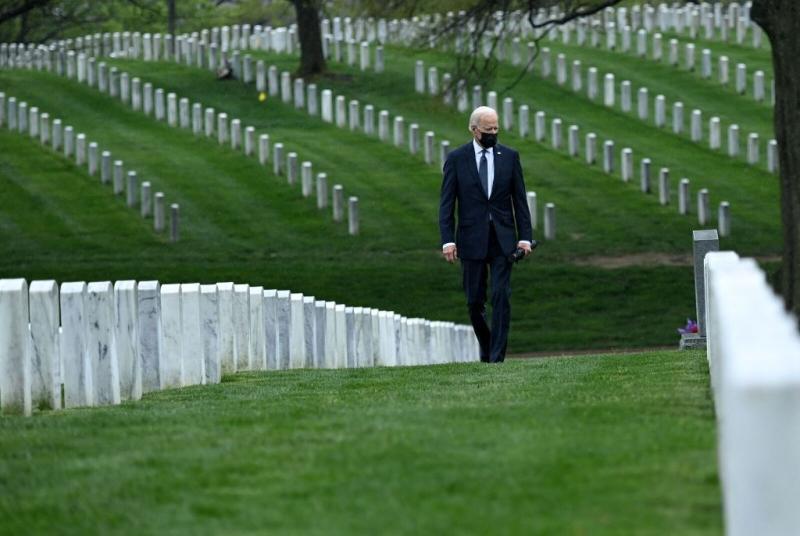
© (BRENDAN SMIALOWSKI/AFP via Getty Images) TOPSHOT - US President Joe Biden walks through Arlington National cemetary to honor fallen veterans of the Afghan conflict in Arlington, Virginia on April 14, 2021. - President Joe Biden announced it's "time to end" America's longest war with the unconditional withdrawal of troops from Afghanistan, where they have spent two decades in a bloody, largely fruitless battle against the Taliban. (Photo by Brendan SMIALOWSKI / AFP) (Photo by BRENDAN SMIALOWSKI/AFP via Getty Images)
Biden is in the unique position of serving in two of the four administrations that were in power during the war in Afghanistan, first as vice president in the Obama administration and now as commander in chief, leading the drawdown of the last remaining troops, which numbered 2,500 before thousands more were sent to assist with evacuating U.S. personnel and Afghan allies.
During his 36-year tenure in the Senate, Biden burnished his foreign policy credentials and frequently touted his past role as chairman of the Foreign Relations Committee. And as vice president, he was known as the one in the Obama White House with significant experience dealing with issues abroad compared to his boss, who only spent three years in the Senate and the federal government before the prominent promotion.
While Democrats broadly believe Biden is a welcome departure from former President Donald Trump's "America First" foreign policy doctrine and brings a wealth of foreign policy knowledge, even his fiercest allies are questioning how the administration couldn't foresee the speedy collapse of the Afghan government without U.S. assistance and how he might govern going forward.
"So for us who are with him, the shocking part is how badly it was handled. That is a troubling point - is that how you're going to be governing?" says Muqtedar Khan, who was the founding director of the Islamic Studies Program at the University of Delaware and testified to Congress about U.S. strategy in Afghanistan more than a decade ago. "The U.S. is coming across as a very incompetent country - not being able to handle the things we're good at handling."
Biden had, in fact, sold himself as the foreign policy pro who would reassure American allies, avoid amateur missteps and restore the nation's standing on the world stage. But just a couple of months after his successful G-7 trip abroad, America's old friends are complaining about the botched withdrawal.
And with other unnerving battles going on - especially the increased infections from the delta variant of the coronavirus - Biden's Afghanistan problem could take on an amplified, confidence-eroding quality, experts say.
"I think he's in for a very bumpy period here," says Simon Rosenberg, a longtime player in Democratic politics and founder of the policy group NDN.
Since the fall of Kabul last weekend, Biden has been bullish about his decision to completely withdraw from the region - one supported by many Democrats and even some Republicans. During his first public remarks on Monday, he argued that the chaos justified his decisionmaking and proved no amount of U.S. military presence would change the situation in Afghanistan. But while he said "the buck stops with me," he also cast his decision as following through on Trump's deal with the Taliban and placed blame on the now nonexistent Afghan government and special forces that retreated from the region when Kabul fell.
His core argument boils down to not passing a 20-year conflict on to a fifth president and relying on another generation of soldiers to fight a war most Americans want to leave. And Biden, in an interview this week with ABC News, said he didn't see a withdrawal scenario where some sort of regional meltdown could have been completely avoided.
"The idea that somehow, there's a way to have gotten out without chaos ensuing - I don't know how that happens," Biden said.
What unfolded in Kabul on Sunday came into stark contrast with what Biden predicted just a month earlier. The president confidently asserted that the withdrawal from Afghanistan bears no resemblance to the U.S. exit from Vietnam and downplayed the Taliban's military capabilities.
"The Taliban is not the North Vietnamese army. They're not remotely comparable in terms of capability," Biden said last month. "There's going to be no circumstance where you see people being lifted off the roof of an embassy of the United States from Afghanistan."
But only a day after the fall of Kabul, jarring images and video saturated televisions and social media as massive crowds of people, many of them vulnerable Afghans who provided help to the U.S. during nearly 20 years of war, tried to cling to military planes preparing to take off. Thousands have been evacuated over the past several days but tens of thousands more are seeking to leave as the U.S. military works feverishly to get them out by the end of the month.
While many Democrats - and some Republicans - ultimately support Biden's decision to withdraw, their main concerns emanate from the way the U.S. left the country without efforts to evacuate personnel and allies sooner, given the embattled state of the Afghan government. And most attribute other missteps related to Afghanistan over the past two decades beyond just the current administration.
Some Democrats in Congress, including those who were already wary of withdrawing from the region and the plans initiated by the Trump administration, have been vocal about their criticism of the Biden White House's handling of the situation.
Senate Foreign Relations Committee Chairman Bob Menendez of New Jersey, who in March warned Biden about going along with Trump's withdrawal deadline of May 1, said he was "disappointed that the Biden administration clearly did not accurately assess the implications of a rapid U.S. withdrawal."
Others, like House Speaker Nancy Pelosi of California, praised Biden's speech earlier in the week and his overall efforts to get the U.S. out of a persistent conflict. But Pelosi and Menendez have announced oversight hearings on the matter scheduled for next week that'll likely place prominent members of Biden's Cabinet in the hot seat - a forum where tensions will unequivocally be on display.
While it's not unusual for a new president's approval rating to settle down months into his presidency, Biden's average approval rating has dropped beneath 50% for the first time in his term, according to polling aggregated by FiveThirtyEight. That was unexpected for Democrats after Biden's legislative wins on passing the COVID-19 relief package and securing Senate approval of the $1.2 trillion bipartisan infrastructure plan that the White House helped negotiate.
But with more than a year until the 2022 midterm elections - and a political lifetime before the 2024 presidential race - the fallout surrounding Afghanistan is unlikely to have electoral ramifications at least as of now, political strategists say.
American voters tend to punish or reward presidents more commonly on domestic issues like the economy as opposed to foreign policy, experts note - unless the foreign policy issue is overwhelming, like the Vietnam War.
Biden and Democrats alike are likely to lean heavily on their domestic legislative successes like passing additional pandemic funds and, if it can clear its way through Congress this fall, both pieces of the president's economic agenda. The bipartisan infrastructure plan still needs to pass the House, and both chambers are navigating hurdles to advance a Democrat-only bill that'll allocate $3.5 trillion to family, education and health care programs.
But what has been widely regarded as a debacle in Afghanistan could well have a domino effect, they say, worrying Democrats eyeing a very challenging midterm election season since the party in the White House historically sees sizable losses during the off year. Some say, however, withdrawal could ultimately be a feather in the cap for the party since many Americans want out but only if the Taliban doesn't further exacerbate a dire situation.
"'I ended the Afghan war' could be a winning slogan," Khan says. "That will work only if the Taliban behaves."
Michael Allen, a Northwestern University history professor who has written extensively on Vietnam and the American presidency, says that while the scene in Kabul does not sync with Biden's self-described image as a foreign policy pro, he ultimately won't suffer consequences for it politically, especially since many Americans want out.
Even with tensions flaring, a large majority in the U.S. want to leave Afghanistan after nearly 20 years. According to a new AP-NORC poll, only 35% of Americans believe the war was worth fighting, which is a shared belief in both parties. But with heavy partisan splits in the country, Biden's handling of foreign policy gets very low marks from Republicans and overwhelming approval from Democrats.
Allen notes that, as in Vietnam, the Afghanistan war spanned several presidencies, Democrat and Republican, and both were highly unpopular by the time the U.S. left. And while the fall of Saigon in 1975 had similar, wrenching images of desperate Vietnamese trying to get out of the country, then-President Gerald Ford did not lose in 1976 because of the event and was later praised for the massive evacuation of Americans and vulnerable South Vietnamese citizens.
What's different now, Allen notes, is that the country is far more polarized politically so even a dramatic event like the one unfolding in Afghanistan won't change as many minds.
"People's partisan attitudes are very hardened," Allen says. "I can't imagine many people, even people who care deeply about foreign policy, saying I think this proved I should have voted for Trump."
Biden's next test will come over the next 11 days as the military tries to evacuate all Americans and vulnerable Afghans who are eligible to leave while the U.S. still controls the airfield in Kabul.
When asked whether troops will stay beyond Aug. 31 if not all Americans are out, national security adviser Jake Sullivan told reporters Tuesday he wouldn't engage in hypotheticals but would focus on "getting as many people out as rapidly as possible." But Biden committed on Wednesday that they will stay beyond the deadline if that's the case. It was not clear whether the commitment would extend to Afghans who aided the U.S. effort.
"The commitment holds to get everyone out that, in fact, we can get out and everyone that should come out. And that's the objective," Biden said in his interview with ABC News, responding to a question about evacuating Afghan allies beyond the deadline and adding that "if there's American citizens left, we're gonna stay to get them all out."
Biden and his team argue they were left with an impossible situation with few good outcomes and they acknowledge the risks posed to Afghans living under Taliban rule, especially women and girls. And while the White House says it remains committed to ensuring human rights for vulnerable populations in Afghanistan, Biden said he ultimately didn't want to put more American lives in harm's way for a conflict he believes should end.
Jon Alterman, who formerly worked as a staffer on the Senate Foreign Relations Committee while Biden served, recounts how the then-senator "had a clear theory of how the world works, how power is wielded, how interests are assessed and how agreements are struck." That was before his service in the Obama White House, "working closely day-in and day-out with the very people who now staff the highest levels," and preparing him to become commander in chief.
"You can argue the system failed, but I'd take a different view - one that I've been hearing from friends for years. That is, no one is ever certain how things will pan out, and at the end of the day, there's only one guy in the executive branch who actually got elected and has a right to be there," says Alterman, who's a senior vice president at the Center for Strategic and International Studies.
"With all of the information at his disposal and all the staff work he demanded, he made a judgment call," he adds. "He'll be judged on how it plays out. He ran for president for the right to make those decisions. Staff gets to do the easy stuff. Presidents get stuck with the hard stuff."
Paul D. Shinkman contributed to this report
Copyright 2021 U.S. News & World Report
Continue ReadingShow full articles without "Continue Reading" button for {0} hours. Microsoft and partners may be compensated if you purchase something through recommended links in this article.

Damage is done.
It was the icing on the cake.
Any voter's remorse yet?
My remorse is that I couldn't vote 4 or 5 times against Trump.
So you could only muster 3 without getting caught? Bummer.
Of course, I'm talking to independents and moderates who thought they'd get peace of mind without Trump.
I WARNED YOU!
Maybe they would have piece of mind if right wing extremists would stop pestering them on social media.
Actually no. I chose what I believed to be the better of two incredibly poor candidates. That led me to vote for the first Democratic presidential candidate of my life.
I would still make the same decision today.
The current situation in Afghanistan is a colossal fuck up. I am very disappointed about the needless danger to which we've exposed our civilians and allies.
That said, I am not convinced Trump would have handled the situation so significantly better that it would make up for his long list of other shortcomings.
Further, I don't give a tinker's damn about what other countries think of us and I certainly don't care about our president's "image on the world stage" or any other such foolishness.
I live in Texas. We have a lot of Trump supporters, and every single one I've ever met is almost completely ignorant about 95% of the shit they complain about. They are every bit as clueless as OWS protesters.
We're also ground zero for illegal immigration.
I wanted somebody to actually use their brain about immigration. Trump had 4 years to pass immigration reform, and at no point was there every any sign of intelligent thought on the matter.
I wanted an infrastructure bill. I wanted to invest inside our country in the things that make us more productive, more competitive and more prosperous. Like Reagan did.
Presidents with any sense whatsoever usually get that done first because then the economic benefits are starting to be realized by the time they run for re-election. Again, in 4 years we saw no signs of intelligent thought on the matter.
I voted for Biden because Trump was a poor president and a terrible leader. Not only was he terrible on policy, but he was also utterly inept at the intangibles of the presidency.
We needed a return to normalcy, and Biden was a step in that direction whereas Trump was simply a freight train further down the rabbit hole.
In the aftermath of Sept 11, GWB united our nation. He capitalized on what is truly great about this country and go us all pulling together to solve a series of problems...none of which he created.
Covid was Trump's 9-11. It was the crisis that defined his presidency. He was abysmal. Where FDR, Reagan, or GWB had engendered confidence and coalesced the American people, Trump undermined confidence and divided us further at every opportunity. Every night he appeared on television and demonstrated more completely that he was in the way of experts who knew 100,000 times more than he did.
He was the worst president since LBJ or Nixon.