In Case You Missed It, December 16th, 2020





Humans have dogs, fish have shrimp
2020 in 20 charts
So tell us... what's up Skip?
The US-UK trade talks Joe Biden inherits
Trump administration has executed more Americans than all states combined
DeVos Urges Education Department Employees To ‘Be The Resistance’
Four-Month-Old Ravens Rival Adult Great Apes in a Battle of the Brains
Trump's Mar-a-Lago neighbors: Get the hell off our lawn!
Ex-Cop Allegedly Held AC Repairman At Gunpoint, Convinced He Was Voter Fraud Kingpin
Humans have dogs, fish have shrimp
We may not be only species to domesticate others.
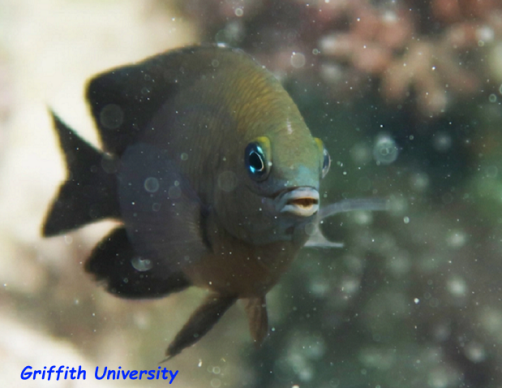
Longfin damselfish ( Stegastes diencaeus ) are known to aggressively defend the farms they rely on for food – but not, it seems, against planktonic mysid shrimps ( Mysidium integrum ).
“We found that the damselfish keep swarms of mysid shrimps within their farms, providing them with a long-term safe haven from predators,” says Rohan Booker from Australia’s Deakin University, lead author of a paper in Nature Communications .
“The mysids, in return, swim over that farm all day and passively pump out waste material. All that extra waste acts as fertiliser, improving the farmed algae, and, in turn, the condition of the farmer, the damselfish.”
This is known as a “domesticator-domestica relationship”, a mutually beneficial arrangement where one species provides ongoing support to another in exchange for predictable benefits, such as cleaner fish picking parasites off other fish or insects pollinating flowers.
Humans have had such relationships with many different animals since domesticating dogs around 10,000 years ago, selectively breeding them for certain appealing characteristics such as tameness.
Other examples of non-human domestication are best known in insects that tame plants such as fungi-farming ants . This study shows non-human vertebrates also domesticate other animals and suggests it may be more commonly than previously known, says Booker.
In non-human species, he notes, the process of domestication likely occurs without conscious intent but rather through co-evolution over millennia. It’s suspected that human relationships with other animals originated in the same way.
Human domestication of grey wolves ( Canis lupus ), for instance, is thought to have started when the wolves were attracted to human camps; as the two species coexisted and became used to each other, humans started deriving benefits such as more successful hunting.
Similarly, chickens and cats may have been drawn to human encampments to feed on scraps, which then developed into a symbiotic, or mutually beneficial relationship, through the benefits they provided such as eggs, meat or hunting rodents.
“I think the really exciting thing we were able to do was use the fish-mysid relationships to experimentally test the commensal pathway which is one of the ways human relationships with animals are thought to have first emerged,” says Brooker.
“The territorial behaviour of the fish created a brand-new niche on the reef which the mysids could opportunistically take advantage of for shelter, similar to how chickens or cats may have taken advantage of human settlements for food, leading to better survival.
“These animals, in turn, provided a benefit to the niche creator and so positive feedback strengthened the relationship over time.”
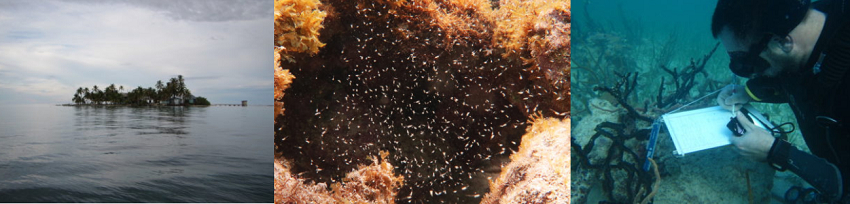
These affiliations have ecologically important ramifications, the authors say, as mutual benefits evolve through the generations, shaping behaviour, adaptation and survival, and even landscapes and biodiversity.
Brooker first spotted the phenomenon with damselfish and mysid shrimp when swimming around coral reefs of Belize five years ago. He and colleagues from Deakin and Griffith universities in Australia, as well as from France, the US and the UK, then followed up with a series of field studies and behavioural experiments.
He is hopeful that future research can verify the phenomenon in other reefs around the world where mysid shrimp are reported to inhabit damselfish territory, such as Lizard Island on Australia’s Great Barrier Reef.
“Our ability to domesticate other organisms has contributed to the success of our species and transformation of the world’s ecosystems,” the team writes. They suggest new insights could be gleaned by further exploring how this happened in other animals.
2020 in 20 charts
From voting to vaccines and from protests to pets, a look at 2020’s biggest trends
2020 was such a terrible, bad, no-good year that even complaining about it got old. A pandemic knocked the world to its knees, killing 1.6 million people so far and leaving untold suffering in its wake. Social distancing kept us inside, away from our friends and loved ones. Businesses shut their doors. Economic inequality grew.
Still, not everything was bad.
It’s been a very good year for bread, hand sanitizer, and pets. Also, greenhouse gas emissions declined in the United States. Earlier in the pandemic — back when people still made jokes — we joked that nature was healing itself.
Here’s a roundup of some of the most important 2020 trends, in charts. Twenty of them!
1) The coronavirus continues to wreak havoc on the US
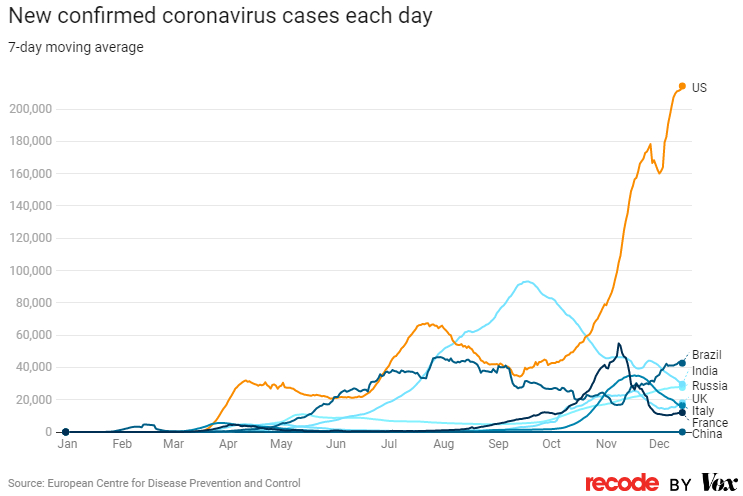
It’s been nearly a year since the first confirmed coronavirus case hit the US. Now, more than 16 million Americans, or nearly 5 percent of the country’s population, have had the virus, and about 300,000 have died, more than any other country in the world by far. The response to the virus — which first tore through large cities, then devastated rural areas, and is now spreading everywhere — was disjointed and inconsistent, and marred by an administration that didn’t take it seriously. Now the United States is averaging more than 200,000 new cases each day, or more than 10 times the number of daily cases this spring. India, a much more populous country, registers around 30,000 per day. China, where the virus first originated, has about 15.
2) Efforts to flatten the curve worked — for a while
The virus has been a public health nightmare, with hospital emergency rooms inundated with sick patients and health care workers struggling to get personal protective equipment to keep themselves and their patients safe. An early effort to “flatten the curve” went viral and helped prevent the medical system from being overwhelmed. Communicated as a chart, the idea of flattening the curve encouraged people and governments to adopt protective measures like self-isolation and closing schools and businesses to keep the virus from spreading too quickly.
But the US never went further to fully suppress the virus, leaving new daily Covid-19 cases at a dangerous plateau in the spring, with a surge in the summer. As many states have reopened businesses, the new surge of cases this fall and winter is threatening once again to overwhelm the health care system if the US doesn’t take serious precautions.
 Christina Animashaun/Vox
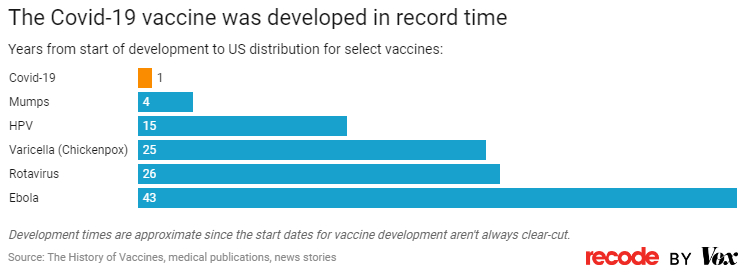
3) A coronavirus vaccine was developed in record time
From conception to distribution in less than a year, the development of the coronavirus vaccine has been the fastest in history. Until now, the fastest vaccine development had been the mumps vaccine, which took four years. (For comparison, more than three decades after the first vaccine trials began, there’s still no AIDS vaccine.) Typically, vaccine development takes at least a decade, and that’s sometimes only after the disease has been spreading for millennia.
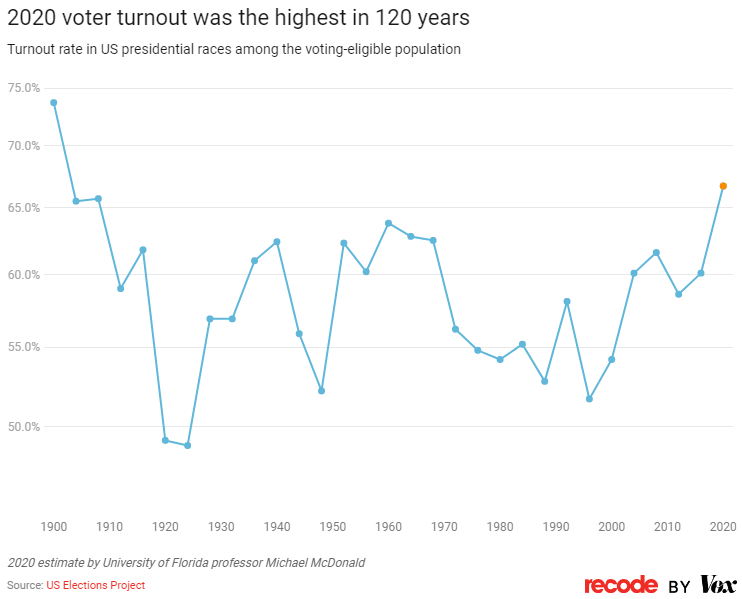
4) Voter turnout was the highest in more than a century
Nearly 160 million Americans voted in the 2020 presidential election, or about 67 percent of the voting-eligible population, according to data from United States Elections Project . While the pandemic had the potential to keep people from voting, mail-in and extended in-person voting options enabled more of the population to vote than had in more than 100 years. High voter turnout rates were due to several factors, including an election that people perceived as very important, a highly partisan race in which few people claimed to be undecided, and omnipresent “get out the vote” messaging.
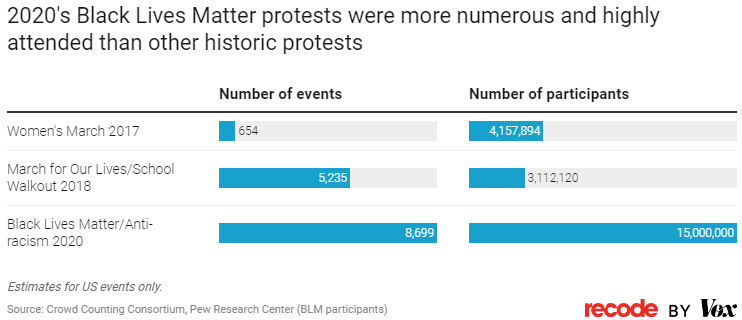
5) A year of protest
Much of the spring and summer was dominated by Black Lives Matter and anti-racism protests, in response to widespread police violence against Black Americans. These protests took place in more locations and over more days than 2017’s Women’s March and 2018’s gun violence protests . They were also highly attended, with an estimated 15 million to 26 million Americans saying they joined these protests in June alone. Anti-racism protests continued into July, so real turnout could have been higher. (Turnout for the civil rights protests of the 1960s were in the hundreds of thousands, for comparison.) This year’s anti-racism protests were “bigger, broader, and more enduring” than any other on record, according to Erica Chenoweth, a Harvard Kennedy School professor who co-directs the Crowd Counting Consortium.
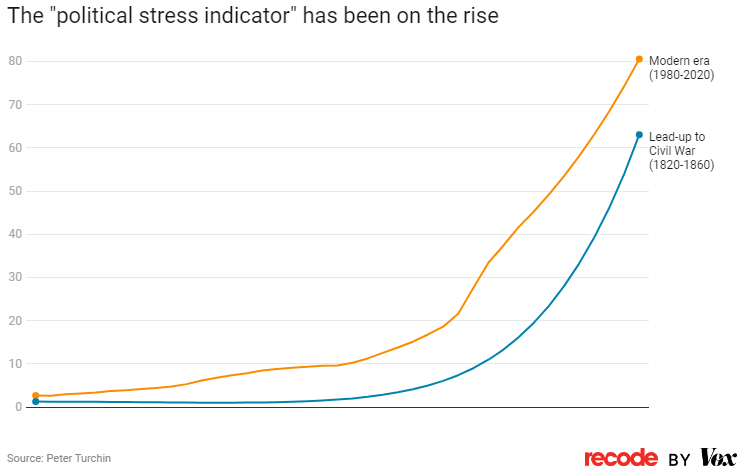
6) Political polarization got worse
The protests and high voter turnout happened amid increased polarization — the kind that means one party not only disagrees with the other’s politics but also hates them as individuals. Spurred on by systemic inequality, vociferous politicians, and social media that’s geared toward increasing user engagement, people are more likely to feel coldness toward the opposing party than warmth toward their own more than at any time in the past 40 years. A so-called political stress indicator , which incorporates measures of wage stagnation, distrust in government, and inequality, has been on the rise in a way that’s similar to what the country saw before the Civil War.
7) Income inequality got worse
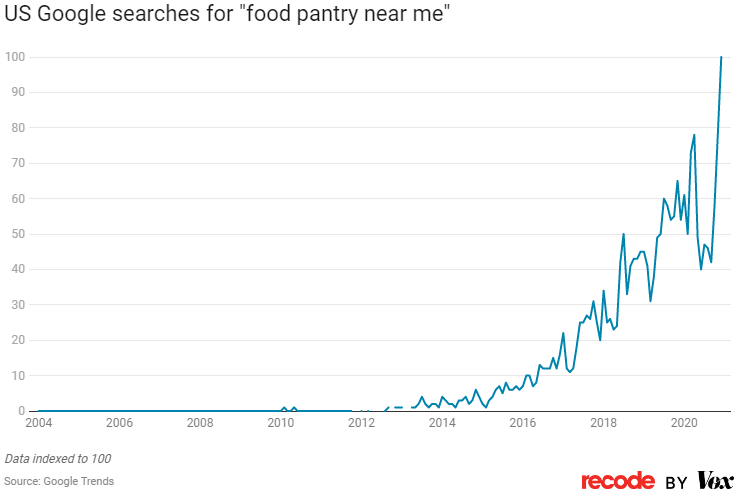
The pandemic exacerbated long-term trends toward inequality, with the rich getting richer and the poor getting poorer . These trends were on display in numerous ways. For example, the rich could ride out the pandemic in the luxury of their homes while the poor were forced to work jobs that put them at greater risk of catching the disease. And as Washington Post data reporter Christopher Ingraham pointed out , while the Dow Jones Industrial Average rebounded to pre-pandemic highs, enriching shareholders in America’s biggest companies, searches for local food banks or food pantries also grew.
8) Wages didn’t rise as swiftly as corporate profits
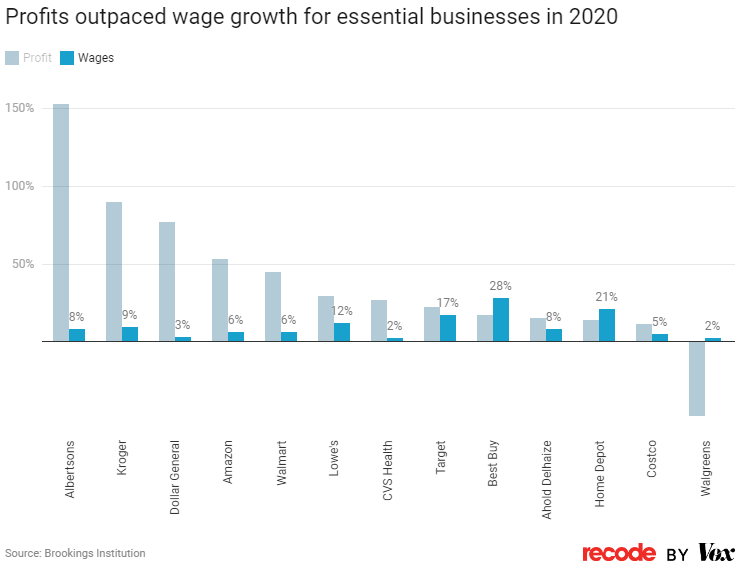
The pandemic made many retail employees into essential workers, whose jobs at grocery stores and pharmacies put them at risk of contracting the virus. But while the companies they worked for made an enormous amount of money, these employees did not, according to a study by the Brookings Institution . The analysis of 13 essential retail companies found that they made an extra $17 billion — 39 percent more — in 2020 compared to the year before. Meanwhile, retail workers only saw their wages rise by about $1 per hour, an increase of just 10 percent.
9) Unemployment rates were the highest since the Great Depression
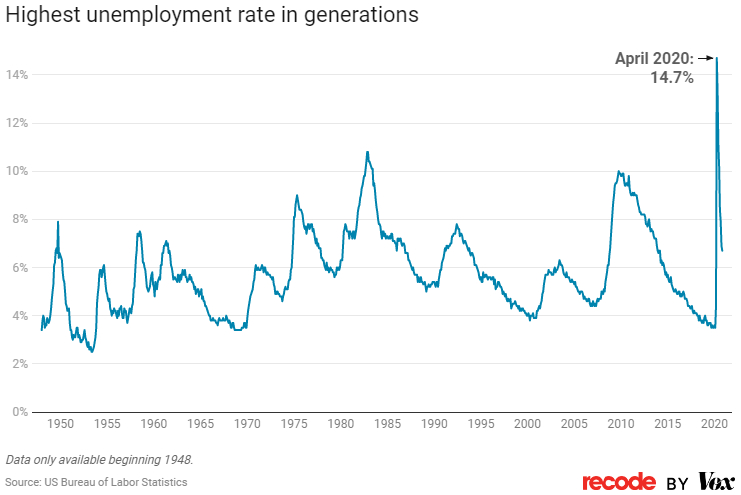
Many Americans went through the pandemic without work at all. In April, unemployment rates in the US neared 15 percent — the highest since the Great Depression, when a quarter of the working population didn’t have a job. The unemployment rate dropped to 6.7 percent in November, which is more typical of a normal recession.
10) Working from home became a reality
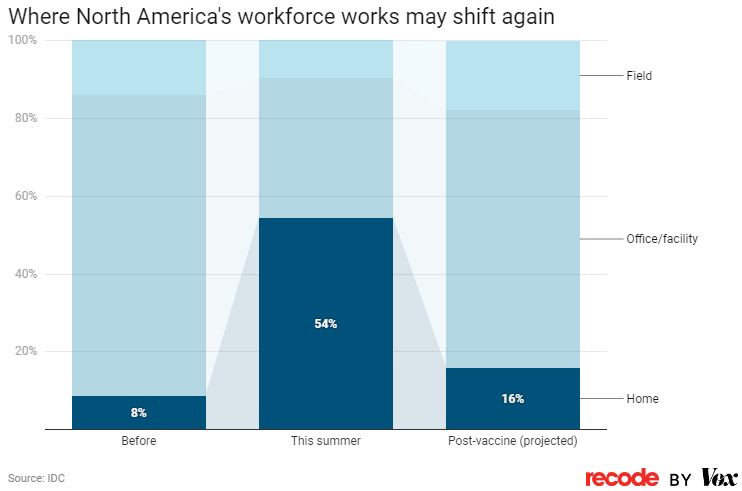
People have been talking about the promise of working from home for as long as there’s been an internet, and the practice has been slowly ticking up for years. However, stay-at-home orders made remote work a reality for a much wider swath of the population. Estimates vary , but this summer, more than half of the North American workforce worked predominantly from home, according to a survey across industries by IDC. After the pandemic, the firm expects working from home to be double its pre-pandemic rates. The numbers may be higher when you look at those who might work from home some of the time in a hybrid work model , which is expected to dominate office work going forward.
11) Pets win
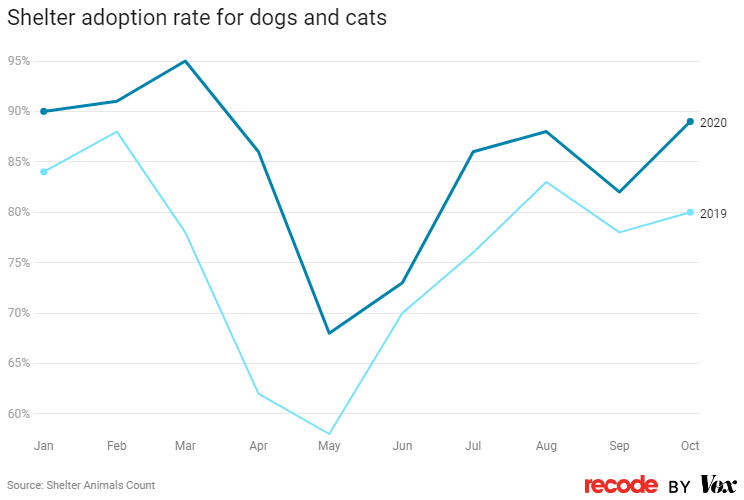
Humans’ new work-from-home situation was good news for pets. Not only did being home mean more time for walks, it also meant many people who didn’t previously have time for pets suddenly were flocking to shelters to find a quarantine companion. In 2020, shelter animal adoption rates — the share of dogs and cats adopted relative to those turned in to the shelter — were consistently higher than in 2019, according to data from nonprofit Shelter Animals Count. The adoption rate reached 95 percent in March. The number of animals adopted actually declined, but fewer were taken to shelters in the first place.
“We’ve seen an incredibly compassionate response from people willing to open their homes to foster and adopt vulnerable shelter animals during this period of uncertainty,” ASPCA president and CEO Matt Bershadker told Recode. “This unprecedented response from communities across the country to support their local shelters reflects widespread appreciation of the invaluable role pets play in our lives.”
12) People became more self-sufficient
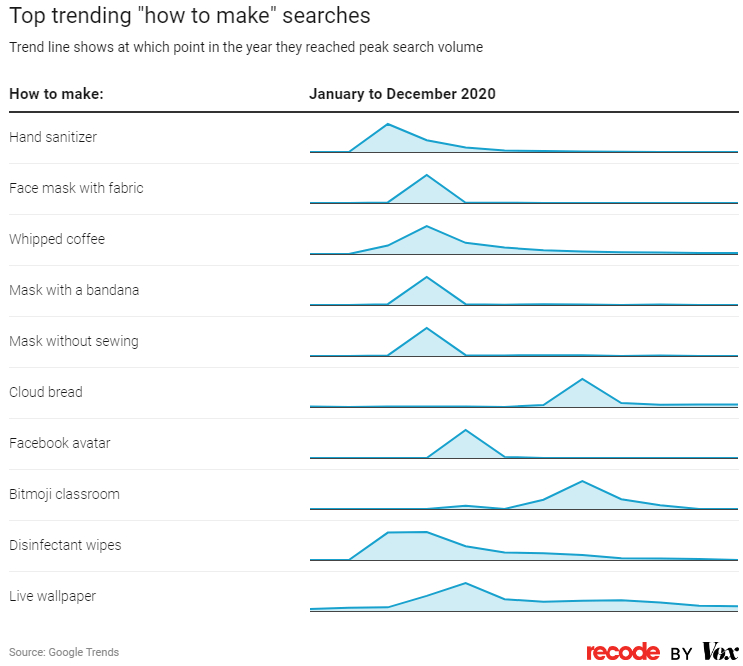
Early in the pandemic, Americans had to contend with the twin forces of boredom and scarcity. We were isolated at home and we didn’t have the same access to commerce that we usually did, so we turned to Google to entertain ourselves and make what we couldn’t buy. The top trending searches on Google for “how to make” this year paint a pretty accurate vignette of what life was like for many Americans during the pandemic. We were making elaborate and trendy foods, trying to figure out the best background for video calls, and learning how to make masks that were newly mandatory and in short supply. One fun trend not included here was the top trending beauty search — how to cut hair at home — which led to lots of, um, stylish coronacuts.
13) Big Tech got even bigger, even as the rest of the economy flailed
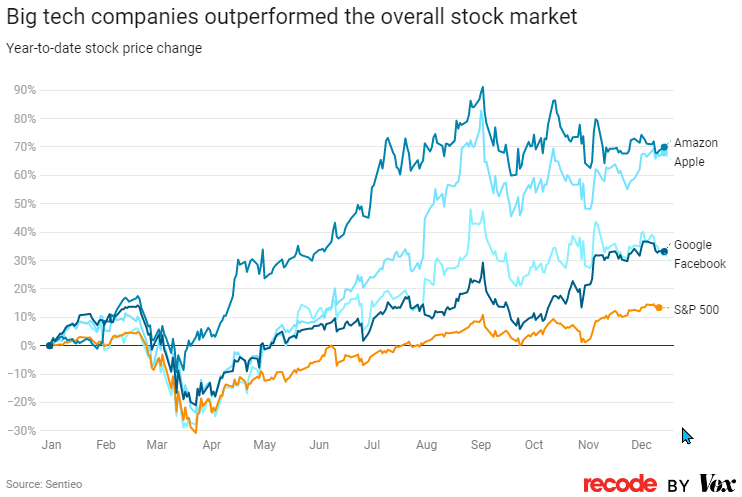
A long-awaited report from House Democrats released in October found that Amazon, Apple, Google, and Facebook all engaged in anti-competitive behavior. The report was just the beginning of upcoming antitrust regulatory proceedings against Big Tech companies, and soon thereafter, the government filed a lawsuit against Google and then Facebook . Still, the prospect of further regulating or breaking up Big Tech has done little to blunt their economic prospects.
While many industries were devastated by the fallout from the coronavirus, the biggest tech companies raked in enormous profits , and their stock prices hit record highs. As of early December, Amazon’s and Apple’s stocks were up nearly 70 percent since the beginning of the year, while Google’s and Facebook’s stocks were up more than 30 percent — much higher than the S&P 500 index, which is made up of the 500 biggest US companies and only went up around 13 percent.
14) It was a very good year for Amazon
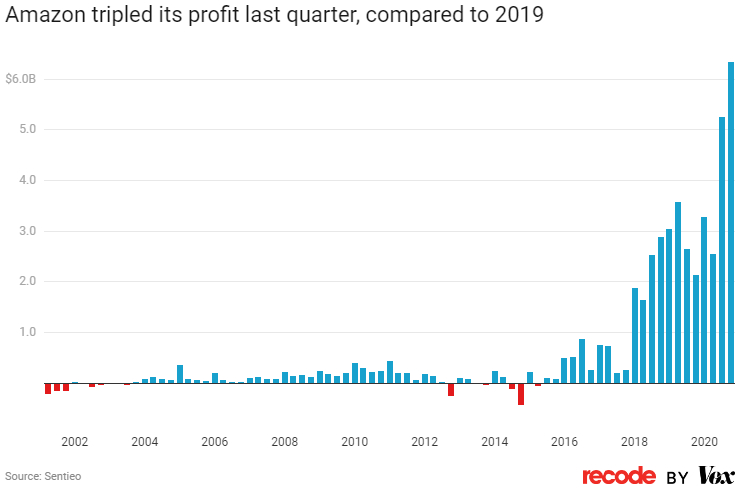
Amazon has had an especially good year as online shopping became a safer retail option and, in some cases, the only one available. In the third quarter, Amazon raked in a record $6.3 billion in profit, three times what it made just a year before.
15) E-commerce became commerce
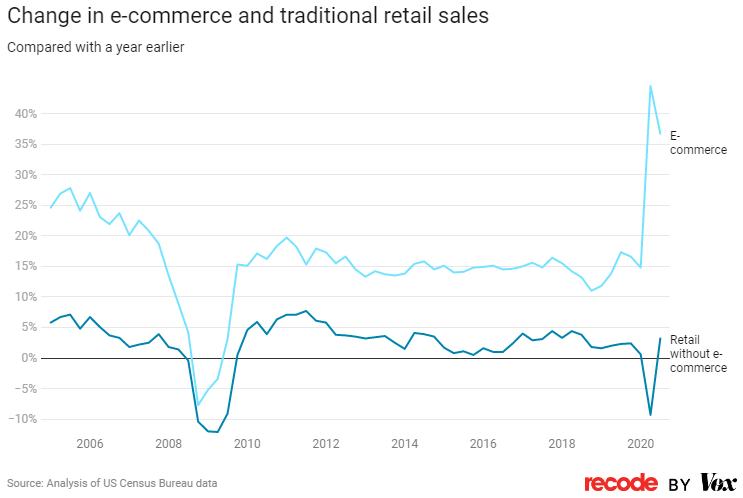
Amazon, of course, is the poster child for e-commerce, which it leads by a wide margin in the US. Census Bureau sales data illustrates how the already fast-growing e-commerce segment saw giant gains, increasing nearly 40 percent in Q3 compared to a year earlier. Online shopping made up 14 percent of all retail sales in the US last quarter as in-store retail flagged. As governments across the country shut down or restrict nonessential retail for a second time this winter, these trends could be exacerbated.
16) Amazon is still terrifying the competition (and everyone else)
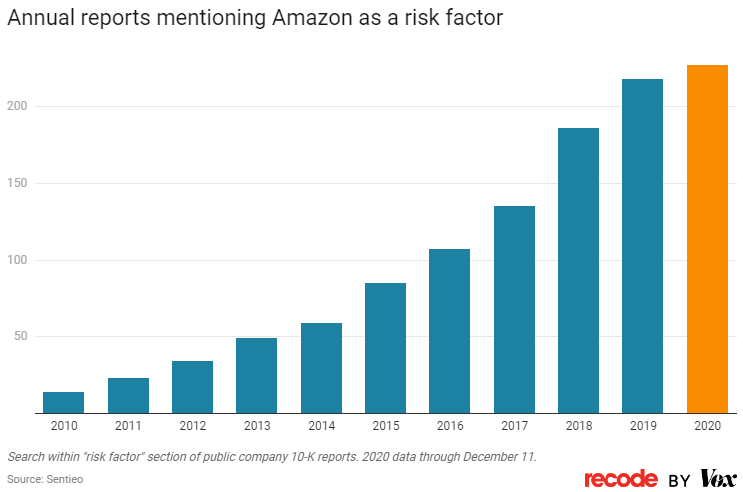
Other companies are taking note of these e-commerce trends and how they benefit Amazon. Again this year, a growing number of public companies — 227 so far — have mentioned Amazon in the “risk factors” section of their annual 10-K financial filings, where companies state the most significant risks to their business, according to information from the financial data platform Sentieo.
17) We all streamed together
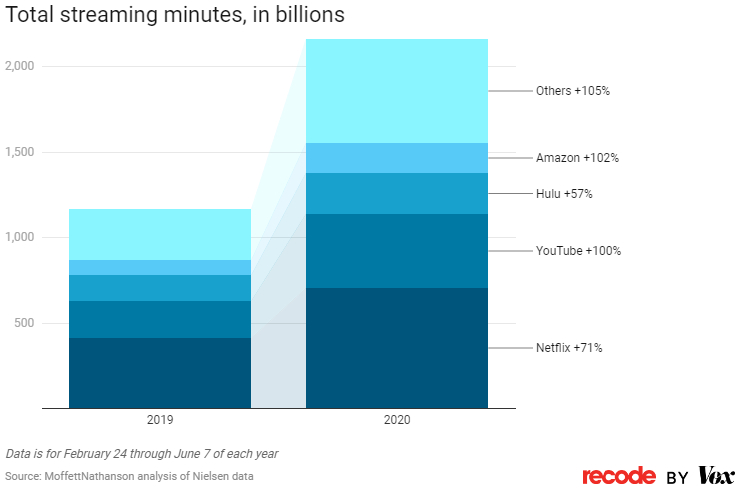
Spending more time at home during the pandemic meant streaming a lot more video. At one point, Netflix downgraded its streaming quality in Europe so it didn’t break the internet. Time spent watching Amazon, Netflix, Hulu, and YouTube grew tremendously during the early part of the pandemic, according to data from the research firm MoffettNathanson, as movie theaters closed and streaming platforms became the only places to watch movies — some of which skipped theaters entirely.
18) The coronavirus economy’s winners and losers
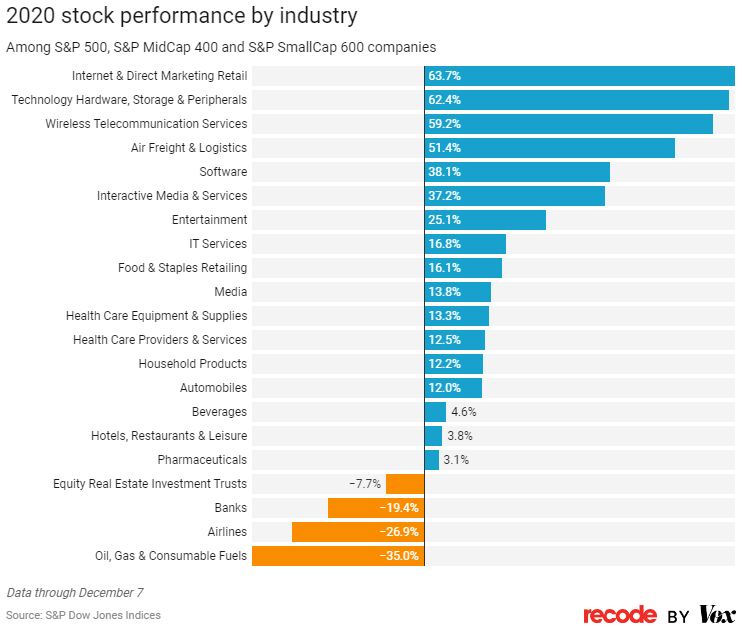
The pandemic’s effect on the economy varied by industry. Airlines, unsurprisingly, did poorly as consumers followed stay-at-home orders and didn’t travel. On the other hand, the air freight and logistics industry, which includes package delivery, saw its stock rise 51 percent this year. Software companies like Zoom also performed well, as Americans increasingly relied on software to do just about everything. The stock performance for select industries through early December illustrates that while the stock market has largely recovered its losses from the pandemic, that recovery is uneven.
19) Greenhouse gas emissions went down unintentionally
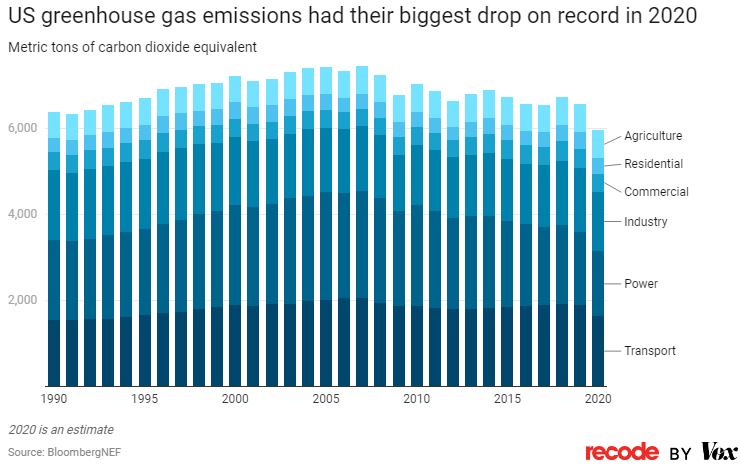
Despite America’s best attempts to the contrary, US greenhouse gas emissions went down drastically this year, to their lowest level since the 1980s, according to data from BloombergNEF . The 9 percent drop was the biggest on record. The Trump administration has been disastrous for the environment, pulling the US out of the Paris accord, an agreement meant to stem the threats of climate change, and reversing more than 100 environmental rules . But the pandemic was stronger. Emissions from transportation dropped the most, due to Americans being stuck at home. BloombergNEF expects emissions to climb again next year.
20) Hurricane and fire seasons set records
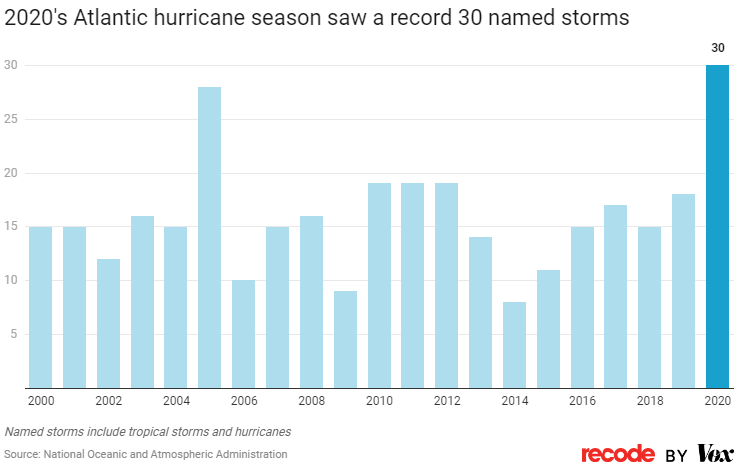
Global warming is making hurricanes more powerful and destructive. In 2020, there were also more of them. 2020’s hurricane season now holds the notorious record for most named storms , with 30 of them, including 13 hurricanes and 17 tropical storms. Twelve made landfall in the US. The previous record had been 28 named storms in 2005. Meanwhile, fires devastated the West Coast. The August Complex Fire became the largest in California history , burning more than a million acres this summer.
Oh, and if 2020 wasn’t wild enough: Aliens reportedly exist and the government knows about it . The former head of space security at Israel’s Defense Ministry wrote in his new book that a “galactic federation” has been hanging out with astronauts in an underground base on Mars. Perhaps most surprisingly, Trump has not tweeted about this.
So tell us, what is up Skip?
Kangaroos try to communicate, research suggests
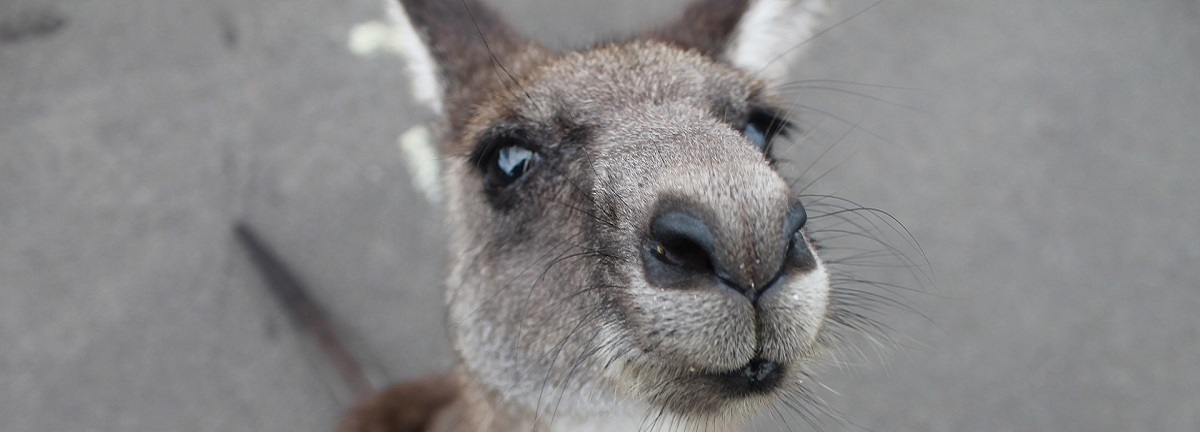
Fans of the iconic television show Skippy (and that oft-repeated question, “what’s up Skip?”) will be pleased to know that kangaroos do in fact try to communicate with humans.
While they can’t capture crooks or play the drums like the star of the show, a new study reveals that kangaroos gaze at humans to ask for help after trying and failing to open a food container.
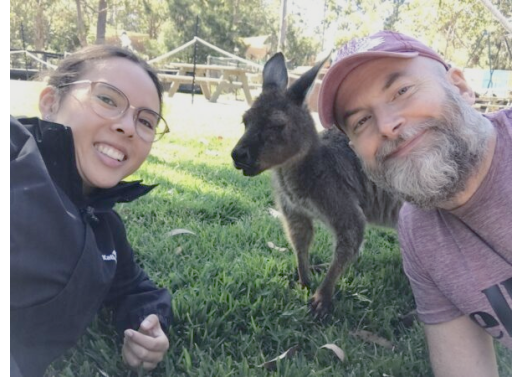
“Their gaze was pretty intense,” says USyd’s Alexandra Green. “If they can’t open the box, they look at the human and back to the container. Some of them used their nose to nudge the human and some approached the human and started scratching at him asking for assistance.”
Researchers and subject
Green and Roehampton’s Alan McElligott focused on Kangaroo Island roos ( Macropus fuliginosus), which are known to be docile and interactive with humans, but also tested some Eastern Greys ( Macropus giganteus) and Reds ( Macropus rufus), which are not.
“Through this study, we were able to see that communication between animals can be learnt and that the behaviour of gazing at humans to access food is not related to domestication,” says McElligott, who is lead author of a paper in Biology Letters .
“Kangaroos are the first marsupials to be studied in this manner and the positive results should lead to more cognitive research beyond the usual domestic species.”
Future research on kangaroos, the authors suggest, should focus on the visual cues and behaviours they use for social interactions within their own species to determine whether they are the same as used to interact with humans.
Neither researcher is new to the field of animal communication skills.
McElligott’s previous work includes shedding light on the ability of goats to perceive human-given cues to find hidden food in buckets, while in a study last year Green found that cows maintain individual vocalisation in the herd.
The cows were shown to have individual cues in a variety of situations to express excitement, arousal, engagement and distress.
The US-UK trade talks Joe Biden inherits
Documents show both parties were close to completion on some chapters — but substantial differences remain.
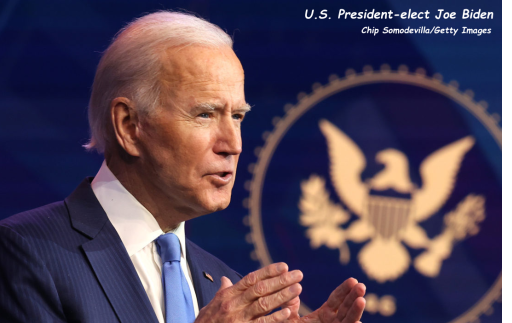
Documents related to the latest round of U.S.-U.K. trade talks seen by POLITICO confirm that some chapters of the deal were close to being agreed by both sides under the Trump administration, but significant differences remain in some key areas.
As a crucial April deadline looms, the documents from both sides of the talks show some sections related to small and medium-sized businesses, investment and digital services were close to completion.
But there were some substantial outstanding points, particularly on the issues of pharmaceutical regulation, textiles and other goods standards along with some thorny points on intellectual property.
Seasoned negotiators with experience of dealing with the U.S. said that while there had been clear and meaningful progress, it’s often the final few clauses in a handful of chapters that can derail the course of a free trade agreement. “Inches apart can be miles from bringing it home,” one said.
The Brexit factor
The state of U.S.-U.K. negotiations is in the spotlight as a deal needs to be agreed and put before the U.S. Congress by April. If not, it will lose the protection of a piece of U.S. legislation known as the Trade Promotion Authority. This legal mechanism allows for deals to be fast-tracked through Congress, while still allowing lawmakers to vote "yes" or "no" to its passage.
Officials on both sides regard this as a vital deadline, giving the best chance of a comprehensive deal and avoiding any agreement getting snarled in political rows. Yet an agreement faces numerous hurdles including Brexit, its effects on the Northern Irish border, and the impending change in U.S. government.
A lack of clarity on Brexit also meant that some areas simply couldn’t be agreed until the terms of any EU-U.K. deal were certain. “It will be difficult to establish greater clarity on these points prior to the end of the transition period,” was a common refrain, one readout noted.
This led to criticisms on the U.S. side that the U.K. negotiating team was still stuck in a holding pattern of “we’ll get back to you on that,” on some important points.
“The deal is quite well advanced and we're in a good position to seal what would be the single biggest bilateral trade deal for either country," a spokesperson for the U.K. Department for International Trade said.
The Office of the U.S. Trade Representative (USTR) did not respond to a request for comment ahead of publication.
Negotiations were complicated not only by the U.S. election and Brexit, but also the coronavirus pandemic. Sensitivities around pharmaceuticals, long a touchy subject in trade talks between the U.S. and U.K. because of the mighty drug-buying power of Britain's National Health Service, were ramped up in the latest round of talks. These areas had to be sidelined as matters touching on national security as work to develop vaccines got underway.
Nevertheless, the readouts and draft text of a deal suggest new ground was broken in talks. Indeed, so confident was the U.K. trade department that a deal covering SMEs might be secured at pace, that it even started the process of asking business organizations to welcome the deal back in October.
There were tentative signs too of something more radical: a working group to discuss U.S.-U.K. labor mobility, headed up by U.S. Secretary of State Mike Pompeo. While this would have been separate from a trade deal, it would have complemented it by easing transatlantic travel for business people. Its future is unclear given the imminent change in U.S. administration. Matters touching on immigration are not usually considered alongside trade talks by the U.S. because they are handled by the State Department, rather than USTR.
Urging caution
Observers of the U.S.-U.K. talks are keen to stress the hard yards still to be done.
One former U.S. official familiar with plans to engage with the U.K. after Biden’s January inauguration said the new administration is expected to take a more gradual and cautious approach to trade overall when compared to the Trump regime. This, they warned, will require a more patient approach from the U.K. government.
The U.K. should focus on having retaliatory tariffs on products like Scotch whisky lifted first, then a “meaty” investment and data treaty ahead of the U.N. climate conference, COP26, they said.
That might be the right approach going forward, two U.K. officials said, given the change in presidency and leadership at USTR. Rather than pursuing a full comprehensive FTA, the U.K. should bid for an investment deal, they said.
Instead of a deal that would cover tariffs on all trade, a requirement of multilateral trade law, such an agreement would essentially be a bilateral data and technology-focused investment treaty, with a green tinge.
It would be a triumph to secure an FTA within two years, the same former U.S. official said. Yet even that might only be achieved if an accord is struck on the taxation of digital services at the Organisation for Economic Co-operation and Development (OECD), which the U.S. side has repeatedly told the U.K. team is their “preferred forum” for modern trade disputes, according to one negotiation readout.
Broad trade deal or narrow treaty, however, there’s considerable appetite for a strengthening of trade ties among businesses on both sides of the Atlantic.
“The transatlantic business community’s excitement at the prospect for a transatlantic trade deal is unbroken," said Emanuel Adam, executive director of BritishAmerican Business in London. "At the same time, businesses are fully appreciative of the changes that affect the prospect of a deal in the near term. What is most important is a better trading relationship for these two partners."
The Department for International Trade said in a statement: “The president-elect’s administration may place new emphasis on issues such as the environment and labour standards. There is a clear opportunity for the UK and U.S. to work together on shared priorities, including the climate crisis.”
Wider moves
Broader efforts to smooth the course of a deal are also underway.
Last week, the U.K. said it would drop reciprocal tariffs it imposed on U.S. goods as a member of the EU in the long-running Airbus/Boeing dispute. These levies were the result of a World Trade Organization ruling on Boeing subsidies. The USTR’s initial response did little but agree that the U.K. was right to remove the tariffs in January as it had no legal basis to levy them.
However, there are some developments in the offing that could mean, even if a trade deal isn’t forthcoming early in the new year, U.K. Trade Secretary Liz Truss may have something to celebrate.
A reprieve for Scotch whisky from U.S. duties is expected next week, according to two officials familiar with the matter. Such a shift would be welcomed by the drinks industry, which has shouldered some of the worst economic impacts from the tariff battle. U.S. imports of Scotch whisky have faced a 25 percent tariff, and sales to the country have fallen 30 percent in the past year.
This would be a boon for the COVID-struck hospitality sector in the U.S., which also happens to be the sector that issued most of the responses to the USTR review of Airbus measures. It would also ease the path to a trade deal, be it a comprehensive FTA or, as some contend is more likely, a more modest green-focused investment treaty.
Trump administration has executed more Americans than all states combined, report finds
The execution spree was a first in US history and stands contrary to the declining trend in death penalty practices
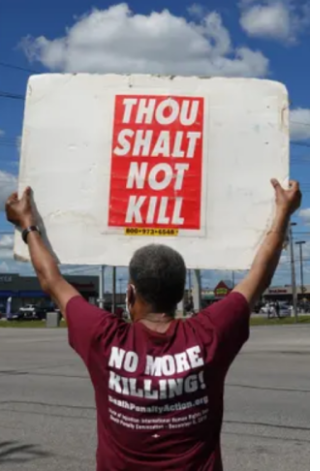
In the course of 2020, in an unprecedented glut of judicial killing, the Trump administration rushed to put 10 prisoners to death. The execution spree ran roughshod over historical norms and stood entirely contrary to the decline in the practice of the death penalty that has been the trend in the US for several years.
A protester holds up a sign near the Federal
Correctional Complex in Terre Haute, Indiana.
Scott Olson/Getty Images
The outlier nature of the Trump administration’s thirst for blood is set out in the year-end report of the Death Penalty Information Center (DPIC). In recent years , the annual review has highlighted the steady withering away of executions, all of which were carried out by individual states.
That pattern continued at state level in 2020, heightened by the coronavirus pandemic which suppressed an already low number of scheduled executions. Only five states – Alabama, Georgia, Missouri, Tennessee and Texas – carried out judicial killings. And only Texas performed more than one, producing the lowest number of executions by the states since 1983.
States carried out seven executions to the federal government’s 10. Despite the rash of federal killings, that still amounted to the fewest executions in the US since 1991.
Against that downward path, the actions of the Trump administration stand out as a grotesque aberration.
“The administration’s policies were not just out of step with the historical practices of previous presidents, they were also completely out of step with today’s state practices,” said Robert Dunham, DPIC executive director and lead author of its year-end report.
Part of the story was Trump’s willful refusal to take the coronavirus seriously. Unlike death penalty states, the federal government insisted on proceeding with executions. As a result, there was an eruption of Covid-19 cases at the Federal Correctional Complex in Terre Haute, Indiana which the DPIC report notes infected at least nine members of execution teams.
But the overwhelming story of the federal executions in 2020 was the disdain shown by the Trump administration towards established norms, and its determination to push the death penalty to the limits of decency even by standards set by those who support the practice.
Since Trump lost the election on 3 November, the federal government has put to death three prisoners: Orlando Hall, Brandon Bernard and Alfred Bourgeois. The last time a lame-duck president presided over an execution was in 1889 , when the Grover Cleveland administration killed a Native American of the Choctaw Nation named Richard Smith.
All three Trump lame-duck executions involved black men. As the DPIC review points out, racial disparities remain prominent in the roll call of the dead, as they have for decades, with almost half of those executed being people of color.
The review exposes other systemic problems in the Trump administration’s choice of prisoners to kill. Lezmond Mitchell, executed in August , was the only Native American prisoner on federal death row. His execution ignored tribal sovereignty over the case and the objections of the Navajo Nation which is opposed to the death penalty.
The subjects of the federal rush to the death chamber included two prisoners whose offenses were committed when they were teenagers. Christopher Vialva was 19 and Bernard 18: they were the first teenage offenders sent to their deaths by the US government in almost 70 years.
The sharp contrast between the Trump administration’s aggressive stance and the dramatic reduction in executions at state level is underlined by the annual review of the Texas Coalition to Abolish the Death Penalty (TCADP), also released on Wednesday.
Texas, traditionally the death penalty capital of America, carried out three executions this year, down from nine in 2019. The most recent was on 8 July. Billy Joe Wardlow was 18 in 1993 when he committed robbery and murder.
“The fact that state legislators, juvenile justice advocates, neuroscience experts and two jurors from Wardlow’s trial had called for a reprieve based on what we know now about adolescent brain development make the circumstances of his arbitrary execution even more appalling,” said Kristin Houlé Cuellar, TCADP executive director.
There was some good news. In March, Colorado became the 22nd state to abolish the death penalty . Louisiana and Utah have not executed anybody in 10 years.
Joe Biden, the president-elect, has vowed to eliminate the death penalty. But until he enters the White House on 20 January Trump remains in charge. Three more federal inmates are set to die – including the only woman on federal death row – before he is done.
DeVos Urges Education Department Employees To ‘Be The Resistance’ In Biden Administration
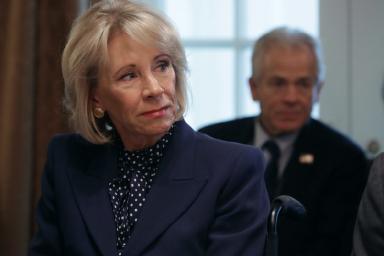
Education Secretary Betsy DeVos listens to
U.S. President Donald Trump talk to reporters
during a cabinet meeting in 2019.
Chip Somodevilla/Getty Images
“Let me leave you with this plea: Resist,” DeVos said, according to a recording of remarks made at a department-wide virtual meting obtained by Politico . “Be the resistance against forces that will derail you from doing what’s right for students. In everything you do, please put students first — always.”
According to the publication, DeVos acknowledged that a majority of the agency’s career employees “will be here through the coming transition and beyond,” during the virtual meeting convened to discuss Biden’s transition.
The secretary touted her widely criticized overhaul of Title IX rules governing sexual assault and misconduct in schools and college as one of her top accomplishments, telling Education Department employees on Tuesday that her goal “in everything we accomplished was to do what’s right for students.”
“Four years later it’s still my focus and it’s still my hope for all of you,” Devos said in her call for resistance after years spent undermining the career employees of her department and blaming bureaucrats at the agency for making it difficult to get things done.
Political appointees at the Education Department sought to investigate and punish career employees who they suspected had leaked department information to the press which President Donald Trump has repeatedly demonized as “the enemy of the people.”
Trump administration officials have also criticized career employees in some government agencies for challenging Trump’s false narratives about the coronavirus pandemic when it came to the safe reopening of schools.
The department has not said whether DeVos has plans to stay in office until Jan. 20 when Biden is inaugurated. According to Politico, however, department officials said during the meeting that they have lined up career officials to take over temporarily in roles left vacant by political appointees in the coming weeks.
Four-Month-Old Ravens Rival Adult Great Apes in a Battle of the Brains
In a series of cognitive tests, the corvids surprised scientists with their ability to interact with each other and with the world around them
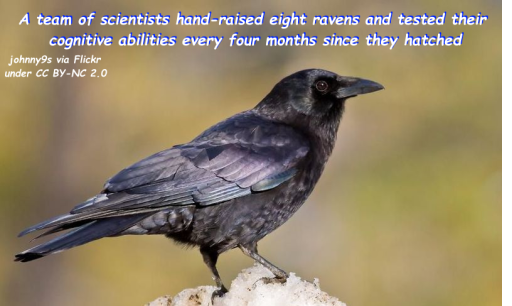
They consistently surprise scientists with their wits, and now a new study published last week in Scientific Reports suggests that four-month-old ravens score similarly to adult chimpanzees and orangutans when put through a series of social and physical tests, reports Sara Rigby for Science Focus .
To come to this conclusion, a team of scientists hand-raised eight ravens and tested their cognitive abilities every four months since they hatched. The tasks were focused on testing how the birds interact with each other and with the physical world around them. Specifically, the researchers were interested in testing the birds' spatial memory, basic math skills, communication skills, and object permanence, which is the ability to recognize that an object exists even when it's hidden, reports Chrissy Sexton for Earth.com .
For example, in one of the tests, the ravens were shown a treat that was then hidden under a cup. Like a shell game on a beach boardwalk, when the researcher moved the cup around, the bird was still able to identify where the food was, reports Rachel Nuwer for Scientific American .
"We now have very strong evidence to say that, at least in the tasks we used, ravens are very similar to great apes," lead author Simone Pika, a cognitive scientist at Osnabrück University in Germany, tells Scientific American . "Across a whole spectrum of cognitive skills, their intelligence is really quite amazing.
The birds were put through 33 tests and passed with flying colors at just four months old. When their results were compared with those of fully grown chimpanzees and orangutans, the team found that the young ravens scored similarly to the great apes, surprising the scientists, reports Scientific American .
"Great apes and primates in general have, for quite a long time now, been praised for their 'extraordinary' cognitive abilities, but we now find that other taxa, including birds, show similar cognitive performance," Claudia Wascher, a behavioral ecologist at Anglia Ruskin University in England who was not involved in this study, tells Scientific American .
In another surprising twist, the team found that there wasn't a significant difference in the scores of four-month-old ravens and the 16-month-old birds. This find suggests that their brains are nearly or fully developed at around the four-month mark, reports Mike McRae for ScienceAlert .
"This may be due to the fact, that at four months of age, young ravens are already quite independent," Pika tells Science Focus. "Hence, they need to be cognitively on top of things to deal with these new challenges."
But this study comes with caveats, reports Scientific American . The team had a sample size of only eight ravens. Plus, their behaviors may not reflect the species as a whole since they were raised in captivity and accustomed to interacting with humans.
Regardless, ravens continue to astonish people with their remarkable physical and social skills, adding fuel to a friendly argument among ornithologists and mammologists over who's smarter: birds or mammals?
TRUMP’S MAR-A-LAGO NEIGHBORS: GET THE HELL OFF OUR LAWN
The people of Palm Beach have kindly requested that, instead of making the resort his full-time, post-presidency residence, Trump stay as far away as possible.
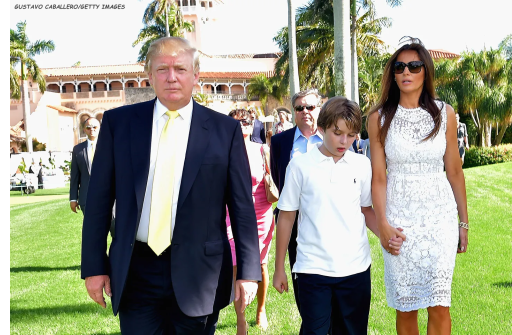
According to The Washington Post, some of Trump’s Palm Beach neighbors have written a formal letter, delivered to both town officials and the Secret Service on Tuesday, stating in no uncertain terms that the president had better find housing elsewhere. Noting an agreement Trump signed in 1993, the letter reminds all those copied that he lost the legal right to live at the club full-time and that in order to “avoid an embarrassing situation” wherein the soon-to-be-former president moves in and then is forced to leave, the town should notify Trump ASAP that he cannot live there.
The current residency controversy tracks back to a deal Trump cut in 1993 when his finances were foundering, and the cost of maintaining Mar-a-Lago was soaring into the multimillions each year. Under the agreement, club members are banned from spending more than 21 days a year in the club’s guest suites and cannot stay there for any longer than seven consecutive days. Before the arrangement was sealed, an attorney for Trump assured the town council in a public meeting that he would not live at Mar-a-Lago.
At the time, the town’s leaders were wary of Trump because he had sued them after they blocked his attempt to subdivide the historic Mar-a-Lago property into multiple housing lots. Placing the limitations on lengths of stays assured that Trump’s property would remain a private club, as he had promised, rather than a residential hotel.
In addition to the 1993 agreement with the town, Trump also signed a document deeding the development rights to Mar-a-Lago to the National Trust for Historic Preservation, which states that he cannot develop or use Mar-a-Lago for “any purpose other than club use.” Unsurprisingly, as is the case today, Trump has repeatedly tried to get out of parts of the agreement, as he obviously views contracts, laws, and promises as things other people, but not him, should be beholden to.
In 2018 he asked the town to waive a provision banning him from building a dock at the club, initially saying the Secret Service and local law enforcement officials needed the structure for his protection. The reasoning was later changed to say the dock was for the private use of the president and first lady Melania Trump. Neighbors feared that the dock would be used for rowdy booze cruises. Trump withdrew the dock request early this year—three days after a Washington Post report that unearthed the details of his 1993 agreement with the town.
The White House did not respond to the Post ’s request for comment. A Trump Organization spokesman said, “There is no document or agreement in place that prohibits President Trump from using Mar-a-Lago as his residence,” which might be more convincing if that person hadn’t said so anonymously.
Ex-Cop Allegedly Held AC Repairman At Gunpoint, Convinced He Was Voter Fraud Kingpin

In fact, Mark Anthony Aguirre’s alleged victim was an ordinary air conditioner repairman, prosecutors say. There was nothing fishy in the back of his truck, nor in the repairman’s home in a nearby mobile home community in Houston, which Aguirre said he and others had surveilled for four days straight, police said.
But it gets stranger: The day after the ex-cop allegedly held the terrified repairman at gunpoint, convinced of a massive election conspiracy that did not exist, he received a wire transfer for $211,400, according to prosecutors. The money came from a conservative group that’s pumped up election fraud conspiracy theories , and which is led by prominent right-wing activists in Texas.
All that — the alleged car ramming, brief hostage-taking, and wire transfer — happened in late October, as President Donald Trump and his allies across the country flailed to make the case that, if he lost his bid for reelection, it would be the result of massive and unprecedented fraud. Aguirre was arrested Tuesday, nearly two months later, and charged with aggravated assault with a deadly weapon.
Police knew about Aguirre’s alleged actions within minutes. In fact, according to a police officer’s affidavit , he had called them three days before the incident, urging them to conduct a traffic stop for his voter fraud investigation. When police refused, Aguirre said he would conduct his own “citizen’s arrest,” according to the affidavit .
Officers were on the scene in time to see that “citizen’s arrest” for themselves, according to the affidavit: The first cop on the scene found Aguirre with his knee on the repairman’s back. Police interviewed the repairman and Aguirre, and even searched the repairman’s home, with his permission, to investigate Aguirre’s claims of a voter fraud conspiracy.
Among other things, according to a police affidavit, Aguirre stated that the repairman had 750,000 fraudulent mail ballots, that Mark Zuckerberg had given $9.37 million for ballot harvesting, and that the repairman was “using Hispanic children to sign the ballots because the children’s fingerprints would not appear in any databases.”
After initially claiming to be working with others, Aguirre changed his story and refused to name them, police said in the affidavit. He refused to say who moved the repairman’s box truck after he’d run into it — though the repairman told police he’d heard Aguirre order another unnamed suspect to search his box truck and then move it away from the scene.
But the ex-cop did have a few choice words for the police who arrived at the scene, according to the affidavit.
“The defendant told Affiant that Affiant can be a hero or part of the problem,” one officer responding to the scene recounted. “The defendant told Affiant, ‘I just hope you’re a patriot.’”
Patriot or not, that officer eventually referred the incident to the public corruption division of the Harris County District Attorney’s Office.
The office hasn’t responded to TPM’s question about the timing of the charges. But in a statement Tuesday, District Attorney Kim Ogg said Aguirre “crossed the line from dirty politics to commission of a violent crime and we are lucky no one was killed.”
Aguirre was fired from the Houston Police Department in 2003, after commanding a street racing raid involving 278 arrests in a Kmart parking lot, the Houston Chronicle noted . Prosecutors dropped all charges resulting from the arrests — none of which specifically alleged street racing violations — and the department was hit with a wave of lawsuits over the incident.
The conservative group that allegedly funded Aguirre’s private investigative work this year, the Liberty Center for God and Country, wired Aguirre $266,400 between September and October, according to grand jury records described by police.

The group’s CEO, Steven Hotze, is a prominent right-wing activist who’s lobbed lawsuits over everything from COVID-19 restrictions to voting rights. He unsuccessfully sued to limit early voting and toss 127,000 ballots cast through a drive-thru location. An affidavit from Aguirre was filed in the first effort. In the document, dated Sept. 27, the ex-cop stated that he was investigating “a wide-ranging and fraudulent ballots harvesting scheme in Harris County intended to rig the elections in the Houston/Harris County area.”
Liberty Center’s president, Jared Woodfill, told the Texas Tribune Tuesday that he was aware of Aguirre’s arrest, but wanted to hear the ex-cop’s side of the story.
He’ll have a chance soon enough: Aguirre is scheduled to appear in court Thursday.
Tags
Who is online
105 visitors
ICYMI
Farmer fish, how cool is that.
COVID, once again the village idiots, both on NT and nationwide don't have the common sense to wear a mask. There was an article earlier today that a mayor of a town in Kansas quit because of the threats she and her family were receiving because she voted for a mask mandate inside of buildings. This is not unusual there have been numerous stories of a threat directed toward health care workers and politicians who favor masks etc and or because they certified election results.
Happy to hear about adoptions are up for shelters dogs/cats. The down side is that more and more people need help with their pets because of job loss. The shelter I volunteer at also helps people keep their pets we offer free dog and cat food, toys, and medication.
I had seen the Aquirre story earlier today. We have a lot of nut cases in this country and soon it's going to lead to a death.
If Trump isn't legally able to live at Mar-a-lago, he can always move to Moscow, or the neighbourhood named after him in an Israeli settlement. I think both possibilities are far enough away.
The visual of Trump and his family living in a kibbutz is hilarious.
Milk that goat, Donald.
Are you kidding? Everyone on a kibbutz has to pitch in and work, and work hard. The toughest work Trump has ever done is to hit his golf ball out of the rough.
Fixed
LOL
The virus has been a public health nightmare, with hospital emergency rooms inundated with sick patients and health care workers struggling to get personal protective equipment to keep themselves and their patients safe.
But the US never went further to fully suppress the virus, leaving new daily Covid-19 cases at a dangerous plateau in the spring, with a surge in the summer. As many states have reopened businesses, the new surge of cases this fall and winter is threatening once again to overwhelm the health care system
Actually it goes way beyond the U.S. not taking actions to effectively slow (or stop) the spread of the virus. new information has revealed that the trump administration actually deliberately took actions designed to increase the spread of the Virus!
I always suspected as such-- but couldn't figure out why . Now these facts about why it spread so rapidly here has come to light!!!