
Panda-themed monorail train adds to city's magic

By: No Author Indicated

 S E E D E D C O N T E N T

Panda-themed monorail train adds to city's magic

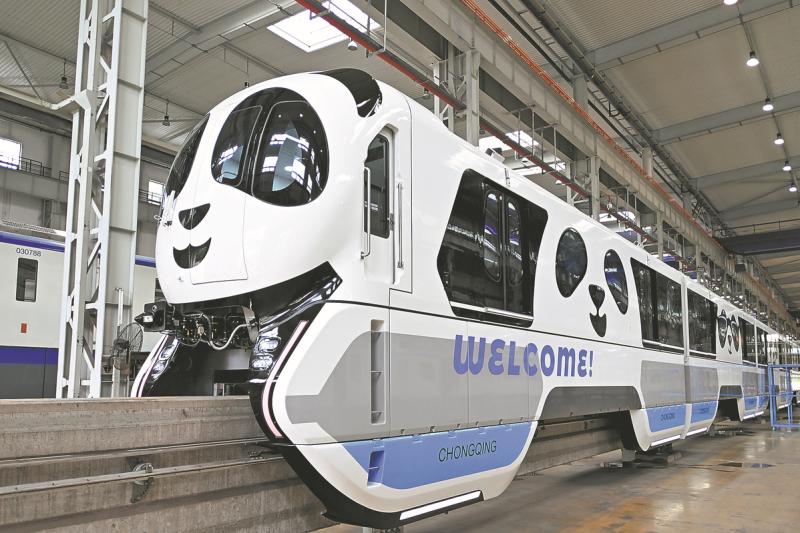
The panda-themed straddle-type monorail train stops at a base of Chongqing Rail Transit in Chongqing on June 16. [Photo by He Penglei/CHINA NEWS SERVICE]
China's renowned "8D magic city", Chongqing, has unveiled a new tourist attraction in the form of the country's first panda-themed straddle-type monorail train.
Its innovative design highlights the city's intricate vertical urban landscape, showcasing how this mountain megacity in Southwest China can transform urban rail transit into cultural experiences.
Chongqing, uniquely perched on mountains and divided by rivers, got its 8D nickname because of how it defies traditional urban planning with its awe-inspiring infrastructure and innovative transportation solutions, which are expected to be elevated to a new level thanks to the new train.
At a base of Chongqing Rail Transit in Tongjiayuanzi, the train instantly captivates with its exterior artistry — minimalist black lines contour a plump panda face on the train head, while it has adorable panda designs on both sides of its streamlined body, along with large panoramic windows and a skylight in the roof.
Inside, passengers enter a "panda universe". Each carriage is equipped with 12 leather seats shaped like pandas, as well as advertising frames and hanging grips in the shape of a panda head. A plush 1.5 meter panda figure stands center stage, serving as the prime photo spot. Souvenir cabinets shaped as a panda display merchandise.
The carriage's ceiling features full-length skylights, inviting travelers to gaze upon Chongqing's iconic layered cityscape and bridges as the train navigates its elevated tracks.

Visitors take selfies in the train. [Photo by He Penglei/CHINA NEWS SERVICE]
Apart from its obvious cuteness, the train is also fitted with intelligent lighting, smart windows, temperature control glass, magnetic assistive listening devices and wireless charging capabilities, Zhang Yang, head of the Chongqing tech development center under the CRRC Changchun Railway Vehicle company, told Xinhua recently.
Notably, the train employs lightweight and energy-saving technologies such as intelligent variable frequency air conditioning and permanent magnet traction motors, significantly enhancing system efficiency, reducing operational energy consumption, and improving economic viability over the vehicle's entire life cycle, Zhang said.
The train is based on Chongqing's next-generation monorail technology platform, as the city advances the system which enjoys global fame for the iconic scene of light rail trains passing through a residential building at the Liziba Station.
The platform, which serves as a tech cornerstone of Chongqing's rail transit endeavors, integrates 20 years of operational data and caters to the diverse needs of single and double-axle monorails, and offers customized solutions based on the line capacity and construction costs, said Wang Ningning, executive deputy general manager of the 3rd branch of Chongqing Rail Transit.
It pioneers a dual delivery model of "physical train plus digital asset". This effectively equips each train with a "digital twin", allowing for intelligent management throughout its life cycle, Wang explained.
The administrator of this group reserves the right, along with the site moderators, to moderate all and any postings to this group, including the right to enforce the ToS, the CoC, and also including anything that the administrator deems within his sole discretion to be offensive or off topic, with the power to delete in exercising those rights.
It would be best, therefore, to be civil in posting on this group.
By now it should be well known that I am unable to open certain videos and pictures. If I cannot, I will ask that they be described and explained. If the poster refuses to comply, their comment will be deleted. Instagrams are banned.

Tags
Who is online
88 visitors
I love living in Chongqing. Do not forget that Chongqing was known as Chunking during WW2, when it was the base for the Flying Tigers, a great contribution to China's war effort with its American pilots and fighter planes that designed the planes' faces to look like tiger heads, just as the train in this article resembles a Panda's head. That is something the Chinese people do not forget.
Here is an exmple referred to in the article above, of a subway train running through an apartment building.
That train is pretty adorable.
I assume that the people living in the apartment below the track of the train running through the building are totally deaf.
Well, that's a little weird. Why is the English word "WELCOME!" printed on the side?
Because it faces the people who are going to enter the train. Another question might be, why is it in English? I suppose it's for the tourists. All signs throughout the subway system, and vocal announcements, are in Chinese and English.
One thing about the British Empire did last - its language.
Well, it IS known to be the international language (much to the disappointment of the French). I believe it is spoken in more countries than any other language. and it is required for communication by airplane pilots for all international flights.
English is the weird part. The description suggests the train is quite advanced technologically. And it is a monorail system which has some very real benefits in an urban setting. That paint scheme is only superficial marketing commonly used in capitalist economies; like some of the paint schemes on commercial aircraft.
Is Chongqing trying to Americanize itself? Doesn't that create some tensions with more traditional elements in Chinese society, government, and politics? This seems like almost a dissident appeal to western tastes.
English has been taught in China for decades. Why do you think I went to China - it was to teach English. It waa easy for me to be in China right from the beginning because English is everywhere, on the strreet signs, on most of the store signs, on menus, so many of the middle aged and younger poeple speak a little English. Of course that is in the big cities - the rural areas and villages are not so multilingual. However, these days a huge effort is being made to attract tourists, and many countries have been given the privilege of visa-free travel for 10 days and tourists are being given special privileges.
Only twice in almost 19 years have I been the victim of negativity. Once when my wife asked an elderly bus conductor to get me a seat on a crowded bus and the answer was (in Chinese of course) "No seat for the lowaiy (foreigner)", and the other time was on the street when a passing person said in Chinese "Lowaiy go home". In both cases my wife was with me so she told me what they had said. But then her elderly mother never called me by my name, but always called me "lowaiy". LOL BUT back when I first came here many people wanted to take a photo with me, I've been asked for my autograph, and one time a couple were having their wedding photos taken and when I walked by they asked me to pose with them for one of their photos. I've been treated like a celebrity, but people are more sophisticated now.
I though Mao's cultural revolution has erected stringent barriers to prevent Americanization. I always assumed that the reintroduction of Americanized interactions resulting from Nixon, Kissinger, and Clinton had been more limited to Beijing. But I guess I also assumed Chongqing was a little more provincial which apparently is incorrect.
One of my nephews applied (and was accepted) to teach English in Japan. According to some of the stories he's told, he experienced the celebrity/outsider attitudes from the native population, too. He had a more important status because of the type of refrigerator he had been provided. Part of that apparently was because he was a teacher which is revered in Japanese culture. Another assumption on my part is that reverence toward teachers is also present in Chinese culture.
There goes the neighborhood. Chongqing risks becoming decadent. More traditional members of society won't like that.
Yes, apparently respect for teachers and elders is most likely an Asian tradition. Your last paragraph puzzles me. Why and in what way would Chongqing risk becoming decadent?
Catering to tourists creates a certain amount of decadence. Tourists are a transient population, with no intent to become residents, so they are not compelled to respect local traditions or culture. Tourists typically expect to be pampered, entertained, and given unique experiences. Tourists are self-indulgent and decadent; that's a big motivation for tourist travel.
From all the reports I've seen many are experimenting with traditional customs, learning calligraphy, watching minority dances, tasting local food specialties, in other words trying out and participating rather than what you've suggested.
The tourist money for the resident population makes it possible for the Chongqing residents to become tourists as well. The middle class in China is burgeoning and catering to the tourists is a big help. Even the Chinese rural villages that were relatively isolated before the eradication of abject poverty are becoming tourist destinations providing those residents welcome income. The benefits outweigh the detriments all across the board.