
50 years later, why the wreck of the Edmund Fitzgerald haunts us still

By: By Sean Boynton - Canda's Global News

 S E E D E D C O N T E N T

50 years later, why the wreck of the Edmund Fitzgerald haunts us still
It was a shipwreck so notorious, it inspired what many critics and listeners agree is one of the greatest songs of all time — a song that helped solidify its legend.
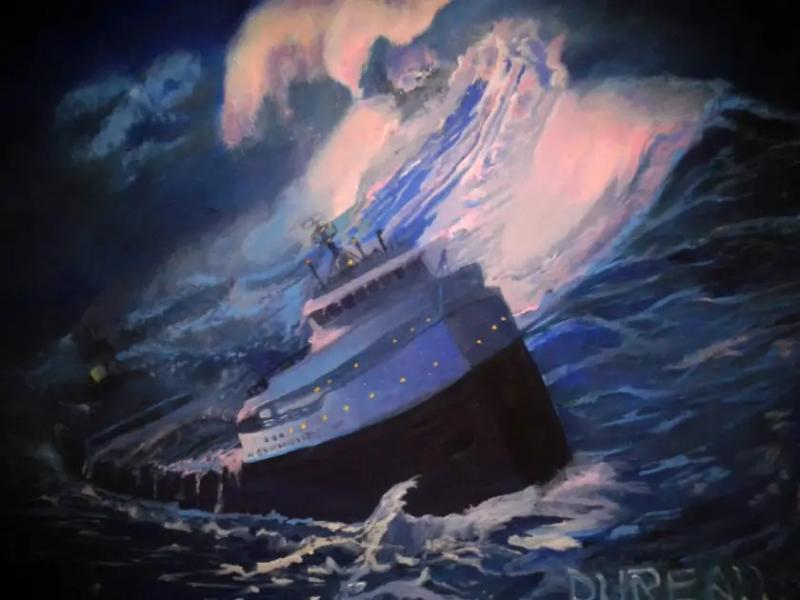
Fifty years ago, on Nov. 10, 1975, the SS Edmund Fitzgerald sank during a brutal storm on Lake Superior while sailing from Superior, Wisc., to Detroit. The entire crew of 29 men died in the Canadian waters.
A year later, the disaster was immortalized by Canadian singer-songwriter Gordon Lightfoot when he released “ The Wreck of the Edmund Fitzgerald ,” which became an unlikely hit single in 1976 and remains popular to this day as both a totem of culture in Canada and the source of online memes.
“There were about 6,000 commercial shipwrecks on the Great Lakes between 1825 and 1975. Everybody knows one, and it’s because of the song,” said John U. Bacon, author of the new book The Gales of November: The Untold Story of the Edmund Fitzgerald .
'The gales of November'
The scale of the wreck itself also makes it stand out, historians say.
The Edmund Fitzgerald remains the largest ship ever to sink in the Great Lakes , which was a particularly booming industrial region in the mid-20th century following the Second World War, when hundreds of commercial vessels ferried raw materials in-between booming port cities on both sides of the border every year.
Before it sank, the over-200-metre-long freighter spent 17 years carrying taconite ore, a low-grade iron, from Minnesota mines to steel mills in Detroit, Toledo and other ports.

The Edmund Fitzgerald in a 1959 file photo, with a crew of 28 to 30 men, was carrying a load of 26,216 tons of taconite pellets. (AP Photo, file).
Sailors on the Great Lakes have regularly had to contend with fierce weather, something with which residents in those cities are all too familiar. As Lightfoot’s song underscores with its repeated references to “the gales of November,” the month brings particularly strong storms.
“The Great Lakes are more dangerous than the Atlantic Ocean, and it’s not even close,” said Bacon, who talked to former Fitzgerald crew members as well as the families of over a dozen of the shipwreck’s victims for his book. “Those guys (former sailors) told me that again and again and again.”
Part of the reason is the combustible mix of incoming Arctic air with still-warm lake water and humidity left over from the summer months, experts say, as the seasons shift.
“It’s that clash in temperature that creates these strong Great Lakes storms,” Global News chief meteorologist Anthony Farnell said.
“These storms cut from the Gulf of Mexico in the south right up into the Great Lakes, and that can lead to a very low barometric pressure and rather intense winds and waves in November.”
The 1975 storm that sank the Edmund was particularly intense, Farnell noted, with near-hurricane force winds of over 100 km/h and waves as high as 11 metres.
“It’s been a while since we’ve had one at at that level,” he said.
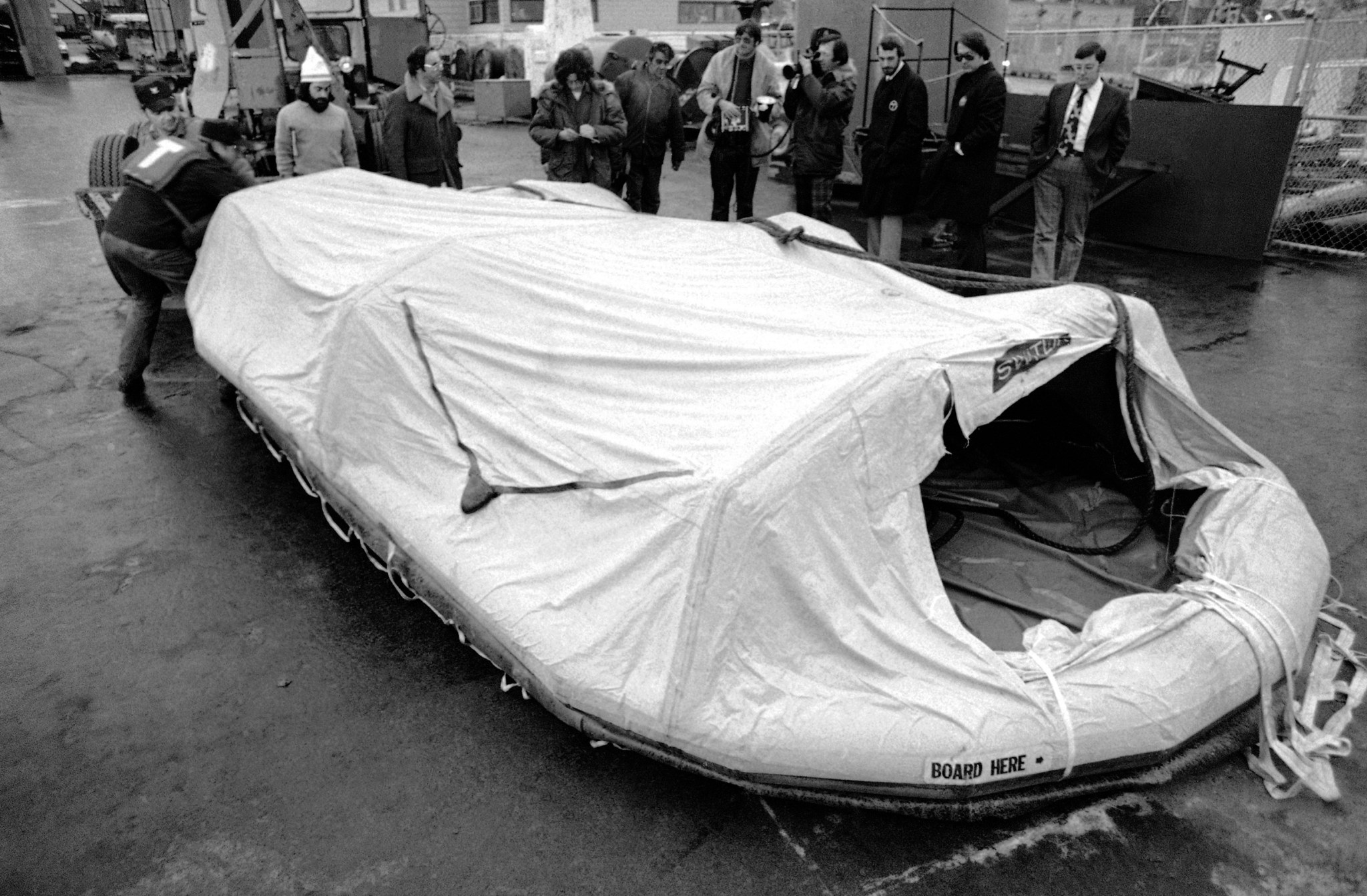
Two U.S. Coast Guardsmen move a life raft from the freighter Edmund Fitzgerald across the dock in Sault Ste. Marie, Mich. Nov. 11, 1975, after the raft was plucked from Whitefish Bay by the freighter Roger Blough, a ship assisting in the search for the missing Edmund Fitzgerald, which sunk on Nov. 10, 1975, in Lake Superior. (AP photo/JCH, file).
That shared experience of intense weather is part of what has bound people together on both the Canadian and American sides of the lakes, said Dan Rose, the collections coordinator at the Great Lakes Museum in Kingston, Ont.
He specifically pointed to the so-called White Hurricane of 1913 , which struck around the exact same time of early November and hit the region with powerful blizzards, killing more than 250 people and blanketing cities from Toronto to Cleveland with snow.
“I think there’s just something that is so unifying about enduring conditions that are that treacherous and that trying, and being able to look across the water at our neighbours and say, ‘Geez, isn’t it great that we were able to bear down and endure these trials and tribulations?” he said.
“It really drives home how unifying it is to just face things head on and work together to solve a problem.”
That bond was only reinforced by the Edmund Fitzgerald disaster and the shared love of Lightfoot’s song, Rose and other historians said.
The Edmund Fitzgerald’s legacy also endures with the improvements to shipping safety and weather tracking on the Great Lakes spurred by the investigations into the sinking.
That’s also partially due to Lightfoot, whose song Bacon said “embarrassed” the shipping industry into action.

Singer Gordon Lightfoot attends an event commemorating the 40th anniversary of the sinking of the Edmund Fitzgerald at the Great Lakes Shipwreck Museum in Whitefish Point, Mich. in a 2015 handout photo. THE CANADIAN PRESS/HO-Deborah Champeau. RJB
Farnell said forecasters can now see major storms approaching days or even weeks in advance, giving shippers plenty of warning. Ship captains are also less willing to venture into heavy storms just to make it to port on time, and have more advanced navigation and location beacons onboard in case disaster strikes.
To this day, not a single commercial freighter has sunk in the Great Lakes since the Edmund Fitzgerald.
Yet historians still make a point to honour those past shipwrecks.
“We use the sinking of the Fitzgerald to bring attention to all the other sailors who have lost their lives on the Great Lakes,” said Billy Wall-Winkel, field curator of the Detroit Historical Society, which hosted several events and exhibitions to mark the 50th anniversary of the wreck leading up to Monday’s annual Lost Mariners Remembrance.
“We want to celebrate the people who built the country, rather than just the people who designed it or paid for it.”
Lightfoot's song still endures
The harrowing story of the Fitzgerald is only part of why Lightfoot’s song continues to endure today for both Canadian and American listeners.
At nearly six minutes and with no chorus, “The Wreck of the Edmund Fitzgerald” relies on a repeating, circular melody that allows Lightfoot to lay out the history of the Great Lakes and that one fateful night in great detail.
“It’s mesmerizing,” said Maria Virginia Acuña, a music history and musicology professor at the University of Victoria who primarily studies early modern musical theatre, and who listened to the song for the first time after being asked to discuss it for this story.
“It’s soothing, but it’s also sad and tragic, like a lament … but the repetition captivates us and turns this historical event into something much more accessible and universal.”
Acuña, who grew up in Argentina, said her Canadian-born husband told her “how important this (song) is and how it’s a big part of our culture.”
The song, which hit number two on the Billboard 100 and number one in Canada in 1976, was given another boost of popularity after Lightfoot’s death in 2023 . The artist himself said it was the song he was most proud of.
“It has a timeless quality to it,” Acuña said. “And I think like with all music, we take songs at different moments in our lives and they acquire new meanings.”
In the past few years, “The Wreck of the Edmund Fitzgerald” has inspired countless memes on TikTok, Reddit and Instagram. The “gales of November” lyric in particular has been used to refer to everything from the overwhelming power of nature to seasonal depression to the lengths one will go to get to a girlfriend’s house, connecting a new generation of listeners to the iconic story and song.
People online have also marveled that the wreck happened a relatively short time ago, instead of the 1800s or early 20th century — or even that it happened at all.
“It not just Gen Z — even boomers have said they had no idea,” said Bacon, who added he’s not surprised why the story of theEdmund Fitzgerald continues to attract new generations of listeners and readers.
“I think it’s also something just truly fundamental and elemental about human nature. Humans in a boat fighting the elements for their lives has captivated us since Noah’s Ark. So that’s not new, and we’re still fascinated.”
The administrator of this group reserves the right, along with the site moderators, to moderate all and any postings to this group, including the right to enforce the ToS, the CoC, and also including anything that the administrator deems within his sole discretion to be offensive, including but not limited to political and/or off topic comments, with the power to delete in exercising that right.
It would be best, therefore, to be civil in posting on this group and not contravene the CoC, the ToS, and to not post comments that are political, insulting, taunting, trolling or offensive.
By now it should be well known that I am unable to open certain sources, videos and pictures. If I cannot, I will ask that they be described and explained. If the poster refuses to comply, their comment will be deleted. Instagrams are banned.

Tags
Who is online
101 visitors
Gordon Lightfoot - The Wreck of the Edmund Fitzgerald Lyrics
The legend lives on from the Chippewa on down
Of the big lake they called 'Gitche Gumee'
The lake, it is said, never gives up her dead
When the skies of November turn gloomy
With a load of iron ore twenty-six thousand tons more
Than the Edmund Fitzgerald weighed empty
That good ship and crew was a bone to be chewed
When the gales of November came early
The ship was the pride of the American side
Coming back from some mill in Wisconsin
As the big freighters go, it was bigger than most
With a crew and good captain well seasoned
Concluding some terms with a couple steel firms
When they left fully loaded for Cleveland
And later that night when the ship's bell rang
Could it be the north wind they'd been feelin'?
The wind in the wires made a tattle-tale sound
When a wave broke over the railing
And every man knew, as the captain did too
T'was the witch of November come stealin'
The dawn came late and the breakfast had to wait
When the gales of November came slashin'
When afternoon came it was freezin' rain
In the face of a hurricane west wind
When supper time came, the old cook came on deck sayin'
Fellas, it's too rough to feed ya
At seven pm a main hatchway caved in, he said
Fellas, it's been good t'know ya
The captain wired in he had water comin' in
And the good ship and crew was in peril
And later that night when his lights went outta sight
Came the wreck of the Edmund Fitzgerald
Does any one know where the love of God goes
When the waves turn the minutes to hours?
The searches all say they'd have made whitefish bay
If they'd put fifteen more miles behind her
They might have split up or they might have capsized
They may have broke deep and took water
And all that remains is the faces and the names
Of the wives and the sons and the daughters
Lake Huron rolls, superior sings
In the rooms of her ice-water mansion
Old Michigan steams like a young man's dreams
The islands and bays are for sportsmen
And farther below lake Ontario
Takes in what lake Erie can send her
The iron boats go as the mariners all know
With the gales of November remembered
In a musty old hall in Detroit they prayed
In the maritime sailors' cathedral
The church bell chimed till it rang twenty-nine times
For each man on the Edmund Fitzgerald
The legend lives on from the Chippewa on down
Of the big lake they call 'Gitche Gumee'
Superior, they said, never gives up her dead
When the gales of November come early
That was one of my favorite songs for many years as a young teenager. Anyone born in the Great Lakes area knows this song well! And some of us remember when the wreck happened like it was yesterday. My immediate family had already moved to California at that time but for all of my relatives who still live there, the memory remains strong.
That song still brings a tear to my eye.
Gord LIghtfoot's delivery of it is almost as important as the words.
One of the local news channels has a short documentary on diving the wreck. Unfortunately it's on YouTube. The whole thing is big here every year. They light up the Split Rock Lighthouse and the song plays on heavy rotation.
Although, as the article says, there have been many wrecks in The Great Lakes, the Edmund Fitzgerald is iconic and for sure will never be forgotten.
I hate to say it, but in time everything will be forgotten. I would guess that even right now most people under the age of 40 have no idea what the Edmund Fitzgerald was.
Do you know what the Eastland tragedy was? 844 people drowned when the Eastland capsized on the Chicago River in 1915. Today I doubt if 1 in 100 people could tell you what is was.
I suppose that in many cases time passes and things are forgotten eventually, but because of the annual events concerning the sinking of the Edmund Fitzgerald it may be a long time before it's forgotten. There are still a lot of historical events that are not forgotten.
Someone else here said its memory is kept alive because of the song and I kind of agree. Without the song the wreck would have generally been forgotten by now, in my opinion.
True enough, but even most songs have a limited life.
Lol honestly without the song I wouldn't even know about the wreck
I still remember the live news report on TV.
We didn't have a TV from when I was 9 until 16 (71 - 78) so I must have missed that
When I was a kid I used to spend my summers at my grandmother's summer cottage at Burlington Beach, the thin strip of land that divides Burlington (Hamilton) Bay from the far western point of Lake Ontario. My uncle used to take me fishing on the pier of the canal through which the giant long iron ore ships like the Edmund Fitzgerald used to pass to get to Hamilton's Steel Company of Canada, and they were the biggest ships I had ever seen in my life as I watched them sail by from about 20 feet away. The news of the tragedy back then was very meaningful to me, as it was a wonder that such a ship could be sunk by the waves and wind of the Great Lakes.
Sounds nice. I have fond memories of my dad taking me and my brother canoeing in, around and through Algonquin Park in the summers. Tents instead of cottages but still fun
I, too, have canoed in Algonquin park. The colours are amazing in the fall. I have a photo in storage of me at about the age of 10 with a fawn eating out of my hand, when my parents took me there.
More information on the Edmund Fitzgerald.
A few underwater photos of it:
.
.
Buzz,
Have you seen this short documentary?
Sorry, but Youtube is blocked in China. What is the title of the video, and who created it? I might have access to it on a website that I can use.
Underwater Drone Reached the SS Edmund Fitzgerald, It Captured Something No One Expected
QUANTARA
I think JR found it!
Thanks for trying,. The link is a Youtube, and the only relevant thing the title opens is Gord's song on bilibili.
Sorry, but I couldn't.