
Tradition goes trendy


Tradition goes trendy

Participants showcase the elegance of hanfu (traditional Chinese attire) on the catwalk during a fashion contest in Chongqing last month. CHINA DAILY
Across the country this spring, people are strolling through blooming gardens, hiking green hills, and visiting ancient landmarks dressed in flowing hanfu (traditional Chinese attire). Blending heritage with modernity, travelers are rediscovering the richness of Chinese culture.
The numbers tell a compelling story. During this year's Spring Festival holiday alone, official statistics showed domestic trips reached 596 million, with tourism spending exceeding 800 billion yuan ($116.6 billion) — both record highs.

A large painted statue of a deity holding a gold ingot attracts visitors seeking blessings for prosperity at a commercial hub in Nanjing, Jiangsu province. CHINA DAILY
According to the outline of the 15th Five-Year Plan (2026-30), China has pledged to strengthen time-honored brands and trendy domestic labels. By infusing ancient charm into contemporary fashion and reimagining tradition through creative expression, guochao, or China-chic trend, is weaving itself into the fabric of modern life.
This year, the Year of the Horse, products featuring horse motifs have galloped into the spotlight. From accessories to home decor, it is a vivid snapshot of surging guochao consumption.

Dragon boat paddlers splash water toward tourists as a blessing during the Qingming Festival holiday at Tangjing village, Huzhou, Zhejiang province. YAO HAIXIANG/FOR CHINA DAILY
Sportswear giants Li-Ning and Anta have taken their China-inspired designs to international fashion weeks, championing a new aesthetic of Chinese sports chic. Tea brands like Modern China Tea Shop and Heytea are digging deep into tea culture to craft neo-traditional brews. State guesthouses have become unexpected favorites among young travelers.
The cultural influence extends far beyond merchandise. The domestic video game Black Myth: Wukong sold nearly 30 million copies and won the Golden Joystick Award for Game of the Year. Meanwhile, toy maker Pop Mart, with its collectible art figures, continues to attract a global following.

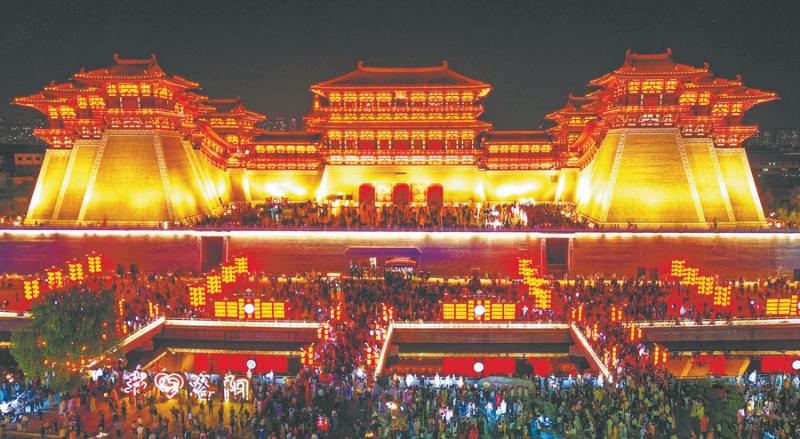
Tourists enjoy a night tour at the Sui-Tang Luoyang City National Archaeological Site Park in Luoyang, Henan province, during the three-day Qingming Festival holiday last week. HUANG ZHENGWEI/FOR CHINA DAILY
"China chic brings a distinct cultural undertone to contemporary life," says Bu Xiting of the China Cultural Industry Association. "The rise of guochao consumption reflects not only strong consumer spending, but also growing cultural confidence."
Beyond merchandise, the trend is shifting to cultural spaces, transforming cultural heritage into immersive travel experiences. From March 30, the Longmen Grottoes in Luoyang, Henan province, launched a night tour program, allowing visitors to experience the carvings illuminated in warm light. Listed as a UNESCO World Heritage Site in 2000, the grottoes remain a treasure trove of Northern Wei Dynasty (386-534) and Tang Dynasty (618-907) Buddhist art.

The night tour at the Longmen Grottoes in Luoyang, Henan province, launched on March 30, uses light and shadow to create an immersive, centuries-spanning cultural experience. ZHANG YIXI/FOR CHINA DAILY
"We need to accelerate the cultivation of talents who understand both culture and design. By infusing products with cultural value, we can better enrich the consumer experience," says Xiong Haifeng, an associate professor at the School of Cultural Industries Management at the Communication University of China.

A performer dressed as a silkworm flower maiden tosses blossoms into the crowd, offering blessings for a prosperous harvest in Xinshi Ancient Town, Huzhou, Zhejiang province. XIE SHANGGUO/FOR CHINA DAILY
.

At a Tong Ren Tang Zhima Health store in Beijing, the time-honored traditional Chinese medicine brand integrates familiar herbal ingredients into modern retail spaces popular with young consumers. CHINA DAILY
.

Dough figurine artist Zuo Ansheng from the Hongshizhai Intangible Cultural Heritage Museum in Linyi, Shandong province, creates red horse dough sculptures to celebrate the Year of the Horse. WANG YANBING/FOR CHINA DAILY
The administrator of this group reserves the right, along with the site moderators, to moderate all and any postings to this group, including the right to enforce the ToS, the CoC, and also including anything that the administrator deems within his sole discretion to be offensive or off topic, with the power to delete in exercising those rights.
It would be best, therefore, to be civil in posting on this group.
By now it should be well known that I am unable to open certain videos and pictures. If I cannot, I will ask that they be described and explained. If the poster refuses to comply, their comment will be deleted. Instagrams are banned.
Tags
Who is online


126 visitors
The image above of the lit-up Longmen Grottoes in Luoyang was a happy reminder for me of when I visted that site and took this photo, but it was in the daytime around 19 years ago when I was a guest of the parents of two of my students whom you see in the bottom right of the image below, which doesn't have the drama or the cultural pageantry as in the current image above.
The thing I like about these Chinese celebrations is how colorful they are.
They sure are colourful. Red is a special colour here.
Really enjoy these old traditional items. Your history goes back thousands of years, but ours just a few hundred, ( although our indigenous history ,by some reports, goes back some 60,000 )
Actually it's not my history, I'm an expat Canadian living in China, and I'm not Chinese racially, but caucasian.