
What Is Chinamaxxing? Why Gen Z Is Suddenly Becoming Chinese

By: NIcole - Stellar Chinese
 S E E D E D C O N T E N T

What Is Chinamaxxing? Why Gen Z Is Suddenly Becoming Chinese
Chinamaxxing is the Gen Z trend of "becoming Chinese" — drinking hot water, eating congee, playing mahjong. What it means, where it came from, and what it misses.
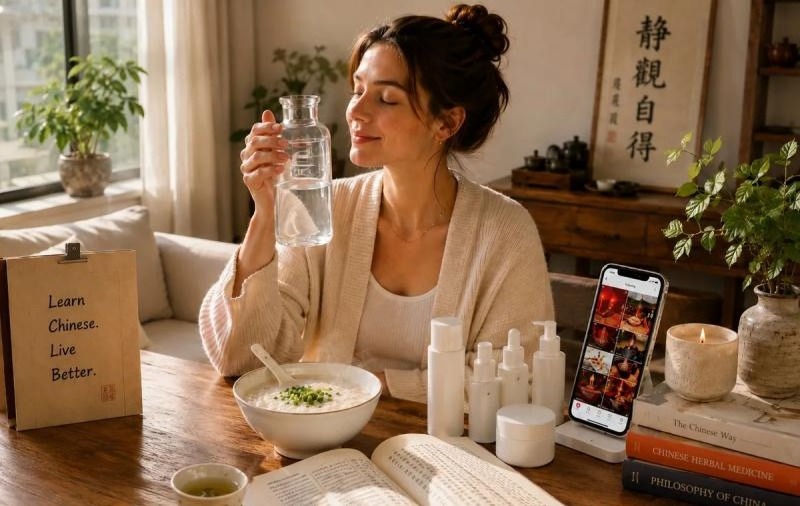
For most of the last decade, China reached Western feeds as a warning label: surveillance, factories, a rival to be managed. In 2026 something quieter is happening. Young Americans are filming themselves drinking hot water, eating congee, playing mahjong, and captioning it all with one line: you met me at a very Chinese time in my life.
Chinamaxxing is a social media trend in which primarily Western Gen Z users adopt or romanticize everyday Chinese habits such as drinking hot water, wearing house slippers indoors, eating congee, playing mahjong, learning Mandarin, and using Chinese wellness practices.
Most of the people doing it have never set foot in China. Chinamaxxing started as a niche internet meme before evolving into a broader social media trend.
This is the long version: what the term means, the genres of video it breaks into, where it came from, what these habits actually are on the ground, how Chinese people and Reddit are reacting, the cultural appropriation debate, and the one thing Western coverage keeps missing.
What Does Chinamaxxing Mean?
The name stitches China onto maxxing, a piece of internet slang lifted from gaming and looksmaxxing communities that means going all in on something, taking it to the extreme. A looksmaxxer optimizes their face. A Chinamaxxer optimizes their life by living, or pretending to live, a little more Chinese.
In practice it is part wellness fad, part political mood, part joke. The same creator who posts a sincere video about boiled water and early nights will caption it with enough irony that nobody can accuse them of meaning it too hard. The trend overlaps with two sister phrases that trend alongside it: becoming Chinese and the very Chinese time meme. They describe the same moment from different angles.
It is primarily an American Gen Z phenomenon that has since spread across Europe and beyond. Much of its shape was set by Chinese American creators, most prominently Sherry Zhu, whose half-tutorial, half-comedy videos on becoming a Chinese baddie and the rules of turning Chinese, hotpot included, ran up millions of views.
What Chinamaxxing Looks Like: The Main Genres
Spend ten minutes in this corner of TikTok and the videos sort into a few recognizable types. Knowing them is the fastest way to understand the trend.
Wellness and Longevity Mode
One of the most common genres. Warm water with fruit, herbal teas, gua sha, gentle morning stretches, earlier bedtimes, keeping the body warm. Everything is framed as an ancient secret to soft, slow, long living. This is the side most Western articles describe, and the side that travels furthest.
Uncle Core
The funniest genre, and the most overlooked. Creators play the archetypal Chinese uncle, 大爷 (da ye): tracksuits, standing around chatting in groups, squatting on the sidewalk, a beer on a plastic stool, and above all mahjong, 麻将 (ma jiang). The whole bit celebrates communal, low-key, unbothered enjoyment over Western hustle and self-optimization. It is Chinamaxxing pointed at a vibe rather than a wellness goal.
Aesthetic China Edits
Fast, highly edited montages of bullet trains leaving on time, spotless metros, futuristic skylines, dense walkable neighborhoods and night markets, usually cut against a tired American street or a delayed train at home. The argument is made entirely through contrast.
The Chinese Baddie
The beauty strand: gua sha, herbal skincare, simple cooked meals, early nights, repackaged as a glow-up. Popularized largely by second-generation creators and worn half seriously, half as a joke.
Home and Feng Shui
The smaller, homier edge of the trend: slippers at the door, a rice cooker always on, and for some, feng shui touches like a convex bagua mirror, 八卦镜 (b gua jing), hung to deflect bad energy. Less viral, but it is where the aesthetic shades into actual daily habit.
The format barely changes across all of them. A creator films one small ritual, lays the very Chinese time caption over it, and scores it with a traditional Chinese instrumental or a clip from Mulan.
One Miami creator walking through hot water, house slippers, and her plan to become a Chinese baddie drew more than 1.4 million views.
The holiday versions are the most literal: on the first day of Lunar New Year, non-Chinese users film themselves not washing their hair so they do not wash away their luck. As the meme spread, Chinese-coded aesthetics moved well beyond Chinese cultural circles and into mainstream internet culture.
Chinamaxxing Examples: Online Framing vs Everyday China
These are the habits the trend is built on, and the gap between how they look online and what they are on the ground is where most of it gets lost in translation. The left column is the TikTok framing. The right is the everyday reality in China.
| Habit | How it is framed online | What it actually is in China |
|---|---|---|
| Hot water | Ancient longevity secret | Just what people drink. Offices have a hot tap, everyone carries a thermos. Rooted in a long tea-drinking culture |
| House slippers indoors | Mindful grounding ritual | Standard. Shoes come off at the door, guest slippers wait beside it |
| Congee and broths | Slow healing lifestyle | Everyday food. Congee is breakfast, not a cleanse |
| Mahjong and uncle core | Anti-hustle philosophy | Real, but it is mostly what retirees do in the park, not a youth movement |
| Gua sha and skincare | The Chinese baddie glow-up | Common, but the online versions are shaped by Western beauty marketing |
| Qigong and tai chi | Ancient flow state | Mostly associated with older people exercising at 7am |
| Early nights, slow mornings | Restorative slow living | Aspirational for young Chinese too, who often work far longer hours |
| Hotpot and shared meals | Cultural immersion | Social life, with its own table manners worth knowing |
Wellness Is Already A Joke In China
Here is the single most useful thing to understand about this trend. The wellness habits at the center of Chinamaxxing are not received in China as serene ancient wisdom. They read as middle-aged, and they come pre-loaded with irony. Hot water has become one of the defining symbols of Chinamaxxing, and it is the clearest case of the trend misreading what it copies.
Two memes explain it.
The first is 多喝热水 (du h re shu, drink more hot water). In China this is not wellness advice. It is the punchline of a long-running joke about emotionally lazy boyfriends: whatever a woman complains about, cramps, a cold, a bad day, the useless reply is always drink more hot water. It became shorthand for care that costs nothing and helps nothing.
I grew up inside this. Offices often had a hot-water tap beside the sink. Train stations had steel boilers. When I came home sick, the first thing my grandmother did was pour boiled water into a second cup to cool it down so I would not scald my tongue. The drink more hot water joke lands for my generation because we heard the phrase a thousand times before it ever became a meme — from mothers, school nurses, aunties, and at least one boyfriend who thought it counted as emotional support.
The phrase even has an afterlife the West never sees: the children of Chinese immigrants carried hot-water wellness onto TikTok, foreigners copied it earnestly, and the thermos turned into an outsider's badge of authentic China. A line once mocked as a lazy answer to every problem is now being rediscovered as lifestyle advice.
The second is 保温杯里泡枸杞 (bo wn bi l pao gu q, goji berries steeping in a thermos). It traces to a 2017 photo of a hard-rock drummer holding a flask of goji tea. The gap between the tough image and the gentle habit went viral, and a rhyming line, once you hit middle age you give in and steep goji in your thermos, became the symbol of the slow slide into midlife.
What young Chinese did with that was invent 朋克养生 (peng ke yng shng, punk wellness): self-destruction and self-rescue at the same time. Goji in your beer. Ginseng in your cola. The deepest all-nighter under the most expensive face mask. It is a joke about a generation too burned out to be healthy and too anxious not to try. So when a Western teenager films goji water as a longevity secret, the Chinese internet's reaction is not recognition of shared wisdom. It is the gentle comedy of watching someone solemnly adopt the very thing your own youth turned into a meme about exhaustion.
That is the whole trend in miniature. The calm is real. The irony underneath it is the part that does not survive translation.
You Met Me At A Very Chinese Time In My Life
The becoming Chinese meme and the very Chinese time meme are closely connected. The signature caption is a parody. The 1999 film Fight Club ends with the line, you met me at a very strange time in my life. In April 2025 an X user swapped one word, posting you met me at a very chinese time in my life, lowercase and deadpan. It picked up tens of thousands of likes and became the template.
From there it spread to Instagram and TikTok, where it merged with a separate wave of videos in which Chinese creators and Chinese American creators walked outsiders through daily habits. The two streams fused.
Today the phrase signals a personal chapter of cultural immersion, sometimes sparked by a relationship, a trip, or just an algorithm that kept feeding someone the same content until they bought a thermos.
Where Chinamaxxing Came From
The trend did not appear from nowhere. Three things stacked up across 2025.
First, the platform shift. When a U.S. TikTok ban looked imminent in January 2025, hundreds of thousands of American users migrated to Xiaohongshu, known abroad as RedNote. For the first time, ordinary Americans and ordinary Chinese were sharing the same feed at scale, comparing grocery bills and apartments in real time.
Second, the streamers. American creators toured China and broadcast genuine surprise at the high-speed rail, the late-night street food, the cities that felt like the near future. Chinese American creators such as Sherry Zhu turned that curiosity into how-to content, half tutorial and half comedy, on becoming Chinese.
Third, the meme gave it a name and a caption. The trend appeared to peak around Lunar New Year in early 2026, when the timing of the festival handed it a natural spotlight. NPR eventually featured the word in a segment on internet language, a sign it had crossed from niche to mainstream.
What Is The Becoming Chinese Trend?
The becoming Chinese trend is the broader umbrella that Chinamaxxing sits inside. Where Chinamaxxing leans toward wellness and lifestyle, becoming Chinese is the wider mood: Western users, mostly Gen Z, deciding that aspects of modern Chinese daily life look better than their own and adopting them, sincerely or half as a joke.
In practice the two names point at the same wave of videos. A creator who films a hot-water routine, a mahjong night, or a slower morning and tags it becoming Chinese is doing the same thing as one who tags it Chinamaxxing. The becoming Chinese label simply foregrounds the identity angle, the sense of stepping into a different way of living, rather than the optimization angle baked into the word maxxing.
What makes it a trend rather than a one-off meme is scale and staying power: thousands of creators, a shared set of habits, a recurring caption, and a steady stream of imitation across TikTok, Instagram, and Xiaohongshu.
Why Is Everyone Becoming Chinese?
The trend lands in a time when people feel let down by life at home, and China becomes a screen to project the opposite onto. Each habit is, underneath, a complaint about home:
- Housing that feels permanently out of reach
- Streets that do not feel safe after dark, against a backdrop of gun violence
- Public transport that is slow, aging, or unreliable
- Healthcare that can bankrupt you
- A burnout culture where self-care pushed to the extreme has started to feel hollow
China, in the videos, is the clean inversion: reachable apartments, late-night streets that feel safe, high-speed rail that leaves on time, a phone that handles everything, and a slower daily rhythm. One business outlet framed the trend as less a love letter to Beijing than an indictment of America (report).
Here is the part the videos miss, and the part worth knowing if you want to understand modern China rather than the meme of it. Many of the habits now being romanticized emerged as coping mechanisms, not luxury lifestyles. Drinking hot water, carrying a thermos, eating simple breakfasts, going to bed early, staying close to family: these are often practical responses to long hours and tight budgets rather than curated wellness routines.
The same generation of young Chinese gave the internet two of its most famous words for burnout: involution, 内卷 (nei jun), the feeling of competing harder and harder for the same shrinking reward, and lying flat, 躺平 (tng ping), opting out of that race entirely. They did not coin those phrases because life felt too slow. The serenity in a Chinamaxxing video is real texture, but it sits right next to long work weeks and high youth unemployment. The trend keeps the serenity and quietly drops the pressure.
How Chinese Netizens React To Chinamaxxing
The reaction inside Chinese social media has been mixed, warm, and a little bemused.
A lot of Chinese creators found it funny and flattering. The common joke ran in the other direction: what took you so long? Several leaned in, telling foreign followers that if you love hotpot, you are basically Chinese now. After years of these habits being treated as strange, watching them turn aspirational landed as a small, genuine pleasure.
Part of that warmth traces back to early 2025, when Americans flooded Xiaohongshu, a Chinese lifestyle app often described as China's answer to Instagram and Pinterest, and the two sides started comparing notes directly: rent, paychecks, grocery receipts, healthcare bills. For many users on both ends, the surprise was how far the lived reality sat from what they had been told about each other. Comparing notes like that did more to soften attitudes than years of official messaging.
Not everyone was charmed. Some Chinese Americans felt whiplash, having been mocked for the exact same thermos and packed lunch a decade earlier. And the sharpest critique from Chinese viewers is the one I keep coming back to: outsiders are romanticizing only the comfortable surface, the calm and the convenience, while skipping the pressure that produced it. Plenty of commentators also expect the whole thing to fade as quickly as it rose, a curiosity spike rather than a lasting shift.
What Reddit Thinks About Chinamaxxing
If TikTok is where the trend lives, Reddit is where it gets argued about, and the mood there is far more skeptical.
One of the most common Reddit responses is that Chinamaxxing says more about American frustration than Chinese reality.
Threads across general and China-focused subreddits tend to split into a few camps.
One treats the whole thing as staged, or quietly planted by someone with an agenda, quick to suspect bots, PR, or state messaging behind the sudden warmth. Others push back that the cynicism is just a reflex. The frustration with American life under the meme is real, they argue, even if the China in the videos is not.
A recurring, sharper point is that Chinamaxxing is less a portrait of China than a Western fantasy projected onto it, a fascination that can make it exotic all over again.
Asian American users are the most divided, some glad the culture is finally getting credit, others tired of watching childhood habits turn into a costume.
In short: TikTok plays the trend out, Reddit argues about it.
What Chinamaxxing Gets Right About Modern China, And What It Misses
It gets the texture right. Hot water really is everywhere. Shoes really do come off at the door. The high-speed rail is famous for leaving on time, many visitors are struck by how safe major Chinese cities feel late at night, and a phone replaces your wallet, keys, and most paperwork for daily life.
Visitors are not wrong to be struck by it. For a Western reader, the most useful thing the trend reveals is that a generation has stopped filing China under threat and started filing it under place with answers worth borrowing.
What it misses is motion. A Chinamaxxing video is a still photo of a country that does not hold still. The convenience that looks effortless on screen usually runs on long hours, and the unbothered calm is, for a lot of young people there, the thing they are reaching for rather than the thing they already have.
Understanding China means holding the high-speed rail and the exhaustion in the same frame, the midnight food delivery and the courier racing to make it, the evening square dancing and the office worker still answering messages at 10 p.m. The convenience, the pressure, the optimism, and the anxiety are all real at the same time. The meme can only hold one.
Is Chinamaxxing Cultural Appropriation?
This is the debate the trend cannot escape, and the honest answer is that it sits in the gap rather than landing cleanly on either side.
The case for appreciation is real. Much of the trend is led by Chinese and Chinese American creators, not extracting from them. Many participants credit their sources, share family stories, and collaborate across cultures. Framed that way, it looks less like theft and more like a cross-cultural moment moving through an algorithm.
The case for appropriation is also real. When habits that got people bullied a decade ago suddenly become a white influencer's aesthetic, the people who lived the originals are entitled to side-eye.
For many Asian Americans it lands differently. Things that once got them teased — hot water at school, home-packed lunches, mahjong with grandparents, Chinese with their parents in public — are suddenly online as hot water girl, Chinese baddie, or mahjong aesthetic.
One creator put the discomfort plainly in a video about mahjong and matcha becoming cool: the West has a habit of gentrifying traditions to make them palatable. A survey of 18 to 24 year olds caught the mixed feelings: a small share called the trend purely sincere, while the largest group, just over half, called it both sincere and performative at once (survey).
The two are not opposites. A person can genuinely enjoy learning Mandarin, drinking hot water, and watching C-dramas while also knowing that posting about it performs well online.
The useful distinction is the usual one. Appreciation tends to listen, participate, and credit. Appropriation tends to flatten it, take it, turn it into a look, and move on. Most Chinamaxxing content lives somewhere on that spectrum rather than at one end.
The Political Backlash And The Soft Power Question
The trend also got read as politics, from both directions.
From parts of the American right came alarm, with some outlets framing Chinamaxxing as something close to switching sides, a test of where your loyalty lies that young people were failing by praising a one-party state.
From Chinese state media came celebration, predictably reading it as proof of growing Chinese soft power. Analysts who study that soft power were more measured, describing the trend as young Westerners complaining about their own lives while treating China as the place that seems to work.
A meme that manages to worry American conservatives, unsettle Chinese American viewers, and please Beijing all at once is not really any one of those things. That is the point of it.
Chinamaxxing FAQ
What Does You Met Me At A Very Chinese Time In My Life Mean?
It means the speaker is in a phase of life shaped by Chinese culture, habits, or a person connected to China. The line is a play on a Fight Club quote, and online it signals that someone has fallen into Chinamaxxing: drinking hot water, learning Mandarin, watching C-dramas, leaning into a slower, more China-influenced routine. It is usually said with affection and a little irony, the way you might mark any period that changed how you live.
Why Are Gen Z Americans Becoming Chinese?
Mostly because the trend is less about China than about America. Young Americans are dealing with high housing costs, expensive healthcare, safety worries, and burnout. Then they see clips of cheap high-speed rail, safe late-night streets, and a slower pace — the opposite of what frustrates them at home. Adopting Chinese habits becomes a way to express that frustration. It is part genuine admiration, part social commentary, and part internet joke, which is why it spread so fast.
What Is a Chinese Baddie?
It is the beauty side of the trend: a confident, put-together look built around Chinese-coded habits such as gua sha, herbal skincare, simple cooked meals, and early nights. The term was popularized by Chinese American creators and is used half seriously, half as a joke about glowing up the Chinese way.
Is Chinamaxxing the Same as Chinesemaxxing?
They are close, with a difference in flavor. Chinamaxxing usually centers wellness and the becoming Chinese aesthetic. Chinesemaxxing leans harder into the uncle core, working-class side: squatting on the sidewalk, smoking, street beer, mahjong. Both are the same broader phenomenon seen through a different lens.
Is Chinamaxxing Still Popular in 2026?
It appeared to peak around Lunar New Year in early 2026 and has cooled from that spike, as fast-moving trends do, and many Chinese commentators expected it to. What is likelier to last is the quieter shift underneath it: more young Westerners treating China as an ordinary place to be curious about rather than only a rival.
If this helped you understand the trend a little better, share it with someone who is curious about China, interested in Chinese culture, or simply enjoys learning how other people live. You never know which article, conversation, or small idea will stick with someone and change the way they see the world.
If you're new to Stellar Chinese, have a look around. There are more guides on modern Chinese culture, internet slang, traditions, and everyday life. And if you'd like occasional updates when new articles go live, you can join the email list through the sign-up box on the site.
The administrator of this group reserves the right, along with the site moderators, to moderate all and any postings to this group, including the right to enforce the ToS, the CoC, and also including anything that the administrator deems within his sole discretion to be offensive, including and not limited to off topic or 'no value' comments, with the power to delete in exercising those rights.
It would be best, therefore, to be civil in posting on this group.
By now it should be well known that I am unable to open certain sources, videos and pictures. If I cannot, I will ask that they be described and explained. If the poster refuses to comply, their comment will be deleted. Instagrams are banned.

Tags
Who is online
86 visitors
A long read, but then I've noted that others here are posting long reads.
It is interesting to me that even before I had any idea about moving to China I had taken a summer course in Tai Jie, and taking an early Sunday morning walk in a local park in Toronto I discovered a group of Chinese people doing Tai Jie and I joined them doing it. They were so welcoming, here I was a "low-eye" (foreigner) who knew how to do it, and I joined them on Sunday mornings thereafter. And besides that, my ex-wife was a Yoga instructor and we did a Feng Shui arrangement in our home. When you opened the front door you could see right down the hall to the windows to the back yard, and that meant that money would just flow away, so she hung a crytal from the ceiling in the hall and that stops the money from flowng. As for drinking hot water in China, it was put on the table in restaurants like cold water is in North America and offered to me in banks and at the dentist - wherever.
Its a fad.
There are people always looking for the next trend because they want to be perceived as with the latest whatever.
Not that I wish to question your limitless expertise in this matter, but do you have any idea when Tai Jie originated?
(deleted)
I'll bet it was long before any of us (or our great grandparents) were born.
I'm not quite sure how to reply to your comment.
Absolutely.
Nope. Nor is it relevant.
I think the point Krishna is making is that it is a form of exercise that is many 100s of years old, maybe as much as 1500 years old.
Okay, so it's a fad, it's harmless, and if people enjoy participating in it, who cares? It does, IMO, set the record straight on some misconceptions.
Many of these practices have been around for many centuries-- and have great value.
Some people today adopt them , stick with the practices, and derive great value for many decades. But others adopt whatever is "the latest thing'-- and soon drop it.
For that later group it is a fad-- but for others it isn't.
I've heard similar discussions re; Meditation. The ancient practice developped by ancient Hinduisim.
I've known people in the West who've done it daily for years--and its been life changing (in a positive way) for many.
There are certain traditions and customs in China that have been followed here in China for thousands of years.
My cousin (who is quite brilliant!) always wanted to help people. She considered conventional western medicine, but finally decided she wanted to become an accupuncturist.
When she told her father he was a bit critical. He said "Why do you always want to do some controversial new-fangled thing?".
She pointed out that Acupuncture was not some recent fad-- in fact its pre-dated conventional western medicine for many many years!
I assume she's not just a sadist who enjoys stabbing people. LOL
A lot of westerners are afraid to try Accupuncture because they are afraid it would be painful. but with a good Accupuncturist its not.
(I also discovered they have two types of needles-- one type is extra thin for use on people afraid of pain).
Also there is more than one way to do a treatment-- for example the same or similar treatments can be done using points on the back of the body or on the front. (Points on the back are less sensitive).
Although my wife has never used accupuncture, she now and then has been treated with "cupping".
"Cupping is a method of applying acupressure by creating a vacuum next to the skin. In Traditional Chinese medicine (TCM) it involves placing glass, plastic, or bamboo cups on the skin with a vacuum."
I've heard of it but never had it done to me.
There are actually many types of Accupuncture, including several Japanese forms. (And I once experienced a session with a practitioner of a Korean style.)
Most of what I've experienced have been Chinese forms. Sometimes it consists of three practices;
1. First insertion of needles of course, but also followed by:
2. Prescribing Chinese herbal formulas after the treatment (often taken at home twice a day for a week until the next session.
3. Sometimes also Tui Na which is a massage focusing on Accupuncture meridians and points
Also there are variations: usually several needles are inserted and then the patient lies there for a while. But occasionally a needle is quickly inserted and withdrawn.
And some Accupuncturists actually leave needles in which are attached to wires with a small electrical charge (In my experience thats not to common).
After my stint of teaching at a private high school just outside of Zhengzhou we moved to Zhengzhou city where I tought English privately and a friend who was learning TCM who had an office for a small business (I forget what it was) which had a small office he gave me to teach private students. I volunteered for him to try the TCM procedure of moxibustion on my ankle, but by doing so he accidentally burned a bit of my skin, and I still have the scar. He was so sorry he gave me a laptop computer as compensation.
"Moxibustion is a therapeutic technique of Traditional Chinese Medicine (TCM), which uses pure Moxa rolls (made from a plant called Artemisia Vulgaris, or mugwort) to apply heat therapy on acupuncture points."
"Moxibustion is a therapeutic technique of Traditional Chinese Medicine (TCM), which uses pure Moxa rolls (made from a plant called Artemisia Vulgaris, or mugwort) to apply heat therapy on acupuncture points.
Moxibustion when done properly can be an extremely powerful (effective) procedure. A friend of mine has some symptons of a serious illness developping. (It was long ago so I foerget what is was).
After Moxibustion she was totally cured!
Some people have heard of, and confuse Mugwort with Motherwort, A different herb.
Incidentally Mugwort when taken before sleep often induces vivid dreams which are reputed to give the user accurate psychic insights.
I googled "wort". Turns out its from Old English. It means . .. "plant"!
I had adopted many of these practices, but haven't kept up with all of them.
One of the most results producing was daily meditation. Powerful results-- I am going to get back to it!
I have Feng Shued my living spaces-- that's resulted in proven gains in the stock market!
And it took me years to realize how to do it, but I have learned a lot of Western Astrology-- that's definitely help in my trading!
Good for you.
I have also studied Ayurveda a bit. These are ancient Hindu practices from India. A lot of it is about what sort of foods-- and special herbs-- to eat for specific types of people and/or or specific conditions.
These people (Ancient Hindus) were also very big on meditation (which later influenced Buddhist meditation).
A lot of practces of working with-- and sending and receiving-- mentally based energy.
Oh, to be young and clueless again. Bits and pieces of Chinese culture have been popular in the United States for a very, very long time. It is true the population of the US is a small portion of the world population and may not represent Gen Z as a whole.
The US began maritime trade with China during the Revolutionary era. So, Chinese (as well as other eastern) religious and social traditions have been popular in the US at various times. What the article seems to be describing is an extension of the New Age movement that began in the United States during the 1960s. Gen Z's attraction to facets of eastern social traditions very likely comes from their grandparents. Tai Chi, holistic medicine, various religious and mystical practices, and philosophy was part and parcel of the New Age movement.
Doesn't anyone remember the 1970s TV program ' Kung Fu ' starring David Carradine? Bruce Lee movies became a phenomena during the 1970s. Asian martial arts (Karate, Judo, Taekwondo) became very popular during the 1970s and 1980s. While not strictly Chinese, the Asian influence post-WWII in the United States has been prominent.
And ironically, it was President Nixon of all people who had often been credited with "Opening up China"!
And ironically, it was #President Nixon of all people who had often been credited with "Opening up China"!
Anyone remember this?
But he did, POLITICALLY.
NIxon's visit was preceded by Kissinger's visit, and that was preceded in 1971 by "Ping Pong Diplomicy", a meeting of the peoples of both nations.