
Are Churches Making America Poor?


Are Churches Making America Poor?
By Victoria Bekiempis On 10/24/13 at 3:49 PM
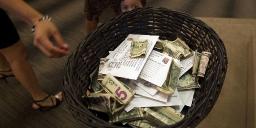
AP Photo/Nick Oza
The Secular Coalition for America wants the Internal Revenue Service to revoke the tax-exempt status of religious organizations that violate 501(c)(3) rules by, for example, promoting political candidates or not using their funds for charitable purposes.
The coalition estimates that stringent enforcement of 501(c)(3) could generate up to $16.75 billion in additional annual revenue - almost enough to fund NASA for a year. Less conservative estimates, including an academic paper that pondered the fiscal implications of taxing all churches like for-profit corporations, put that number at $71 billion - enough to send a Mars Rover into space almost every two weeks.
Though the federal government is funded until January 15, the coalition is already lobbying Congress to make it easier for the IRS to investigate and punish rule-breakers as a way of increasing tax receipts. Currently, the IRS is effectively prevented from doing so both because it would start a political firestorm and because of the Church Audit Procedures Act of 1984, which maintains that investigations can take place only with the blessing of a "high-level Treasury official."
"We're trying to use the current budget crisis as an example, as a way to show lawmakers what can be done," says Lauren Anderson Youngblood, Secular Coalition for America spokeswoman. "We're not doing this to hurt anyone. We're not doing this to attack churches or attack religion. We simply want things to be fair."
The coalition isn't suggesting that churches be taxed like for-profits. It just wants religious organizations treated like other nonprofit organizations, including filing annual Form 990 returns reports. Those 990s provide details on the finances of charities, so the IRS can tell if a nonprofit is illegally padding someone's wallet.
The coalition is also asking Congress to scrutinize how churches get 501(c)(3) status - churches automatically qualify, whereas nonreligious 501(c)(3)s must go through a rigorous application process to get tax benefits.
The coalition argues that if just 25 percent of the some $100 billion reportedly donated per annum to religious organizations didn't qualify for a tax deduction, it might be subject to a gift tax "of up to 35 percent, or as much as $8.75 billion in revenue." The coalition used data from a Lincoln Institute of Land Policy study on the impact of nonprofit property tax exemptions to estimate that property taxes on nonqualifying churches could reach $8 billion.
Some take this argument further: They think American taxpayers are footing the bill for what, in a private enterprise context, would be considered fiscally frivolous business behavior.
In 2012, Ryan Cragun, associate professor of sociology at the University of Tampa, with colleagues Stephanie Yeager and Desmond Vega, published a paper on this issue in Free Inquiry , the Council for Secular Humanism's magazine. It was called How Secular Humanists (and Everyone Else) Subsidize Religion in the United States , and asked: What if the cash going to church coffers was taxed like corporate income?
Cragun and his colleagues crunched the numbers, combining estimated federal-income, state-income, property and investment tax breaks that are now applicable to churches. They also added in the parsonage subsidy, a provision for clergy members to write off housing expenses from their taxable income, and indirect subsidies for faith-based initiatives.
Their tally came to $71 billion.
Cragun doesn't think the U.S. will ever tax churches like corporations but, like the coalition, he thinks there should be additional reporting and auditing of churches, and that certain exemptions should be eliminated.
For example, the parsonage exemption allows clergy members to deduct their homes' upkeep, furnishings, and utilities, in addition to rent, mortgage payments or even the cable bill.
Cragun's report also challenges the basic premise for exempting religious organizations - that their money mainly goes toward charitable purposes.
Some of the available stats were damning. "One calculation of the resources expended by 271 U.S. congregations found that, on average, 'operating expenses' totaled 71 percent of all the expenditures of religions, much of that going to pay ministers' salaries," the report said.
Cragun and the others have compared this to the American Red Cross, which "spends 92.1 percent of its revenue directly addressing the physical needs of those it intends to help; only 7.9 percent is spent on 'operating expenses.' "
The paper also points out that the Church of Jesus Christ of Latter-day Saints, of which Cragun is formerly a member, only gave .7 percent of its annual income to charity between 1985 and 2008. Wal-Mart, on the other hand, "gives about $1.75 billion in food aid to charities each year...almost double what the LDS church has given in the last 25 years," according to Cragun's research.
When presented with this data, the church said that it does far more charitable work than is reflected in spending.
The church also defended its for-profit assets, including a $1 billion ranch in central Florida, saying that it pays taxes on these enterprises and operates "by all applicable business standards." These businesses, a church spokesman told Newsweek in an e-mail, serve "as a rainy-day fund" and that agricultural holdings, specifically, "can be converted into welfare farms in the event of a global food crisis. The key to understanding church finances is to understand that they are a means to an end. They allow the church to carry out its religious mission across the world."
The Mormons are far from the only group to get flak on this matter. A 2012 paper in the Rutgers Journal of Law & Religion argued that the United States Catholic Conference of Bishops' 501(c)(3) status should probably be revoked because of their flagrant political lobbying and electioneering - from refusing Holy Communion to pro-choice Catholic pols to issuing partisan voter guides.
Also drawing the ire of reformists is Pulpit Freedom Sunday, an Alliance Defending Freedom-backed event in which participating pastors nationwide "will address the subject of current candidates for office, including the positions held by those candidates, in light of Scripture." (On its website, the ADF, formerly known as the Alliance Defense Fund, says it is a "servant ministry building an alliance to keep the door open for the spread of the Gospel by transforming the legal system and advocating for religious liberty, the sanctity of life, and marriage and family.")
According to Pulpit Freedom Sunday's Facebook page, the initiative is intended to directly challenge the IRS, claiming that the political lobbying and electioneering limitations violate the First Amendment. Pulpit Freedom Sunday's Facebook page, in fact, reads as a call to political action: "It's time for the intimidation & threats to end. Churches & pastors have a constitutional right to speak freely & truthfully from the pulpit - even on candidates & voting - without fearing tax exemption loss."
Despite all this, no one really expects things to change any time soon. Chuck McLean, vice president of research at charity watchdog organization Guidestar, says the IRS has its hands tied. "If they flipped a coin and it came up heads, then they would go after tax exemption of churches. If it came up tails, they would poke themselves in the eye with a red hot needle," he says. "It's a no-win proposition for them to go after churches under the best circumstances."
Citing the recent political fallout from IRS audits of Tea Party organizations, McLean says, "The IRS is already in a situation right now where public relations is not good. They went after Tea Party organizations, so now they're going to go after Southern Baptist congregations? I don't think so. The IRS's nose is really being rubbed in it, and they have decided not to take the bait."
For McLean, who thinks that some churches violate laws but not to the extent of the Coalition's claims, what's most at stake is the credibility of all non-profits and the IRS.
If churches blatantly violate laws by politicking, then other nonprofits might feel emboldened to follow suit, creating a situation in which charities increasingly look like lobbying organizations - unpoliced PACS, if you will.
The IRS did not specifically respond to requests for comment on this issue. Instead, an IRS spokesman sent Newsweek an e-mail with a link to a tax guide for religious nonprofits.
http://www.newsweek.com/2013/10/25/are-churches-making-america-poor-243734.html
Tags
Who is online
127 visitors
O....Kay, I have to admit it, this is one of my favorite articles that I've come across. It's a couple years old but hey I thought since Tax Day is right around the corner and we're in the midst of an election season it's like killing two birds with one stone.
I think it would be very difficult to prove what churches are forcing politics on their congregations. Who's going to gather the evidence and how are they going to gather it? Is it just what comes from the pulpit that is of concern, or is the minister's demeanor at coffee hour (where the congregants are actually awake) also a concern?
Frankly, a high percentage of churches in the US couldn't survive taxation. Membership is dwindling (thankfully), and they are struggling to keep the doors open. With others, like the slick mega churches with rock bands that play during the services to attract younger suckers, they really are making sick profits.
I don't know what the answer is, so I'll just keep doing what I do to get people to see how religion poisons everything. Some day you may wish you hadn't foolishly given your money away.
Well I've come to realize that some need to be told what to do in order to do the right thing. Apparently, they are incapable of knowing right from wrong. Surprisingly even after being preached to many still choose to do the "wrong" thing through hatred, intolerance, and bigotry. Very confusing this religious stuff. But I have to admit they certainly have had enough time to come up with a disclaimer.."We're all sinners. We're gong to make mistakes but we just keep asking for forgiveness and taking the lord into our hearts". That has got to be the BEST free pass for doing the complete opposite of what "God" teaches that I've ever heard.
I feel greatly enriched rather than poorer after attending church service!
We have republicans, democrats, tree-huggers, anarchists and some just politically agnostic in the congregation, but we do not gather to discuss politics
we do not gather to discuss politics
Very well rehearsed response. Is that practiced before or after sermon?
Just kidding RIO. I'm happy that you find enrichment in attending church.
Sounds like another push from the government to steal people's money. I'm not religious but am happy churches are fighting the taxman. I support their efforts to keep the hand of big brother out of their pockets.
Oh Dean!
I haven't said that to you in a while so I plopped it in on this one. lol
All these articles about religion and churches are just becoming flame bait on this forum.
The seeded article is 2 1/2 years old .
I would love to see a comparison of the money that churches supposedly "steal" as compared to the amount of money the government wastes or steals from taxpayers.
Churches use the promises of man-made sky fairies to coax folks outta their money, while the Fed uses deception and force.
I have seen very, very few examples where either one gave a flying' fig about my personal freedoms, passions, or my family's safety or welfare.
When these man-made institutions battle each other, it is almost always over the desire to exert more control than the other, over others.
One of these days it will be appropriate to rid our selves of our man made excuses for controlling each other; but, until then, it is appropriate to understand that both of these man-made institutions are important checks-and-balances on each other and ourselves. Allowing either institution to have more control, is going the wrong direction IMHO.
Yes, I think so.