The white knight would have to be a bishop to have the black king in check. It's the white king that's in check by the black queen. The black queen cannot be taken by the white king because the queen is protected by a black pawn. No other white piece is in position to take the black queen. That means the white king has to move but he has nowhere to go. The white king cannot take the square occupied by the black knight (just above his rook) because he'd still be in check by the black queen. He cannot move behind his own rook because he'd be in check by the black bishop. He cannot move to the white square on the right of him because he'd still be in check by both the black queen and the black knight. He cannot move to the black square just below that because he'd be in check by a black pawn. Unless I'm missing something, that's checkmate.
Even if it weren't checkmate, white has only a king, rook, and knight (in no attack position) plus three pawns against black's queen, two rooks, two bishops and a knight plus seven pawns. One black pawn is two moves away from pawn progression to a second queen. Black would still checkmate white in roughly five moves.
So it's the unarmed black man who's beating the cop . . . badly.
Right. That's what I said above. I'm surprised you could see the board so clearly. For me even on enlarging the photo the pieces are fuzzy and I can't tell a bishop from a knight.
Very smart to set up your own board in the same configuration. I had done that in order to understand Escher's woodcut, Metamorphosis II . That work of art shows gradual changes from one scene to another and then back to the beginning. In the bottom panel there is a depiction of a chess game in process. That particular scene is two scenes from the end . When I set up the board and placed the pieces I could play the game out. The probable start has to be the white rook taking out the black queen, then the black knight moves forward to place the white king in checkmate. Two moves to the end. I thought it was brilliant. But then all his works are brilliant.
Yes that is brilliant. The black queen is sacrificed to get the white rook to box in its own king. With no means for the white king to get out of the box the black knight moves to checkmate. However, unless that's a black bishop on the other end of the board, checkmate is seemingly avoided by capturing the black queen with the white king instead of using the white rook.
Yes, it concerned me as to whether that was a black or a white bishop. However, although if it is a black bishop our scenario will work, but on the other hand it could work if the bishop is white in which case if the King or the rook takes out the black queen, the white queen moves to the other end of the board and checkmates the blocked in black king. It might have been even more clever on the part of Escher to make it difficult to discern if the bishop were black or white.
If the bishop is white and the black King is blocked in, then the queen can checkmate by moving to the other end of the board as you say. However, if the black King is not blocked, then I would move the white rook to the other end of the board to check the black King. After the white king moves out of check, I would take the black knight with the white queen. My next move would be to move the white queen horizontal to the left end of the board and check the black King if he's exposed or just tighten the noose if I can't check him. The black King seems to have no pieces to mount much of a defense or offense so it's just a matter of time.
Now that I think about it, the bishop has to be black. If it were white, the attack by the black queen would fail because the white bishop would capture the black queen right after the black queen landed on the square next to the white King.
As well, if the bishop were white, how did it not take out the black queen before it moved next to the white king? The black queen had to have been in its line of fire first to arrive at that spot. The first move HAD to be the rook taking out the queen. The king could not do it because the square was protected by the bishop. The movement of the rook also enabled the knight to advance to the square to put the king into checkmate.
The only common-sense scenario has to the be the first one, with a black bishop.



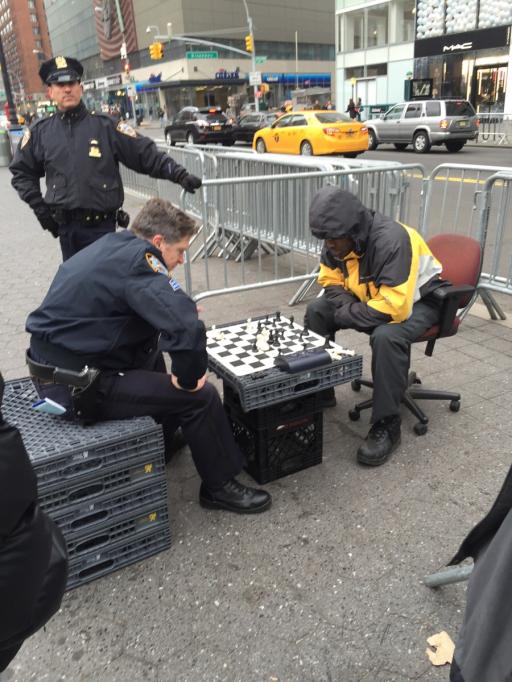
A serious confrontation!
From the looks of the board, I would say the black guy is beating the cop.
King's knight has opponent's king in check.
That doesn't end the game.
No sir, but it does put additional pressure on the opponent to wipe out the knight - maybe with the pawn on the lower right???
The white knight would have to be a bishop to have the black king in check. It's the white king that's in check by the black queen. The black queen cannot be taken by the white king because the queen is protected by a black pawn. No other white piece is in position to take the black queen. That means the white king has to move but he has nowhere to go. The white king cannot take the square occupied by the black knight (just above his rook) because he'd still be in check by the black queen. He cannot move behind his own rook because he'd be in check by the black bishop. He cannot move to the white square on the right of him because he'd still be in check by both the black queen and the black knight. He cannot move to the black square just below that because he'd be in check by a black pawn. Unless I'm missing something, that's checkmate.
Even if it weren't checkmate, white has only a king, rook, and knight (in no attack position) plus three pawns against black's queen, two rooks, two bishops and a knight plus seven pawns. One black pawn is two moves away from pawn progression to a second queen. Black would still checkmate white in roughly five moves.
So it's the unarmed black man who's beating the cop . . . badly.
Right. That's what I said above. I'm surprised you could see the board so clearly. For me even on enlarging the photo the pieces are fuzzy and I can't tell a bishop from a knight.
I thought you were right so I went and found a clearer picture. Then I set up my board to clearly see what piece was where.
Very smart to set up your own board in the same configuration. I had done that in order to understand Escher's woodcut, Metamorphosis II . That work of art shows gradual changes from one scene to another and then back to the beginning. In the bottom panel there is a depiction of a chess game in process. That particular scene is two scenes from the end . When I set up the board and placed the pieces I could play the game out. The probable start has to be the white rook taking out the black queen, then the black knight moves forward to place the white king in checkmate. Two moves to the end. I thought it was brilliant. But then all his works are brilliant.
Yes that is brilliant. The black queen is sacrificed to get the white rook to box in its own king. With no means for the white king to get out of the box the black knight moves to checkmate. However, unless that's a black bishop on the other end of the board, checkmate is seemingly avoided by capturing the black queen with the white king instead of using the white rook.
Dammmm - all I got was fuzzy fuzzy covered with fuzzy fuzz.
Concede.
Yes, it concerned me as to whether that was a black or a white bishop. However, although if it is a black bishop our scenario will work, but on the other hand it could work if the bishop is white in which case if the King or the rook takes out the black queen, the white queen moves to the other end of the board and checkmates the blocked in black king. It might have been even more clever on the part of Escher to make it difficult to discern if the bishop were black or white.
Ooops, no I'm wrong. the second scenario would take more than two moves.
If the bishop is white and the black King is blocked in, then the queen can checkmate by moving to the other end of the board as you say. However, if the black King is not blocked, then I would move the white rook to the other end of the board to check the black King. After the white king moves out of check, I would take the black knight with the white queen. My next move would be to move the white queen horizontal to the left end of the board and check the black King if he's exposed or just tighten the noose if I can't check him. The black King seems to have no pieces to mount much of a defense or offense so it's just a matter of time.
Now that I think about it, the bishop has to be black. If it were white, the attack by the black queen would fail because the white bishop would capture the black queen right after the black queen landed on the square next to the white King.
As well, if the bishop were white, how did it not take out the black queen before it moved next to the white king? The black queen had to have been in its line of fire first to arrive at that spot. The first move HAD to be the rook taking out the queen. The king could not do it because the square was protected by the bishop. The movement of the rook also enabled the knight to advance to the square to put the king into checkmate.
The only common-sense scenario has to the be the first one, with a black bishop.
I think we both knew the bishop had to be black but neither of us could pass up playing out a "what if" scenario. Thanks for the mental exercise.
The meme relies on the comprehension of multiple meanings for the word "beating".
I would just say there are multiple meanings for the word "unarmed". The black guy is not unarmed, he has a right and a left.
True.
And of course there are multiple meanings of the words "officer", "black" "man" and "watches".