
Congress rejects Obama veto on 9/11 bill; first override of his presidency


Congress rejects Obama veto on 9/11 bill; first override of his presidency
Donovan Slack, and Brian J. Tumulty 7 mins ago
WASHINGTON — The House and Senate Wednesday voted to reject President Obama's veto of legislation allowing lawsuits against foreign sponsors of terrorism in the first successful override of a presidential veto since Obama took office.
The president had vetoed the legislation Friday because he said the bill — known as the Justice Against Sponsors of Terrorism Act, or JASTA — would infringe on the president’s ability to conduct foreign policy. It was the 12th veto of his presidency.
But after an intense, lengthy push by 9/11 survivors and families of victims who want to sue Saudi Arabia based on claims the country played a role in the 2001 terror attack, even Obama’s Democratic allies on Capitol Hill voted to override his veto. The final vote tally in the Senate was 97-1. Minority Leader Harry Reid, D-.Nev., cast the sole vote against override.
"In our polarized politics of today, this is pretty much close to a miraculous occurrence," said Sen. John Cornyn, R-Texas. Democrats and Republicans in both chambers have agreed, he said, that the bill "gives the victims of the terrorist attack on our own soil an opportunity to seek the justice they deserve.".
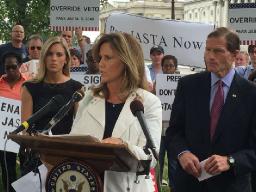
© Brian Tumulty, USA TODAY Terry Strada, national chair of the 9/11 Families and Survivors United for Justice Against Terrorism, speaks outside the U.S. Capitol on Sept. 20, 2016, urging President Obama to sign the Justice Against Sponsors of… The top Democrat on the Senate Foreign Relations Committee said he shared some of Obama's concerns but said the victims' rights outweighed them.
"We cannot in good conscience close the courthouse door to those families who have suffered unimaginable losses," Sen. Ben Cardin, D-Md., said.
White House Press Secretary Josh Earnest decried the override as the "single most embarrassing thing the United States Senate has done possibly since 1983."
"Ultimately these senators are going to have to answer their own conscience and their constituents as they account for their actions today," he said, adding that Reid showed "courage" in opposing it.
The measure was approved in the House by voice vote earlier this month and sailed through the Senate by unanimous consent in May. In recent weeks, however, there had been some pushback against the bill, which would create an exception to sovereign immunity, the doctrine that holds one country can’t be sued in another country’s courts.
Former ambassador to the United Nations John Bolton and former U.S. AttorneyMichael Mukasey, both of whom served under President George W. Bush, warned in a Wall Street Journal op-ed earlier this month that the legislation could open Americans to such suits abroad.
“An errant drone strike that kills non-combatants in Afghanistan could easily trigger lawsuits demanding that U.S. military or intelligence personnel be hauled into foreign courts,” they wrote.
Rep. Adam Smith, D-Wash., ranking member on the House Armed Services Committee, and committee Chairman Rep. Mac Thornberry, R-Texas, reached out to colleagues in recent days asking them to reconsider support for the bill. Thornberry sent them a letter saying that in addition to putting Americans abroad in legal jeopardy, the move undermines the United States’ reliability as an ally.
“We must work with other nations, even imperfect ones,” he wrote. “Requiring their government officials to participate in and give testimony in lawsuits — even when nothing has been proven — will create tensions and lead to less cooperation. I believe the net result will harm our security.
As recently as Tuesday, some lawmakers had said they may have been wavering in their support. Sen. Orrin Hatch, R-Utah, a co-sponsor of the legislation, told USA TODAY he was still “thinking about it.”
“I’m not sure that I want to — I just have to think it through, that’s all,” he said at the time.
Sen. Bob Corker, R-Tenn., said he had “concerns about what this bill’s going to mean to America.”
“This isn’t to me about Saudi Arabia, it’s the blowback to us because we’re the most involved in the world,” Corker said. “What you really do is you end up exporting your foreign policy to trial lawyers.”
Still, he conceded the veto would be “handily overridden” and said he hoped to revisit the issue when Congress returns from recess after the November elections.
Both Corker and Hatch voted to override Obama's veto.
Terry Strada, national chairwoman for 9/11 Families & Survivors United for Justice Against Terrorism, had called the override votes a “tremendous test of our democracy.”
“I mean, do we have a democracy or does Saudi Arabia own us?” she said. Her group sent a letter to Congress on Tuesday urging lawmakers to override "the President's unjustifiable veto."
Strada, whose husband was a Cantor Fitzgerald bond trader who died when the World Trade Center collapsed on 9/11, drove to Washington on Tuesday from her home in New Jersey to continue lobbying for the override vote.
In his unusual three-page veto message to Congress last week, Obama said he has "deep sympathy" for the families of victims of terrorism.
"I recognize that there is nothing that could ever erase the grief the 9/11 families have endured," Obama wrote. "Enacting JASTA into law, however, would neither protect Americans from terrorist attacks nor improve the effectiveness of our response to such attacks."
http://www.msn.com/en-us/news/us/congress-rejects-obama-veto-on-9-11-bill-first-override-of-his-presidency/ar-BBwJ8wB?li=BBnb7Kz
Tags
Who is online

98 visitors
"We cannot in good conscience close the courthouse door to those families who have suffered unimaginable losses," Sen. Ben Cardin, D-Md., said.
White House Press Secretary Josh Earnest decried the override as the "single most embarrassing thing the United States Senate has done possibly since 1983."
"Ultimately these senators are going to have to answer their own conscience and their constituents as they account for their actions today," he said, adding that Reid showed "courage" in opposing it.
“An errant drone strike that kills non-combatants in Afghanistan could easily trigger lawsuits demanding that U.S. military or intelligence personnel be hauled into foreign courts,” they wrote."
This strikes me as a non-trivial consideration.
I agree with you John, and this is an issue near and dear to me. I would have been much happier not giving them money.