If someone else has seeded this, please let me know, and I will remove this seed. LINK
For the Native Americans who gather in camps near the Standing Rock Sioux Reservation, this snake has a name.
They call it the Dakota Access Pipeline.
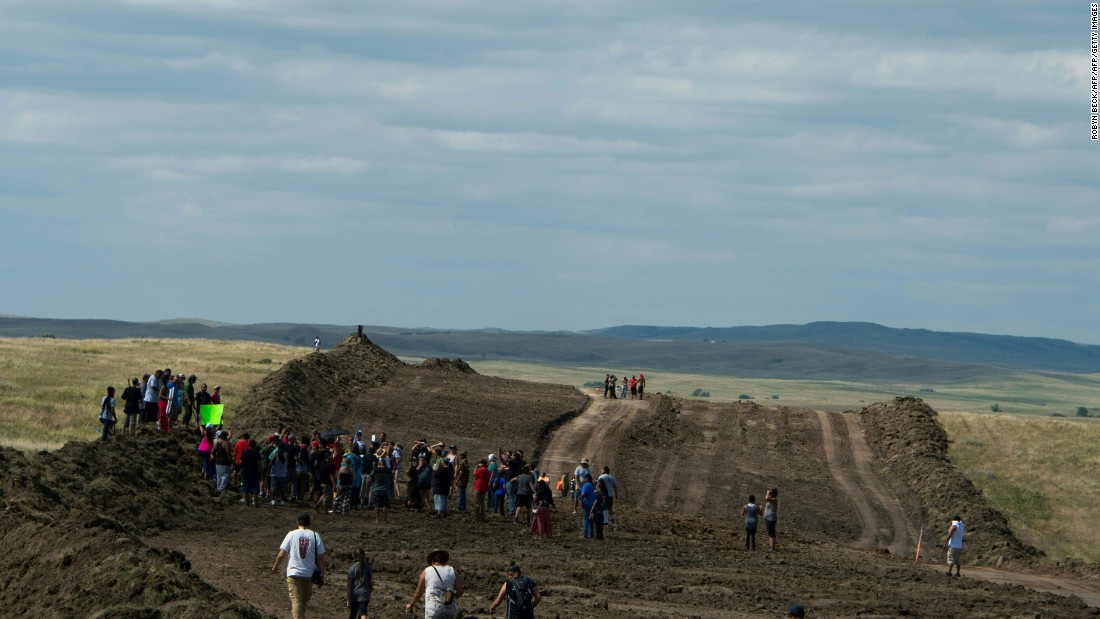
Corporate greed and the potential for an environmental disaster -- should the pipeline leak or break -- are two arguments against it. But the more complicated issue challenging Western sensibilities is about threats to sacred land.
What's at stake, and what does it even mean to be sacred?
The 'grandmother'
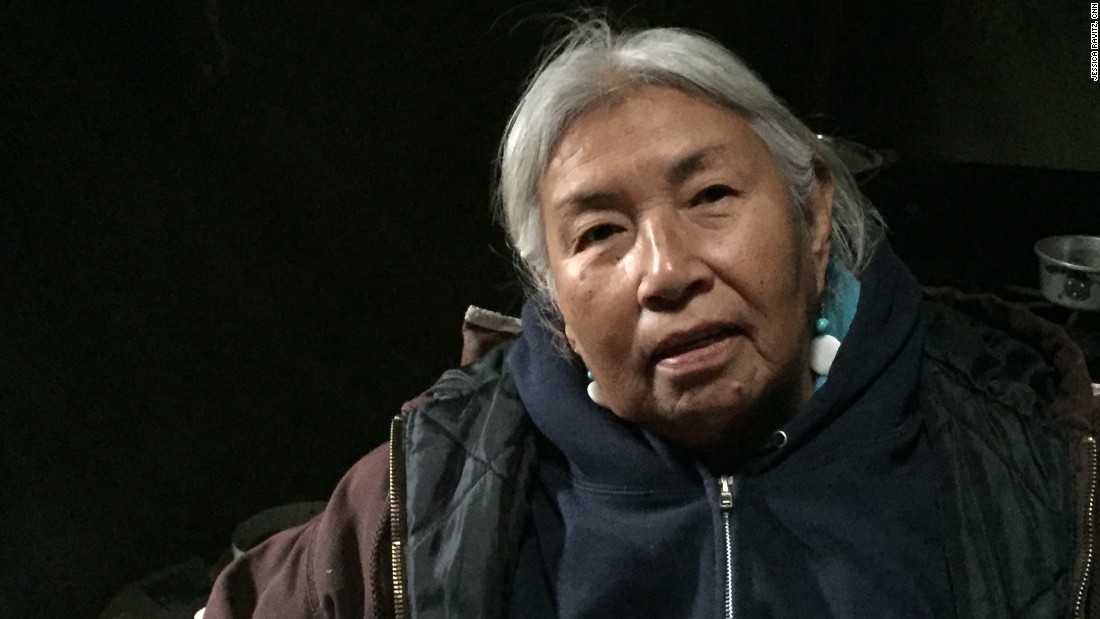
Seated in a camping chair, Faith Spotted Eagle, 68, pulls a blanket around her to ward off the cold. Though she lives on the Yankton Sioux Reservation of South Dakota, Spotted Eagle has traveled to these pipeline opposition camps to help women define their roles here.
Part of her mission as a "grandmother" -- the term used to describe wise female elders -- is to bring people back to what's sacred.
As Spotted Eagle speaks, the smell of campfires hangs in the air and the sounds of chainsaws fade away. When the sun disappears behind the clouds, the temperature plummets. The landscape is brown, the wind biting and the arrival of winter palpable.
A small airplane, presumably monitoring the camp, circles from time to time. Men behind her prop up cedar poles.
They're constructing a new tipi for a baby she's come here to welcome.
A baby girl with a symbolic name
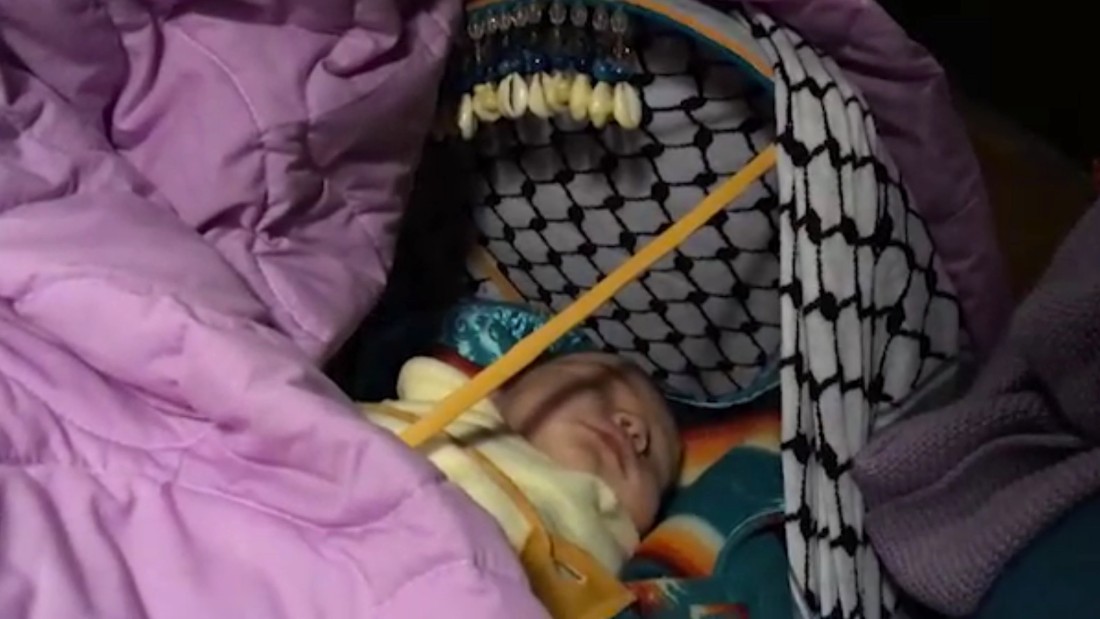
Just three weeks before, in the large army-style tent, a baby girl was born. She signifies hope in an ominous time, and her name reflects that.
She is Mni Wiconi -- Water is Life.
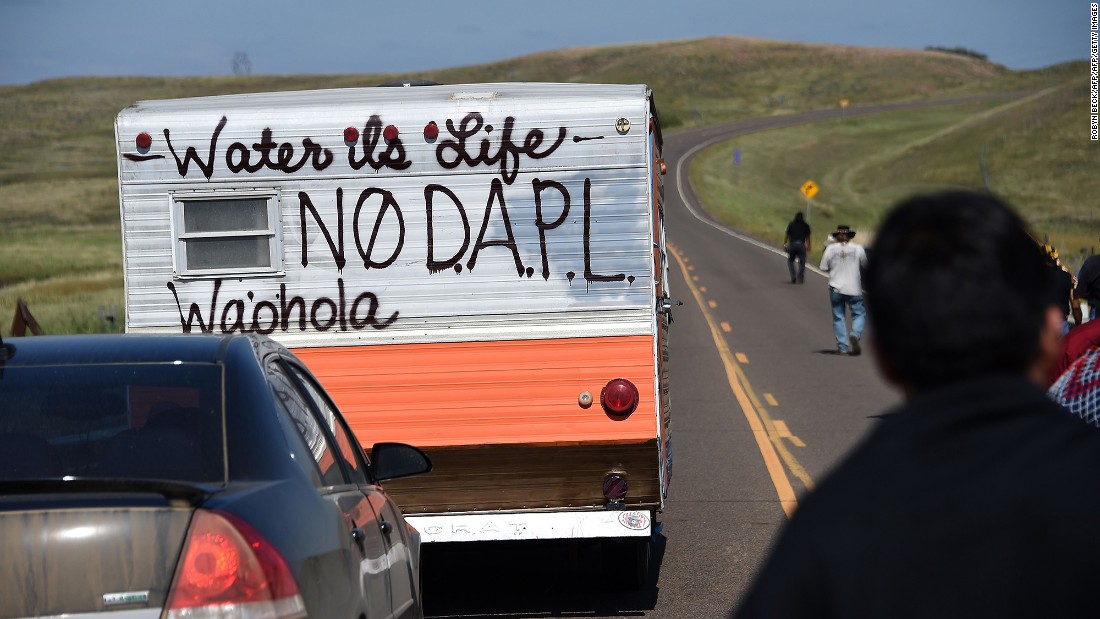
It's a name or phrase that long predates this baby's birth. It appears on T-shirts, vehicles and signs all over the camps. It is painted on purple tie-dyed fabric that hangs beneath a large dreamcatcher near a food tent across the uneven dirt road where the sacred fire, lit on day one, is guarded and still burns.
Every tribe, Spotted Eagle says, has a story about water being threatened. For this reason, people here say they're not protesters; they are "water protectors."
It's not just sacred land at stake now -- it's the water as well. The Missouri River and all the tributaries that flow into it, including the Cannonball River that runs by the camps, are sacred.
Water is the "first medicine;" it sustains us in our mother's womb, Spotted Eagle says. It's used in ceremonies to heal people. The steam it gives off in a sweat lodge, for example, purifies. Water can clean a spirit when it's bleeding. It can calm a person and restore balance.
Its power goes even deeper, though. Water, she says, also has memory. When people speak or sing to it during a ceremony, it is believed that the water holds on to what it hears and can later share what it learns.
So when a group of women gathers on the river's bank next to the crowded main camp and they hold up tobacco offerings while singing prayers, the water is listening.
"One hundred years from now, somebody's going to go down along the Cannonball River and they're going to hear those stories," Spotted Eagle says. "They're going to hear those songs. They're going to hear that memory of what happened here at this camp."
Echoes with power
Oftentimes burial grounds are the sacred sites that are threatened or destroyed. But understanding what these grounds look like, what desecration means, requires wisdom most of us don't have.
Spotted Eagle gives an example: What if the Great Sioux Nation decided to build a project through Arlington Cemetery?
"The point would be taken that you don't disturb people that have been put to rest," she says.
That's easy enough to get.
But it turns out, leaving burial sites alone is about more than simple respect. Protection prayers -- those that ensure the deceased will not be disturbed on their "walk to the spirit world" -- are recited over relatives who are buried. If spirits linger, like they might in the case of violent deaths, and are then interrupted, "They're not going to be able to find their way. They'll still roam on this land," Spotted Eagle says.
Then consider this: Who's to say where ancestors are buried? Certainly not Western archaeologists, Spotted Eagle says. She believes they are no more qualified to make these determinations than she would be if she set out to survey a
Hutterite cemetery.
"Archaeologists come in who are taught from a colonial structure, and they have the audacity to interpret how our people were buried," she says. "How would they even know?"
Over the course of thousands of years, can they identify the correct stone placements or the specific sorts of vegetation? What's sacred cannot be confirmed through their eyes, she says.
She says 38 miles of the Dakota Access Pipeline cuts through territory that still belongs to Native Americans, based on a 1851 treaty signed at Fort Laramie in Wyoming.
She still holds out hope that through legal channels her people will prevail in shutting down this pipeline.
'They're coming home'
Just as water holds memories, so does the earth.
In this same place in 1713, there was a Sun Dance -- a tribal ceremony featuring dancers, songs and the beating of a traditional drum. If you listen carefully between 3 a.m. and 4 a.m., Spotted Eagle says, you "can hear eagle whistles [used in ceremonies]. You can hear people kind of mumbling and talking and praying."
Those echoes from the land have a power that draws people, allowing them to connect with their roots.
And you can see that across the camp.
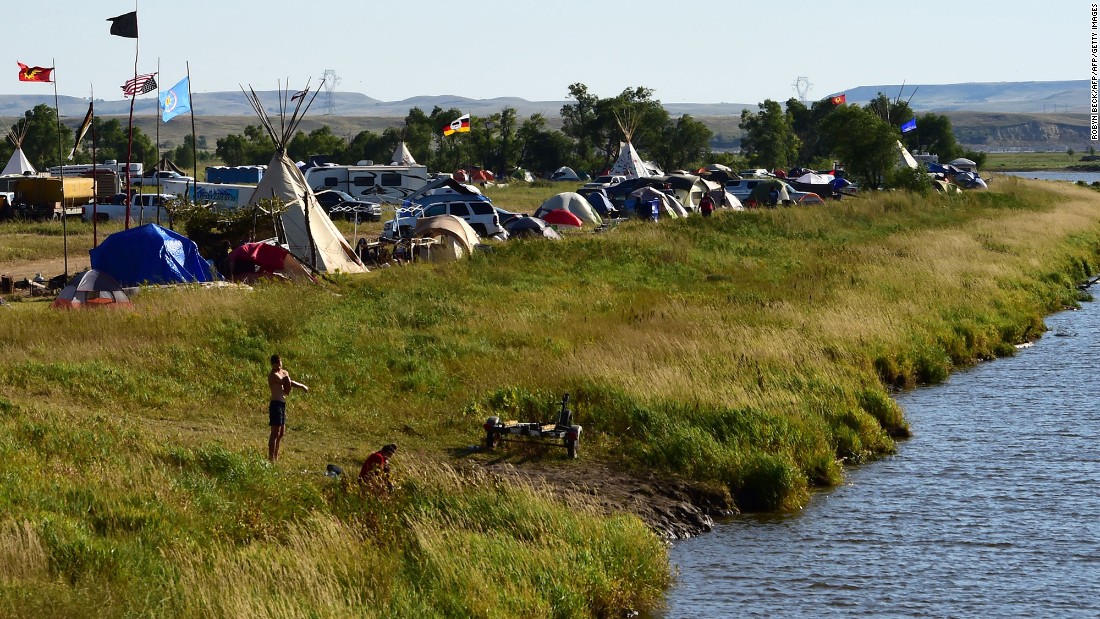
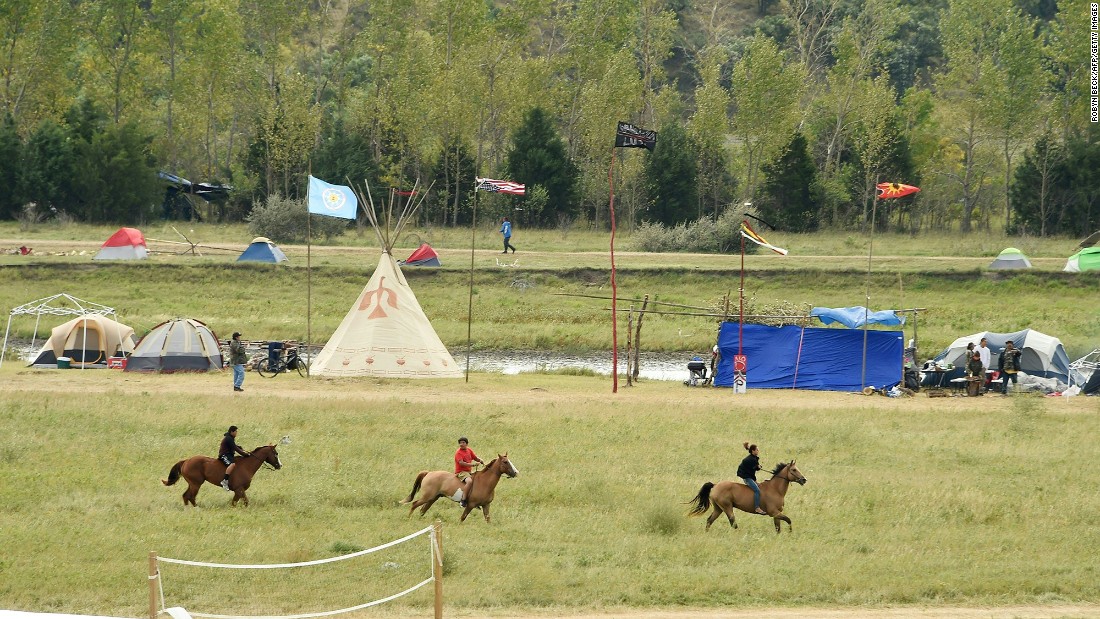
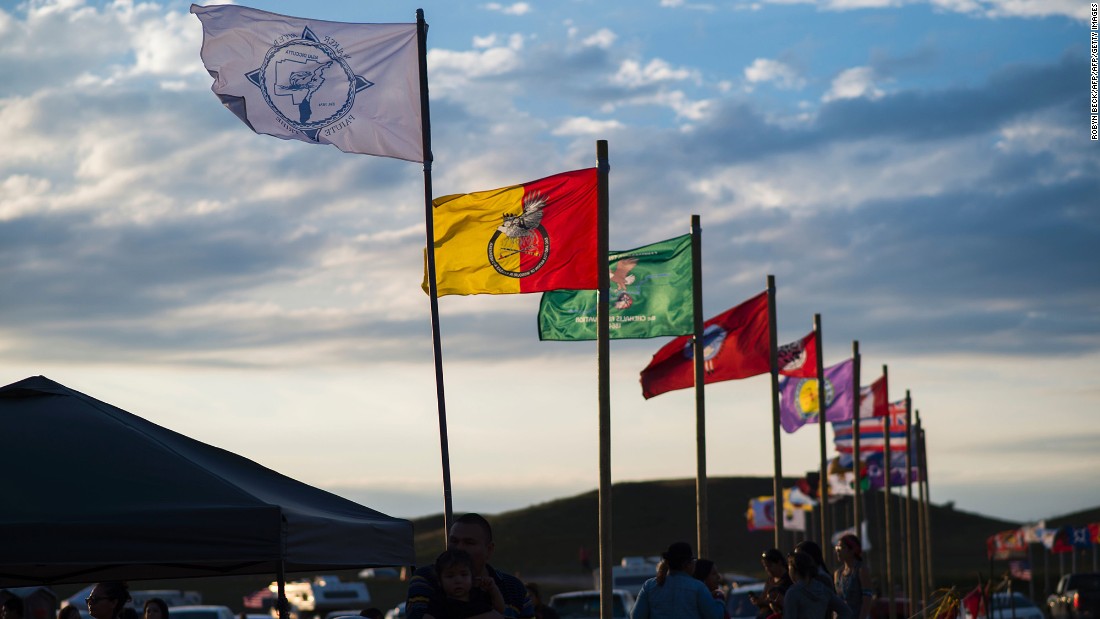
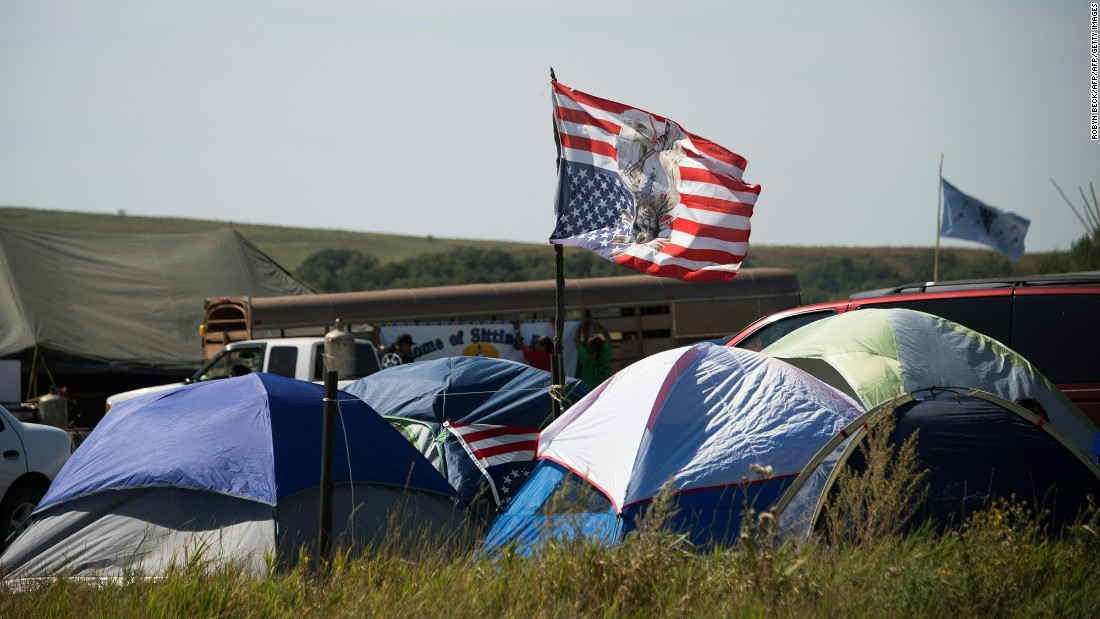
Flags representing supporters and ideas line the road and dot the landscape. Ones for the Leech Lake Band of Ojibwe and the Tulalip tribes fly next to an RV bearing the sign, "Muslims Standing with Standing Rock Sioux." There's a gay pride rainbow flag, a POW/MIA flag and an American flag hung upside down.
Some are living in an old school bus painted with blues, greens and purples. There are high-end tents, campers and tipis, and failed structures with tarps blowing in the wind. One open tent offers winter jackets hanging on metal racks. Another advertises with its bright yellow sign: "Free feminine hygiene & baby" products.
A man with a microphone announces a training in "direct action principles," the rules to live by in camp that include being "peaceful and prayerful."
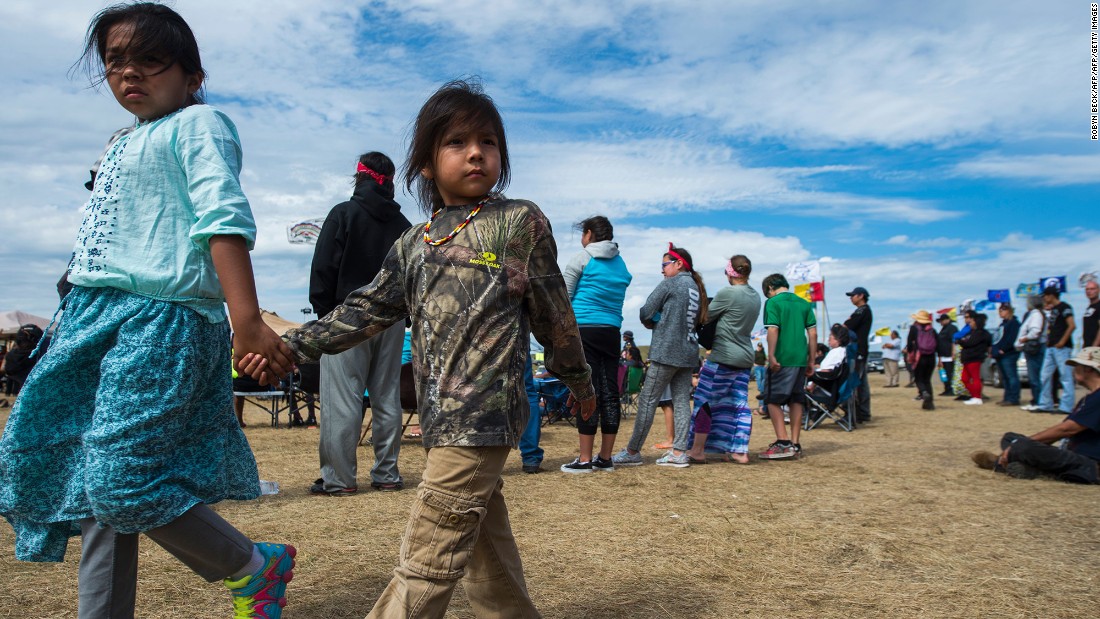
Many of the Native Americans who have come here in recent months, Spotted Eagle says, are arriving from urban areas around the country.
Whether they know it or not, they likely carry an ancestral suffering they've inherited from generations past, says Spotted Eagle, who also works as a PTSD therapist serving veterans and tribes.
It's important for people to face and know who they are.
By building relationships on this sacred land at this crucial time, "they're coming home," experiencing ceremonies like many haven't before, Spotted Eagle says.
They signal a "rebirth of a nation."
Like an umbilical cord
The new women's lodge has been completed for the baby girl.
Like all tipis, this one has 13 poles -- the 13th being the woman's pole. Attached to it is the canvas, which wraps around like a skirt, enfolding the tipi "just like the woman enfolds her family," Spotted Eagle says.
The rope hanging down inside anchors the tipi to Mother Earth, much like an umbilical cord.
Spotted Eagle helps pass on sacred understanding, but she's also a longtime activist. She railed against the Vietnam War, helped develop the first Native women's shelter and was on the front line with other grandmothers in the battle against the Keystone XL Pipeline.
The people behind the Dakota Access Pipeline, the capitalists who she says cannot seem to get enough, make her think of one of the gifts the new baby, Water is Life, will receive.
After birth, baby girls are given beaded turtles. Inside, tucked away and sewn in, they keep their "belly buttons," meaning their fallen-off umbilical cord stumps.
It's a custom that reminds Native Americans of their connections, and perhaps it explains what is wrong with the forces behind the pipeline, Spotted Eagle says.
"When people don't know where their belly buttons are, they don't know where they belong," she says. "So they keep digging all their lives."
Water is Life shouldn't have that problem. It will be hard to forget the sacred place from where she came.




All of us have land that we hold sacred in our hearts. This helps explain how the Standing Rock Sioux feel about their lands. I can only agree with them!
How would we feel if there was a pipeline going through Gettysburg? I would feel desecrated. I would feel that no amount of money is worth this. I would feel that nothing could ever make up for the hurt of being ignored.
I stand with the Standing Rock Sioux!
Dear Friend Dowser; As do I and many others.
As a proud Orthodox Jewish Rabbi I know just how Sacred is the soil, people, history, culture and all of Israel.
That is the origin and spiritual center of my People.
I know how these people feel.
The history of Indigenous peoples in North America reads very much like the history of the Jewish People indeed.
Great article.
Thanks for very for posting it.
Gratitude to all those who commented here in support of it,. and those who fight for their land and water rights as well.
Good show all.
Peace, and Abundant Blessings Always.
Enoch.
The video didn't transfer over, just the picture. So, here is the video!
Great video Dowser.
Good article Dower, showing the other side of the fight, and the history of the land.
Thanks, Kavika. I think there are a few of us here who have trouble with the concept of sacred land... Perhaps this will help.
Dowser - there are so many that have difficulty understanding that we have a different concept of spirituality - because of the way we've lived, what we've been taught, what we've experienced, and how we interpret life.
This is a beautiful thread - thank you so much.
My pleasure! I, too, need to understand my own feelings...
Beautiful article; thank you Dowser.
Water is sacred. Don't think so? Ask someone in want of water.
Exactly!
Wonderful article Dowser. It does show how a people are tied to a land. We as Americans came here for land and took land from the original inhabitants, because they didn't understand the concept of owning land. It didn't mean that the land wasn't part of their legacy. Finally, they are standing up for the one thing of value to them... the land and water that will be passed down for generations to come. This article says it all.
Actually, this article is proof of why the Standing Rock Sioux are at the breaking point over this issue.
See the Standing Rock Sioux’s ancestral land shrink over 165 years
The Standing Rock Sioux’s history is full of broken promises — their land eroded away over the past 165 years.
As the tribe fights to stop the Dakota Access Pipeline, click through our interactive map to see how from the first treaty, in 1851, the boundaries of the tribe’s land have changed.
Boundaries were quickly shrunk in the Treaty of 1868 as settlers and developers pressed into Lakota/Dakota territory.
When the Lakota/Dakota people would not agree to a new treaty, Congress stole additional land, including the gold-filled Black Hills.
Lakota/Dakota lands were fractured and dispersed into smaller chunks, as development pressure by non-Indians continued.
The U.S. Army Corps of Engineers' Oahe Dam on the Missouri River in 1958 flooded much of the last best agricultural lands the Lakota/Dakota had.
Today the Lakota/Dakota people's reservation is reduced to just fragments of their ancestral lands.
http://www.seattletimes.com/seattle-news/environment/watch-the-standing-rock-siouxs-ancestral-land-shrink-over-165-years/?utm_source=RSS&utm_medium=Referral&utm_campaign=RSS_all
A number of illegal acts, so much for a country of laws.
Laws only count, if you are not Indian.
SCOTUS, in 1977, stated that the land grab was illegal and the land belongs to the tribes/nations. Congress couldn't see giving the land back, so they offered money instead. The tribes/nations denied their offer and are STILL demanding that the land be returned.
So, technically, the land STILL belongs to the tribes/nations.
Thanks, 1st.
I think the land belongs to the Sioux. How the pipeline people got a piece of it is beyond me...
I have always felt a tie to the land that my ancestors farmed... I'm glad that the land "remembers", and maybe will welcome me when I go to visit. Fanciful? Perhaps, but also true. I also like the thought that the water carries our stories... It makes me want to go to the Ohio River today and ask it to tell Owensboro "hello"...
The weird thing is that there has always been an over-hanging cliff in Hawesville, where my great grandmother grew up, that I've always been drawn to. So was my mother... Both of us wanted to go there to play! I recently found out that my great-grandmother's aunt, who reared her after her poor mother's death, lived nearby, and, very likely, my great-grandmother played there. Her house backed up to the cliff, a bit further down the road.
Sometimes, we have to listen to our hearts and what it is telling us. There is a lot more to this life than we know...