
Canadian leader spotlights his own nation’s injustices at UN


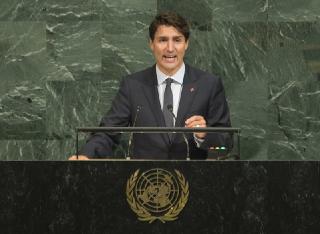
“For indigenous peoples in Canada, the experience was mostly one of humiliation, neglect and abuse” under successive governments that didn’t respect their rights, he said.
“We are greatly ashamed,” Trudeau said. “And for far too many indigenous people, that lack of respect for rights still persists today.”
Trudeau’s speech, which detailed measures Canada has taken to right the wrongs, struck an unusual tone at the annual gathering of presidents, prime ministers and monarchs, many of whom use their U.N. speeches to boast about their countries, complain about others or discuss global flashpoints.
It is rare for a leader of Canada, a nation that prides itself on its image of tolerance and social harmony, to talk about the plight of the country’s native people in a global forum.
Still, General Assembly speeches are often designed to appeal to audiences at home, and “talking about indigenous issues and women fits with Trudeau’s domestic political and policy agendas,” said University of Toronto political science professor Nelson Wiseman.
Trudeau said after his speech that he was trying to send a strong message of accountability by acknowledging Canada’s mistakes.
“If there are things we are not doing right at home, then we need to take responsibility for it,” he said. He noted that he had sometimes pressed other countries to improve their human rights records, “and the response has been, ‘Well, tell me about the plight of the indigenous people in Canada.’ ”
Many indigenous people are frustrated by the disparities between their lives and those of their fellow Canadians.
Indigenous people make up 4.3 percent of Canada’s population. But the proportion of indigenous adults in jail or prison is about nine times higher than it is among other Canadians. Youth suicide rates are far higher and life expectancy is five to seven years lower than for non-indigenous Canadians.
Indigenous people in Canada didn’t have the right to vote in federal elections until 1961 and were not allowed to leave a reservation without a permit until 1951. In much of the last century, 150,000 indigenous children were taken from their families to state-funded residential schools where they were barred from speaking native languages and forced to convert to Christianity. Many were beaten or abused, and up to 6,000 were said to have died, before the policy ended.
Trudeau pointed to recent progress. Investments have made water safe to drink in more than two dozen indigenous communities, and nearly 4,000 new homes are being built, he said.
Thanks for coming by!
Tags
Who is online

92 visitors
It may be a baby step, but it is still a step in the right direction!
To all those who wish to puke, etc., about Native American articles, just please don't bother to read it.
Some don't like "native American" articles because they contain an either or. If we acknowledge injustices against the indigenous of North America it is inescapable that the perpetrators of those injustices will be named at some point. Some of the group of historical perpetrators can't face facts.
Well, what is, is. It's history. No one can change it...
Thank you Justin Trudeau.
Exactly! A brave man!
When you read actual statistics and you read specific injustices the impact is sobering. I ask myself; "how were these things considered okay and normal"?
I wonder the same thing, Dave. How could people think this was the thing to do?
This is the story of Francis Pegahgabow (Ojibwe First Nation) you was the greatest sniper in Canadian history. Not a citizen who fought in WWI, but fought for his people to bring equality to the First Natiions of Canada.
Courtesy University of Michigan Press
Sounding Thunder cover
Sounding Thunder: Francis Pegahmagabow’s World War 1 Stories
Awarded for bravery, World War 1 hero Francis Pegahmagabow was a sniper who revered life
More than 20 years in the writing, Brian D. McInnes’s Sounding Thunder: The Stories of Francis Pegahmagabow ( Michigan State University Press , October 2016) is an extraordinary book.
McInnes, a member of the Wasauksing First Nation and a professor of English at the University of Minnesota Duluth, is a great-grandson of Pegahmagabow (1889–1952), Ojibwe, who served for four years in World War I and became the Canadian aboriginal soldier most decorated for bravery and the most skilled sniper in North American military history .
But McInnes has chosen to emphasize—his success as a warrior, and the lifelong pride he took in that notwithstanding—that Pegahmagabow had a deep reverence for life , an abiding commitment to his culture and language, and an unassailable love for his wife and children, six of whom survived to adulthood.
Stories, says McInnes, are among the cornerstones of Ojibwe life, and Pegahmagabow was a tireless storyteller. The stories here were recounted to McInnes by his great-grandfather’s two youngest children, Marie (Pegahmagabow) Anderson and Duncan Pegahmagabow, himself “an exceptionally gifted storyteller—renowned throughout many parts of Ojibwe country for his ability to tell a wide variety of stories, including legends, humorous anecdotes, philosophical accounts, and historical reports. His remarkable memory allowed him to readily recall details of conversations that had taken place many years prior.”
In the mid-1990s, McInnes taped conversations with Duncan and Marie about the family’s history and Francis’s stories. The stories are presented in Ojibwe followed by an English translation, for part of McInnes’s purpose in writing the book is to make an irrefutable plea for the preservation of Native languages and the intimate connection between story, place, language, being and lifeways.
“Like his father, Duncan believed that even contemporary business should be discussed in the Ojibwe language so that a calmer and more respectful discourse might ensure,” he writes. “As a spiritual language, Ojibwe provided the people with a special connection to their identity and purpose. Only through language, Duncan believed, could we be sure that our thinking was reflective of the values and teachings given to the Nishnaabe people in the beginning.”
Culture, McInness maintains, changes faster than language.
“Ojibwe stands as a valuable source of cultural perspective and practice,” he writes. “The anecdotes, stories and teachings of the people become ways of sharing the deeper meaning of the language and culture that, in its truest and total expression, reveals the quality and character of the Nishnaabe people’s soul.”
But Francis’s stories, in actuality, comprise only a small fraction of this book. McInnes’s gift is that he has told a different kind of story, neither dibaajmowinan, a story of everyday life, nor aadzookaanan, a traditional legend, but rather a careful and extremely rich tapestry that interweaves the personal story of Pegahmagabow’s life and the public and historic events that formed its context.
Pegahmagabow lived in a time of transition for the indigenous people of this continent.
“He would be among the last to grow up with the older generations whose lifeways were not significantly influenced by settler cultural expectations, institutions and implements,” writes McInnes.
He was a political activist and Native rights leader, serving as the Supreme Chief of the [Canadian] National Indian Government. He fought for Indian self-government, a notion so radical at the time that an Indian agent accused him of having dementia.
The portrait that emerges is of a gentle man who took up arms—and words—to fight for what was so central to his life and his people that he could not do otherwise. McInnes does a remarkable job of conveying this with an unsentimental compassion for his people combined with unemotional and factual statements of what has happened to them over the course of the past 100 years. Rather than express justifiable outrage, for instance, McInnes simply states the facts: “With the old-growth forests cut down, the sacred territories of the Ojibwe seized and sold off, and virtually every aspect of life regulated by the Indian Act of 1876, Nishnaabe society was irrevocably changed.”
A strident voice could be expected, but McInnes has chosen to speak in the same measured, understated voice that is evident in his great-grandfather’s stories. Basing his work on oral history, painstaking research into the written record, however flawed, and his own experience as a member of a First Nation, McInnes has written a book that would make an invaluable contribution to any classroom in which the history of the North American continent is taught. And it must be of interest to anyone, Native or non-Native, who wants to learn about the history of the Indigenous Peoples of the Americas.
“Many details of his [Pegahmagabow’s] life have irretrievably scattered to each of the four winds,” McInnes writes. “Yet much of his story remains known to his family and community, and it is a task of the present to ensure this much survives into the future. Such is the way we should honor our ancestors.”
And that is exactly what McInnes has done.
This story was originally published on June 16, 2017.
I have said, as a Canadian patriot who has been an expat for 11 years that the only good thing Trudeau has done is to speak up about Canada's injustices to its indigenous people and to do something meaningful about it, but unfortunately that's the only thing he can brag about, because otherwise he is a child-Prime Minister who does not have the experience or philosophy to benefit Canada. I do not support him or his party for the directions (other than benefiting the indigenous people) he has taken that I believe are detrimental to Canada, and I'm glad I'm not there, but am concerned about the safety and welfare of my daughter, who is.