
Trump is betting American families are willing to pay for his trade war

 S E E D E D C O N T E N T


President Trump speaks to reporters on the North Lawn of the White House
on June 15, shortly after he announced new tariffs on China.
Evan Vucci/AP
President Trump's decision Friday to put hefty tariffs on $50 billion worth of Chinese products means costs are going up for a lot of goods. A tariff is another word for a tax, and Trump just announced significant new taxes on 1,102 items.
This is no longer a war of words between Trump and China. There are actual economic consequences now. The result is that Americans will almost certainly face higher costs as companies pay more for parts they need to build cars, dishwashers and tractors, and then firms turn around and pass those higher prices onto consumers.
All of Trumps tariffs so far — on China, on steel and aluminum, on washing machines and on solar panels — will end up costing the average U.S. family $80 a year, Moody's Analytics estimates in a report to be released next week. If Trump continues to pile tariffs on China (he has threatened to do another $100 billion) and China retaliates, then the cost to the average family would rise to $210, according to Mark Zandi, chief economist at Moody's Analytics. Wall Street bank Goldman Sachs has also forecast rising prices from the tariffs.
The Tax Foundation, a think tank that supported Trump's tax law, predicts that more than 45,000 jobs will be lost because of the tariffs Trump has issued so far. They also forecast a small hit to the economy and wages. Analysts Kyle Pomerleau and Erica York argue that the tariffs will hurt the economy because prices will rise, reducing profits for companies and costing consumers more. Alternatively, tariffs could cause the U.S. dollar to rise, which usually makes it more difficult for American companies to sell their products abroad, another potential hit to jobs and the economy.
The effects of a trade war are difficult to fully predict, in part because how much pain they'll cause the United States depends on how other countries respond. And, of course, the worst case may not come to pass if Trump and China's President Xi Jinping strike a deal soon. But the bottom line is that a lot of different organizations, including ones that typically lean to the right, are all saying costs are probably going up from these tariffs.
Even Trump agrees with that.
In a rally in late April in Michigan , he told supporters to be prepared for “a little pain” in this fight with China and the European Union. He actually issued the warning twice.
First he said: “There may be a little pain for a little while, but ultimately for my farmers, I love my farmers. They are great patriots. … You're going to do much better.”
Then Trump said: “When we lose $500 billion a year … in a trade deficit. When we lose hundreds of billions of dollars in intellectual property theft, not only China but others, we have to stop it. We can’t allow this to happen. So in a certain way, I call people patriots because … short-term you may have to take some problems. Long-term, you’re going to be so happy. You’re going to be so happy.”
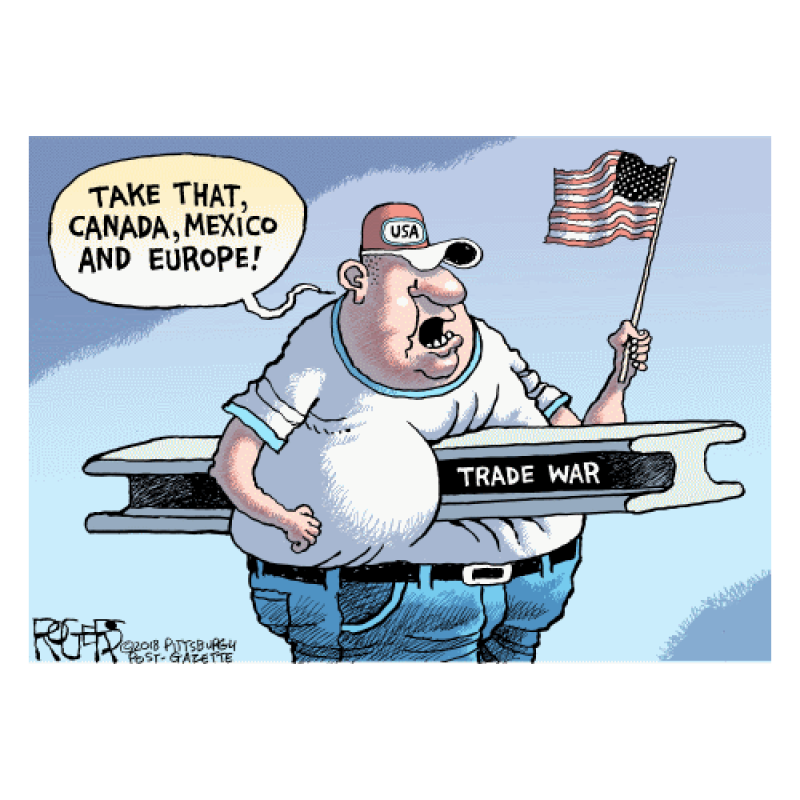
Trump is calling on Americans to pay higher prices for a while because he thinks it will be worth it if he gets concessions from China and the E.U. It's what economists and business leaders call a cost-benefit analysis, and Trump is arguing it will be worth it in the end.
But plenty of people are running that cost-benefit calculation in their head and saying it is not worth it. A slew of businesses and Republicans in Congress are urging Trump to stop. They say these tariffs are harming too many U.S. companies and families. That's because higher costs don't hit everyone equally.
The reality is every family isn't going to pay $80. Some families are likely to pay hundreds or thousands or be the ones losing jobs and livelihoods, while most others probably won't notice the price increases.
For example, “laundry equipment” prices have shot up 17 percent since Trump put tariffs on washing machines in January . Families that are buying a new washing machine now probably aren't happy, but the majority of Americans aren't shopping for a new washing machine and may not care much.
Trump's latest round of tariffs is hitting a lot of farm equipment, such as combines used in harvesting and parts for milking machines. For America's 2.1 million farms, that could hurt a lot, especially since China is retaliating by putting tariffs on a lot of U.S. agricultural products. But the rest of the United States might not notice.
China, Canada and the E.U. have targeted politically vulnerable parts of America with their retaliatory tariffs. It's another reason many Republicans are urging Trump to back down. They also say that growth, which is picking up after the Republican tax cut and extra government spending, is now in doubt because of the tariffs.
Gary Cohn, Trump's former top economic adviser, went as far as to say Trump's tariffs could wipe out the entire economic gains of the tax cuts at a Washington Post Live event this week.
But Trump and (most of) his top advisers say this is about winning the big economic war of the 21st century. China and the United States are fighting for dominance in technology and biotechnology. Trump and his team say the United States won't win if China keeps stealing American intellectual property and technology secrets. Years of talks have only made it worse, they say, and it's time for action.
That’s why Trump told farmers and blue-collar supporters in Michigan to buckle up for a bumpy ride for a while. But he also told them it will be worth it in the end.
Trump's top trade negotiator, U.S. Trade Representative Robert E. Lighthizer, told Fox Business a similar story Friday morning, calling the new tariffs “very moderate.”
“We hope that this leads to further negotiations. We hope it leads to China changing its policies,” Lighthizer said.
But Trump is making a gamble. If he does end up getting China to concede on big issues, such as IP theft, many will probably say it was worth it. But for the farmer or the small auto parts manufacturer that may have a terrible year or go out of business during the tariff battle, it probably won't feel worth it. And if China doesn't give in some, Trump will have upset many nations around the world with tariffs and have little to show for it but upset consumers — and potentially upset voters.
Tags
Who is online
137 visitors
So... America must make economic sacrifices in order to win a trade war which (hopefully) will eventually bring economic advantages...
Makes sense, in a Tea Party sort of way.....
I'm seeding this article because I find it worthy of the time necessary to read it and to think about it. I will not be participating in any conversation here, but if you would like to discuss it with me, please contact me via Chat or Private Note - I will reply.
At least Obama did one thing when he was President. As a requirement for any money received from the American citizens during his stimulus (ARRA) it was required to use steel from the USA.
First off, if anyone thinks China will all the sudden not make their own crap, one is mistaken. People complain about intellectual property theft yet would be upset if all the sudden there is no longer cheap flatscreen televisions to buy.
Second, it was shown that trump had a lot of his MAGA crap made in China.
Third, some in the article are correct. It is the middle class and the poor that will end up paying for all of this.
E.A so Who Stole the Printing Technology? The Silk manufacturing?
Who Forced Drugs on a Whole Country?
Sounds like the great US of A.
E.A LOL a little study will go a Long way:
Printing see the Gutenberg press.
Silk worm theft see Japan and Great Britain
Forcing the Drugs on and to the Chinese People see " Opium Wars " On that the US of A did have a minuscule part
I guess he forgot about the Maine lobster fishermen who he just fucked. China is matching Trump's tariffs dollar for dollar, and they started with Maine lobsters and other agricultural products, that will most likely cause perhaps more than what Trump calls "a little pain" to his beloved farmers. Xi Jinping will not back down. Trump is raising tariffs on 50 million dollars of goods, Xi is matching it, and if he puts on another 100 million dollars as he has threatened, Xi will match that as well - China is not a third world country, and although its economy may have slid slightly lately, it isn't exactly a financially destitute and desperate nation.
I personally am getting screwed by Trump two different ways. If what he does is causing prices to rise in China, I'm going to suffer. If he is raising tariffs on Canadian goods and screwing with NAFTA, the Canadian dollar will drop in value and have a lesser exchange rate with the Chinese yuan, then my Canada pension is going to be worth less. I'm going to suffer from both directions because of him.
The only thing Trump has done so far that I support, and it is more than any POTUS has done before him, is what he has done and is doing for the benefit of Israel. Otherwise, he is causing me, and what appears to be a lot of other people, and I bet a lot of you American NT members, a lot of problems.