
California Burning: How the Greens Turned the Golden State Brown – American Greatness


 S E E D E D C O N T E N T
I n October 2016, in a coordinated act of terrorism that received fleeting attention from the press, environmentalist activists broke into remote flow stations and turned off the valves on pipelines carrying crude oil from Canada into the United States. Working simultaneously in Washington, Montana, Minnesota, and North Dakota, the eco-terrorists disrupted pipelines that together transport 2.8 million barrels of oil per day, approximately 15 percent of U.S. consumption. The pretext for this action was to protest the alleged “catastrophe” of global warming.
These are the foot soldiers of environmental extremism. These are the minions whose militancy receives nods and winks from opportunistic politicians and “green” investors who make climate alarmism the currency of their political and commercial success.
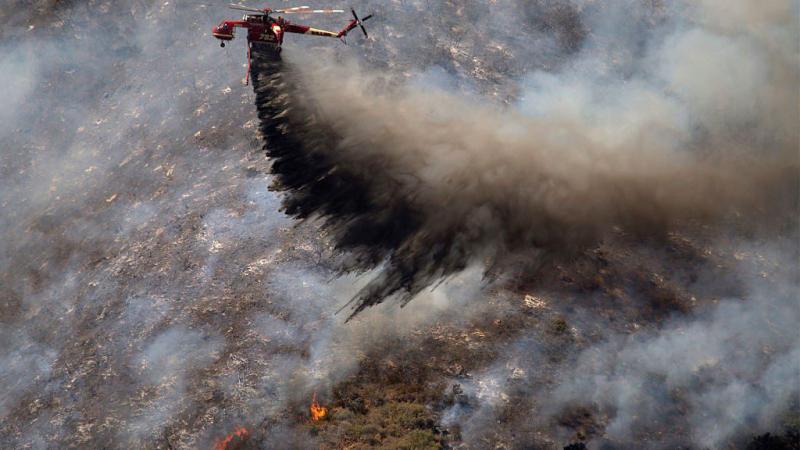
More recently, and far more tragic, are the latest round of California wildfires that have consumed nearly a quarter million acres, killed at least 87 people, and caused damages estimated in excess of $10 billion .
Opinions vary regarding how much of this disaster could have been avoided, but nobody disputes that more could have been done. Everyone agrees, for example, that overall, aggressive fire suppression has been a mistake. Most everyone agrees that good prevention measures include forest thinning (especially around power lines), selective logging, controlled burns, and power line upgrades . And everyone agrees that residents in fire prone areas need to create defensible space and fire-harden their homes.
Opinions also vary as to whether or not environmentalists stood in the way of these prevention measures. In a blistering critique published earlier this week on the California-focused Flash Report , investigative journalist Katy Grimes cataloged the negligence resulting from environmentalist overreach.
“For decades,” Grimes notes, “traditional forest management was scientific and successful—that is until ideological, preservationist zealots wormed their way into government and began the overhaul of sound federal forest management through abuse of the Endangered Species Act and the ‘re-wilding, no-use movement.’”
U.S. Representative Tom McClintock, whose Northern California district includes the Yosemite Valley and the Tahoe National Forest, told Grimes that the U.S. Forest Service 40 years ago departed from “well-established and time-tested forest management practices.”
“We replaced these sound management practices with what can only be described as a doctrine of benign neglect,” McClintock explained. “Ponderous, byzantine laws and regulations administered by a growing cadre of ideological zealots in our land management agencies promised to ‘save the environment.’ The advocates of this doctrine have dominated our law, our policies, our courts and our federal agencies ever since.”
Grimes goes on to outline the specific missteps at the federal level that led to America’s forests turning into tinderboxes, starting in the Clinton Administration and made worse, thanks to activist judges, by thwarting reforms attempted by the Bush Administration, and accelerating during the complicit Obama presidency.
All of this lends credence to Interior Secretary Ryan Zinke’s fresh allegations of forest mismanagement . But what really matters is what happens next.
Institutionalized Environmental Extremism
California’s 2018 wildfires have been unusually severe, but they were not historic firsts . This year’s unprecedented level of destruction and deaths are the result of home building in fire prone areas, and not because of wildfires of unprecedented scope. And while the four-year drought that ended in 2016 left a legacy of dead trees and brush, it was forest mismanagement that left those forests overly vulnerable to droughts in the first place.
Based on these facts, smart policy responses would be first to reform forest management regulations to expedite public and privately funded projects to reduce the severity of future wildfires, and second, to streamline the permit process to allow the quick reconstruction of new, fire-hardened homes.
But neither outcome is likely, and the reason should come as no surprise—we are asked to believe that it’s not observable failures in policy and leadership that caused all this destruction and death, it’s “man-made climate change.”
Governor Jerry Brown is a convenient boogeyman for climate realists, since his climate alarmism is as unrelenting as it is hyperbolic. But Brown is just one of the stars in an out-of-control environmental movement that is institutionalized in California’s legislature, courts, mass media, schools, and corporations.
Fighting climate change is the imperative, beyond debate, that justified the Golden State passing laws and regulations such as California Environmental Quality Act , the Global Warming Solutions Act of 2006 , the Sustainable Communities and Climate Protection Act of 2008 , and numerous others at the state and local level. They make it nearly impossible to build affordable homes, develop energy, or construct reservoirs, aqueducts, desalination plants, nuclear power plants, pipelines, freeways, or any other essential infrastructure that requires so much as a scratch in the ground.
Expect tepid progress on new preventive measures, in a state so mired in regulations and litigation that for every dollar spent paying heavy equipment operators and loggers to do real work, twice that much or more will go to pay consultants, attorneys, and public bureaucrats. Expect “climate change” to be used as a pretext for more “ smart growth ,” which translates into “ stack and pack ,” whereby people will be herded out of rural areas through punishing financial disincentives and forced into densely populated urban areas, where they can join the scores of thousands of refugees that California is welcoming from all over the world.
Ruling Class Hypocrisy
Never forget, according to the conventional wisdom as prescribed by California’s elites, if you don’t like it, you are a climate change “denier,” a “xenophobe,” and a “racist.”
California’s elites enjoy their gated communities, while the migrants who cut their grass and clean their floors go home to subsidized accessory dwelling units in the backyards of the so-called middle class whose taxes pay for it all. They are hypocrites.
But it is these elites who are the real deniers.
They pretend that natural disasters are “man-made,” so they can drive up the cost of living and reap the profits when the companies they invest in sell fewer products and services for more money in a rationed, anti-competitive environment.
They pretend this is sustainable; that wind farms and solar batteries can supply adequate power to teeming masses crammed into power-sipping, “smart growth” high rises. But they’re tragically wrong.
Here the militant environmentalists offer a reality check. Cutting through their predictable, authoritarian, psychotically intolerant rants that incorporate every leftist shibboleth imaginable, the “Deep Green Resistance” website offers a remarkably lucid and fact-based debunking of “ green technology and renewable energy .” Their solution, is to “create a life-centered resistance movement that will dismantle industrial civilization by any means necessary .”
These deep green militants want to “destroy industrial civilization.” At their core, they are misanthropic nihilists—but at least they’re honest. By contrast, California’s stylish elites are driving humanity in slow motion towards this same dire future, cloaked in denial, veiled coercion, and utopian fantasies.
This is the issue that underlies the California wildfires, what causes them and what to do about them. What is a “sustainable” civilization? One that embraces human settlements, has faith in human ingenuity, and aspires to make all humans prosperous enough to care about the environment, everywhere? Or one that demands Draconian limits on human settlement, with no expectation that innovation can provide solutions we can’t currently imagine, and condemns humans to police-state rationing of everything we produce and consume?
That is the stark choice that underlies the current consensus of California’s elites, backed up by dangerous and growing cadres of fanatical militants.
Tags
Who is online


102 visitors
America's forests have turned into tinderboxes due to anthropogenic global warming.
California doesn't want to address the real issue, that they have too damn many people living in an area that doesn't have the resources to support them.
Until California controls their population growth they will be more subject to intense environmental changes; and not being able to cope with them.
How would California control their population.
Texas currently has 28 million residents with growth projected to reach 40 million by 2050. Should Texas control it's growth and how would either state do that?
Water issues are a major concern in most of the west and Texas as well. Large populations of both states drain the resources and create problems.
Growth on north Texas will be limited due to lack of fresh water...
One of the best ways is to fight socialism. Return the responsibility for the children back where it belongs to the parents. Then they will think twice about breeding like rabbits if they are responsible for the cost of the kids. This will also decrease immigration which contributes to the problem.
Here is the problem with that solution Dean...If we didn't have immigration and a decent birthrate we'd be in the same situation that Japan is in...On the up side if we did follow your solution we'd have to increase taxes to compensate....
I like it.
Did you hear me say that population control isn't a problem elsewhere? It is a problem in the US as a whole. We consume far more than we can produce; and our numbers are going nothing but up. Uncontrolled illegal immigration is a large part of the problem; anchor babies are another; and the fact that the poor produce more offspring than the rich.
China is facing the same situation and has taken draconian measures.
I doubt the US is ready to accept near those policies. We cannot have open borders; and unsustainable birth levels at the same time. Want to let everyone in, then there needs to be a rule like China's- 1 child per family- no exceptions- no second chances. It will never work; but it is the solution that no one wants to talk about.
America remains The World's Bread Basket. Our military dominates and dwarfs all others combined. We are by far the world's financial powerhouse allowing our economy to fuel the world's. There are no problems we cannot address if we have the will and faithful leadership. No doubt Our current leadership is lacking but that can be changed. We are, after all, a democracy. So, our future remains boundless as long as we retain our founding values and conserve this land which has provided our boundless national wealth. The environmental problems we face are universal and are certainly not limited to California. During the Dust Bowl we adopted conservation techniques to alleviate the problem. Are we less advanced now and less prepared to face this problem head on? I wonder...
I asked what your the solutions for CA and TX were. You answered with an outdated policy for China which has since rescinded. Their one child policy wasn't working in that is had unintended consequences.
Are you talking about food? If so do you have links to back this up?
What does that even mean? I'm sure I haven't a clue, again...
I am not talking about just food. I am talking about fuel, water, air quality, increased demand on electrical grids and infrastructure. Or do you think that somehow all of this magically appears to compensate ever increasing population numbers?
It all has to come from somewhere; and until there are controls on population size it will never be enough.
I used China as an example. Yes, their 1 child per family failed; but they don't have near the immigration numbers the US does (both legal and illegal). We have to do something; but no one wants to talk about it. It is unmanageable so do nothing. Then be shocked when everything comes crashing down.
They said that before the start of the Dust Bowl in 1930. Keep trying to grow produce in lands that won't support it; and we will be saying the same thing again. Technological advancements can only achieve so much.
Yup, and sucks down a great amount of our resources. You want more population and resources going towards supporting them; then the military needs to be scaled down. Which means no more leader of the free world. No more NATO pit bull. Most of all our "allies" pulling their own weight for a change and not relying on the US to do all of the heavy lifting. Good luck with that. Ask the last several POTUS how that goes.
You are almost hilarious. The US does lead the world economy from one financial bubble to the next. Want to bet on which bubble will be the one we can't recover from when it bursts?
Not just the current leadership; but the past leadership as well. Can't run around destabilizing the planet and expect anything good to come of it. Can't turn third countries into rubble countless times over and expect no fallout. Reagan, Bush I, Clinton, Bush II, and Obama were all exceedingly good at doing that. Not to mention the wasted resources on rebuilding those countries- just to have the governments we propped up fail.
A democratic republic. Please remind Hillary. Again.
Pretty hard to conserve the land when it is needed for an ever burgeoning population. Which brings us back to the topic of California. Too many people living on land that can't possibly support the numbers; with more coming every year. But rather than talk about the one thing that will work population control we would rather scream climatic change, global warming, and whatever other garbage they come up with next. Until consumption of natural resources reaches a sustainable level the rest will continue to get worse.
Never said they were; but the article is about California. Not the entire US. I limited my facts to California. Pick almost any other state and we can discuss the same thing.
Glad you mentioned the Dust Bowl as I did above. Back in 1930 they thought they had all the answers as well. Nature did a nice readjustment to prove they didn't. We now have much better technology; and far more people that are dependent on it. We are putting a much greater strain on the environment (as a planet). How long before we reach the tipping point where nature does another readjustment using famine, plague, war, or a combination of all of them? The planet might survive; the human race- not so sure. So take your pick- either we control our population size- or the planet will correct it for us.
I am very concerned by the fact that our species is, as a whole, is using our planet's resources as an unsustainable rate and have been for several decades.
The US citizens had already used their fair share of the planet's resources for 2018 before spring. Adding millions of more consumers to the US population could be considered inhumane to the remainder of life on the planet. However, I do not believe that anything will ever be done that addresses this problem. Our species will continue to consume resources with no real consideration of what the effects are until it bites them personally.
Below is a link to how populations rank in resource consumption by their "Overshoot Day".
Most of California’s population growth comes from the illegals
native Californians like myself have been abandoning that cesspool for over a decade, moving to states that still promote individualism like Texas, Arizona, Idaho, Montana, and the Dakotas
California has a ten billion dollar surplus butt Texas is broke ass...
True. If CA. ceased to exist, 10 red states would starve to death.
Notice the bottom of the list, all red states, at the top of the list? Mostly blue states.
California’s Budget “Surplus” is nothing but Shadows and Mirrors
“California’s Titanic budget heading for fiscal icebergs
The second iceberg is the balance sheet of the state. It is still ugly. We have the largest unrestricted net deficit ($169 billion) and the largest unfunded pension liabilities in the nation.
And as of June 30, 2018, new Government Accounting Standards Board rules will require California to include an estimated $91.5 billion in unfunded retiree medical liabilities. The Golden State’s balance sheet deficit will be more than a quarter-trillion dollars!
The University of California’s unrestricted net deficit was $11 billion in 2016. The next year, 2017, it was $19 billion upside down. When we add the retiree medical for the UC system to the balance sheet for June 30, 2018, it will be more than $38 billion in the red!”
As wealthy and middle class taxpayer continue leaving the State, CA will find itself drowning in deficits and debt because the radical left will never abandon their Marxist programs
Wrong.
California’s State Budget: The Enacted 2018–19 Budget
On June 27, 2018, Governor Brown signed the 2018–19 Budget Act, which includes $201.4 billion in spending. General Fund appropriations total $138.7 billion, an $11.6 billion (or 9.2%) increase over the revised 2017–18 budget expenditures. General Fund revenues are estimated at $137.7 billion for 2018–19, which is $5.2 billion (3.9%) more than the revised 2017–18 revenues.
The budget allocates an additional $3.7 billion to fully fund the Local Control Funding Formula (LCFF), which supplies base grants to K–12 schools and extra funding for targeted student groups. K–12 schools will also receive $1.1 billion in discretionary funds, $300 million to help low-performing students, and support for career technical education: $150 million to continue a grant program and $164 million through the Strong Workforce Program. The budget includes $523 million to implement a new funding formula for community colleges, based on overall enrollment, enrollment of low-income students, and performance outcomes. The spending plan also provides $100 million in one-time funds ($20 million ongoing) to create a new online community college focused on credentialing and certificate programs. Base funding for California State University increases by $92 million, with an additional $105 million ongoing to support operational costs and the Graduation Initiative, and $120 million over four years for enrollment growth. The University of California’s base funding increases by $92 million, with an additional $5 million ongoing for enrollment growth and $105 million in one-time funding for general university needs
Eligibility for the state Earned Income Tax Credit was expanded to include working individuals between the ages of 18 and 24 and those over 65, and the income range now takes into account the rising state minimum wage; these changes will benefit an additional 700,000 households. One-time funding of $500 million will go to help local governments address the homelessness crisis, with the state asking voters to approve $2 billion in additional funding for affordable housing (the No Place Like Home program) on the November ballot. The state will also spend $90 million in 2018–19 ($360 million ongoing) to increase CalWORKs grants, which assist children and families living in deep poverty (with cash incomes below 50% of the federal poverty level, about $12,500 for a family of four).
New funding for transportation infrastructure (SB 1) will provide $4.6 billion in the first full year, split evenly between state and local priorities. The budget also allocates $334 million to various state departments for deferred maintenance and $630 million to build a replacement for the State Capitol Annex. Funding for cap-and-trade programs to reduce greenhouse gas emissions total $1.4 billion in 2018–19. The spending plan also includes $1.3 billion in lease revenue bonds to construct 10 new court facilities, $134 million to help counties replace their voting systems, and $90 million for outreach related to the upcoming 2020 Census.
The state made a constitutionally mandated payment of $1.7 billion to the Rainy Day Fund. If combined with an optional payment of $2.6 billion—which will be held in the new Budget Deficit Savings Account until May 2019—the Rainy Day Fund would reach $13.8 billion by July 2019. In addition, the new Safety Net Reserve Fund will have $200 million to help pay for future health and welfare programs during the next recession. Both new reserve accounts have fewer restrictions than the Rainy Day Fund, giving the state more spending flexibility.
Not wrong. You are ignoring the UNFUNDED pension liabilities which are greater than the other 49 states together. Under Brown rthey have underfunded those public pensions to make the budget ledger look better than it is.
furthermore as more and more wealthy and middle class taxpayers leave the state, the risks of financial collapse grow greater
middle class taxpayers can no longer afford to live there with $4 per gallon gas and one bedroom apartment rentals in Southern California averaging over $1800 per month
moving to Arizona let’s me live a middle class life on less than $15000 per year. I would need 4 times that just to survive in California
Maybe you should find a better paying job. Not California's fault you cannot afford to live there.
No it's not california's fault....
It's the people that run California's Government that are at fault....
It's rapidly getting to where I"m going to have difficulty living here in WA State... Why?
Cause it is also turning into a progressive tax and spend hell hole... It's just getting too damned expensive....
Yes, how DARE they have a great economy!!!! Those bastards!!!! [eye roll]
Yep, and that is only if you really support the wealthy getting wealthier, the poor getting poorer and the middle level culls evacuating as fast as they can....
Great for the elites to give handouts to the poor without having to let anyone else have a taste of success...
California now world’s fifth-largest economy, bigger than Britain
The Golden State is getting even richer.
California is now the world’s fifth-largest economy, according to data released Friday morning by the U.S. Department of Commerce. Its 2017 Gross State Product was $2.747 trillion, surpassing the United Kingdom’s $2.625 trillion Gross Domestic Product.
The new ranking marks the highest point for California’s relative GSP since 2002. The state had slipped to the 10th-largest world economy in 2012, when its GSP was just $2.003 trillion.
Texas was the U.S.’s next highest-producing state with a GSP of $1.696 trillion, followed by New York, Florida and Illinois. Vermont, Wyoming and Montana produced the least valuable goods and service in the U.S.
California trails only Germany ($3.685 trillion), Japan ($4.872 trillion), China ($12.015 trillion) and the United States (16.644 without California) among the world’s leading economies.
At age 70 I’m not looking for a job. And I left the corporate world many years ago to serve God.
I prefer living in rural areas with a low cost of living where people are not led by materialism and the pursuit of wealtHy
BTW, only seniors with retirement incomes larger than the national average income can afford to live in Southern CA. Do you think all seniors must be forced to work until they die just to pay rent
This is the Marxist ideology of the Democrats brings
“California’s housing affordability challenges remain daunting and continue to increase, according to a draft report from the state’s Department of Housing and Community Development released Tuesday.
The report found:
1 Housing production over the last decade fell more than 100,000 new homes short of demand and continues to lag, leading to surging prices at all income levels.
2 The state’s homeownership rates are at their lowest since the 1940s.
3 One-third of the state’s renters spend more than half their income on housing costs.
4 California has 12% of the nation’s population, but 22% of the country’s homeless population.”
This is the actual link to the article.
"With proper Forest Management, w e can stop the devastation constantly going on in California. Get Smart!"