
Top Nancy Pelosi Aide Privately Tells Insurance Executives Not to Worry About Democrats Pushing “Medicare for All”


 S E E D E D C O N T E N T
Top Nancy Pelosi Aide Privately Tells Insurance Executives Not to Worry About Democrats Pushing “Medicare for All”

Less than a month after Democrats — many of them running on “Medicare for All” — won back control of the House of Representatives in November, the top health policy aide to then-prospective House Speaker Nancy Pelosi met with Blue Cross Blue Shield executives and assured them that party leadership had strong reservations about single-payer health care and was more focused on lowering drug prices, according to sources familiar with the meeting.
Pelosi adviser Wendell Primus detailed five objections to Medicare for All and said that Democrats would be allies to the insurance industry in the fight against single-payer health care. Primus pitched the insurers on supporting Democrats on efforts to shrink drug prices, specifically by backing a number of measures that the pharmaceutical lobby is opposing.
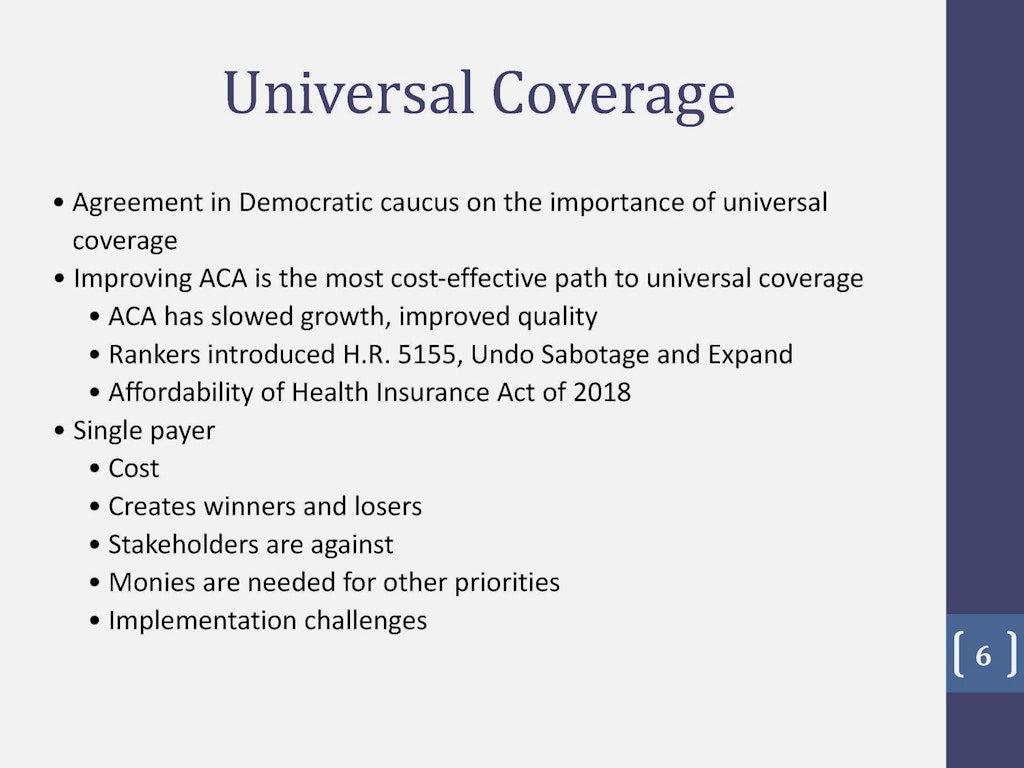
Primus, in a slide presentation obtained by The Intercept, criticized single payer on the basis of cost (“Monies are needed for other priorities”), opposition (“Stakeholders are against; Creates winners and losers”), and “implementation challenges.” We have recreated the slides for source protection purposes.
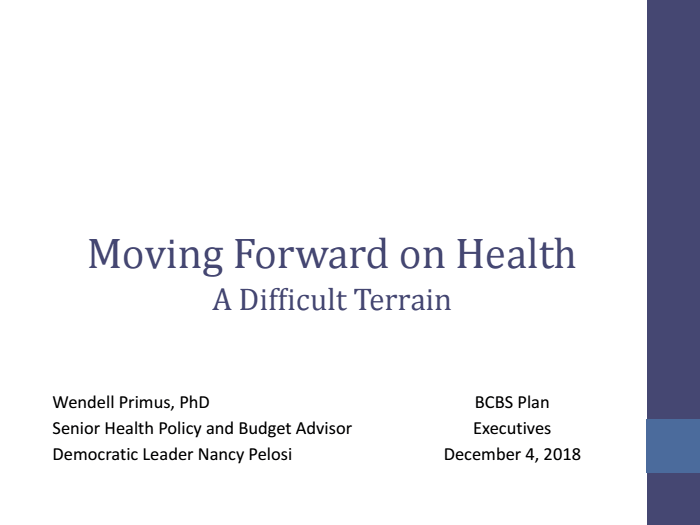
Wendell Primus BCBS Presentation 15 pages
Slide: Recreated by The Intercept
Democrats, Primus said, are united around the concept of universal coverage, but see strengthening the Affordable Care Act as the means to that end. He made his presentation to the Blue Cross executives on December 4. “We don’t discuss private meetings, if there was such a meeting,” said a BCBS spokesperson. Primus said that he did not discuss any kind of deal with the insurers. Henry Connelly, a spokesperson for Pelosi, said that the assessment of single payer was not related to any dealmaking with the industry. “We’re not going to barter lower prescription drug costs for inaction in the rest of the health care industry. The presentation was a broad look at the health care environment and some of House Democrats’ legislative priorities over the next two years in a period of GOP control of the Senate and White House,” Connelly said.
The debate over Medicare for All is playing out on a number of different levels, with no clear consensus over how the government-run, single-payer health plan ought to take shape. Presidential candidates are arguing over whose plan is stronger and gets to full Medicare for All faster, with a debate raging over whether private insurance should be banned outright or operate in addition to universal Medicare coverage.
In the House, even as the idea has picked up momentum with voters and members of the Democratic caucus, Democratic leadership has remained deeply skeptical. Pelosi’s consistent messaging, instead, has been around protecting the Affordable Care Act and lowering prescription drug prices.
“Speaker Pelosi has ensured that Medicare for All will have hearings in the House and tapped Congressman Brian Higgins to take the lead on Medicare buy-in legislation. For the first time, House committees will be seriously examining and tackling some of the questions and possible solutions raised by Medicare for All legislation,” said Connelly.
“The biggest obstacles facing Medicare for All right now are Mitch McConnell and Donald Trump,” he added. “But in the near term, there is a window for Democrats to press Trump to help pass aggressive legislation to negotiate down the skyrocketing price of prescription drugs.”
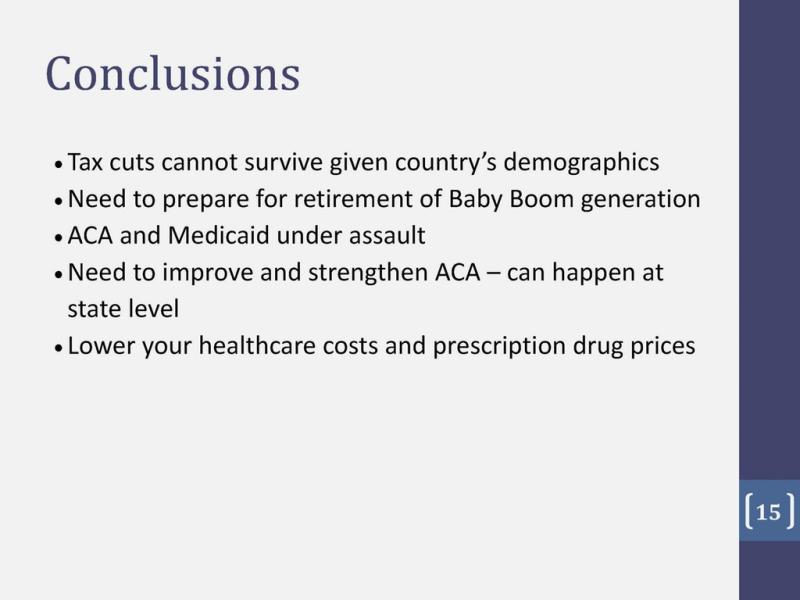
Primus concluded his presentation with a bullet point that summarized Pelosi’s mission on health care: “Lower your health care costs and prescription drug prices.”

Slide: Recreated by The Intercept
The “your” refers to insurers, who bear costs for medical expenses covered under their plans. That puts insurers and Pelosi, at least in one sense, in alignment, as both have an interest in lower costs. Indeed, insurers regularly negotiate to lower their health care costs, but in practice their efforts have had little effect on the general trend in costs. Drug company patents give pharmaceutical giants outsized power to set prices, and hospital consolidation has also given providers more power in those negotiations. Even where insurers have been able to negotiate lower prices for their own customers, that has done little to shrink the list price of drugs for the public.
At the briefing, Primus mentioned three avenues that Pelosi, a California Democrat, sees toward lower drug prices, sources said. The first, the CREATES Act , is bipartisan legislation, strongly opposed by Big Pharma, that would make it easier for generic drug companies to get access to a sufficient quantity of medications needed to produce generics.
The second measure addresses what’s known as “pay for delay,” in which a drug company pays a generic manufacturer to not produce a generic version of an expensive drug. Democratic leadership wants to ban that practice. The third revolves around the issue of “evergreening,” which is a pharmaceutical industry practice of extending patent protection for a particular drug through a variety of practices. Democrats want to restrict evergreening to encourage cheaper generics make it to the market faster.
Primus’s approach has a strong political logic to it, as taking on every health care stakeholder at once is arguably more difficult than singling out one industry and hammering away, even if the effort is out of step with where progressive energy is at the moment.
Primus is known in Congress as one of the staunchest foes of Big Pharma, while Pelosi’s posture toward Medicare for All is more complicated. Publicly, she has long said that she supports it aspirationally. “I was carrying around single-payer signs probably before you were born, so I, you know, I understand that aspiration,” she said in 2017 during an interview with TV host Joy Reid.
“This is an idea that if we had a tabula rasa, if we were just starting clean, would be the most cost-effective way to go forward. We don’t have that,” she said. “Over 120 or 150 million people in our country have employer-based access to their health coverage and insurance.”
At the time, her objection to Medicare for All was that it distracted from the fight to defend the ACA, which Republicans were trying to gut. “So right now, I’m going to be crude. Now we’re in my living room, so I can be crude. It isn’t helpful to tinkle all over the ACA right now,” Pelosi said. “Right now, we need to support the Affordable Care Act and defeat what the Republicans are doing.”
At other moments, she has said that single payer isn’t popular , arguing, also in 2017, that “the comfort level with a broader base of the American people is not there yet.”
The Democratic Congressional Campaign Committee, which operates under Pelosi, in 2017 presented House Democrats with survey data , claiming that it showed that single-payer was a political loser, and that Democrats should focus their messaging on lowering drug prices and protecting the ACA.
Yet a significant number of Democrats who flipped Republican districts blue in 2018 were publicly supportive of Medicare for All, suggesting that it isn’t necessarily the albatross Pelosi and the DCCC believe it to be. A poll from October found that more than half of Republicans support the concept.
Pelosi’s agreement to hold House hearings on Medicare for All came after pressure from the Congressional Progressive Caucus. Yet the hearings will be held by the Budget Committee, which, unlike the powerful Ways and Means and Energy and Commerce committees, would not have final jurisdiction over Medicare for All in the event of a genuine attempt to pass it.
Join Our Newsletter
Original reporting. Fearless journalism. Delivered to you.
I’m in
Primus, like Pelosi, is well-known to be a deficit hawk, and both subscribe to the argument put forward by the late Pete Peterson that the debt and deficit are among the gravest threats facing the country. When Peterson, a billionaire who spent hundreds of millions of dollars to push Washington policymakers toward austerity, died in 2018, Pelosi delivered a floor speech that praised him and his vision effusively, speaking of the man as if he’d dedicated his life to eradicating child malnutrition or curing cancer, rather than as a Wall Street tycoon who spent millions pushing for major cuts to Social Security and Medicare. “Pete was a clarion voice for fiscal responsibility, and a strong moral conscience in Washington,” Pelosi said in her House floor eulogy of Peterson, who, by 2012, had already spent half a billion dollars targeting Social Security, Medicare, and other spending programs.
“Pete’s prophetic voice on the importance of fiscal sustainability brought together generations of policymakers, no matter their political background,” Pelosi said . “His legacy will endure in many ways, but especially through the work of the Peterson Foundation, which continues to focus on solutions to America’s fiscal and economic challenges.”
Slide: Recreated by The Intercept
Two of Primus’s five objections to single payer before the Blue Cross audience related to such alleged fiscal challenges. That argument, though, runs headlong into a surge of new interest among Democrats in Modern Monetary Theory, the idea that policymakers are still constrained by a mindset that was justifiable when the U.S. was on the gold standard, but is no longer defensible. Now that the U.S. issues a currency independent of its gold reserves, the obstacle to government spending is inflation, not the debt or deficit, proponents of MMT say. “This zero-sum mentality has no place in a post-Bretton Woods world,” said economist Stephanie Kelton in reaction to Primus’s argument that spending on Medicare for All would foreclose other priorities. (Post- Bretton refers to the global agreement that the dollar will be the global economy’s reserve currency, ultimately decoupled from gold.)
“The U.S. dollar is no longer tethered to gold, which means the federal government is not constrained in its spending by the need to raise revenue. The federal government cannot run out of dollars. This should be painfully obvious, but the gold-standard mentality continues to grip many lawmakers,” Kelton said.
As long as inflation remains low, the government can continue to authorize additional spending. That’s not so much an argument as it is simply an observation of the post-gold-standard reality that austerity advocates like Peterson have spent billions to distort. “The government can afford any new program it chooses to fund. The limits are in the real economy — if producers can’t keep up with the additional demand, inflation will result,” said Kelton, a former adviser to the Senate Budget Committee when it was chaired by Sen. Bernie Sanders. “The federal government — as the issuer of the U.S. dollar — can create all the money that is needed to guarantee health care for all of its people. It’s the rest of us — who merely use the dollar — who have to worry about costs and where to come up with the money to pay a huge medical bill when our private insurer refuses to cover the cost of care.”
This reality has been recognized by former Federal Reserve Chairs Alan Greenspan and Ben Bernanke , as well. “The United States can pay any debt it has because we can always print money to do that. So, there is zero probability of default,” Greenspan once said.
Ryan Grim is the author of the forthcoming book “We’ve Got People: The End of Big Money and the Rise of a Movement.” Sign up here to get an email when it’s released.
Tags
Who is online

78 visitors
"Medicare For All" will be a major policy discussion in the Democratic primaries, but in the end I think Pelosi is right. The most important goal right now is to get a Democrat back in the White House.
Universal health care will have to be delayed by a few years while we take out the trash.
TADA !
That's all Democrats are about.
Democrats have been doing the "Behind-the-scene" (don't worry, we are just gonna use the foot-in-mouth disease election mantra for just a little bit) for decades, just to make sure they get "Elected" !
That's all Democrats (I need to keep my job) really want !
This is obvious. The country is is disarray after just two years of Trump. Another four after 2020 is unthinkable.
I wish it were pragmatic to push for universal health care during the upcoming election cycle, but I don't think it is when the necessity of winning , and making it more of a sure thing, is of the utmost importance.
So much for "The American People" huh !
All you've done is reiterate what the "Liberal" party is really all about !
THANKS !!!!!!!!!!!!

"The country is is disarray after just two years of Trump."
YOU ....must be doing terrible !
Don't confuse yourself.
If you want to vote for Elizabeth Warren in a Democratic presidential primary I'm sure that will be available to you.
So your doing great ?
Donald Trump isn't remotely qualified to be president of the United States. It doesn't matter how anyone is "doing".
If Jane Fonda were president and unemployment went down during her term , would you vote for her re-election?
So your doing bad ?
Ok. Enough fooling around. If you have nothing to say about the seeded article, I will ask your comments to be deleted.
I try to be nice and play along with you for a comment or two and now you want to derail the seed.
Only warning.
Yes. And frankly not objectionable. That is what the opposition party is supposed to do....figure out a way to meet the desires of the electorate better than the incumbent.
No. Just damn silly. The kind of nonsense a 17-year-old would say. Regular, working, bill-paying Americans are not in disarray. They're fine. They are rocking and rolling, and about to get even better now that we've got a bit of gridlock.
57% of Americans said in a new poll that they will not under any circumstances vote to re-elect Donald Trump.
A 57% vote in the election against the incumbent president would be considered a landslide.
If things are fine, why is Trump on schedule to be defeated in a landslide?
In simple wording.....Don't do as YOU do, Do as YOU say !
Did you happen to notice, my first comment was actually about your seed, put forth by an actual Democrat mouth piece ?
You "Fed" what you got in return. Ain't that a bitch ?
And in 0ctober of 2016 polls were saying that we would be getting a second Clinton in the White House and trump had virtually a zero chance of winning. How did that work ou
Mostly because the mainstream media other wise known as the DNC propaganda committee is telling the sheep to think that they should
Seems a bit of a stupid poll, given that nobody knows the alternative yet. Fortunately for the rest of us, people who answer questions like that rarely vote.
Anybody who thinks he'll be defeated in a landslide during a robust economy is idiotically naive. If the economy tanks, then it's possible.
The thing is....grown ups actually care much more about stuff like paying bills, raising kids, buying houses and cars, and saving for the future than they do about who tweets what or who calls Haiti a shithole. As James Carville said to Bill Clinton's campaign staff, "it's the economy, stupid". That will be truer every year as Millennials grow up, have kids, buy houses and start "adulting" on a full-time basis.
IF....and it's looking like a big "if" right now... the Democrats put forward somebody who convinces voters they can behave properly without screwing up the current good things we have going, they have a pretty good chance. (think Bloomberg, Schultz, possibly Biden) If they put forward a leftist idiot who says how terrible it is that everybody has a job and can pay their bills and wants to change everything, (Sanders, Warren, Booker, Harris) they're making Trump's re-election a whole lot easier.
I really like how you guys are denying reality. Keep it up until after the next election.
Things were 'going well' for most people before Trump was elected. Unemployment was steadily coming down and the GDP was rising as well. No one thought Clinton was going to tank the economy.
What exactly is so astoundingly better since Trump took office? The stock market? It was better for a while but has been precarious for over a year. Wages are only advancing slowly, as they also were under Obama. There is a lot more hype that the economy is booming in a heretofore unseen way, but reality is things are little different than they were in Obama's last couple years. Families generally still need two breadwinners and individuals need to work many hours or have multiple part time jobs to make ends meet. The rich are getting richer, that is true, but they are a limited number of votes.
Trump got beat back in the Great Lakes region in the midterms, an area he absolutely needs to carry to have any chance in 2020.
He is at 40 or 42% popularity , at best, with no real path to improve on that. Or do you think that once the Mueller report comes out "undecideds" will suddenly flock to Trump after Muller tells the world that Trump's campaign was duped, or corrupted, by a foreign adversary? LOL.
The question you're not going to like is "exactly what is so astoundingly worse since Trump took office?" The answer is "your feelings".
For most people isn't worse at all.
It's better.
Exactly.
They have continued to progress well. So you can see all the reasons not to vote for a Booker/Harris/Sanders/Warren psycho. Hence the differentiation between looney leftists and sound, regular Democrats.
Everybody is getting richer. As you've already said.
If midterm reversals were an indicator, Barack Obama would have lost in the biggest landslide since Mondale.
All kinds of things can happen between now and then. But one thing is certain: A mainstream, regular, non-psycho Democrat will have a 10x better chance of winning than a leftist whackjob.
The last two years have revealed Trump to be a pathological liar and a buffoon and psychologically unstable, and a con man. For some reason a lot of independents and "Democrats" didnt realize that before the '16 election and voted for him, but they won't be fooled again.
Once a con and a liar is revealed, he can never get that trust back. The independents that have left Trump because he is not fit to serve as president of the United States are not going to go back to him because the GDP goes up a half a point.
Over half of all Americans say he is not fit to serve. The horse is out of the barn.
I hate to break this to you, but most people knew that already. Politicians lie all the time. Even when they're not actively lying, what they say generally isn't reliable.
That's ridiculous. No Democrats voted for him. The independents who voted for him were more concerned about SCOTUS picks than his honesty.
Dude.... seriously.. People. Never. Trusted. Him. They just were that opposed to Hillary.
Independents make their voting decisions at the poll. That's why they're called "independents". GDP is another one of those things nobody gives a shit about. They care about their job, their bank account, and their retirement plan.
By all means, let's don't take the realists seriously.
You do realize I started this out agreeing with you.
Do you really imagine the voters of America to be such complete morons that they actually trust the people they elect?? Do you actually live in America? Maybe the liberals you run around with are that naive, but nobody else is.
Correct. But people don't give a fuck. I'm not sure how much evidence has to present itself before you begin to understand this.
I realize you can't get even 1 inch past your Trump hatred. But if you manage that one inch, you'll realize I haven't defended him. I'm simply telling you people don't expect the truth. Ask any Democrat about Bill Clinton's lies and perjury. They don't give a fuck. Ask any Republican about Iran/Contra. They don't give a fuck. People stopped caring about honesty when they elected LBJ. They gave up on honesty completely with Watergate. By the time we got to Clinton and the blue dress, nobody was surprised anymore.
Poll results are generally worthless as a source of reliable information as they are solely a reflection of those initiating said polls and results are easily manipulated to reflect views of said initiators. Poll 100 people in the area where you know you are likely to get favorable results, but circular file majority of unfavorable ones. Yep, great poll results all right...
Socialized health care as a Democratic platform plank would definitely and massively increase Trump's probability of re-election.
Universal health care is a different thing entirely and could be achieved reasonably easily through our current system.
Not necessarily.
Skyrocketing premium costs, inane deductibles, and the highest drugs costs in the world effects the majority of US citizens in negative ways.
To date, the majority of people benefiting from the current system own insurance companies, or big pharma companies or stock.
Recent polls show that 70% of the people polled are interested in a single payer healthcare where everything (except cosmetic) and everyone is covered without paying a middleman.
Insurance coverage should never be tied to an employer. This should benefit the work force. It should put US corporations on a more level playing field with countries that have single payer healthcare for its citizens.
The voters of the US may put party aside and vote for their own economic interests.
When it is explained to them that "their own economic interests" will include their taxes doubling to pay for a cool $1 trillion/yr in corporate welfare while their wait time to get care skyrockets, most of them will remember that they can work out what their best interests are on their own.
Doubling?
Who has calculated the cost of insurance plus taxes currently in place to pay for insurance subsidies for the ACA plus the costs of taxes going to pay for the under and un insured, and adding in the cost of meeting deductibles that are usually over $1000 before the insured can even use their insurance?
Where are the figures detailing the current cost vs projected costs?
How will the costs change if the US government demands that Big Pharma has to charge US citizens the same as citizens in other countries?
Currently, health insurance companies are raking in huge profits at the expense of US citizens' health and at the expense of the insured, at taxpayer expense if they are subsidized in any way by the ACA or other government program.
Healthcare should not be a commodity that is traded on Wall Street.
Probably more than doubling. Yes.
You haven't done any of that math? How, exactly, have you formed an opinion on the subject?
We currently spend $3.5 trillion/yr on healthcare. That number would immediately grow over $4 trillion as we cover people who haven't been covered, eliminate or reduce deductibles, and expand the fraud and improper payments that currently plague govt programs.
About $1.3 trillion is already govt controlled, through Medicare and Medicaid. So we're looking for an additional $2.7 trillion. Total revenue of income and payroll taxes combined is about $2.5 trillion.
How much? Exactly how much money are they raking in, and what percent of total healthcare expenditure is that?
Sadly this kind of statement is common among socialized insurance supporters, who don't realize how bad they are at math.
They're talking about millions.....in the face of Trillions....with a T. They are complaining about the equivalent of $342 in the face of $3.5 million. Or $3.42 compared to $35,000. Did you argue over the president of the dealership making $3.42 the last time you bought a car? No?
BTW, the top 8 insurance companies make less money in combined profits than Medicare alone lost in fraud and improper payments last year.
I see. There are a lot of numbers being thrown around with no real details.
As far as fraud, that is a societal issue that should be addressed with meaningful penalties for all involved.
How much does health insurance with a $1000 deductible per person cost for a single, a couple, a couple with 1, 2 or more children? Then how much are the co-pays? Do they have to stay in a network?
If a single person pays $5000 a year and does not use their insurance, then they are out $5000 for no services whatsoever. If they do use their insurance with a $1000 deductible, then they have paid out $6000 before the insurance company pays out a single dime. If their deductible is $2000 then it jumps to $7000 and so on and so forth.
How about a married couple paying out $10,000 or more a year on insurance with $1000 (or more) deductible per person? For both of them to use their insurance, each of them would be out $6000 (or more) before using one dime of insurance? And there are copays.
People can't switch jobs easily without worrying if the company has some kind of health insurance.
I don't see how this is cost effective insurance for anyone.
Maybe the one and only way to address this issue is for everyone in the US to quit buying health insurance and bankrupt the insurance industry so we have to start over from complete scratch.
So numbers are not details. How does that work, exactly?
And yet...... it is a bigger expense to government health programs than prescriptions.
You keep asking these questions. As though you don't know. And yet you seem to have formed an opinion you appear willing to attempt to defend. What were you saying about "details"??
Not at all how most health insurance works.
I'm not sure how that single person paying an additional $7k/yr in taxes for services they may never use makes the situation better.
Good luck with that.
I haven't seen a doctor since 2002. I haven't had a medical checkup since 2000. My husband has a yearly check up at the VA and takes no meds. He is 71 years old. I am 62.
I haven't worked for a corporation in many years. I have no real idea of what workers are paying for insurance and if it actually covers anything.
This is why I asked questions.
Ten years ago, a truck driver told me that he was out over $12,000 a year for insurance for just him and his spouse. They had a large deductible and their insurance was pretty worthless. They were both smokers and over 55. Both might have been factors. I don't know.
Another acquaintance, who co-owned a business, found out her insurance was pretty worthless when she needed medical care for cancer. She had a surgery or two, endured months of chemo, was diagnosed as cancer free, then began the process all other again and died. I don't have details on the faults with her company's insurance because I felt it was inhumane to badger a dying woman about her insurance problems.
Did you have to stay in a network or were you free to shop around and compare prices and services offered?
BTW, the last time I had insurance in 2000, it costs me (as a single) around $1000 a year. I had a $750 deductible. It is flipping ridiculous that insurance and costs have risen this much compared to wages.
I was making $11.40 an hour working at Wal-Mart corporate. My classification was among the top paid hourly at the time. I had been there 7 years.
The establishment Democrat's strongest point
2020 is shaping up to be another choice between voting for Wall Street rep vs. Main Street rep among the Democrats.
I seem to remember Booker being against US citizens having access to cheaper drugs in Canada.
I don't know how much influence the Young Turks has among Democratic voters, but they seem to be solidly progressive and solidly against Pelosi and the Dems who cater to Big Pharma and insurance companies.
I guess it all boils down to the Democratic candidate who can snow the voters that it is cheaper for them to pay for their own insurance, pay all deductibles, and pick up the tab for welfare costs and to pay exorbitant rates for drugs than it would be to have single payer health care in the US.