
A $15 minimum wage would spur job losses but lessen poverty, congressional report finds


 S E E D E D C O N T E N T
Raising the federal minimum wage to $15 an hour — a proposal supported by President Joe Biden — would result in the loss of 1.4 million jobs, but would bring nearly 1 million people out of poverty over the next four years, a government study released Monday found.
The study, conducted by the nonpartisan Congressional Budget Office (CBO), also found that increasing the minimum wage would raise the cumulative budget deficit from 2021 to 2023 by $54 billion and would drive inflation, resulting in higher prices for goods and services.
The CBO evaluated a proposal that would gradually increase the minimum wage, reaching $15 an hour by 2025.
Once fully implemented, the CBO concluded "17 million workers whose wages would otherwise be below $15 per hour would be directly affected, and many of the 10 million workers whose wages would otherwise be slightly above that wage rate would also be affected."
The report found, as a result of the minimum wage increase, 1.4 million workers would be without a job compared to scenarios where there was no change.
"And the number of people in poverty would be reduced by 0.9 million," the report concluded.
Biden has called for raising the minimum wage, which has been set at $7.25 since 2009, to $15 an hour over the next four years. Last month, just days after being sworn in, he signed an executive order requiring that everyone working for the federal government be paid a minimum of $15 an hour.
The White House did not address the CBO report at a press briefing on Monday.
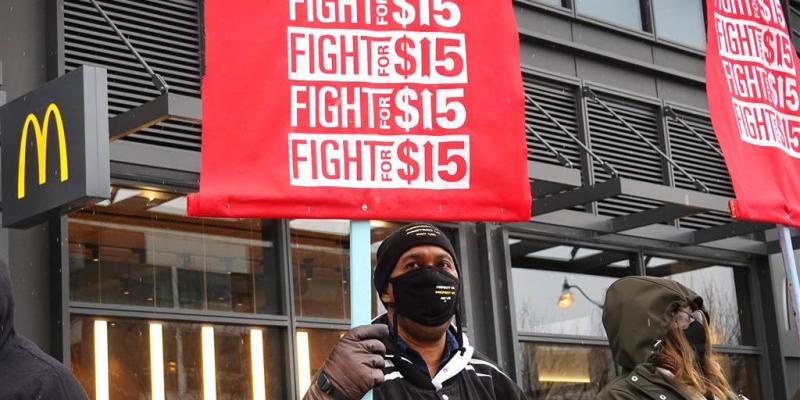
Raising the minimum wage for all workers to $15 an hour has been a rallying cry of the progressive wing of the Democratic Party. Biden included the proposal in his broad $1.9 trillion Covid relief package.
The proposal, however, faces opposition from Republicans.
Democrats are moving toward passing the coronavirus relief package using budget reconciliation, a process that would allow Congress to approve the proposal with only a simple majority, and therefore, no Republican support.
However, the rules of reconciliation may prevent the increased minimum wage from being included.
"I put it in, but I don't think it's going to survive," Biden told CBS in an interview last week.
At a press briefing Monday, however, White House Press Secretary Jen Psaki said that Biden "remains firmly committed to raising the minimum wage to $15" but suggested the administration was waiting for input from the Senate parliamentarian on whether a minimum wage increase could be passed via reconciliation.
"We'll see what the parliamentarian decides, and then we'll see what additional options are," she said.

Tags
Who is online
370 visitors
If "Bill McBurger-flipper" and "Suzie McCannot count change" at the counter / window are making $15 / hour, it'll be more expensive for my family of 5 to "dine" at McDonald's than it would be for us to get food from Outback Steakhouse! I'm being serious here. Last McD's order for the 5 of us was $48. The last BK order for the 5 of us was $53. The last pizza order we had was $57. The last Jimmy John's order we had was $65. The last restaurant order for all 5 of us was $74. KFC came in 2nd least expensive at $44 (Door Dash delivery, so tip included). Least expensive order... Of course was Taco Bell (always has been the least expensive) at $38.
Having 3 teens makes for very expensive take-out / drive-thru. Hence, why we usually make something for dinner. I couldn't imagine how expensive it will be when minimum wage goes from $9.50 / hr to $15 / hr!
There's a silver lining though if your three teens got jobs making 15 bucks an hour you might not have to buy all their crap. Hell they might even take you out to eat (wishful thinking).
My youngest isn't technically a teen until July 31 this year... he'll be 13. Can't legally send my 13 year old to work.
As for the other two, my daughter is 17 and my daughter's boyfriend is 19... my daughter has applied to many places and never received a call. Most places around our house won't hire someone under 18... especially without having a driver's license and a car of their own. Daughter's boyfriend (the "adopted one") has been helping my son with his school work; I'm working from home, my son is doing all online school this year, and the adopted one is making sure my son is doing what he needs to do while I'm working.
Moreover, while places will hire him, he still doesn't have a license or transportation. I don't have the money to buy two cars for two teens right now. I have to take the adopted one into the Secretary of State to sign up for an "adult driver's permit", find the time to teach him how to drive within 30 days, and then get him back to the SoS for the road and written tests. The SoS closes long before I'm done with work. Makes things a bit difficult. It took us almost a year to get his birth certificate so we COULD get him an adult driver's permit. I don't know if they'll require a "proof of residence" or not, but he doesn't really have any proof that he lives with us. He's not a minor, but doesn't receive mail either. It's far more complicated than most people think. It's certainly not like it was when I got my license either. They now have to have X number of hours in X number of days and in X types of conditions... and on job applications, they ask, "Do you have your own transportation"?
Actually they probably would. They're all very sweet. My son is really good at saving money and from birthday, allowance ($5 / wk.), Christmas, etc. he has saved nearly $500... AFTER he bought himself an X-box One. He has bought pizza for everyone simply because HE wanted pizza.
My daughter had gift cards for TJ Maxx and she told me to pick out a sweater and she paid for it.
The adopted one bought me a wooden Sudoku puzzle [one where you lay out based on the booklet with it] so I didn't have to keep buying paper Sudoku books.
So, I have a really good bunch here.
The other thing is... the adopted one's youngest sister wants to emancipate herself [their mom is a real piece of work] and we already told her she's got a place to stay. Currently, she's 15. Hell, she's at our house more often than her own as it is... she's here right now. We have a full house and it costs a lot to feed everyone. I
 Aldi and the Salvation Army resale store.
Higher wages = less employees, fewer hours, and higher prices.
What did the CBO say?
It would help millions and also put millions out of work:
"Raising the federal minimum wage to $15 an hour — a proposal supported by President Joe Biden — would result in the loss of 1.4 million jobs, but would bring nearly 1 million people out of poverty over the next four years, a government study released Monday found.
The study, conducted by the nonpartisan Congressional Budget Office (CBO), also found that increasing the minimum wage would raise the cumulative budget deficit from 2021 to 2023 by $54 billion and would drive inflation, resulting in higher prices for goods and services."
How has that claim worked out every other time minimum wage went up? Hmmmm?
It has always resulted in: Higher wages = less employees, fewer hours, and higher prices.
So you are claiming that there are fewer full time employees in the job market at any time after July 24, 2009?
Another strawman argument. You guys all try the same crap....
To quote Greg,
"Higher wages = less employees, fewer hours, and higher prices."
Wages went up in 2009, so if Greg is telling the truth, we have always had a lower number of full time employees after 2009, than before.
In which states? Because we're discussing minimum wages, yes?
Another strawman...<sigh>
His statement was all inclusive, meaning all states.
I was asking a legitimate question. Because ALL states do not have the same minimum wage. So, considering that information, how is that strawman again?
You have to follow the thread.
Greg's claim was universal, it was not being broken down per state, county, or city. When you try to break it down as such, you are trying to get me to defend something I never claimed. Hence, strawman.
While examining the impact of minimum wage increases based on state, county, or city is a legitimate question, it is not something that is being addressed on this thread.
Okay. You win. Do you feel better now?
I was just asking a question and looking for a simple answer and you turned it into something completely different... so, you win. Have a lovely day.
It's not a "simple" question, if you want to know the answer, do your own research.
And no, I didn't turn it into something "different", I explained why it wasn't the topic we were discussing.
I have.
I already said that you win. So again, have a lovely day.
Outstanding. Please elucidate us then.
There will be no minimum wage increase in this relief bill. None of the Republicans will vote for it and enough Dems oppose it to kill it. It was my understanding it would have only apply to federal workers anyway.
He took care of that with the executive order. The rest of the workforce is in his $1.9T relief package.
So... here's to hoping Congress votes against that drastic of an increase.
However, Gov. Whitmer will probably be all for MI increasing min. wages to $15 / hr.
Thanks, Jim. It's been a long week and we're only starting Wednesday. HA!
You read 'motherjones'? Yikes, what's this world coming to?
Nope but in searching for the story, I thought I would save our friends here the bandwidth needed to refute the story due to the source. They cannot HONESTLY discount Mother Jones as a source any more than they would MSNBC, Salon, or Vox.
Florida passed amendment 2 in November. The minimum wage will increase to $15 an hour by 2026.
It's the old "frog in the pot of water" thing. Slowly raise the temperature (minimum wage) and it won't know it is going to boil to death (affect prices across the board).
Yes sir, there is no way it doesn’t cause all prices for goods and services to rise.
Yes or no. Should the minimum wage keep up with inflation and gains in productivity made by the economy ?
When the economy increases, should everyone gain, or just managers and owners?
If you compare the average salary in 1970 , $6,186, to 2020's average salary $49,874, the increase is 8.06 times.
The minimum wage in 1970 was 1.60, so that times the 8.06 increase is $ 12.90. That should be the bare minimum minimum wage. The national minimum wage is $7.25 right now. And it hasnt been raised in 11 years.
Yes or no, do you think the companies will take the hit or pass it on to the consumer?
Where did I say that there should be no increase in minimum wage? I only stated that prices will increase for consumers. Do you think they won’t?
Wages on average have risen X 8.06 in the past 50 years. The minimum wage has risen X 4.53 in the past 50 years, which is little more than half as much as the average. I'm sure that doesn't sound fair to you. If prices rise a little prices rise.
One more time John. Where did I say that minimum wage should not be increased?
I dont think I said that you said the minimum wage shouldnt be increased. You said prices will go up. Should prices going up impact a rise in the minimum wage?
John I am in favor of a minimum wage increase. I don’t think it should go from $7.25 to $15. That will cause prices to rise more then a little. It is my opinion that we don’t wait 11 years and try to increase it all at once. I think that hurts the very people who get that raise, because they will pay more for goods and services which basically wipes out the raise they received.
I believe that the proposal is for it to go up over 4 years to $15.00.
Thank you for the info.
Yes, that's the average between 50 US states. However, the average does not reflect total reality. In MI, the minimum wage is currently $9.65. According to the following, it's been rising far more often than it used to; hell, from 1998 - 2007 the minimum wage stayed the same. Almost a decade. From 1981 - 1997 it shows as remaining the same. That's 16 years and that was only a $1.80 once the increase occurred. Wages under $50,000 / year, but over minimum wage remain virtually the same in many instances (automotive companies are famous for not doling out raises for several years - see last paragraph). It's logical to assume that at some point, the middle-class will be wiped out in some areas.
$15 / hr. is a yearly gross income of $31,200 (your example of national average of min. wage or what it should be at $12.90 / hr. is a yearly gross salary of $26,832). After deductions (average is 25%) and assuming a 40 hour work week @ $15 / hr. = $23,400 annual net [$1950 monthly net]. After deductions as previously stated and assuming 40 hour work week @12.90 / hr. = $20,124 annual net [$1677 monthly net]. In Detroit Metro Area, making $15 / hr. as a single person without dependents is considered middle-class now. Hell, at $12.90 / hr., single without dependents is considered middle-class in the Detroit Metro Area.
Source:
I understand that this income does not cover expenses the same way in every state. For example, $15 / hr. in metro areas throughout California likely means poverty.
I'm not saying that minimum wage shouldn't increase, but shouldn't there be something for those that are above minimum wage, but not making much more? I was making $18 / hr. for several years with two dependents. That's considered poverty according to the link I provided above.
The automotive companies in Southeast MI, are pretty stingy with wage increases... most of the time, you're laid off before any merit raise can be given. I went 6 years without a raise ($23 / hr.) and then had to take a job that paid less ($18 / hr.) for two years before I got my degree in my 30s (in student loan debt for $55,000) just to break $50,000 / year gross in a different company.
It will get passed on to the consumer....
Manufacturers have been automating things based upon ROI for decades. Boosting the minimum wage will only provide an easier justification to automate something that was at a break-even at the current minimum wage. Job losses under these circumstances are inevitable.
I put this link to a video out every so often as it depicts precisely what this manufacturing engineer has experienced over the last 30 years, and what I see is coming at us down the road.
Humans Need Not Apply - Bing video
The question of it all is where is the break point to where x-number of people can't afford to purchase y-number of products sold by manufacturers simply because they don't have jobs that earn z-amount of income?
Thanks for the video.
We've agreed more often than no Ahyoka!
"it will get passed on to the consumer." Your words.
I do not disagree----But-----the minimum wage has not increased for quite a while-----So-----I wish someone would explain to me why an ordinary 40 gal. residential water heater cost around $200 in 1990 and now cost $600+ in 2021. The increase sure as heck can't be for labor costs--------especially when the items are supposedly less expensive by being made offshore.
Does anyone understand why I asked the question and why I am not sure if I agree with the premise of the article?
Depends on the state.
And where do you shop for a HWT?
In case you don't feel like clicking a link:
Materials, logistics, executive compensation, regulations & certifications...... all of it adds up.
Controls on the heaters have also gotten a bit more complicated, thus more expensive too.
Yep. Higher efficiency.
I don't think it will result in permanent major job losses at the federal level. As the recovery moves forward those jobs will return. Sometimes the way the information is worded make it a scare tactic. Many private businesses have already raised the minimum wage to that rate. Workers that make more money have more buying power which restores the economy. Aldi stores advertise minimum wages of $12 to 13.50 per hour starting wage so even in the private sector this is not a huge leap. Every corporation in this country should be happy to have more consumers with more money in their pockets to spend because in the long run it all comes back to various companies in consumer spending.
I've been supporting local businesses that have raised wages on their own like Aldi. In a few of local the restaurants that do this I get superior food, awesome wait staff and don't feel like I have to tip. They also locally source their bread, meat and produce which is great for our local family farmers. I even hit up a local distillery that locally source their ingredients.
Aldi has a sign now saying 16.00 but that's in the New England.
So ... if you double someone's salary from 7.50$ to 15$, just where do you think that extra 7.50$ will go? Under a mattress or straight back into the private economy? Money denies the laws of physics folks, it flows uphill.
Just remember that manufacturers will pass their costs on to the consumers as "push rate inflation".
I think it would be better policy to improve access to education and training than to raise the minimum wage. I was poking around the internet and found I could find any number of studies by real researchers that would support any number of positions on this topic. It seems to be a complex issue with many variables. It looks to me that the lowest end of workers would suffer job loses that don't really recover (as much as 13%), while other job markets take a small hit (around 4%), but in time do mostly recover.
I absolutely agree. Sometimes however, people don't seem to want to better their situation. Anyone that can pass a drug screen can apply to a Local Union [at least in Detroit Metro] to be a plumber's or electrician's apprentice with little knowledge. I know a few people that have done it. Get a free education, while getting paid, and after 4 years as an apprentice, get a journeyman's card. I know several people in the trades making 6 figures. The skilled trades are hurting, because the Baby Boomers that filled all of those spots are retiring and there's not enough people getting into the trades to fill those retiree's spots. Most High Schools are still pushing kids into college bound lessons. I'm just grateful that the school district my kids are in still find machine shop, auto shop, electronics, etc. equally important.
There were always be poor people and the working poor. If everyone in America had a college degree then we would have people with a college degree under the poverty line. It is the nature of capitalism that there will be poor people.
People don't need a college degree to have a livable wage career.
In my honest opinion minimum wages should not be set as a default dollar amount by the federal government. Minimum wage should be set at the state or even the county level, based on median income for that state or county. The federal government should set the rate as X% of Median income or however they want to calculate it. This would more accurately set the base wage at a more realistic local level.
Agreed. $15 / hour is very different in comparison between San Francisco vs. Detroit [or even a suburb]. Hell, it's even different in comparison between a Detroit suburb and Marquette (just examples of large cities in very different parts of MI). Luce County in the UP of MI wouldn't require nearly the amount to live as Wayne County.
Am not sure I agree with the premise of this article although there may be merit with some of its points.
On the other hand there has never been a study as to the cost on the general working population of the salaries/compensation of certain Insurance Executives, Hedge Fund Managers, upper tier Wall Street investors or others in that class------------especially those that shield/hide their monetary values in offshore havens.
Have no problem with people making money as long as they pay the taxes required like the rest of the 99.5%
If minimum wage is $15, workers with skills, certifications and licenses, those who produce more, do the more difficult jobs and have seniority and experience will want and deserve more money.
It is like pouring more water in a tub, everything will go up
In some parts of the country there are skilled tradesmen that build this country that make in the low 20’s per hour. $15 for flipping burgers or pushing carts pales in comparison. Ridiculous.
As a skilled trades apprentice [for plumbing, electrician, or HVAC], they make less than $20 / hour. As a STARTING journeyman [already went through apprenticeship], they make in the low $20 / hour range.
At least in Southeast MI. I've been helping my daughter do some research.
Exactly. Why does an over the road semitruck driver make approx. $20 / hour to deliver everything we use / need everyday and the expectation that Bill McBurger-flipper and Suzie McCannot-count change make $15 / hour? How about if we're increasing minimum wage, other wages get similar increases? More specifically those that aren't much more than $15 / hour. I know from personal experience that most prototype mechanics that build and test soon-to-be production vehicles that everyone eventually buys, make $15-$18 / hour. Why would someone choose to bust their ass with that kind of liability on the line for the same amount as working at a drive-thru window? I've done both... working at a drive-thru window is much easier and can be a lot of fun actually.
What we've seen over time is that wages tend to naturally adjust to a floor above the minimum. A Federally imposed minimum wage only provides a short term benefit. The Federally imposed minimum wage certainly doesn't have a history of ending poverty or achieving any sort of equity. The Federal government exerts more influence over poverty with its own fiscal policy than with laws imposed on the private sector. Fiscal policy grounded in deficit spending inflates the money supply and devalues the currency which has a much larger influence on creating poverty.
The problem with an imposed minimum wage is it's supply-side economic foundation that requires exploiting consumers. Success of the policy depends upon consumers providing the money to pay the increased wages. Private businesses do not have access to a magic supply-side money tree. The burden of higher compensation packages for both labor and management is born by consumers.
Since a Federal minimum wage has been imposed on the country then increasing and adjusting that minimum by political government becomes inevitable. First, raising the minimum wage has become a political way to buy votes. And second, the minimum wage becomes a distraction to divert attention away from how political government creates poverty with fiscal policy.
Unfortunately, raising the minimum wage has become necessary because of political ineptitude. But that necessity has been caused by political government; not by the private sector and certainly not by consumers. Make no mistake, consumers will pay the wage increases. Political government is being charitable with your money.
Do consumers pay when managers and executives salaries and compensation are raised by a company? Since, following your logic they do, why do we see little complaint about that from "conservatives", but we see complaint about raising the minimum wage?
Want the consumers to pay less? Pay the managers stockholders and executives less.
Yes, consumers pay managers, executive, and board members compensation packages. Consumers pay stock dividends, too. Raising the minimum wage provides the money to make the rich richer.
That's how supply-side economics works. Supply-side labor and tax policy can only succeed by exploiting consumers.
Yes. But political government is doing nothing to address that. Political government has chosen to buy votes by being charitable with your money.
You said it better than I did.