Atheism always tries to claim the default position , in other words that it is up to "believers" to prove Gods existence otherwise there is no God. That is the point where faith has meaning.
In reality there is no default because it is impossible to prove God exists and also impossible to prove God doesnt exist , and that will be the case forever.
"God" is a super-natural being, outside of nature. Nature is this existence. So by definition a supernatural being can be neither proven or disproven within the workings of nature.
Atheism is simply the position that the 'evidence' of a god is not persuasive. That the 'evidence' actually suggests god is merely an invention of the human mind. The great differences in gods invented by human beings over time illustrate this nicely. And even if we stick with just the Christian god, we see that this god is defined inconsistently; almost as if created by human beings. Take omniscience, for example. The Christian god knows past, present, and future yet is able to be surprised, feel regret, be persuaded to change His mind, etc. Take slavery, as another example. Not a word in the Bible decrying slavery as immoral but plenty of words ostensibly from God that provide rules for proper enslavement. Plenty of rules for how to have sex, eat, dress, etc. but not a word even suggesting that it is wrong to have another human being as your property to beat, sell, and leave to your kids as part of an inheritance.
The notion of a god being supernatural is just a cop-out similar to 'the Lord works in mysterious ways'. Same with the first cause claim. If there must be a first cause (logical) then why must it be the most complex entity imaginable rather than the essential substance of existence (which might be some low form of energy) which interacts over time to produce the emergent forms we recognize today (i.e. the universe as we know it)?
It is impossible to disprove the existence of some creator entity, but there has yet to be anything that is even close to proof that such an entity exists. Such is the position of the agnostic atheist (the vast supermajority of atheists).
rather than the essential substance of existence (which might be some low form of energy) which interacts over time to produce the emergent forms we recognize today (i.e. the universe as we know it)?
yet is able to be surprised, feel regret, be persuaded to change His mind, etc.
That would be the human part.
As for slavery, the Hebrews at least had rules for the treatment of slaves which did involve a punishment for mistreatment which also found it's way into Christianity. As for the Christians that owned slaves in the US, did they not eventually get punished and also in much of the world slavery has been abolished.
but not a word even suggesting that it is wrong to have another human being as your property to beat, sell, and leave to your kids as part of an inheritance.
You cannot get something from nothing ( the scientific explanation for the origin of the universe) within the workings of "nature" (this existence) , but you could get something from nothing if it were created from beyond or outside nature.
Religions are human cultural expressions, and may not have anything definitive to say about God.
The truth is we dont know what God thinks of the religions created in his name. Maybe they are faithful to Gods intentions and maybe they arent, and again, we will never know.
Any way you look at it, there must be something to start with. So if you think it makes logical sense that a creator entity has always existed then why would you have a problem with the possibility that what has always existed is an essential substance ... that which underlies everything that exists?
In short, which is more plausibly eternal existence, an extremely primitive substance (quintessential existence: maybe a form of base energy for lack of another description) that interacts to produce emergent properties (ultimately a universe) or the most complex entity imaginable?
Our understanding of science tells us that complex forms reduce to ultimately very simple substances. An irreducible complex entity is a great notion for religious purposes, but defies all that we know about reality.
You cannot get something from nothing ( the scientific explanation for the origin of the universe) within the workings of "nature" (this existence) , ...
The scientific explanation for the origin of the universe is NOT that something came from nothing. It is that the universe emerged from a net zero energy state. That is NOT in any way the same as nothing.
... but you could get something from nothing if it were created from beyond or outside nature.
Where do you get the idea that it is possible for something to emerge from nothing under any circumstance? 'Supernatural' is the convenient category in which to claim that anything is possible.
Religions are human cultural expressions, and may not have anything definitive to say about God.
Indeed.
The truth is we dont know what God thinks of the religions created in his name. Maybe they are faithful to Gods intentions and maybe they arent, and again, we will never know.
Sure, but what a potential god might think of religions has nothing to do with the point I made.
A Universe from Nothing: Why There Is Something Rather than Nothing is a non-fiction book by the physicist Lawrence M. Krauss , initially published on January 10, 2012, by Free Press . It discusses modern cosmogony and its implications for the debate about the existence of God . The main theme of the book is the claim that "we have discovered that all signs suggest a universe that could and plausibly did arise from a deeper nothing —involving the absence of space itself and—which may one day return to nothing via processes that may not only b A Universe from Nothing - Wikipedia
Its been a long time since I looked at Krauss' book but I believe its contention was that the universe did not need a creator because it could create itself out of nothing. That is not possible, and I dont care how smart he is.
“It is impossible to disprove the existence of some creator entity, but there has yet to be anything that is even close to proof that such an entity exists.”
Hence the question that has puzzled mankind since our earliest existence. A conundrum that is simply impossible to explain. Some lean on their faith, some doubt. Neither will lead to a satisfactory conclusion and sadly, neither seem able to accept the other’s conclusions.
Perhaps we should all just live in gratitude for the incredible, inexplicable gift of life and learn to coexist in all its splendor. Just my opinion.
Of course it is, John. I doubt the existence of God so I will need proof that he exists. Some here insist that he is real and think I'm a evil monster because I doubt the existence of a god. If someone "sees" a god in their brain then that's faith and faith doesn't need proof. It exists on its own
If someone "sees" a god in their brain then that's faith and faith doesn't need proof. It exists on its own
I agree with that more or less, if people didnt have faith a God exists there would be nothing to talk about. But that begins to beg the question, why did people first start to believe in God? I'd say it was because they realized there had to be something "more".
Ok, I get why you didn't catch that, you stated that "the Christian god knows the past, present, and future", so this would mean no real sense of time, you're claiming an omniscient being should've stopped slavery or never let it happen in the first place. Slavery is/was a human condition, the Hebrews, believing in God ordered treatment of slaves, started the rules, the Christians followed those rules and expanded on it to this day and eliminated slavery in much of the world. For us it took a few millennia, for God it was instantaneous.
“I'd say it was because they realized there had to be something "more". “
I’d agree with that.
Unfortunately, in everything mankind touches, we seem unable to do anything but cause harm. Harm towards our brethren, harm towards our society, harm towards our environment, and thus harm to ourselves. Too often in the name of a manmade entity to justify such harm.
Living in peace should be our driving force and responsibility, again in gratitude for the gift we have been given.
...but I think it's because they needed a way to explain things they didn't understand like thunderstorms, blizzards, death of babies, earthquakes, etc
I have had a concept in my mind most of my life - human beings are "fallen creatures" relating to the development of self-consciousness ( the birth of the ego). The demands of the ego lead to cruelty, war, destruction etc.
Why are we formed in this way as it relates to "God"? We dont know.
Atheists generally don't not make any claims. They are simply not convinced god exists. But they do challenge affirmative claims of a God made by theists. The onus of proof lies on the one making the affirmative claim, which theists often do.
”I have had a concept in my mind most of my life…”
My concepts came later in life but I believe that every single thing is imbued with a purpose and a spirit and it is important to understand how our personal interactions commingle and effect that relationship.
Our late, great mentor Kavika could explain it better than I, but we are just a small leg of a of a miraculous, communal journey through life, and should treat it with respect and reverence.
Science does not say the universe came from nothing. That is only a superficial appearance of what is said or commonly thought.
Exactly. All science is basically saying is that the recording they were watching in reverse, the cosmic microwave background radiation, stops at the big bang. It does not make any claims as to what caused the big bang or what existed before the big bang because there simply is no evidence of anything that our current methods of observation can observe before the big bang.
Any claims anyone makes beyond that, whether spiritual, magical, divine or any other supernatural explanation, are, as of yet, unproven.
And there lies the heart of the four types of believers.
Gnostic Atheist: There is definitely no God and thus God cannot be proven.
Agnostic atheist: I see no evidence of any God or Gods and thus I don't believe in one, but I accept that something most humans would define as a God might exist considering how vast this universe is.
Agnostic theist: I see no evidence of any God or Gods but considering how vast the universe is I personally like to believe in one, but I accept that something most humans would define as a God might not actually exist.
Gnostic Theist: There definitely is a God and I know who that God is and what he expects of mankind! I see evidence of my God in everything everywhere and no one will ever make me stop believing in my God!
I believe most debates, wars, conflict, inquisitions and death has been solely due to Gnostic Theists trying to force their will on the other three who are unwilling to kneel to the Gnostic Theists God, whether Allah, Christ, Zeus etc. in the past.
So, the top 3 can get along pretty well, though the Gnostic atheist can be a bit of an asshole at parties, but at least they're not usually trying to proselytize the entire time like number four does.
Personally, I'd like to see the AI debate between all four of these positions. I think it would be more insightful than the one above.
I believe most debates, wars, conflict, inquisitions and death has been solely due to Gnostic Theists trying to force their will on the other three who are unwilling to kneel to the Gnostic Theists God, whether Allah, Christ, Zeus etc. in the past.
Its hard to imagine how a world without any belief in God would be more peaceful than the one we have now.
The impulse to dominate and conquer other people is a function of ego, in other words the dog eat dog aspect of evolution. This aspect would exist with or without religion.
We simply haven't tried a world with no belief. Belief in god certainly hasn't stopped conflicts or discouraged people from conquering others and such. With no belief, logic, reason, and rationality can be more embraced, and thats a good thing.
You've grown up in a society that incoculates it in you whether you understand its religious roots or not. It's like a fish claiming water doesn't exist.
With no belief, logic, reason, and rationality can be more embraced
Just like religion, logic reason and rationality can be misused. It might be logical for someone to say because I am more intelligent with better genes I deserve more money power and status than you do.
It might be entirely rational to say that people with great disabilities are a drag on society and should be taken out to the woods and left to die.
It might be reasonable to conclude that government shouldnt inspect food because that responsibility belongs to the individual.
I am well aware of Krauss and his poor choice of sensationalism over clarity.
He is taking liberties with the word 'nothing' and does not, if you get into the details, mean the absence of everything. He is referring to a quantum vacuum with fluctuating quantum energy capable of particles coming into and out of existence (think of the integer zero splitting into -1 and +1).
It really pisses me off that Krauss chose sensationalism to sell books because it obviously misleads people.
My point was that the Christian God, per the Bible, condoned slavery. That is inconsistent with His other messages (especially those of the NT) and is probably one of the most basic rules of morality: do not own another person as property that can be sold, abused, and passed as inheritance to children.
The fact that He did not stop slavery and instead wrote rules for proper enslavement (all per the Bible of course) suggests strongly that these are not the views of a loving, omniscient, etc. god but rather human beings anthropomorphically describing what they think makes sense for a god to express. The biblical authors grew up in a time where slavery was so commonplace and ingrained into the economic system that they did not see it as wrong. So of course the god they invented also was fine with slavery.
And on this 'no big deal, this was just a blip for God' stuff, then apply that to everything else. Why then did God impose rules on sexual behavior, diet, clothing, etc. These were blips too. The logic does not hold water.
does not, if you get into the details, mean the absence of everything. He is referring to a quantum vacuum with fluctuating quantum energy capable of particles coming into and out of existence (think of the integer zero splitting into -1 and +1).
I think he proposed that something could come from nothing as a way of saying there was no need for a Creator.
How could there be evidence when its never been tried before? It would require a grand social experiment where people collectively abandon religion. Then we can see if things would be better or worse.
The Vikings conquered because they wanted wealth and land and subjugated people. It had nothing to do with religion
I see no difference. Religion took the same things, they just said they were doing it for altruistic reasons which, without evidence, was a fantasy at best, a lie at worst. Vikings come in and rape and pillage in the name of wealth and power, Spanish Catholics and other Christians raped and pillage claiming they were "saving souls" but the results were exclusively enriching themselves and empowering themselves.
I accept that many (I can't even give it a most) Christians of today would never force their religion on others at the point of a sword, or gun. However, I also recognize there is an underbelly of Christianity often found within the rabid white Anglo Saxon Protestant branches of the religion that tend to be very conservative and very pro-Christo-fascism, that I believe would have no problem forcing their beliefs on what they fantasize are the "evil far left".
So, whether the Vikings had any spirituality behind their motives or not, religion has been used, in one way or another to do both great and terrible things. The problem I have with that is that when it becomes some ethereal thing like a belief in a God that can't be seen, anything can be claimed as good or bad according to that God, it doesn't have to answer to anyone because it's a God. That is the problem with any sort of argument based on something you can't even prove exists. How the fuck is "it" supposed to take responsibility for "its will" when "it" can't even be proven to exist?
As the atheist historian Tom Holland wrote "To campaign against discrimination, to value the weak, to protect the rights of every individual—these are not universal values. They are Christian ones."
He just released a good book on the topic which I would advise all people who fall for the simplistic "religion is too blame for all bad things" that gets carelessly thrown around.
Dominion: How the Christian Revolution Remade the World
religion does not have a good track record.
Right. An amazing argument with the 20th century right there in front of you.
Whatever his reasoning, 'something from literal nothing' is not a scientific position and, importantly, that is not his position when you read his books.
It does have a poor track record historically. However, I see how religion does help people who need something like the belief in a god (or gods) to cope. Some need the fear of divine wrath. Others need the comfort that they can be forgiven by some divine arbiter and thus achieve a reform for their past bad deeds. Others, and I believe this is the majority, try to live their lives according to the teachings. I know this backfires when dealing with some denominations like Southern Baptists who are inherently racist. But from what I have seen of Catholics (most of my friends and family) the principles of helping one's neighbor, etc. are generally good.
Buddhism is a fine example of a religion (of sorts) that makes sense. It does not have a divine entity but rather is replete with moral wisdom to help one be a better person (in principle).
In aggregate, I think it would be better if people did not live their lives believing ancient fiction. And from what I can see, the Bible, Qur'an, et. al. are fiction (at least in terms of the divine characters in the story).
My friend, if I can be so bold as to call you that, you have used the word, "never" at least twice now in a declarative way of speaking; why do you choose to use this word, "never" in this manner?
I'd say it was because they realized there had to be something "more".
Emphatically. And that 'more' was on the ground running before critical thinking and science began investigating life on this earth and beyond this Earth. I firmly believe religion sticks around in the world (of all kinds) because the human 'spirit' latches on to a greater Spirit concept. That is, there are materials ('things') in the earth that last exceeding numbers of years, and yet we, the mortals, span mere decades as a group, and thus we never see the 'conclusion' and so it follows that there has to be something more . . . and perhaps and certainly we are being driven toward It.
There were reasons to have slaves in biblical times, which was a consequence borne out of wars. That is, the God who issued the edict: Thou shalt not kill. Also, ordered the deaths of people during conquest as offering (to rid this or that "bunch" from this planet). Similarly, the God who ordered death to some tribes of people, permitted life to other tribes and they came to live amongst the Jewish population/nation. The question then became how could they practically live amongst the Jews? They did so as servants and yes, slaves.
I will suggest that since most of our world is on spectrums: The instance chaos was born-order was born adjoining it. The instance religion was born-antireligion adjoined it. Thus, it is why "all these things" we know of continue to exist in the world of humans as essential to being here.
We all believe in something, it's part of the human condition. Rationality and Irrationality are on the spectrum adjoining each other. That is, as humans when we are not being rational in some regard, we are transiting the spectrum toward 'greater' irrationality.
Emphatically. And I will add this: We must not 'fall' to any concept that atheists by default are all good people doing versions of good in this world. The world seeks 'balance' between all its spectrums. And people of all stripes can transit back and forth across the world's spectrums.
The problem I have with that is that when it becomes some ethereal thing like a belief in a God that can't be seen, anything can be claimed as good or bad according to that God, it doesn't have to answer to anyone because it's a God. That is the problem with any sort of argument based on something you can't even prove exists.
The 'resolution' for a belief system is to live its truth and live its greater good. If one finds oneself at odds ('performing feats of hypocrisy) toward what is delineated in one's faith—by self or another individual or grouping of individuals in the faith, then one needs to question and come to a meeting of the minds whether that faith holds true to those following it.
The bible says to 'test the faith.' That is, make it make sense. If one can not, perhaps it is a faux faith being practiced.
(The above probably needs 'cleaning up' but that comes later if needed.)
As the atheist historian Tom Holland wrote "To campaign against discrimination, to value the weak, to protect the rights of every individual—these are not universal values. They are Christian ones."
That's also part of the Golden Rule.
religion does not have a good track record. Right. An amazing argument with the 20th century right there in front of you.
Not really. But I like what you are thinking. Given the chance, atheists probably would have slaughtered millions prior to the last century. But explicitly atheistic regimes didn't have much traction before the last century and when they did, their scope was limited. See the reign of terror in Paris for instance, where members of the cult of reason slaughtered tens of thousands during their short run in power. But the 20th century was when truly atheists got to shine. Lenin, Stalin, Mao, Hitler, Pol Pot combined to make the 20th century, by far, the most bloody in history. The industrialization of murder by people who threw off the shackles of religion in the name of reason and rationality. Well done!
I never thought I would have someone openly declare they do not believe in 'anything.' There are all kinds of beliefs to be formed; even if not religious. And of course, I would not suggest that an atheist has a belief in anything religious—goes without stating.
Polar opposites. . .of course. Was that not clear by the words, "on the spectrum"?
Let's agree when there is plainly nothing to which we disagree.
I suspect that Gordy is referring to belief as in believing something to be true based solely on faith.
I do not believe anything to be true on faith. To believe something to be true, I need to be convinced of same based on logic and very persuasive evidence.
What can I say? I'm a 'show me the evidence' type of guy. People can believe in whatever they want. But dont expect me to take it with any serious consideration without evidence or proof to back it up.
No, no I did Not! WTF, why are so many using me as a scape goat ?
How about the teachings and learnings from your social environment molded you to decide to do what 'YOU' do, and whether or not you are susceptible to influence and bias, is mostly influenced by those same learnings, teachings, and environment one is exposed to. Enough with this stuff,
I've got a HELL OF A LOT OF THINGS TO GO MAKE PEOPLE DO, DAMN IT !!!
Except such leaders didn't do what they did in the name of atheism. They wanted absolute power or dominion and religion was a competition for that. Besides, religion did plenty of killing in its own right with swords and bows and arrows centuries past without the benefit of modern weaponry.
and just having a little fun with your quoted phrase.
Though, the more i think about it, since it was MY idea, the Devil DID MAKE ME DO IT ! Now i'm on to make others do what is long over due, cause no one wishes to take the blame for what they do, from failing to flailing to Lying to dying, we all gonna do it. Are any man/woman enuff to accept where the origin began, and then through life carried on...?
Cause I DID IT! Whatever happen in i'd guess over 90% of peoples lives, is a direct result of/from their choices, and you have NO choice, in whether to B Leave Me A Loan, cause paybacks, i'm up front about them, and the terms of alone, must be jointly established by committee, and mind you, and all, I'm very meticulous, so read ALL the coarsely worded fine print, cause i'm in their somewhere. One last thing, if you agree, might you wish to join my advocacy group ?
Except such leaders didn't do what they did in the name of atheism.
Yeah, you guys keep saying that while ignoring the obvious result of an atheistic worldview. If there is no higher power (God) that makes the rules and has the power to hold people accountable, then that means such things are left to the human intellect. Communism does a great job of showing how great a world without religion would be, because, you know, intellect is such an infallible tool in humans.
Communism is a political-economic system, not a religious one. And so far, again world with religion does not seem so great as it is. If thats the standard you go by, then religion and/or the "higher power" you refer to has been an abject failure! Besides, if there is a"higher power," then prove it!
Pay attention to what I'm actually arguing. I never claimed they killed in the name of atheism. They were atheists trying to create a utopia and therefore unrestrained by the strictures of religion. They killed over a hundred million people in less than a century. If you understand that, you realize you have no support or evidence for your claim.
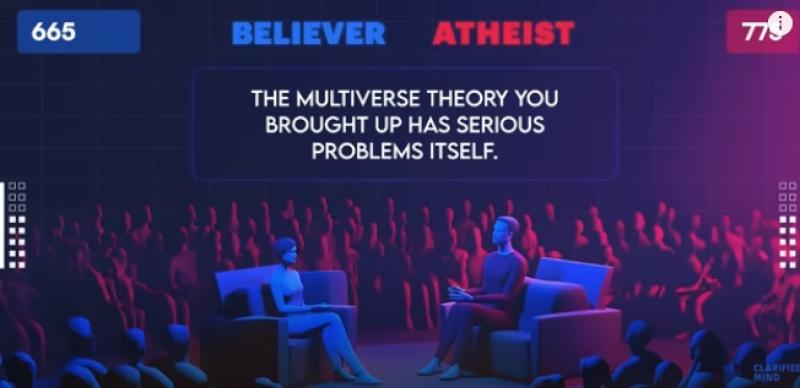
At 7:40 (Intentional suffering versus natural suffering). . .I saw a 'mistake' in the 'believer' remarks. . . it was 'corrected' by the atheist respond immediately after when it spoke at 8:36.
The point being that if God is in control over every------thing, then God controls all suffering and more to the point, the means of suffering and the measures and limits, both of pain.
At 18:36 what the atheist presumes is existence of the Multiverse (in theory). He can not use such a theory to claim the existence of multiverse (that is "touchable") because it would be a case of circular reasoning.
Ah! As I moved to the 'believer's' next term up (at 19:14): She, er—it raises the point I make above!
The multiverse is a theory based on physics. It is not a belief, but a theoretical possibility. It is a key scientific counter to the fine-tuning argument which suggests that since the factors of physics as we know them today (e.g. the fundamental forces) could not vary by much or else our universe could not exist. The religious argument is that God fine-tuned the universe for our existence (so that one little planet can evolve our species) ... and all the rest of it presumably is for show. The problem with that argument is the presumption that this was done for us rather than the logical notion that whatever intelligent beings evolve from whatever universe emerged would ALSO believe that their universe was created for them. If our universe was slightly different, there might be silicon-based (vs. carbon-based) creatures musing about their origins.
To wit, the universe most likely was not created for us but rather we are merely one of the many byproducts of the universe that emerged.
Been 'away' even when logged in all day. I see your point. The 'AI-atheist' is simply mentioning the multi-verse theory verbatim, whereas at first impression of that mentioning, I felt the 'AI-atheist' was stating the multiverse as evidence of something tangibly known. . . despite its mention of 'theory.' That said, the 'AI-religionist' arrived at a similar understanding as I did because it 'clocked' and responded that multi-verses are not evidenced in science—like God is not evidenced in tangible flesh.
Multiverse is a concept in theoretical physics. It is not even a theory since it cannot be tested / falsified. It is, however, a very rigorous mathematical extension of our understanding of physics.
It makes great sense, but since it cannot be verified the scientific community is (appropriately) skeptical.
The key here is if someone is going to argue that the universe was fine-tuned an appropriate thing for them to consider is that not only is it a bit arrogant to think the universe was fine-tuned for us but that the opposite is really true. The opposite being is that we are fine-tuned for the universe. In other words, because the universe is as it is, we are as we are.
The multiverse notion is another consideration suggesting that fine-tuning is not even remarkable because virtually every conceivable universe likely already exists. I do not find this to be that appealing of an argument. To me the strongest argument is that we are fine-tuned for our universe. We are ... because the universe is (not the other way around).
The multiverse notion is another consideration suggesting that fine-tuning is not even remarkable because virtually every conceivable universe likely already exists. I do not find this to be that appealing of an argument. To me the strongest argument is that we are fine-tuned for our universe. We are ... because the universe is (not the other way around).
Impressive, in that it manages to cover a lot of the usual arguments, but fairly shallow in depth. That is, it didn't really explore the issues brought up beyond superficially.
I actually like the introduction of this into AI generator -'thought.' Perhaps, its sessions will produce new insights over time into the different dynamics of this wide-ranging discussion. Doing so without partiality or 'odd' (stray) points being introduced. I enjoyed this video and find value in its focus.


 S E E D E D C O N T E N T


I found this somewhat interesting but not really compelling.
I didnt hear either of them mention faith, which is the basis for a belief in God.
Faith is a basis for believing in God but, the alternative is believing in magic.
What's the difference again?
None.
Atheism always tries to claim the default position , in other words that it is up to "believers" to prove Gods existence otherwise there is no God. That is the point where faith has meaning.
In reality there is no default because it is impossible to prove God exists and also impossible to prove God doesnt exist , and that will be the case forever.
"God" is a super-natural being, outside of nature. Nature is this existence. So by definition a supernatural being can be neither proven or disproven within the workings of nature.
Very well done.
Atheism is simply the position that the 'evidence' of a god is not persuasive. That the 'evidence' actually suggests god is merely an invention of the human mind. The great differences in gods invented by human beings over time illustrate this nicely. And even if we stick with just the Christian god, we see that this god is defined inconsistently; almost as if created by human beings. Take omniscience, for example. The Christian god knows past, present, and future yet is able to be surprised, feel regret, be persuaded to change His mind, etc. Take slavery, as another example. Not a word in the Bible decrying slavery as immoral but plenty of words ostensibly from God that provide rules for proper enslavement. Plenty of rules for how to have sex, eat, dress, etc. but not a word even suggesting that it is wrong to have another human being as your property to beat, sell, and leave to your kids as part of an inheritance.
The notion of a god being supernatural is just a cop-out similar to 'the Lord works in mysterious ways'. Same with the first cause claim. If there must be a first cause (logical) then why must it be the most complex entity imaginable rather than the essential substance of existence (which might be some low form of energy) which interacts over time to produce the emergent forms we recognize today (i.e. the universe as we know it)?
It is impossible to disprove the existence of some creator entity, but there has yet to be anything that is even close to proof that such an entity exists. Such is the position of the agnostic atheist (the vast supermajority of atheists).
Where did this low form of energy come from?
That would be the human part.
As for slavery, the Hebrews at least had rules for the treatment of slaves which did involve a punishment for mistreatment which also found it's way into Christianity. As for the Christians that owned slaves in the US, did they not eventually get punished and also in much of the world slavery has been abolished.
but not a word even suggesting that it is wrong to have another human being as your property to beat, sell, and leave to your kids as part of an inheritance.
But it seems to have worked out, didn't it?
You cannot get something from nothing ( the scientific explanation for the origin of the universe) within the workings of "nature" (this existence) , but you could get something from nothing if it were created from beyond or outside nature.
Religions are human cultural expressions, and may not have anything definitive to say about God.
The truth is we dont know what God thinks of the religions created in his name. Maybe they are faithful to Gods intentions and maybe they arent, and again, we will never know.
Any way you look at it, there must be something to start with. So if you think it makes logical sense that a creator entity has always existed then why would you have a problem with the possibility that what has always existed is an essential substance ... that which underlies everything that exists?
In short, which is more plausibly eternal existence, an extremely primitive substance (quintessential existence: maybe a form of base energy for lack of another description) that interacts to produce emergent properties (ultimately a universe) or the most complex entity imaginable?
Our understanding of science tells us that complex forms reduce to ultimately very simple substances. An irreducible complex entity is a great notion for religious purposes, but defies all that we know about reality.
The standard 'rebuttal'. Offering the Hebrew exception does not in any way address what I stated.
You are deflecting.
The scientific explanation for the origin of the universe is NOT that something came from nothing. It is that the universe emerged from a net zero energy state. That is NOT in any way the same as nothing.
Where do you get the idea that it is possible for something to emerge from nothing under any circumstance? 'Supernatural' is the convenient category in which to claim that anything is possible.
Indeed.
Sure, but what a potential god might think of religions has nothing to do with the point I made.
Faith is the only reason any god exists. Faith is not tangible. It has no physical presence. It's only in the mind
Its been a long time since I looked at Krauss' book but I believe its contention was that the universe did not need a creator because it could create itself out of nothing. That is not possible, and I dont care how smart he is.
“It is impossible to disprove the existence of some creator entity, but there has yet to be anything that is even close to proof that such an entity exists.”
Hence the question that has puzzled mankind since our earliest existence. A conundrum that is simply impossible to explain. Some lean on their faith, some doubt. Neither will lead to a satisfactory conclusion and sadly, neither seem able to accept the other’s conclusions.
Perhaps we should all just live in gratitude for the incredible, inexplicable gift of life and learn to coexist in all its splendor. Just my opinion.
You dont know that, you assume that. It is not possible to either prove or disprove the existence of God, and it never will be possible.
Of course it is, John. I doubt the existence of God so I will need proof that he exists. Some here insist that he is real and think I'm a evil monster because I doubt the existence of a god. If someone "sees" a god in their brain then that's faith and faith doesn't need proof. It exists on its own
I agree with that more or less, if people didnt have faith a God exists there would be nothing to talk about. But that begins to beg the question, why did people first start to believe in God? I'd say it was because they realized there had to be something "more".
Ok, I get why you didn't catch that, you stated that "the Christian god knows the past, present, and future", so this would mean no real sense of time, you're claiming an omniscient being should've stopped slavery or never let it happen in the first place. Slavery is/was a human condition, the Hebrews, believing in God ordered treatment of slaves, started the rules, the Christians followed those rules and expanded on it to this day and eliminated slavery in much of the world. For us it took a few millennia, for God it was instantaneous.
“I'd say it was because they realized there had to be something "more". “
I’d agree with that.
Unfortunately, in everything mankind touches, we seem unable to do anything but cause harm. Harm towards our brethren, harm towards our society, harm towards our environment, and thus harm to ourselves. Too often in the name of a manmade entity to justify such harm.
Living in peace should be our driving force and responsibility, again in gratitude for the gift we have been given.
May...bee....
...but I think it's because they needed a way to explain things they didn't understand like thunderstorms, blizzards, death of babies, earthquakes, etc
I think there's a little more to it than that but we can agree to disagree.
Of course we can. We're friends
I have had a concept in my mind most of my life - human beings are "fallen creatures" relating to the development of self-consciousness ( the birth of the ego). The demands of the ego lead to cruelty, war, destruction etc.
Why are we formed in this way as it relates to "God"? We dont know.
Atheists generally don't not make any claims. They are simply not convinced god exists. But they do challenge affirmative claims of a God made by theists. The onus of proof lies on the one making the affirmative claim, which theists often do.
Science does not say the universe came from nothing. That is only a superficial appearance of what is said or commonly thought.
”I have had a concept in my mind most of my life…”
My concepts came later in life but I believe that every single thing is imbued with a purpose and a spirit and it is important to understand how our personal interactions commingle and effect that relationship.
Our late, great mentor Kavika could explain it better than I, but we are just a small leg of a of a miraculous, communal journey through life, and should treat it with respect and reverence.
Good chat…Peace
Exactly. All science is basically saying is that the recording they were watching in reverse, the cosmic microwave background radiation, stops at the big bang. It does not make any claims as to what caused the big bang or what existed before the big bang because there simply is no evidence of anything that our current methods of observation can observe before the big bang.
Any claims anyone makes beyond that, whether spiritual, magical, divine or any other supernatural explanation, are, as of yet, unproven.
And there lies the heart of the four types of believers.
Gnostic Atheist: There is definitely no God and thus God cannot be proven.
Agnostic atheist: I see no evidence of any God or Gods and thus I don't believe in one, but I accept that something most humans would define as a God might exist considering how vast this universe is.
Agnostic theist: I see no evidence of any God or Gods but considering how vast the universe is I personally like to believe in one, but I accept that something most humans would define as a God might not actually exist.
Gnostic Theist: There definitely is a God and I know who that God is and what he expects of mankind! I see evidence of my God in everything everywhere and no one will ever make me stop believing in my God!
I believe most debates, wars, conflict, inquisitions and death has been solely due to Gnostic Theists trying to force their will on the other three who are unwilling to kneel to the Gnostic Theists God, whether Allah, Christ, Zeus etc. in the past.
So, the top 3 can get along pretty well, though the Gnostic atheist can be a bit of an asshole at parties, but at least they're not usually trying to proselytize the entire time like number four does.
Personally, I'd like to see the AI debate between all four of these positions. I think it would be more insightful than the one above.
Its hard to imagine how a world without any belief in God would be more peaceful than the one we have now.
The impulse to dominate and conquer other people is a function of ego, in other words the dog eat dog aspect of evolution. This aspect would exist with or without religion.
I have to agree with that. The Vikings conquered because they wanted wealth and land and subjugated people. It had nothing to do with religion
The restraint religion has put on human nature is massively understated.
We simply haven't tried a world with no belief. Belief in god certainly hasn't stopped conflicts or discouraged people from conquering others and such. With no belief, logic, reason, and rationality can be more embraced, and thats a good thing.
What restraint? Religion has often been used to fuel our worst traits and motivations. History demonstrates this quite well.
Maybe so, but there is no evidence a world without belief in God would be a better world. It is just your and other atheists opinion.
You've grown up in a society that incoculates it in you whether you understand its religious roots or not. It's like a fish claiming water doesn't exist.
Just like religion, logic reason and rationality can be misused. It might be logical for someone to say because I am more intelligent with better genes I deserve more money power and status than you do.
It might be entirely rational to say that people with great disabilities are a drag on society and should be taken out to the woods and left to die.
It might be reasonable to conclude that government shouldnt inspect food because that responsibility belongs to the individual.
I am well aware of Krauss and his poor choice of sensationalism over clarity.
He is taking liberties with the word 'nothing' and does not, if you get into the details, mean the absence of everything. He is referring to a quantum vacuum with fluctuating quantum energy capable of particles coming into and out of existence (think of the integer zero splitting into -1 and +1).
It really pisses me off that Krauss chose sensationalism to sell books because it obviously misleads people.
Correct, it is not possible. Krauss has done a disservice to science by playing games with the word 'nothing'.
My point was that the Christian God, per the Bible, condoned slavery. That is inconsistent with His other messages (especially those of the NT) and is probably one of the most basic rules of morality: do not own another person as property that can be sold, abused, and passed as inheritance to children.
The fact that He did not stop slavery and instead wrote rules for proper enslavement (all per the Bible of course) suggests strongly that these are not the views of a loving, omniscient, etc. god but rather human beings anthropomorphically describing what they think makes sense for a god to express. The biblical authors grew up in a time where slavery was so commonplace and ingrained into the economic system that they did not see it as wrong. So of course the god they invented also was fine with slavery.
And on this 'no big deal, this was just a blip for God' stuff, then apply that to everything else. Why then did God impose rules on sexual behavior, diet, clothing, etc. These were blips too. The logic does not hold water.
I think he proposed that something could come from nothing as a way of saying there was no need for a Creator.
How could there be evidence when its never been tried before? It would require a grand social experiment where people collectively abandon religion. Then we can see if things would be better or worse.
I see no difference. Religion took the same things, they just said they were doing it for altruistic reasons which, without evidence, was a fantasy at best, a lie at worst. Vikings come in and rape and pillage in the name of wealth and power, Spanish Catholics and other Christians raped and pillage claiming they were "saving souls" but the results were exclusively enriching themselves and empowering themselves.
I accept that many (I can't even give it a most) Christians of today would never force their religion on others at the point of a sword, or gun. However, I also recognize there is an underbelly of Christianity often found within the rabid white Anglo Saxon Protestant branches of the religion that tend to be very conservative and very pro-Christo-fascism, that I believe would have no problem forcing their beliefs on what they fantasize are the "evil far left".
So, whether the Vikings had any spirituality behind their motives or not, religion has been used, in one way or another to do both great and terrible things. The problem I have with that is that when it becomes some ethereal thing like a belief in a God that can't be seen, anything can be claimed as good or bad according to that God, it doesn't have to answer to anyone because it's a God. That is the problem with any sort of argument based on something you can't even prove exists. How the fuck is "it" supposed to take responsibility for "its will" when "it" can't even be proven to exist?
We can't be sure of what effect no religion will have on society. But religion has a poor track record so far.
That still doesn't explain what restraint. As i said in my post 2.1.43, religion does not have a good track record.
As the atheist historian Tom Holland wrote "To campaign against discrimination, to value the weak, to protect the rights of every individual—these are not universal values. They are Christian ones."
He just released a good book on the topic which I would advise all people who fall for the simplistic "religion is too blame for all bad things" that gets carelessly thrown around.
Dominion: How the Christian Revolution Remade the World
religion does not have a good track record.
Right. An amazing argument with the 20th century right there in front of you.
You are probably correct there.
Whatever his reasoning, 'something from literal nothing' is not a scientific position and, importantly, that is not his position when you read his books.
It does have a poor track record historically. However, I see how religion does help people who need something like the belief in a god (or gods) to cope. Some need the fear of divine wrath. Others need the comfort that they can be forgiven by some divine arbiter and thus achieve a reform for their past bad deeds. Others, and I believe this is the majority, try to live their lives according to the teachings. I know this backfires when dealing with some denominations like Southern Baptists who are inherently racist. But from what I have seen of Catholics (most of my friends and family) the principles of helping one's neighbor, etc. are generally good.
Buddhism is a fine example of a religion (of sorts) that makes sense. It does not have a divine entity but rather is replete with moral wisdom to help one be a better person (in principle).
In aggregate, I think it would be better if people did not live their lives believing ancient fiction. And from what I can see, the Bible, Qur'an, et. al. are fiction (at least in terms of the divine characters in the story).
My friend, if I can be so bold as to call you that, you have used the word, "never" at least twice now in a declarative way of speaking; why do you choose to use this word, "never" in this manner?
Emphatically. And that 'more' was on the ground running before critical thinking and science began investigating life on this earth and beyond this Earth. I firmly believe religion sticks around in the world (of all kinds) because the human 'spirit' latches on to a greater Spirit concept. That is, there are materials ('things') in the earth that last exceeding numbers of years, and yet we, the mortals, span mere decades as a group, and thus we never see the 'conclusion' and so it follows that there has to be something more . . . and perhaps and certainly we are being driven toward It.
There were reasons to have slaves in biblical times, which was a consequence borne out of wars. That is, the God who issued the edict: Thou shalt not kill. Also, ordered the deaths of people during conquest as offering (to rid this or that "bunch" from this planet). Similarly, the God who ordered death to some tribes of people, permitted life to other tribes and they came to live amongst the Jewish population/nation. The question then became how could they practically live amongst the Jews? They did so as servants and yes, slaves.
I will suggest that since most of our world is on spectrums: The instance chaos was born-order was born adjoining it. The instance religion was born-antireligion adjoined it. Thus, it is why "all these things" we know of continue to exist in the world of humans as essential to being here.
The Vikings had/have Norse Gods, TG.
We all believe in something, it's part of the human condition. Rationality and Irrationality are on the spectrum adjoining each other. That is, as humans when we are not being rational in some regard, we are transiting the spectrum toward 'greater' irrationality.
Emphatically. And I will add this: We must not 'fall' to any concept that atheists by default are all good people doing versions of good in this world. The world seeks 'balance' between all its spectrums. And people of all stripes can transit back and forth across the world's spectrums.
The 'resolution' for a belief system is to live its truth and live its greater good. If one finds oneself at odds ('performing feats of hypocrisy) toward what is delineated in one's faith—by self or another individual or grouping of individuals in the faith, then one needs to question and come to a meeting of the minds whether that faith holds true to those following it.
The bible says to 'test the faith.' That is, make it make sense. If one can not, perhaps it is a faux faith being practiced.
(The above probably needs 'cleaning up' but that comes later if needed.)
organized religion is the perfect crime ...
Speak for yourself. Belief isn't really my thing.
Theu are polar opposites. Belief is on the irrational end. Reason is on the rational end.
Humans can be quite the irrational species.
What's the old excuse, "the devil made me do it?"
That's also part of the Golden Rule.
And many centuries before that too.
[✘] nd many centuries before that too.
Not really. But I like what you are thinking. Given the chance, atheists probably would have slaughtered millions prior to the last century. But explicitly atheistic regimes didn't have much traction before the last century and when they did, their scope was limited. See the reign of terror in Paris for instance, where members of the cult of reason slaughtered tens of thousands during their short run in power. But the 20th century was when truly atheists got to shine. Lenin, Stalin, Mao, Hitler, Pol Pot combined to make the 20th century, by far, the most bloody in history. The industrialization of murder by people who threw off the shackles of religion in the name of reason and rationality. Well done!
Well said.
I never thought I would have someone openly declare they do not believe in 'anything.' There are all kinds of beliefs to be formed; even if not religious. And of course, I would not suggest that an atheist has a belief in anything religious—goes without stating.
Polar opposites. . .of course. Was that not clear by the words, "on the spectrum"?
Let's agree when there is plainly nothing to which we disagree.
I suspect that Gordy is referring to belief as in believing something to be true based solely on faith.
I do not believe anything to be true on faith. To believe something to be true, I need to be convinced of same based on logic and very persuasive evidence.
What can I say? I'm a 'show me the evidence' type of guy. People can believe in whatever they want. But dont expect me to take it with any serious consideration without evidence or proof to back it up.
No, no I did Not! WTF, why are so many using me as a scape goat ?
How about the teachings and learnings from your social environment molded you to decide to do what 'YOU' do, and whether or not you are susceptible to influence and bias, is mostly influenced by those same learnings, teachings, and environment one is exposed to. Enough with this stuff,
I've got a HELL OF A LOT OF THINGS TO GO MAKE PEOPLE DO, DAMN IT !!!
Except such leaders didn't do what they did in the name of atheism. They wanted absolute power or dominion and religion was a competition for that. Besides, religion did plenty of killing in its own right with swords and bows and arrows centuries past without the benefit of modern weaponry.
Who's using you as a scapegoat? What are you even on about?
on drugs.
about now.
and just having a little fun with your quoted phrase.
Though, the more i think about it, since it was MY idea, the Devil DID MAKE ME DO IT ! Now i'm on to make others do what is long over due, cause no one wishes to take the blame for what they do, from failing to flailing to Lying to dying, we all gonna do it. Are any man/woman enuff to accept where the origin began, and then through life carried on...?
Cause I DID IT! Whatever happen in i'd guess over 90% of peoples lives, is a direct result of/from their choices, and you have NO choice, in whether to B Leave Me A Loan, cause paybacks, i'm up front about them, and the terms of alone, must be jointly established by committee, and mind you, and all, I'm very meticulous, so read ALL the coarsely worded fine print, cause i'm in their somewhere. One last thing, if you agree, might you wish to join my advocacy group ?
Yeah, you guys keep saying that while ignoring the obvious result of an atheistic worldview. If there is no higher power (God) that makes the rules and has the power to hold people accountable, then that means such things are left to the human intellect. Communism does a great job of showing how great a world without religion would be, because, you know, intellect is such an infallible tool in humans.
Communism is a political-economic system, not a religious one. And so far, again world with religion does not seem so great as it is. If thats the standard you go by, then religion and/or the "higher power" you refer to has been an abject failure! Besides, if there is a"higher power," then prove it!
Pay attention to what I'm actually arguing. I never claimed they killed in the name of atheism. They were atheists trying to create a utopia and therefore unrestrained by the strictures of religion. They killed over a hundred million people in less than a century. If you understand that, you realize you have no support or evidence for your claim.
I do not need a god to care about others.
As if a society was ever restrained from killing by religion 😆
At 7:40 (Intentional suffering versus natural suffering). . .I saw a 'mistake' in the 'believer' remarks. . . it was 'corrected' by the atheist respond immediately after when it spoke at 8:36.
The point being that if God is in control over every------thing, then God controls all suffering and more to the point, the means of suffering and the measures and limits, both of pain.
At 18:36 what the atheist presumes is existence of the Multiverse (in theory). He can not use such a theory to claim the existence of multiverse (that is "touchable") because it would be a case of circular reasoning.
Ah! As I moved to the 'believer's' next term up (at 19:14): She, er—it raises the point I make above!
The multiverse is a theory based on physics. It is not a belief, but a theoretical possibility. It is a key scientific counter to the fine-tuning argument which suggests that since the factors of physics as we know them today (e.g. the fundamental forces) could not vary by much or else our universe could not exist. The religious argument is that God fine-tuned the universe for our existence (so that one little planet can evolve our species) ... and all the rest of it presumably is for show. The problem with that argument is the presumption that this was done for us rather than the logical notion that whatever intelligent beings evolve from whatever universe emerged would ALSO believe that their universe was created for them. If our universe was slightly different, there might be silicon-based (vs. carbon-based) creatures musing about their origins.
To wit, the universe most likely was not created for us but rather we are merely one of the many byproducts of the universe that emerged.
Been 'away' even when logged in all day. I see your point. The 'AI-atheist' is simply mentioning the multi-verse theory verbatim, whereas at first impression of that mentioning, I felt the 'AI-atheist' was stating the multiverse as evidence of something tangibly known. . . despite its mention of 'theory.' That said, the 'AI-religionist' arrived at a similar understanding as I did because it 'clocked' and responded that multi-verses are not evidenced in science—like God is not evidenced in tangible flesh.
Multiverse is a concept in theoretical physics. It is not even a theory since it cannot be tested / falsified. It is, however, a very rigorous mathematical extension of our understanding of physics.
It makes great sense, but since it cannot be verified the scientific community is (appropriately) skeptical.
The key here is if someone is going to argue that the universe was fine-tuned an appropriate thing for them to consider is that not only is it a bit arrogant to think the universe was fine-tuned for us but that the opposite is really true. The opposite being is that we are fine-tuned for the universe. In other words, because the universe is as it is, we are as we are.
The multiverse notion is another consideration suggesting that fine-tuning is not even remarkable because virtually every conceivable universe likely already exists. I do not find this to be that appealing of an argument. To me the strongest argument is that we are fine-tuned for our universe. We are ... because the universe is (not the other way around).
That is a very convincing point!
Impressive, in that it manages to cover a lot of the usual arguments, but fairly shallow in depth. That is, it didn't really explore the issues brought up beyond superficially.
I actually like the introduction of this into AI generator -'thought.' Perhaps, its sessions will produce new insights over time into the different dynamics of this wide-ranging discussion. Doing so without partiality or 'odd' (stray) points being introduced. I enjoyed this video and find value in its focus.