
╌>

Amy Coney Barrett rips Ketanji Brown Jackson over dissent in birthright citizenship case

  

Category:  News & Politics

Via:  vic-eldred  •  last year  •  42 comments

By:   nypost (New York Post)

Amy Coney Barrett rips Ketanji Brown Jackson over dissent in birthright citizenship case

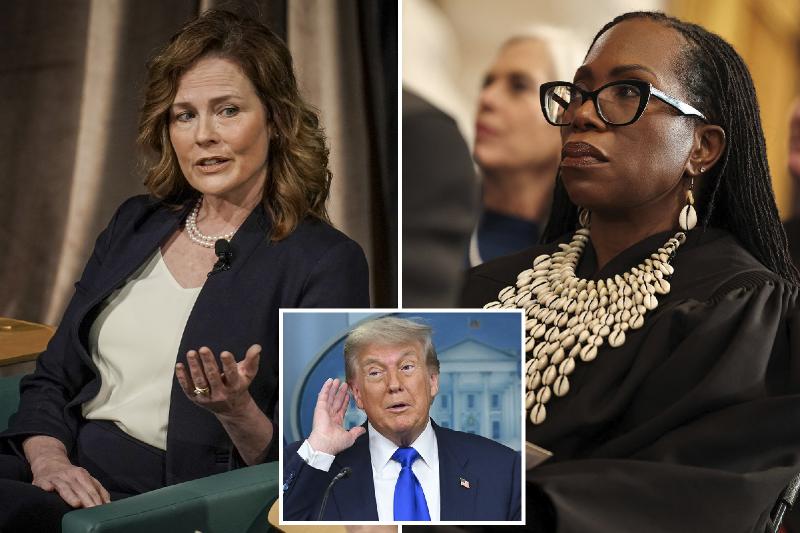
Conservative Supreme Court Justice Amy Coney Barrett stunned veteran bench watchers Friday with a blunt takedown of liberal Justice Ketanji Brown Jackson's "extreme" dissent in the landmark birthright citizenship case in which the Supreme Court curtailed lower court use of nationwide injunctions.

S E E D E D   C O N T E N T


Conservative Supreme Court Justice Amy Coney Barrett stunned veteran bench watchers Friday with a blunt takedown of liberal Justice Ketanji Brown Jackson's "extreme" dissent in the landmark birthright citizenship case in which the Supreme Court curtailed lower court use of universal injunctions.

"We will not dwell on Justice Jackson's argument, which is at odds with more than two centuries' worth of precedent, not to mention the Constitution itself," wrote Barrett, the court's second-newest justice, in a jaw-dropping rebuke of her colleague, the newest justice.

"We observe only this: Justice Jackson decries an imperial Executive while embracing an imperial Judiciary."

Barrett had authored the majority opinion in the case, the most consequential on the docket this term, which gave President Trump a major win by limiting the power of district judges to block his actions.

Liberal Justice Sonia Sotomayor penned the main dissent for the left flank of the high court, which Jackson joined.

But Jackson also wrote a concurring dissent that featured a heavy fixation on the potential practical ramifications of the 6-3 decision rather than grounding her argument in legal theory.

"It is not difficult to predict how this all ends. Eventually, executive power will become completely uncontainable, and our beloved constitutional Republic will be no more," Jackson dramatically fretted at one point.

"Quite unlike a rule-of-kings governing system, in a rule of law regime, nearly '[e]very act of government may be challenged by an appeal to law,'" Jackson wrote elsewhere. "At the very least, I lament that the majority is so caught up in minutiae of the Government's self-serving, finger-pointing arguments that it misses the plot."

Jackson even went so far as to dismiss the question of whether universal injunctions were provided for by the Judiciary Act of 1789 as "legalese" that "obscures a far more basic question of enormous legal and practical significance: May a federal court in the United States of America order the Executive to follow the law?"

Barrett's response in her opinion was almost mocking: "Because analyzing the governing statute involves boring 'legalese,' [Jackson] seeks to answer 'a far more basic question of enormous practical significance: May a federal court in the United States of America order the Executive to follow the law?'

"In other words, it is unnecessary to consider whether Congress has constrained the Judiciary; what matters is how the Judiciary may constrain the Executive. Justice Jackson would do well to heed her own admonition: '[E]veryone, from the President on down, is bound by law,'" Barrett continued.

"That goes for judges too."

While Barrett, 53, gave lukewarm praise to Sotomayor, 71, for focusing her dissent on "conventional legal terrain, like the Judiciary Act of 1789 and our cases on equity," she rounded on Jackson, 54, for adopting "a startling line of attack that is tethered neither to these sources nor, frankly, to any doctrine whatsoever.

"Waving away attention to the limits on judicial power as a 'mind-numbingly technical query' … she offers a vision of the judicial role that would make even the most ardent defender of judicial supremacy blush," Barrett wrote.

Meanwhile, Jackson opted not to conclude her opinion with the common phrases "I dissent" or "respectfully, I dissent" in an apparent sign of her fury at her colleagues' ruling.

"It's not something that we see every day," Republican Iowa Attorney General Brenna Bird told The Post about Barrett's jabs, though Bird stressed that Barrett confined her critique to legal differences rather than personal attacks.

Other commentators were more scathing.

"Holy s—, this is about as brutal as I've ever seen SCOTUS be on one of their own," attorney Kostas Moros wrote on X in response to Barrett's "imperial Judiciary" quote. "Translated: 'you are so stupid that you aren't even worth responding to.'"

"The FACT that six Justices were OK with signing onto an opinion where Justice Barrett took a personal shot at Justice Jackson is a VERY STRONG indication that Jackson has alienated her colleagues and there is a growing lack of respect for her work," mused X user Shipwreckedcrew, whose profile describes him as a former federal prosecutor.

"Justices circulate Memos among with their legal views on certain cases in order to bring others around to their thinking. Given what she has written in her dissent, imagine the memos that Jackson must have sent around in this case."

Three lower courts had stayed Trump's Jan. 20 executive order narrowing the definition of birthright citizenship — which the 14th Amendment states confers automatic naturalization on all individuals born in the US — after concluding the executive action was likely unconstitutional.

The Supreme Court did not address the merits of Trump's order — only the power courts had to enjoin it.


Tags

jrDiscussion - desc
[]
 
Vic Eldred
Professor Principal
1  seeder  Vic Eldred    last year

Jackson finally got her comeuppance.


1stwarrior
Professor Participates
1.1  1stwarrior  replied to  Vic Eldred @1    last year

And, actually, Jackson is complaining 'bout the President telling the courts what their authority is, and no real discussion on immigration.


Vic Eldred
Professor Principal
1.1.1  seeder  Vic Eldred  replied to  1stwarrior @1.1    last year

That is exactly right. The Court decided something that needed fixing now.

The issue of birthright citizenship has been sidelined until the October session.


Ozzwald
Professor Quiet
1.2  Ozzwald  replied to  Vic Eldred @1    last year
Jackson finally got her comeuppance.

How dare anyone, especially a woman of color, dare oppose our supreme leader!!!!! 

images?q=tbn:ANd9GcSbL83DSbYfE4nEhdbOaoTxY2mVcKRFf5I7Dg&s


1stwarrior
Professor Participates
2  1stwarrior    last year

What Jackson has shown is that she, really, doesn't have a firm understanding of how court decisions are made.

[lack] [✘] of [any citations] [✘] or [links, SP]
[✘] It's a wonder that Justice Gorsuch hasn't taken Jackson under his wing and taught her the basic fundamentals of making decisions based on law - that of intent and precedent.


JohnRussell
Professor Principal
2.1  JohnRussell  replied to  1stwarrior @2    last year

Put the link up before someone accuses you of plagiarism. 


1stwarrior
Professor Participates
2.1.1  1stwarrior  replied to  JohnRussell @2.1    last year

Sorry John - just following examples shown on NT.

Look it up - you'll find the cases in various law libraries.


Vic Eldred
Professor Principal
2.2  seeder  Vic Eldred  replied to  1stwarrior @2    last year

Basically, she wrote an emotional dissent based on what she thought the law should be.


JohnRussell
Professor Principal
2.2.1  JohnRussell  replied to  Vic Eldred @2.2    last year
Birthright citizenship , also known as   jus soli   (“right of the soil”), is the legal principle that grants citizenship to individuals born within a country’s territory, regardless of the nationality or legal status of their parents. This concept contrasts with   jus sanguinis   (“right of blood”), where citizenship is determined by the nationality of one’s parents. While   jus soli   is seen as a progressive and inclusive approach, its implementation and implications have been the subject of heated debates across different countries.

In countries that recognize birthright citizenship, individuals automatically become citizens at birth if they meet specific territorial or legal criteria. This policy, widely practiced in the Americas, reflects ideals of inclusivity and equality, ensuring that all individuals born within a country’s borders have an equal claim to citizenship and its associated rights. By offering this legal protection,   jus soli   helps prevent statelessness and promotes social integration.

What Is Birthright Citizenship, Its History, Implications, And Why It's Now Controversial In The United States

Jui soli has always been the position of the United States.  The 14th amendment was needed because southern racists wanted to change that following the Civil War. 


Just Jim NC TttH
Professor Expert
2.2.2  Just Jim NC TttH  replied to  JohnRussell @2.2.1    last year
This provision was primarily intended to guarantee citizenship to formerly enslaved individuals and their descendants, ensuring their equal treatment under the law. The amendment marked a pivotal moment in the nation’s history, symbolizing a commitment to inclusivity and equal rights.

And there it should have ceased..It served its purpose.


JohnRussell
Professor Principal
2.2.3  JohnRussell  replied to  Vic Eldred @2.2    last year
jus soli The principle of birthright citizenship, known as   jus soli   (Latin for “right of the soil”), can be traced back to English common   law , where it was long established that any individual born within the King’s dominion was considered a natural-born subject. This principle was most famously articulated in   Calvin’s   Case   (1608), a landmark ruling that held that persons born within the realm of England, regardless of the status of their parents, owed allegiance to the monarch and were entitled to the rights of English subjects.

This   doctrine   was carried over to the American colonies and remained a foundational   legal principle   even after the United States declared independence in 1776. While the U.S.   Constitution , ratified in 1789, did not explicitly define citizenship, early legal interpretations continued to adhere to   jus soli   as a guiding principle. However, racial and social exclusions complicated its application, particularly in regard to enslaved individuals and Native Americans, who were often denied full legal recognition as citizens.

Birthright Citizenship 101: A Pillar Of Democratic Inclusion Or A Policy In Need Of Reform? - The Law To Know

The principle of birthright citizenship was not invented for the freed slaves, it already existed. The 14th amendment was needed because southern racists were trying to change that through Jim Crow laws. 


Sean Treacy
Professor Principal
2.2.4  Sean Treacy  replied to  Vic Eldred @2.2    last year

That’s left wing jurisprudence in a nutshell.  No need for the “legalese” (statutes, the constitution) that Jackson finds so irrelevant 


1stwarrior
Professor Participates
2.2.5  1stwarrior  replied to  JohnRussell @2.2.3    last year

You're starting to sound like my brother - "my mind is already made up, don't confuse me with the facts".

You confuse reality with wishes. Whatever has been written/passed by Congress does not go through a "let's let **)$% approve what we do (which is our job) because they think they can do it better".

Recommend you stay away from legal discussions - you are getting too many things confused with the realities.[✘]


JohnRussell
Professor Principal
2.2.6  JohnRussell  replied to  1stwarrior @2.2.5    last year

Most of your comments make no sense. The 14th amendment was not created to carve out an exemption for freed slaves , it was created to prevent racists from subverting a principle of law that already existed. 

jus soli existed in practice before the 14th Amendment

The argument that the 14th amendment was only supposed to pertain to freed slaves holds no water. 


JohnRussell
Professor Principal
2.2.7  JohnRussell  replied to  1stwarrior @2.2.5    last year
jus soli existed in practice before the 14th Amendment

You copied and pasted a long passage from the internet without attribution. That is considered plagiarism on Newstalkers as far as I know. 


1stwarrior
Professor Participates
2.2.8  1stwarrior  replied to  JohnRussell @2.2.6    last year

Just proved my point.


1stwarrior
Professor Participates
2.2.9  1stwarrior  replied to  JohnRussell @2.2.7    last year

Of course you should be aware of that having practiced it so often.


JohnRussell
Professor Principal
2.2.10  JohnRussell  replied to  1stwarrior @2.2.9    last year

LOL. I literally never copy and paste anything longer than a sentence without a link. 

I think it was a simple oversight on your part and now you are doubling down. 


Vic Eldred
Professor Principal
2.2.11  seeder  Vic Eldred  replied to  JohnRussell @2.2.1    last year
Jui soli has always been the position of the United States.

WRONG. It was not originally spelled out in the US Constitution.


 The 14th amendment was needed because southern racists wanted to change that following the Civil War. 

ABSOLUTELY WRONG. The predecessors of today's democrats had zero power to change anything after the Civil war. The Fouteenth Amendment was adopted by congress following the Civil War to specifically protect the rights of native-born Black Americans who suddenly became free, just like 1st Warrior perfectly pointed out in Post 2. The Amendment has just enough ambiguity to have some wondering if it goes beyond those born to the newly freed slaves. The key phrase is: "Every person born within the limits of the United States, and subject to their jurisdiction,"  That would seem to exclude migrants rushing into the country to have an anchor baby born here.

The Supreme Court needs to decide that once and for all. I don't care much which way they go. It needs clarification.

As to what the court did decide: The district judges created by congress without any guidelines on their authority, now have a very clear line as to where their authority ends and that desperately needed to be settled.


TᵢG
Professor Principal
2.2.12  TᵢG  replied to  Vic Eldred @2.2.11    last year

The 14th Amendment codified Jus Soli.   The landmark Wong Kim Ark case established a precedent in 1898 that a child born in the USA to parents who were not citizens (and not foreign diplomats) is a citizen of the United States by being born here (Jus Soli).

The SCotUS can overturn this longstanding precedent of over 127 years, but that does not change the fact that this is the standing interpretation.

Trump (or any other PotUS) has no authority to change this.   Any change of interpretation must come from the SCotUS or by an Amendment to the CotUS.


JohnRussell
Professor Principal
2.2.13  JohnRussell  replied to  Vic Eldred @2.2.11    last year

You dont understand the material. 


JohnRussell
Professor Principal
2.2.14  JohnRussell  replied to  Vic Eldred @2.2.11    last year
Birthright citizenship is rooted in colonial history when settlers born in the colonial United States were considered "natural born" subjects of the King of England. The idea of conferring citizenship based on being born within the borders of the United States comes from this history.   Jus soli - Wikipedia

Birthright citizenship is not something that was created simply to apply to the children of freed slaves.  End of story. 

Why do you think most legal experts say the SC will not overturn birthright citizenship. 


1stwarrior
Professor Participates
2.2.15  1stwarrior  replied to  TᵢG @2.2.12    last year

Sorry - United States v. Wong Kim Ark, 169 U.S. 649 (1898), is a landmark decision of the U.S. Supreme Court which held that "a child born in the United States, of parents of Chinese descent, who, at the time of his birth, are subjects of the Emperor of China, but have a permanent domicile and residence in the United States, and are there carrying on business, and are not employed in any diplomatic or official capacity under the Emperor of China", automatically became a U.S. citizen at birth.

Try a little more accuracy - makes for better reading.


1stwarrior
Professor Participates
2.2.16  1stwarrior  replied to  JohnRussell @2.2.13    last year

You, very obviously, don't - probably need to recommend you stay out of legal discussions.


TᵢG
Professor Principal
2.2.17  TᵢG  replied to  1stwarrior @2.2.15    last year
Try a little more accuracy - makes for better reading.

Adding detail does not change the meaning of the ruling.   And your snarky crap does not help your argument.

Here is an example of making an argument without making things personal ☞

On Wong Kim Ark case we have this clear language :

As Justice Horace Gray wrote in Wong Kim Ark, “The Amendment, in clear words and in manifest intent, includes the children born, within the territory of the United States, of all other persons, of whatever race or color, domiciled within the United States. Every citizen or subject of another country, while domiciled here , is within the allegiance and the protection, and consequently subject to the jurisdiction, of the United States.”

Next, we have 8 U.S. Code § 1401 wherein Congress affirmed Jus Soli.   Congress enumerated the details yet nowhere do they put in any exceptions for illegal immigrants :

8 U.S. Code § 1401 - Nationals and citizens of United States at birth

The following shall be  nationals  and citizens of the  United States  at birth:

(a)  a person born in the  United States , and subject to the jurisdiction thereof;

(b)  a person born in the  United States  to a member of an Indian, Eskimo, Aleutian, or other aboriginal tribe: Provided, That the granting of citizenship under this subsection shall not in any manner impair or otherwise affect the right of such person to tribal or other property;

(c)  a person born outside of the  United States  and its outlying possessions of parents both of whom are citizens of the  United States  and one of whom has had a  residence  in the  United States  or one of its outlying possessions, prior to the birth of such person;

(d)  a person born outside of the  United States  and its outlying possessions of parents one of whom is a citizen of the  United States  who has been physically present in the  United States  or one of its outlying possessions for a continuous period of one year prior to the birth of such person, and the other of whom is a  national,  but not a citizen of the  United States ;

(e)  a person born in an outlying possession of the  United States  of parents one of whom is a citizen of the  United States  who has been physically present in the  United States  or one of its outlying possessions for a continuous period of one year at any time prior to the birth of such person;

(f)  a person of unknown parentage found in the  United States  while under the age of five years, until shown, prior to his attaining the age of twenty-one years, not to have been born in the  United States ;

(g)  a person born outside the geographical limits of the  United States  and its outlying possessions of parents one of whom is an  alien,  and the other a citizen of the  United States  who, prior to the birth of such person, was physically present in the  United States  or its outlying possessions for a period or periods totaling not less than five years, at least two of which were after attaining the age of fourteen years: Provided, That any periods of honorable  service  in the Armed Forces of the  United States , or periods of employment with the  United States  Government or with an international  organization  as that term is defined in  section 288 of title 22  by such citizen parent, or any periods during which such citizen parent is physically present abroad as the dependent  unmarried  son or daughter and a member of the household of a person (A) honorably serving with the Armed Forces of the  United States,  or (B) employed by the  United States  Government or an international  organization  as defined in  section 288 of title 22 , may be included in order to satisfy the physical-presence requirement of this paragraph. This proviso shall be applicable to persons born on or after December 24, 1952, to the same extent as if it had become effective in its present form on that date; and

(h)  a person born before noon (Eastern Standard Time) May 24, 1934, outside the limits and jurisdiction of the  United States  of an  alien  father and a mother who is a citizen of the  United States  who, prior to the birth of such person, had resided in the  United States.

(June 27, 1952, ch. 477, title III, ch. 1, § 301,  66 Stat. 235 ;  Pub. L. 89–770 , Nov. 6, 1966,  80 Stat. 1322 ;  Pub. L. 92–584 , §§ 1, 3, Oct. 27, 1972,  86 Stat. 1289 ;  Pub. L. 95–432 , §§ 1, 3, Oct. 10, 1978,  92 Stat. 1046 ;  Pub. L. 99–653, § 12 , Nov. 14, 1986,  100 Stat. 3657 ;  Pub. L. 103–416, title I, § 101(a) , Oct. 25, 1994,  108 Stat. 4306 .)

Finally, ChatGPT offers numerous cases which have affirmed the precedent and 8 U.S. Code § 1401:

Perkins v. Elg (1939)         Reaffirmed citizenship for U.S.-born children of alien parents

Plyler v. Doe (1982)          Undocumented persons are “within the jurisdiction” of the 14th Amendment

Regan v. King (1943)       9th Cir.: automatic citizenship at birth confirmed

Oforji v. Ashcroft (2003)   7th Cir.: children of undocumented parents are U.S. citizens

Nolos v. Holder (2010)     5th Cir.: birthright citizenship upheld, barring limited exceptions


To wit, Jus Soli is well-established in our CotUS and has been adjudicated and reaffirmed several times.   To change this requires a precedent-breaking ruling by the SCotUS (which it did not do) or a constitutional amendment.

Trump's EO violates the CotUS.


JohnRussell
Professor Principal
2.3  JohnRussell  replied to  1stwarrior @2    last year

Conclusion

In essence, while jus soli existed in practice before the 14th Amendment, it was the Amendment that standardized and guaranteed this principle across the United States. The early application of jus soli was fraught with exceptions and inequalities, which the 14th Amendment sought to address by ensuring comprehensive citizenship rights for all individuals born on U.S. soil, thereby firmly entrenching jus soli in U.S. law.
Prior to the 14th amendment jus soli was an established American principle. So why the 14th amendment? Because certain forces wanted to subvert that principle by punishing freed slaves and Native Americans. 


1stwarrior
Professor Participates
2.3.1  1stwarrior  replied to  JohnRussell @2.3    last year

False - notice that Native Americans were SPECIFICALLY noted as not part of the 14th.

The majority held that the "subject to the jurisdiction" phrase in the 14th Amendment specifically encompassed these conditions (plus a third condition, namely, that Indian tribes were not considered subject to U.S. jurisdiction.


JohnRussell
Professor Principal
2.3.2  JohnRussell  replied to  1stwarrior @2.3.1    last year

Completely immaterial to the fact that the concept of jus soli, which is citizenship conferred by soil not blood, was already the practice in the US, and can be traced back to precolonial England. (Which interestingly enough is an application that was used to argue in favor of the 2nd amendment rights according to the Heller decision. )


1stwarrior
Professor Participates
2.3.3  1stwarrior  replied to  JohnRussell @2.3.2    last year

WTF does a firearms court decision have to do with immigration - or, better yet, any of the topic of this thread???

JFC John - WTH???


Perrie Halpern R.A.
Professor Guide
2.3.4  Perrie Halpern R.A.  replied to  1stwarrior @2.3.3    last year

Thread 2.4 was removed for massive meta. Knock it off. Only warning. 


Sean Treacy
Professor Principal
3  Sean Treacy    last year

We will not dwell on Justice Jackson's argument, which is at odds with more than two centuries' worth of precedent, not to mention the Constitution itself

I feel bad for Jackson brown.  She’s intellectually outgunned and has no business being on the court.  Six justices signing onto acb’s nuking of Jackson  shows how just how thin her antics are wearing.

ACB’s summary is a good lesson about wasting time with fools too. . 


Greg Jones
Professor Participates
4  Greg Jones    last year

How did this activist make it through the confirmation process?

MC-StinkyPants_063025-thm-800x0.jpg


1stwarrior
Professor Participates
4.1  1stwarrior  replied to  Greg Jones @4    last year

Check the squares - all that was needed - female - minority - attended Harvard - first elevated by Obama - nominated to SCOTUS by Biden.


charger 383
Professor Silent
5  charger 383    last year

Giving citizenship to a baby born on US soil with foreign parents might have been OK before this country became overcrowded but now it just makes problem of overpopulation worse. 

Past time to end it


freepress
Freshman Silent
6  freepress    last year

After the same court gave Trump who is a convicted felon total immunity as executive, essentially making him a king that is no longer bound by law. It's a travesty for Barrett to say "Everyone from the President on down is bound by the law" which is clearly a lie.

This President is not "bound" by the law if he REFUSES to follow courts decisions dragging every case to a Supreme Court knowing they will automatically give him a win.


MrFrost
Professor Guide
7  MrFrost    last year

I wonder where Baron Trump, (anchor baby), will be sent to? 


Jeremy Retired in NC
Professor Guide
7.1  Jeremy Retired in NC  replied to  MrFrost @7    last year

How cute.  You really don't know the SCOTUS rulings on this.  


Just Jim NC TttH
Professor Expert
7.1.1  Just Jim NC TttH  replied to  Jeremy Retired in NC @7.1    last year

Guess not. Barron was born to an American father and immigrant/citizen mother. They seem to forget that one Barack Obama had much the same lineage only reversing the citizen non-citizen roles. Father, Kenyan. Mother, US citizen.

As usual, memories get short.


Jeremy Retired in NC
Professor Guide
7.1.2  Jeremy Retired in NC  replied to  Just Jim NC TttH @7.1.1    last year
As usual, memories get short.

While sort memories are a problem, this is also a selective memory thing.  Hypocrites usually pull this nonsense then cry when called out.


Who is online


114 visitors