
Minneapolis church shooting search warrants reveal new details and evidence

Category: News & Politics
Via: perrie-halpern • last year • 12 commentsBy: Selina Guevara, Erik Ortiz and Cat Corrigan

 S E E D E D C O N T E N T
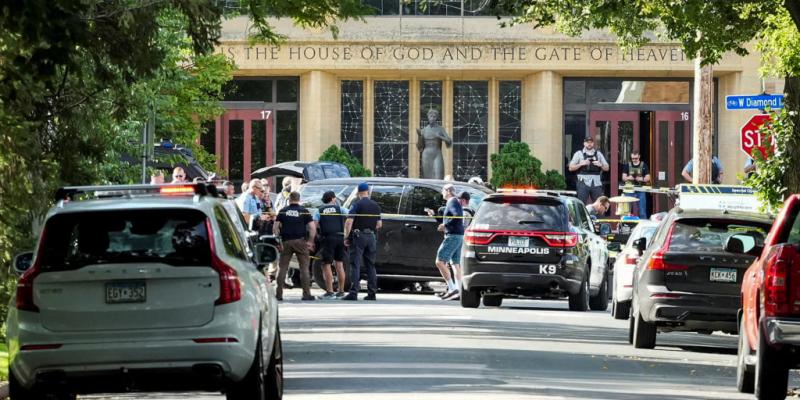
MINNEAPOLIS — The heavily armed assailant who opened fire during Mass at a Minneapolis Catholic school was found dead at the rear of the church with an apparent gunshot wound to the head, according to preliminary information in newly released search warrants.
Robin Westman, 23, was found dressed in black "tactical" gear with at least two firearms nearby in Wednesday morning's rampage at Annunciation Catholic Church, police said. Two children were killed and 18 other worshippers were injured.
A search warrant for the church said three guns were taken into evidence: a Taurus semiautomatic pistol, a Mossberg pump-action shotgun, and a Magpul semiautomatic rifle. Police found a wood board with a gas container and a metal pull pin on the ground, according to the search warrant, items that may have been intended to be used as a smoke bomb.
Minneapolis police said Thursday that they had recovered 116 rifle rounds and three shotgun shells from the scene. Search warrant details show that the shooter left four empty magazines from the semiautomatic rifle and had more to spare.
Investigators found three more magazines full of live rifle rounds on the ground, and three magazines containing 9mm ammo for the handgun— two on the ground and one recovered from inside the weapon. Police say the handgun "appears to have malfunctioned" as the shooter used it and one live round got stuck in the chamber.
Six unused shotgun shells were pulled from that weapon and more were found in a pouch on the shooter's belt. Investigators also said they collected a knife, green fingerless gloves, black mechanic gloves, headphones and a gray zip-up sweatshirt.
A commercial van — a 2015 Ram ProMaster City — had been parked behind the church with at least one of its rear doors opened and a rifle case visible to officers, according to the search warrant. The vehicle was registered to Westman's father, James Westman.
In a conversation with police after the shooting, James Westman said Robin Westman was his child and was driving the van. He also said Robin Westman had recently been living in the nearby suburb of Richfield, but had broken up with a "significant and/or romantic partner" and was staying with another friend in neighboring St. Louis Park, according to the search warrant.
James Westman also advised police that his child formerly attended Annunciation Church and its school, and that his ex-wife, his child's mother, had worked there.
At the father's home, police recovered a tactical vest, two external media storage devices and miscellaneous documents, according to the search warrant.
In total, police listed 100 pieces of evidence, including T-shirts, bullets and cartridges, to be tested by the Minnesota Bureau of Criminal Apprehension. A Minneapolis Police Department property report also lists 158 pieces of evidence, including the guns, the items appearing to belong to the shooter, and a USB and iPhone taken from the vehicle.
Minneapolis Police Chief Brian O'Hara told reporters Thursday that Robin Westman's family has been cooperating with investigators, although they had not spoken to her mother, Mary Grace Westman. Law enforcement said Friday they were in contact with her.
Records show that she has a residence in Florida and that she has hired a criminal defense attorney, Ryan Garry. He declined to comment Thursday.
Police have not said whether Mary Grace Westman or any family members potentially face charges. O'Hara said that the weapons used in the shooting were legally purchased recently and that there was no previous indication that Robin Westman, who was a transgender woman, suffered from mental illness. Westman had no police record, besides a traffic ticket.
Investigators are continuing to search for a clear motive for the attack and what led Westman to fire a rifle through the side windows of Annunciation Catholic School's church, aiming at children sitting in the pews, just before 8:30 a.m.
Two children, 8-year-old Fletcher Merkel and 10-year-old Harper Moyski, were killed. Fifteen other children, ages 6 to 15, were injured, as well as three adult parishioners in their 80s.
Westman left behind videos online with disturbing content and writings that referred to suicide.
The FBI's special agent in charge in Minneapolis, Alvin Winston Sr., said the agency had not had any previous contact with the shooter.
FBI Director Kash Patel called the attack "an act of domestic terrorism motivated by a hate-filled ideology."
Police are continuing to review the online videos posted by Westman, in which the shooter wrote racial slurs, a homophobic slur, antisemitic messages, a call for President Donald Trump's death and references to the Holocaust and the Catholic Church.
Besides the church and James Westman's home, two other nearby residences associated with the shooter were searched as part of the investigation.
"Additional firearms are being recovered from those residences as we speak," O'Hara told reporters Wednesday.
Brianna Seidl, a neighbor of the home in St. Louis Park where Westman had been living, said Friday that she would see Westman occasionally rollerblading or skateboarding in the neighborhood. Police swarmed the home on Wednesday just before 11 a.m., Seidl said, and called on a loudspeaker for a resident to come out.
Police put caution tape around the scene and carted out boxes, she added.
The resident "was very compliant with them. Kind of seemed like whatever you got to do, do it, type of situation," Seidl said.

Tags
Who is online
159 visitors
Interesting that they got a search warrant for the church. Some might infer from that that the church wasn't going to consent to a search, but I would guess the church wanted to make sure the search was properly limited to a search for evidence of the crime, as opposed to a free-roaming search of the whole premises. Give some cops an inch and they'll take a mile.
Actually it's almost a requirement to get around the 4th and 14th Amendment as laid out in the 1978 case of Mincey v Arizona. I'll include a lengthy document link but IMO the telling part is this..
While police may do a warrantless search of a murder scene, it is limited. They have to believe there may be other victims that are in need of medical assistance or if the killer is still on the premises. Any evidence in plain sight that is observed by the officers at that time may be seized. After that officers may secure the site for a reasonable amount of time to obtain a search warrant. But in-depth investigation may not occur until a search warrant for the sight has been obtained.
In that case, though, they were in Mincey’s (the suspect) apartment and didn’t have his consent to conduct a search. In the present case, the church could have simply consented to a search.
And if the church was the only other "suspect" then I could agree that this would work (although I don't know the law fully as I'm not a lawyer). But what if during that consented search the police found evidence that tied to another suspect? Then it is conceivable that a lawyer could have gotten that evidence tossed out due to the SCOTUS ruling.
No, I think the police getting the search warrant before letting investigators into the church was the correct step.
In this case, the church is not a suspect, so the police would need either consent to search or a warrant. I suppose there is an exigent circumstances argument to be made about the preservation of evidence, but it doesn’t seem like anyone was trying to do that here.
If we’re talking about something in plain view, then the plain view rule applies. If it’s something that you had to kind of look for - like a closet had to be opened for example - then it’s still admissible if that search could be reasonably part of the search they were consented to do. The same applies to the warrant, actually. The warrant is supposed to declare, with specificity, the places to be searched and the things or persons to be searched for.
So for example, if police are searching for a stolen TV, it’s probably not reasonable to making opening a dresser drawer part of that search.
When you give consent to a search, it is a good idea to define the scope and limit of that consent. And technically, consent can be withdrawn at any time, although you’ll likely get an argument and foot-dragging from the cops.
I’ve never been in charge of a murder investigation, but I would imagine the warrant would allow cops to take their time documenting the scene, being as thorough as possible, without having to keep checking with the church.
I think you are wrong here. The guns could be picked up but I do not believe any additional testing could be done on the guns (fingerprints) in case it pointed to another suspect. Additionally even though a bullet could be in plain sight, they cannot dig them out of a wall for instance without a warrant. Just having the consent of the church would not necessarily prevent the court from throwing out evidence that could be protected by the 4th and 14th Amendments.
As far as preserving the evidence, I'm actually confident that the police did in fact secure the church after insuring there were no other victims or other shooters.
I don't believe that is correct. If the search is consensual, it does not violate the 4th Amendment. Any evidence found, even if it implicates a third party, can be used in court against that person, nor would the search be restricted where evidence is in plain sight, as in your example, or otherwise. Consent to search means a warrant is not required.
As I said, I'm not a lawyer. But I'm not sure that's correct as the consensual search would not involve everybody who could be a suspect.
But IMO it's a moot point as they did wait to get a search warrant before letting the investigators into the church. In this case I'll go with the expertise of the police.
The Fourth Amendment products the people from unreasonable searches of their “persons, houses, papers, and effects.” But that does not mean the whole world is off limits.
If you commit a crime and leave the evidence in my house, I can consent to a search. And if the police find your evidence, you’re just screwed. It’s the same as if you had left it on the sidewalk.
It’s probably just SOP in murder cases or anything else where a major investigation is required.
Just SOP in those cases?
Yes I think you are right.
And I can agree. I took my opinion based on reading the link I had provided AND the fact that this was a murder scene that would require a major investigation. Had they found fingerprints on one of the guns that didn't belong to the shooter before they obtained a warrant, it's possible that a defense lawyer could have gotten that evidence tossed out.
So - is Westman's dad going to be charged as an accessory due to the amount of armament/etc. found in his residence?