
China showcases new Moon ship and reusable rocket in one extraordinary test

Category: Health, Science & Technology
Via: bob-nelson • 9 months ago • 16 commentsBy: Stephen Clark, Ars Technica


The test marks a significant step in China’s push to land humans on the Moon by 2030

Arizona senators challenge Surprise ICE center on environmental grounds
Sens. Mark Kelly and Ruben Gallego sent a letter to the Department of Homeland Security chief Kristi Noem and U.S. Immigration and Customs Enforcement acting director Todd Lyons on Feb. 10, expressing concerns about the future 1,500-bed processing facility in the suburban city northwest of Phoenix.
The Copper Courrier - AZ news website
Halloween for cowards
Here are two things that definitely don’t belong together: guns and masks.
Lucian K. Truscott IV
The Big Lies at the Heart of Trump’s Mass-Deportation Campaign
Trump conceals how immigrants help the economy and commit relatively few crimes.
John Harwood
America Is Hurting Little Children Again And MAGA Couldn't Be Happier
Don't worry, ICE says they're being fed, so shut up.
Doktor Zoom
Her mom was detained in the Zipps raids. Now, she’s speaking out
Patricia Gonzalez was one of more than 30 people detained after immigration authorities conducted raids at Zipps Sports Grill locations across the Valley.
The Copper Courrier - AZ news website
Sahara Sajjadi
Despite Birth Rate Concerns, GOP Stays Laser-Focused On Helping Men Become More Repulsive To Women
And in so many ways!
Robyn Pennacchia
Trump Loses a Symbolic Vote
And it is an important symbol, in keeping, once again, with the fact that resistance is far from futile.
Jared Bernstein
What Happens When the World Decides It Can’t Trust America Anymore?
From France to Germany to Canada, governments are recalibrating their security, technology, and defense policies around one unspoken reality: America can’t be counted on…
Thom Hartmann
Trump Can’t Cancel Elections. He Could Undermine Them.
“When you think of it, we shouldn’t even have an election,”
Sean Morales-Doyle, NYT
It’s The Economy, (You) Stupid (Fascist)
One of Trump’s favorite pollsters warns he’d lose to Biden in an election held today. Plus, the DOJ is spying on lawmakers who search the Epstein files, and a balloon gets mistaken for... a drone.
Asawin Suebsaeng
Pam Bondi LOUD NOISES! Tabs, Thurs., Feb. 12, 2026
Morning news roundup! Things to read!
Rebecca Schoenkopf
Border patrol chief praised federal agent who shot US citizen in Chicago
New evidence shows Gregory Bovino hailed agent who fired at Marimar Martinez five times in her car
Robert Mackey, The Guardian
 S E E D E D C O N T E N T
VCG/VCG via Getty Images
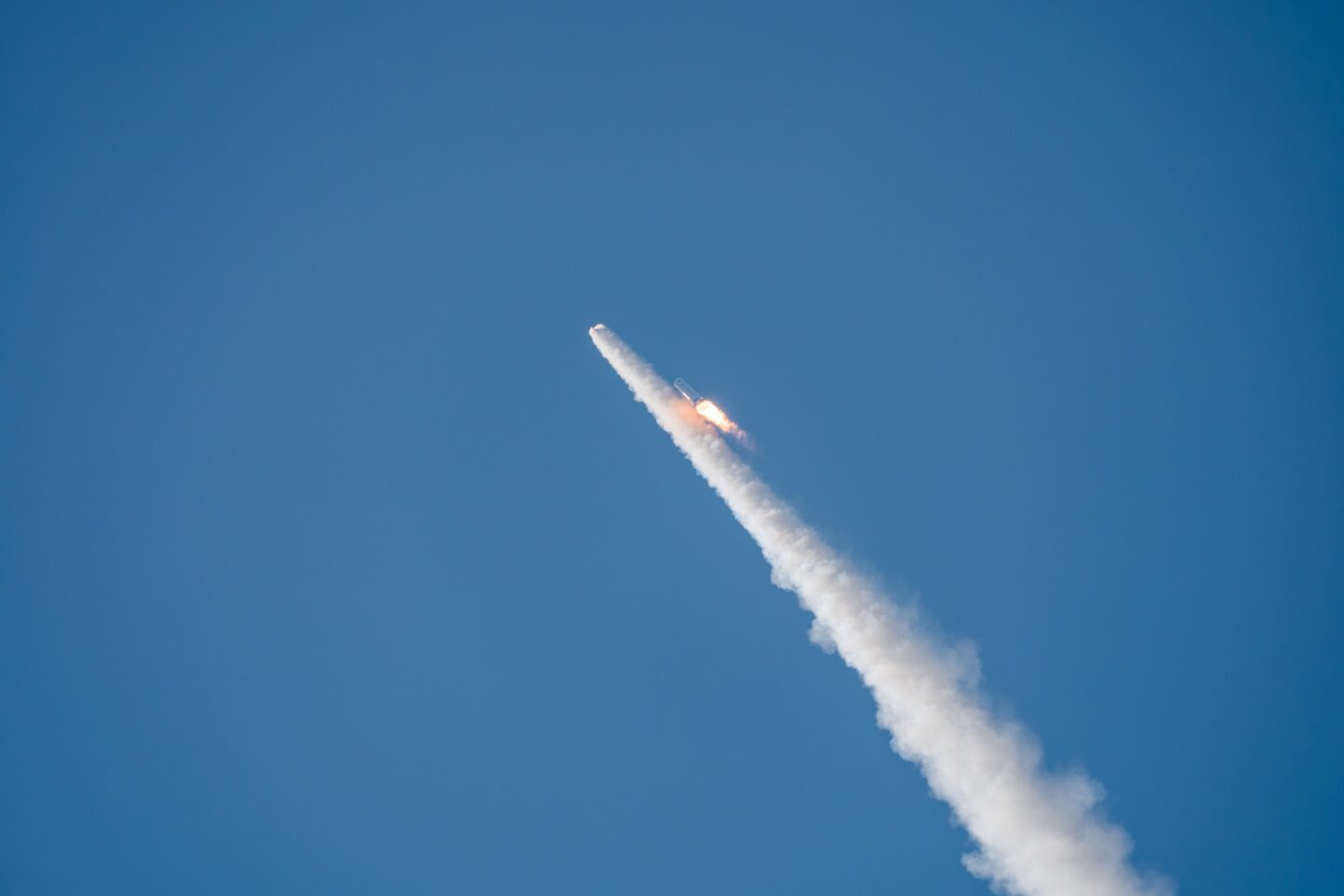
China’s space program, striving to land astronauts on the Moon by 2030, carried out a test flight of a new reusable booster and crew capsule late Tuesday (US time), and the results were spectacular.
The demonstration “marks a significant breakthrough in the development of [China’s] manned lunar exploration program,” the China Manned Space Agency (CMSA) said in a statement. China and the United States are racing to accomplish the next human landing on the Moon in a competition for national prestige and lunar resources. The Long March 10 rocket and Mengzhou spacecraft, both tested Tuesday, are core elements of China’s lunar architecture.
The launch of a subscale version of the Long March 10 rocket, still in development, provided engineers with an opportunity to verify the performance of an important part of the new Mengzhou capsule’s safety system. The test began with liftoff of the Long March 10 booster from a new launch pad at Wenchang Space Launch Site on Hainan Island, China’s southernmost province, at 10 pm EST Tuesday (03:00 UTC or 11 am Beijing time Wednesday).
A test version of the Mengzhou spacecraft, flying without anyone onboard, climbed into the stratosphere on top of the Long March booster before activating its launch abort motors a little more than a minute into the flight as the rocket reached the moment of maximum aerodynamic pressure, known as Max-Q. The abort motors pulled the capsule away from the booster, simulating an in-flight escape that might be necessary to whisk crews away from a failing rocket. The Mengzhou spacecraft later deployed parachutes and splashed down offshore from Hainan Island.
NASA and SpaceX performed similar in-flight abort tests before flying astronauts on the Orion and Dragon spacecraft. The test boosters on the Orion and Dragon abort tests were expended, but the Long March 10 rocket wasn’t finished after the Mengzhou abort command. Remarkably, the booster continued its ascent without the crew capsule, soaring into space on the power of its kerosene-fueled YF-100 engines before reentering the atmosphere, reigniting its engines, and nailing a propulsive landing in the South China Sea, right next to a recovery barge waiting to bring it back to shore.
“The rocket’s first stage and the spacecraft’s return capsule were safely splashed down in the designated sea area according to procedures,” CMSA said.
A recap video released by Chinese state television shows highlights from the test flight.
One test, two goals
In a matter of minutes, Chinese engineers moved closer to human-rating the Mengzhou crew capsule and achieved the country’s most successful test of a reusable rocket.
“The test successfully verified the functional performance of the rocket’s first stage ascent and recovery phases, as well as the maximum dynamic pressure escape and recovery of the spacecraft,” CMSA said. “It also verified the compatibility of relevant interfaces across various engineering systems, accumulating valuable flight data and engineering experience for subsequent manned lunar exploration missions.”
The low-altitude demonstration of the Mengzhou launch abort system follows a ground-level abort test last year that verified the spacecraft’s ability to escape an emergency on the launch pad. The Long March 10 booster also completed two test-firings on the launch pad prior to the in-flight abort test. At the same time, Chinese engineers have run a prototype lunar lander through a series of ground tests.
The Mengzhou spacecraft is the vehicle China will use to ferry astronauts from the Earth to the vicinity of the Moon, where crews will transfer into a lander to carry them to the lunar surface. After a short stay on the Moon, Chinese astronauts will take off and rendezvous with the Mengzhou capsule to bring them home.
Chinese officials say the Mengzhou spacecraft will also service the country’s space station in low-Earth orbit, replacing the Shenzhou capsule in use since the 1990s. The Mengzhou capsule has the capability for “multiple reuses,” according to CMSA. Mengzhou flights to low-Earth orbit will carry crews of up to seven astronauts, with smaller crews for lunar missions.
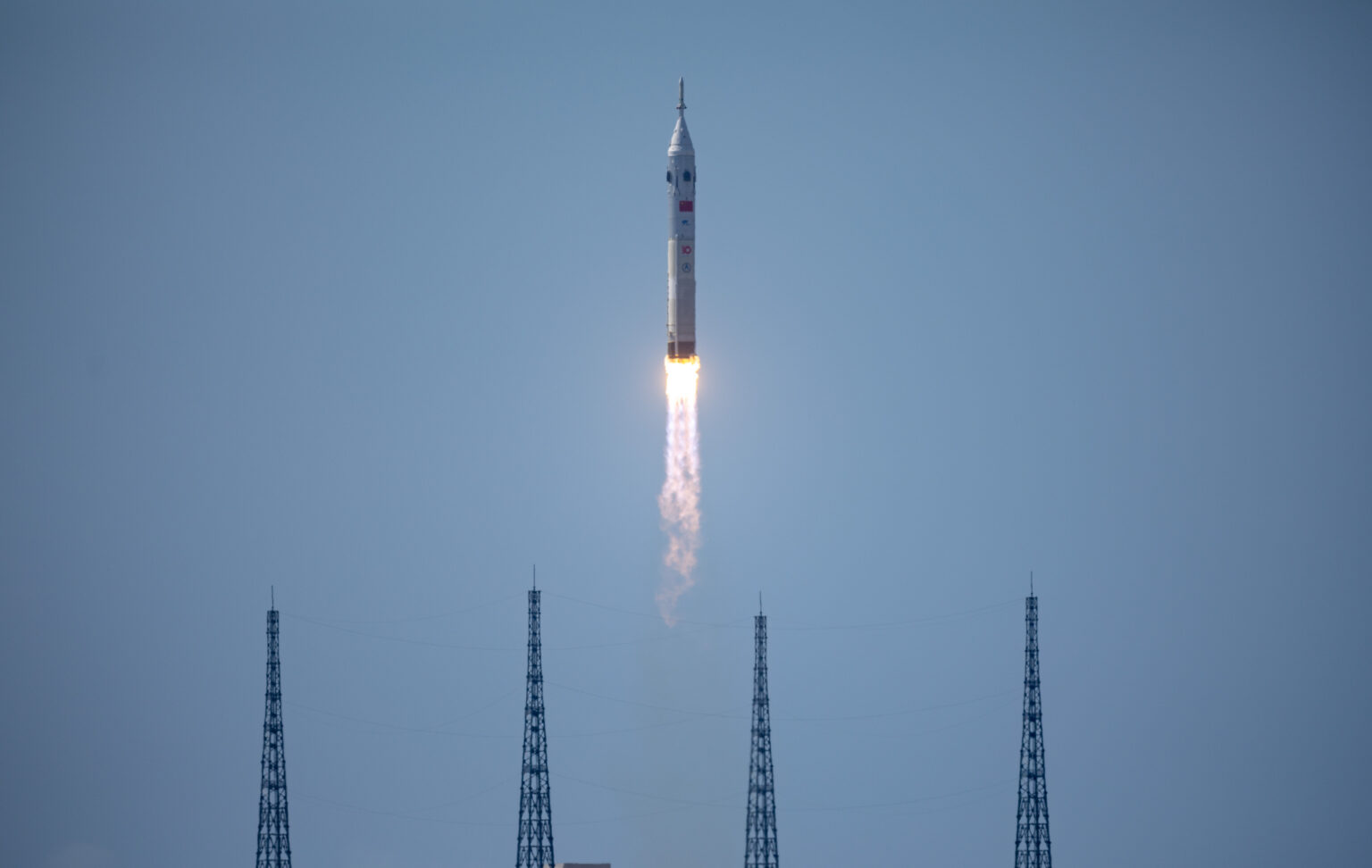
Mengzhou, which means “dream vessel” in Chinese, is scheduled for its first orbital test flight later this year. The spacecraft will launch on a Long March 10A rocket and dock with China’s Tiangong space station in low-Earth orbit. The Long March 10A, optimized for low-Earth orbit flights, will consist of a single reusable first-stage booster flying in combination with an upper stage. The full-size Long March 10, with 21 engines on three first-stage boosters connected together, will have the power to place payloads up to 70 metric tons into low-Earth orbit, and enough energy to propel the 26-metric-ton Mengzhou spacecraft to the Moon.
China’s leading state-owned space industry contractor, the China Aerospace and Science Technology Corporation (CASC), said the recovery of the Long March 10 booster after the in-flight abort test lays the foundation for “subsequent full-profile flight tests” and marks a “significant step” for China in “mastering reusable rocket technology.”
“The flight test further evaluated several key technologies, including the reliability of multiple engine restarts and high-altitude ignition during the rocket’s reentry phase, adaptability to complex force and thermal environments, and high-precision navigation control during the reentry phase.”
CASC oversees a sprawling industry of rocket and spacecraft manufacturers, including those responsible for designing and building the Mengzhou spacecraft and Long March 10 rocket.

The successful splashdown and recovery of the Long March 10 booster continues a busy period for China’s reusable rocket initiatives. No fewer than 10 Chinese companies are working on reusable rockets at different levels of maturity, all seeking to match the success of SpaceX’s reusable rocket program in the United States.
In December, two Chinese launch providers debuted new rockets —the Zhuque-3 and Long March 12A —with recoverable and reusable boosters. The rockets reached orbit, but their boosters missed their landings downrange from their launch pads.
Several Chinese companies have also completed high-altitude “hop tests” to evaluate vertical takeoff and vertical landing technologies ahead of launching their first orbital flights.
These advancements in China’s reusable rocket and lunar exploration programs come as NASA prepares to launch a crew of four astronauts on a loop around the far side of the Moon as soon as next month. A US-made lunar lander is likely still a few years away from being ready to transport crews to and from the lunar surface.
Whatever
Tags
Who is online
86 visitors
Meanwhile, in the United States:
America will destroy itself long before China gets the means or opportunity.
Honestly, what for? Let’s be real. There are no resources there that we really need. It would be INSANELY expensive to extract what is there. The whole enterprise - just to go and come back - is already stupidly expensive.
We can’t have food, housing, and healthcare for everyone here, but we can go to the moon? The whole thing is irrational.
Don’t misunderstand me. I think it’s neat and fascinating and an achievement of incredible engineering. I love science and all things space. But if we’re talking about real life priorities, going to the moon is just stupid.
I see no reason to go back to the Moon or to Mars either for that matter. Human beings will never live on Mars in numbers that would effect life on earth
Terraforming Mars could be easier than scientists thought
Aug 7, 2024 · Terraforming Mars could be easier than scientists thought Tiny rods made from martian ingredients could trap heat and warm planet
Did you ever watch the movie Red Planet? With Trump's help in speeding up the process of oiur planet becoming unhabitable, mankind might just HAVE to move its survivors to Mars.
I'm sorry, I consider that to be ridiclous
That's what the Wright Brothers were told.
I imagine you're aware of this, but a return to the Moon is set to become a political thing again, like in the Cold War, but this time against China instead of Russia. That's the reason we're going back. It's already in progress.
I don't want to say never, as I share in the romanticized excitement about eventually establishing colonies there, but living on Mars in the foreseeable future is a literal pipe dream. Anyone who thinks they want to go and live there permanently at our current level of technology has to be high. It would be like living in a cramped and smelly prison, almost entirely dependent on resupply from Earth. Basically a pointless endeavor fraught with never ending danger. No thanks.
I don't consider that a good enough answer at all. We've already been first to the moon. and 2nd through 12th.
I'm wondering why what you and JR have just posted made me think of Dr. Ellie Arroway (Jodie Foster) in the movie Contact telling the Haddon funding staff about the Wright Brothers.
The thinking(?) is that the moon will be a gas station for interplanetary flights. (There is currently a "gold rush" mentality for mining asteroids for precious metals. The moon as a gas station is necessary to make that possible.)
There is also a desire to establish a telescope observatory on the far side of the moon. An observatory could be used to precisely measure astronomical distances (using parallax techniques). But the most interest would be in constructing a Very Long Base Interferometer which would essentially create a telescope the size of the distance between earth and moon. The belief is that would allow enough precision to find life on habitable planets in other solar systems.
Some evidence suggests there are abundance sources of helium-3 isotopes on the moon that could, theoretically, be used as fuel for fusion electricity generation.
Finally, the earth is running out of easily exploited natural resources. The cheap low hanging fruit has been picked. So it's time to search for other exploitable resources that require more money than labor to make profit. (It's a way to convince suckers to part with their money.)
Also pointless. At least for now.
It's just way too expensive. Nothing out there is worth the cost.
Even more pointless, unless something is coming to absolutely destroy Earth.
Not nearly bad enough to justify spending what we have on space flight.
I agree that your questions (and objections) are valid. To me it comes down to what people want from or for the future?
For most of the world's population the space program of the 1960s is just TV. They haven't experienced anything like Neil Armstrong's first step onto the moon. People want the challenges simply because they are challenging. So what is an alternative challenge for space exploration that can excite people's desire to explore, discover, and accomplish something momentous?
For now, I’m a big fan of drones, probes, robots, etc. If we’re going to do space exploration, this is the way to go. It’s not as thrilling as seeing people out there, but it is WAY less expensive.
I would love for us to fill the galaxy with human settlement, à la Star Trek. But as much as I love that franchise, physics just does not work that way. And really, unless we can figure out a way to move through space at something like faster than light speeds or wormholes or something, it is never going to be a galactic community.
I can see us possibly sending out arks of humans, whose great great great great great grandchildren will settle somewhere, but we are never seeing or talking to those people again, once they leave. And to me, the only reason to even consider doing that is Earth becoming uninhabitable for some reason (e.g.: an incoming asteroid, solar expansion).
Any planet we go to that is capable of supporting life will probably already have some form of life (bacteria, etc.) that is likely horribly toxic to humans.