
Why do cats always land on their feet? Science finally answers

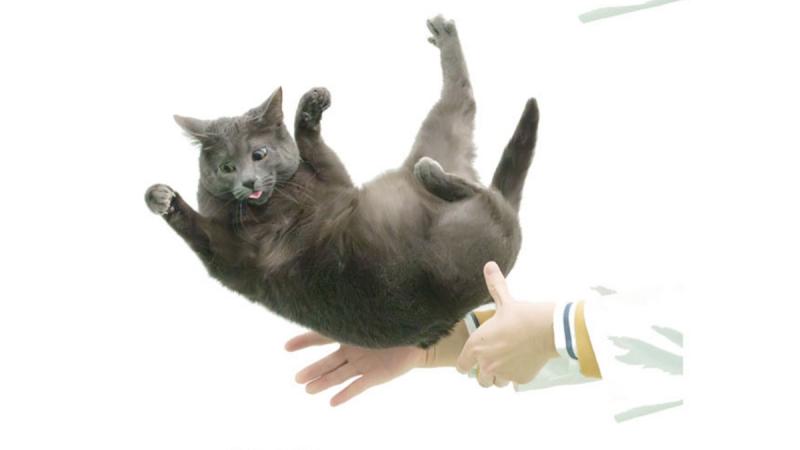

Photo credit: The Anatomical Record (2026). DOI: 10.1002/ar.70165
Related:
Tashirojima - Cat Island Japan
 S E E D E D C O N T E N T
“A cat always lands on its feet.” That’s how the old adage goes. But how do they do it?
Researchers from Yamaguchi University in Japan studied cat spines and threw a few (safely) onto a cushioned surface to explain how felines make flawless landings. Their findings are presented in a paper published in the journal the Anatomical Record .
“Cats are renowned for their air-righting behaviour, effectively reorienting themselves in midair to land on their feet,” the authors write. “However, how cats move their bodies during air-righting remains unclear.
“Complex motor factors, such as trunk flexion and axial torsion, may be involved; however, to obtain a definitive answer, quantitative data on the flexibility of spinal axial torsion and how this flexibility differs between spine regions are needed.”
The answer, they say, is down to differences between the thoracic spine and the lumbar spine.
Thoracic vertebrae make up the middle section of the spine connecting the neck to the lower back. The lumbar spine makes up the lower back, connecting the upper body to the pelvis.
First, the researchers analysed the spinal structure of 5 cat cadavers. Presumably the unlucky cats didn’t meet their end due to a fall.
They separated the thoracic and lumbar spines and twisted them to test their flexibility, strength and resistance to rotation.
“The thoracic and lumbar spine regions exhibited marked differences in torsional mechanical properties. The thoracic region exhibited a larger range of motion, a larger neutral zone, and lower stiffness than the lumbar region, indicating greater torsional flexibility,” they report.
To further understand cats’ air-righting abilities, the researchers used high-speed cameras to see how live cats reacted to being dropped from a height.
They noticed a difference between the front of the torso (the anterior trunk) and the back (posterior trunk).
“During air-righting, anterior trunk rotation was completed earlier than posterior trunk rotation. These results suggest that trunk rotation during air-righting in cats occurs sequentially, with the anterior trunk rotating first followed by the posterior trunk, and that their flexible thoracic spine and rigid lumbar spine in axial torsion are suited for this behaviour,” the authors explain.
“A researcher held each cat by the back, with the dorsal sides of both the anterior and posterior trunk facing downwards, before dropping it onto a soft cushion from a height of 1m,” they write.
They say future research may look into how other animals respond to falls from height.
Follow da rulz (or suffer the consequences)
Tags
Who is online
86 visitors
Researchers from Yamaguchi University in Japan studied cat spines and threw a few (safely) onto a cushioned surface to explain how felines make flawless landings. Their findings are presented in a paper published in the journal the Anatomical Record
They didn't throw them, they dropped them.
“Cats are renowned for their air-righting behaviour, effectively reorienting themselves in midair to land on their feet,” the authors write. “However, how cats move their bodies during air-righting remains unclear.
“Complex motor factors, such as trunk flexion and axial torsion, may be involved; however, to obtain a definitive answer, quantitative data on the flexibility of spinal axial torsion and how this flexibility differs between spine regions are needed.”
I'll let you know when I understand what they're talking about.
“During air-righting, anterior trunk rotation was completed earlier than posterior trunk rotation. These results suggest that trunk rotation during air-righting in cats occurs sequentially, with the anterior trunk rotating first followed by the posterior trunk, and that their flexible thoracic spine and rigid lumbar spine in axial torsion are suited for this behaviour,” the authors explain.
Never having dropped my cat (or thrown it) I'll leave it up to the scientists to deal with it.
The authors?
Re-reading that paragraph I was wondering if it was written by the authors-- or by some out of control AI!
Starting with the researchers pet turtle, Maxx.
It amazes me that a turtle can turn over from lying on its back.
They learned how to do that from many years of observing cats!
LOL
I can categorically state that cats do not always land on their feet, and it's hilarious when they don't
"hilarious" how? What do they do?
Only a Free Faller would know!
Good one …. That’s a 10. Absolutely no splash on entry.
In many ways, mostly watching them scramble to their feet and immediately look around checking to see if anyone saw them klutzing out
Wow, was so true with my cat - making a mistake or doing something dumb and then looking around to see if anyone saw it.
Bet those cats loved you.
Well I didn't know all of them so can't be sure of that, but certainly the couple that were mine did (well as much as cats love anything)
Its true!
I have known cats that often do not land on their own feet but rather often land on the feet of a human in the room!