
Octopuses have nine brains, three hearts, and blue copper-based blood...


The complete title:
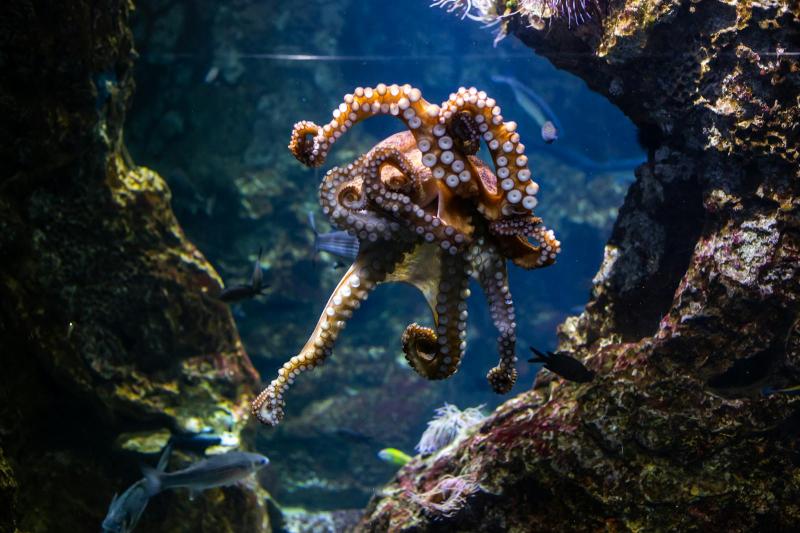
Octopuses have nine brains, three hearts, and blue copper-based blood, with roughly two-thirds of their neurons spread through their arms, allowing each arm to taste, move, and react with a startling degree of local control.
 S E E D E D C O N T E N T
An octopus reaching into a crevice is not simply moving a limb the way a human moves a hand.
By Space Daily Editorial Team·Editorial process
Published May 20, 2026
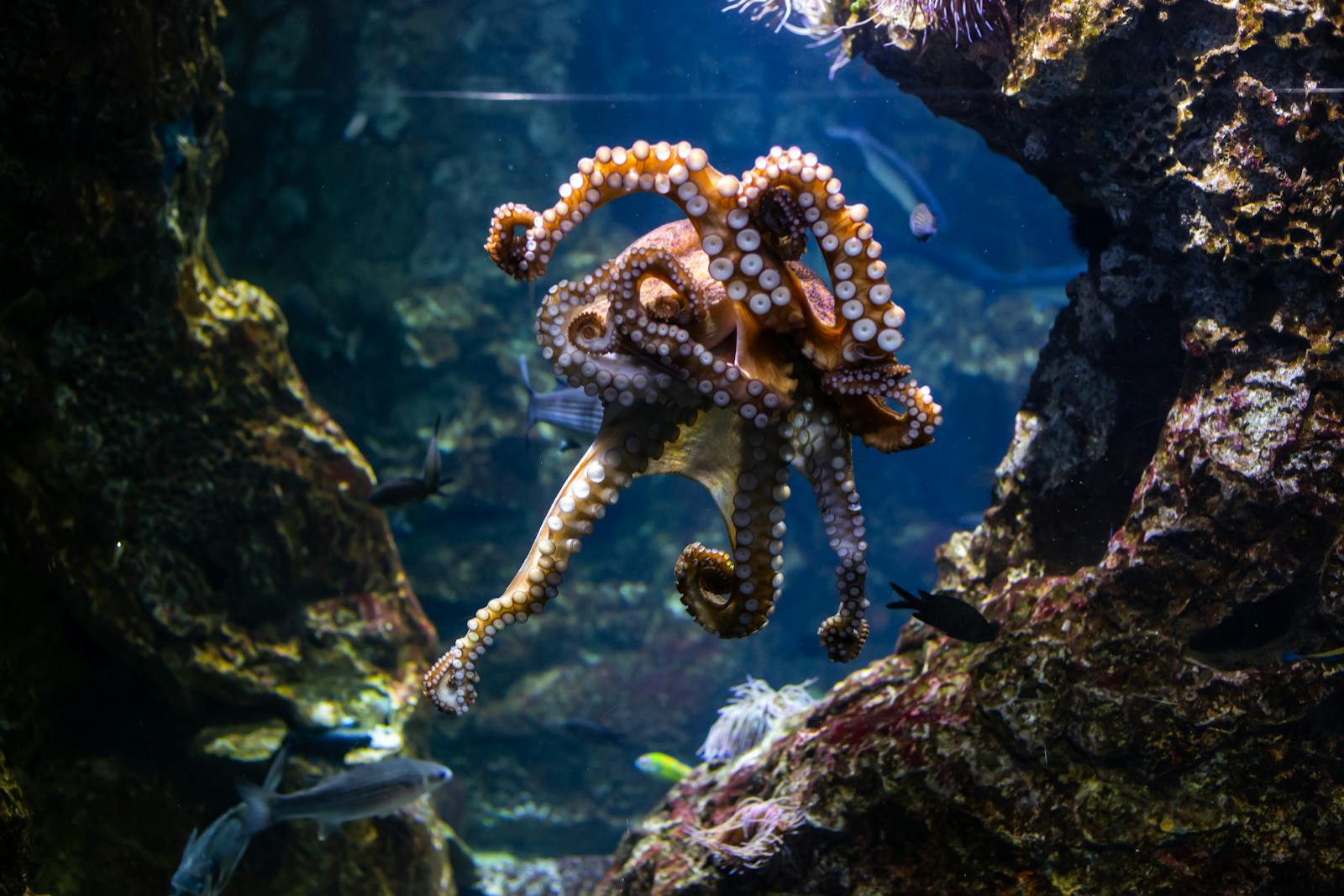
An octopus reaching into a crevice is not simply moving a limb the way a human moves a hand. The arm is lined with suckers that can touch and chemically sample the surface around it, while a large share of the animal's nervous system sits inside the arms themselves.
That is the fact that makes octopus anatomy feel almost like science fiction. The common octopus has around 500 million neurons, and the Natural History Museum in London notes that about two-thirds of them are in the arms, not in the central brain. The animal still has a central brain, but it does not run the body like a single executive issuing detailed orders to eight passive limbs.
The headline arithmetic reads like a riddle. Nine brains. Three hearts. Blue blood. Eight arms that can taste, move, grip, explore, and respond with a degree of local control that has no close parallel in vertebrate bodies.
Nine brains, but not in the cartoon version
The phrase "nine brains" is shorthand, but it is not pure myth. An octopus has one central brain wrapped around the oesophagus, plus major nerve structures running through each arm. Those arm nerve cords are packed with neurons and can handle a surprising amount of local sensory and motor processing.
Call them ganglia if you want to be technical. Call them mini-brains if you want the image to land. The important point is that octopus arms are not puppets on strings. They are more like semi-independent workers connected to a central coordinator.
What the central brain still does
The central brain matters. It helps coordinate the animal's overall behaviour, learning, memory, vision, and broad intentions. When an octopus sees prey, chooses a direction, or solves a problem, the central brain is still part of the story.
But the arms are not waiting for every instruction. They contain local circuitry that allows them to probe, taste, grip, adjust, and explore. The central brain can guide the mission while the arms work out many of the details.
Each arm can taste and react
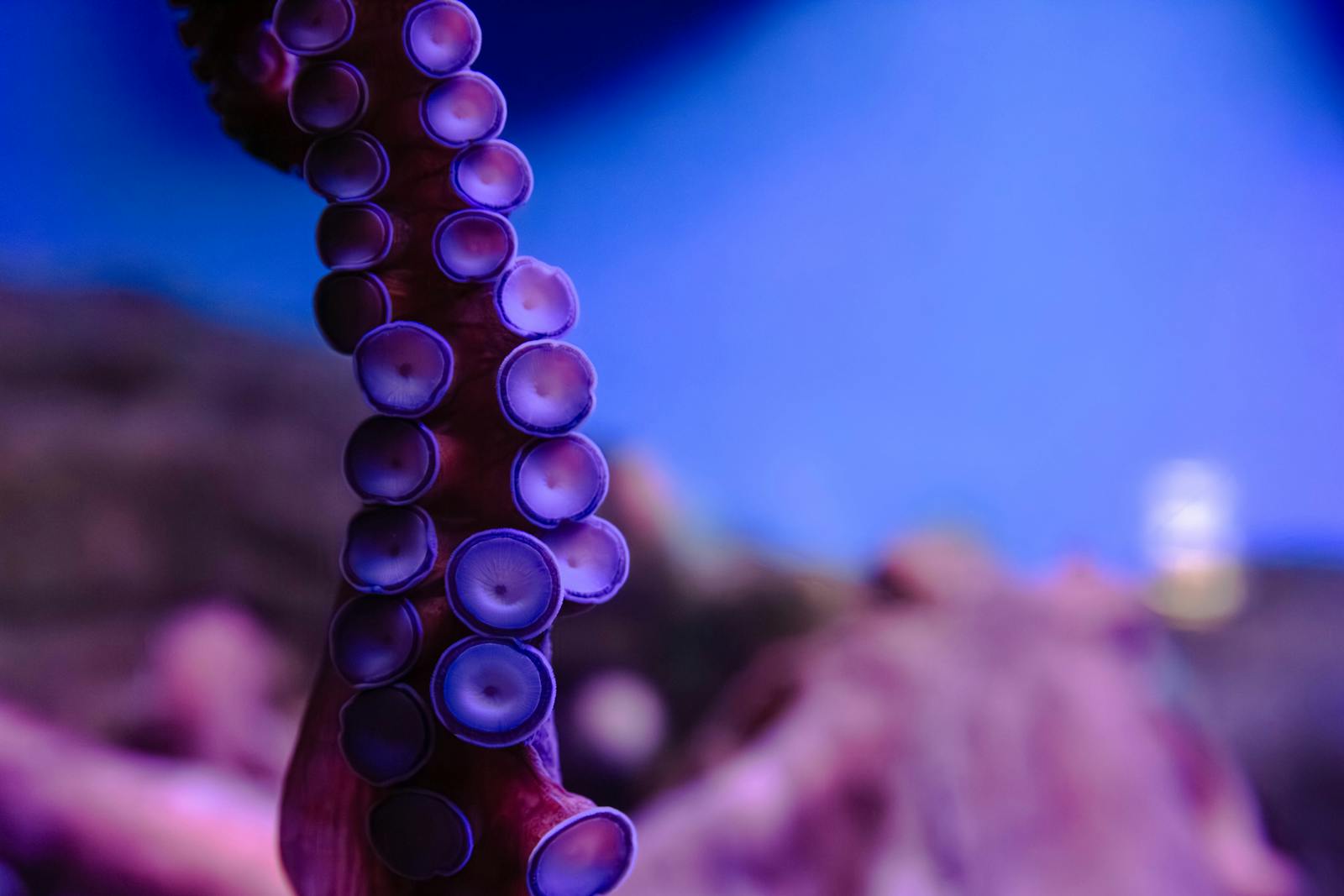
The suckers are not just suction cups. They are sensory organs. They help the octopus feel texture and chemically sample what they touch, which is why people often describe octopuses as tasting the world with their arms.
A 2025 paper in Bioelectronic Medicine recorded neural activity from detached octopus arms and found that electrical signals in the arm could predict movement responses very quickly after stimulation. The clean version is not that the arm is "thinking" like a separate animal. It is that the arm contains enough local circuitry to turn sensation into action without needing the central brain to micromanage every twitch.
That distinction matters. A severed or isolated arm can still respond to stimulation, but a living octopus is a whole animal. Its intelligence comes from the interaction between central control, arm-level processing, sensation, muscle, and environment.
The arms are built in segments
The distributed nervous system is not a loose tangle. A 2025 Nature Communications study on cephalopod arms found that the axial nerve cord running through the octopus arm is organised into repeated neuronal segments. That gives the arm a modular structure for controlling movement and mapping the suckers along its length.
In practical terms, that means different parts of the same arm can participate in different pieces of a task. One section may be anchoring to a rock while another explores a crack. One sucker may be sampling a surface while another is adjusting grip. The arm is not a simple cable. It is a living, sensing, flexible control system.
Three hearts, and why they need them
The three-heart system is the second strange piece of the animal. Two branchial hearts pump blood through the gills, where it can pick up oxygen. A third systemic heart sends that oxygenated blood through the rest of the body.
This arrangement helps support an active animal with a demanding body plan. Octopuses crawl, squeeze, hunt, hide, jet through water when they need to, and operate eight flexible arms filled with sensory and motor machinery. The circulatory system has to keep up.
Why the blood is blue
Human blood is red because haemoglobin uses iron to carry oxygen. Octopus blood is blue because it uses haemocyanin, a copper-containing oxygen carrier. The same Natural History Museum article explains that this copper-based protein works well in cold and low-oxygen ocean conditions.
When oxygenated, octopus blood can look blue. When it loses oxygen, it can become much paler. The effect is one of those details that sounds invented until the chemistry catches up with the image.
What a decentralised body changes
The deeper question is not whether octopuses are intelligent. They solve problems, learn, explore, manipulate objects, and show flexible behaviour. The stranger question is where their intelligence lives.
In vertebrates, people are used to thinking of a central brain as the command centre and the body as the machinery that carries out instructions. The octopus complicates that picture. Its central brain is important, but so are the arms, the suckers, the nerve cords, and the feedback loops between touch, movement, and decision.
That makes the octopus feel alien not because it came from another planet, but because it represents a different evolutionary answer to the same problem: how to build a body that can sense the world, decide what matters, and act quickly enough to survive.
An ancient experiment in being a mind
Cephalopods and vertebrates split from each other hundreds of millions of years ago. The last common ancestor of humans and octopuses was nothing like either species today. Complex octopus behaviour, camera-like eyes, problem-solving, and distributed motor control evolved along a very different path from the one that produced mammals and birds.
That is why octopuses are so useful to think with. They show that intelligence does not have to be built around a body like ours. It can be centralised, distributed, embodied, tactile, chemical, and soft-bodied all at once.
Why roboticists care
Engineers building soft robots have been paying attention for a reason. Controlling a flexible arm with no bones is a brutal computational problem. Every point along the arm can bend, twist, shorten, lengthen, grip, and press against the world.
A 2022 paper in Frontiers in Robotics and AI argued that conventional central planning would be computationally intractable for an octopus-style arm. The octopus points to a different approach: put more intelligence into the limb itself, let local control solve local problems, and allow the central system to guide rather than command every detail.
That is not just biology trivia. It is a design philosophy. You do not always need a bigger central brain. Sometimes you need smarter edges.
The strangeness, all the way down
Add it together and the animal becomes even stranger. An octopus has three hearts, copper-based blue blood, a central brain wrapped around the oesophagus, and most of its neurons distributed through eight arms that can taste, grip, explore, and respond with local control.
It is not nine separate minds arguing inside one body. That would go too far. But it is also not one brain puppeteering eight obedient limbs. The truth is more interesting: a body in which control is shared, sensation is spread out, and intelligence is partly built into the arms that touch the world first.
The next time you watch an octopus slip through a hole the size of its eyeball, you are not watching a single command centre drag eight limbs behind it. You are watching a nervous system distributed through a soft body, solving the world by touching it.
And every sucker, on every arm, is sampling the dark as it goes.

Written by
Space Daily Editorial Team
The Space Daily Editorial Team produces content across our two editorial pillars: space industry news and Mind & Meaning. We cover launches, missions, satellites, defense, and the technology of getting humans to space, alongside the psychology of ambition, isolation, and meaning under extremes. Articles reflect our team's collective editorial process, source verification, drafting, technical review, and editing, rather than a single writer's work. Space Daily takes editorial responsibility for content under this byline. For more on how we work, see our editorial policy.
More from this author →
This is a non-political seed. Please keep it that way.

Tags
Who is online
86 visitors
I've heard it said that if Octopuses had our lifespan they would be the apex lifeform on the planet.
I can't eat anything that smart.
I'm not ready to give up bacon yet...
I've never heard of an octopus farm ...
They are out there. There are not many because it's labor intensive and controversial. You can find some in Mexico, Japan and Spain.
A farmer walks into a bar with a one-legged pig under his arm and the bartender says "Hey, you can't bring that pig in here!" to which the farmer replied "But sir, this pig is like family. It once woke me from a deep slumber when my barn had caught fire. If it hadn't, the barn would have caught the house on fire and my wife and I would have been cooked! And another time, after we had our first child, this pig came and got me when our toddler fell in the pond which saved our daughters life!". So, the bartender said "Well, that is a pretty amazing story and clearly an amazing pig. I'll let you bring him in. But if you don't mind me asking, why does it only have one leg?" to which the farmer replied, "Well you don't eat a pig like this all at once!".
Funny!
as astute problem solvers and escape artists, how are they contained?
Good questions. I seen some videos in the past talk about lids and they still have had problems. One YouTuber was loosing fish in a nearby aquarium and ended up putting in a camera to find the octopus travel from it's tank to the other tank, feed, and then climb back.
monotonous prison food menu - problem solved
Clever little beasties.
I think the only limitation they really have is they have to be close to water at all times. They could never become elected officials in Arizona
About 55 years ago i ran a pet shop and that is exactly what would happen.
In the morning I could see salt water trails to the fresh water tanks, no fish or fish having nervous breakdowns.
Octopus Escape Artists That Outsmart Aquariums Around the World - NewsBreak
The only thing worse, just as smart but 100% evil are Mantis Shrimp.
They are not affectionately called Thumb Splitters.
They come in two variations where one arm is a club or a spear.
They can't travel as far or tolerate fresh water as well as the average octopus
but they are 100% more evil.
Meet The Shrimp That Punches With The Force Of A .22 Caliber — A Biologist Explains
We are not the smartest animals on this planet.
that's funny. 55 years ago I managed the pet dept at a woolworths. I was more like the pet coroner though, since job 1 every day was to remove all the animal and fish carcasses. hamsters are cannibals. the first time I got a bird shipment, the shipping box came apart and I let a few dozen finches and canaries loose in the store. I caught a few, the storefront windows collected a few kamikazes, but several made their way into the mall. the mall had a fountain by the food court and it was probably a good life for the aviary shut-ins. newer generations of their offspring were still living in the mall decades later when it was razed. back then my friend albert was a janitor at the mall, and the birds irritated him severely. I never admitted to him that it was me that had introduced the very bane of his existence at his high school job. what's funny is that the alleged song birds imprisoned in the pet dept were silent compared to their escaped friends that could be heard over the sound of the fountain in the mall, but you had to have a sharp eye to even see them up around the ceiling.
My bird story involved a snake that escaped and I eventually located because the birds in those cages were literally behaving like bats,
So I found her and returned her to "her" home.
A couple weeks later I had the same feeling, the birds were all hanging upside down in just about every cage.
here she had gotten up to the top shelf and laid eggs behind the cages, when they hatched the tiny snakes slipped right into the bird cages.
There was one that actually ate a finch.
Canaries, finches and Parakeets were hanging from the top of the cages and they were wet ( sweating?)
The boss was not amused until we pointed out the monetary balance; lost two birds, gained a dozen small snakes for free.
That place too had some permanent escapees that made a lot more noise than the caged birds.
I have a lot of snake stories from back when I was a cable TV installer. having them slither out of backyard service peds across your arms and legs will really get your heart started. not a fan. I once knew an unlicensed pharmacist that used to keep his inventory inside a fake rock in a terrarium with his pet rattlesnakes. that was always an interesting business transaction. I've been bit by both a black widow and a brown recluse spider. a couple days of flu like symptoms both times, freaked out wife one time, but no work missed. the brown recluse bite did leave a scar on my forearm, and the mrs claimed the black widow left one too, but it's not where I can easily see it.
They are not of this world. I knew it all along
So, that means someone selling stolen octopus can be charged with transporting illegal aliens! Someone should let MAGA know! Down with sanctuary seafood restaurants!
if they can't remain white, it's off to the frying pan ...
Whadda ya got against pink octopi?
I'm sure they'll tell you it's the hat...
I love it!
I see what you did there. that ancient mackerel snapper past still has a grip on you ...
That little gal was spotted down at Octopi Wallstreet...
There are lot of people that believe these are legit aliens.
What Makes Octopus DNA So Strange? - ScienceInsights
Octopuses may be so terrifyingly smart because they share humans' genes for intelligence | Live Science
They share human genes for intelligence?
That sounds like an insult to octopi
search "octopus escapes" on youtube ...
Morning...
At the next election can you mob please vote in an octopus..
Far more intelligent than what's on offer at the moment...
We do have a blue ringed octopus can kill you in minutes...now there's a thought...
Nope not my photo..
I can think of a dunny in DC where that bloody little ripper wouldn't have to wait long to change history ...
Arvo..nah that would be a red back spider in the dunny..not an ocy..
Outdoor thunder boxes were their favourite haunt.. getting bitten on the backside was a one way ticket to 6 foot under in those days...
Is it venomous? Sure is a cute little beastie
Evening....errr yes one bite is enough to kill you in minutes..but we developed an antidote in 1956..
Actually it's a rellie of your black widow but naturally ours is more deadly..😁 psst can't let you mob beat one of our bities...
I found one the other day in my compost bin, it met it's god with the sole of my shoe...
I much prefer our Huntsman spiders..just a little tacker he will grow up one day.. he's harmless I like his cute eyes...
I was talking about the octopus.
I like that huntsman. He can come live at my house
your cat will like that ...
she doesn't bother spiders
they're not as fun as moths, caterpillars, or rolly-polies ...
Morning...opps sorry my bad..it was late in the evening...
Yes the little ocy is very venomous..dead in minutes..
But they do warn you the blue rings actually become very vibrant which means they are getting ready to bite.. it's leave me alone or else..
Not my photo..
At least they give you fair warning. Still a beautiful critter
The animal still has a central brain, but it does not run the body like a single executive issuing detailed orders to eight passive limbs.
Male humans are born with a similar limb. When we’re young it flexes uncontrollably, and as we get older we blame our poor behavior on it.
OK, my octopus story. On a Kaua'i trip one time my local friend got me up at 4:30 a.m,, just as the sun was rising, to go out on the reef at low tide when the young octopus would be caught in the crevices. He called it "squidding". It was beautiful watching the sun come up over the mountains with a rainbow over the ocean. There were some other local folks out on the reef then, also. He caught two of the young octopus. As soon as he caught them he bit into their heads between the eyes to crush their brains to kill them. Local style. He also pounded them to tenderize them. Then, he kept them in the refrigerator overnight. We cooked them up the next day with some shrimp we caught in a stream in the afternoon after going squdding, and some fish we caught the next morning out on the ocean on another friend's boat. Hawaiian adventure.
until I went down the youtube rabbit hole, it didn't dawn on me that people actually kept them as pets. I can't imagine having an aquatic creature that you potentially would have to go find every morning to put back into it's aquarium habitat.
In ancient Hawaiian culture, some considered the octopus ( he'e ) to be an 'aumakua (ancestor god/family guardian spirit) and they would not harm or eat them.
More about 'aumakua :
And it's probably chasing the cat
I can't visualize an encounter like that ...