
if God already knows what we are going to do in the future, how can we be said to have free will?

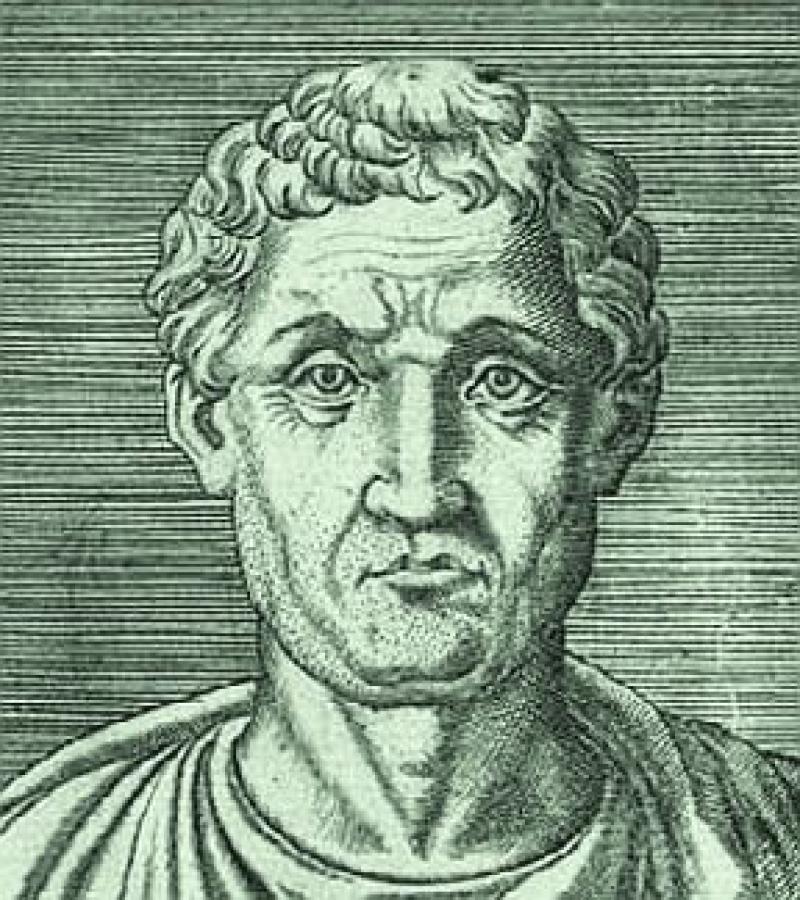
The seed is an excerpt from the book The Philosophy Book , a DK Publishing book that has multiple contributors.
The Roman philosopher Boethius was trained in the Platonist tradition of philosophy, and was also a Christian. He is famous for his solution to a problem that predates Aristotle: if God already knows what we are going to do in the future, how can we be said to have free will? The best way to understand the dilemma is to imagine a situation in everyday life. For instance, this afternoon I might go to the cinema, or I might spend time writing. As it turns out, I go to the cinema. That being the case, it is true now (before the event) that I will go the cinema this afternoon. But if it is true now, then it seems that I do not really have the choice of spending the afternoon writing. Aristotle was the first to define this problem, but his answer to it is not very clear; he seems to have thought that a sentence such as “I shall go to the cinema this afternoon” is neither true nor false, or at least not in the same way as “I went to the cinema yesterday.”
Boethius faced a harder version of the same problem. He believed that God knows everything; not only the past and the present, but also the future. So if I am going to go to the cinema this afternoon, God knows it now. It seems, therefore, that I am not really free to choose to spend the afternoon writing, since that would conflict with what God already knows. Boethius solves the problem by arguing that the same thing can be known in different ways, depending on the nature of the knower. My dog, for instance, knows the sun only as something with qualities he can sense—by sight and touch. A person, however, can also reason about the category of thing the sun is, and may know which elements it is made of, its distance from Earth, and so on. Boethius considers time in a similar kind of way.
As we live in the flow of time, we can only know events as past (if they have occurred), present (if they are happening now), or future (if they will come to pass). We cannot know the outcome of uncertain future events. God, by contrast, is not in the flow of time. He lives in an eternal present, and knows what to us are past, present, and future in the same way that we know the present. And just as my knowledge that you are sitting now does not interfere with your freedom to stop, so too God’s knowledge of our future actions, as if they were present, does not stop them from being free. Some thinkers today argue that since I have not yet decided whether I shall go to the cinema this afternoon, there is simply nothing to be known about it, so even a God who is all-knowing does not, and cannot, know if I shall go or not.
Anicius Boethius was a Christian Roman aristocrat, born at a time when the Roman Empire was disintegrating and the Ostrogoths ruled Italy. He became an orphan at the age of seven and was brought up by an aristocratic family in Rome. He was extremely well educated, speaking fluent Greek and having an extensive knowledge of Latin and Greek literature and philosophy. He devoted his life to translating and commenting on Greek texts, especially Aristotle’s works on logic, until he was made chief adviser to the Ostrogothic king Lady Philosophy and Boethius discuss free will, determinism, and God’s vision of the eternal present in his influential book, The Consolation of Philosophy.
 Article is LOCKED by author/seeder
Who is online
86 visitors
I tend to agree with this approach. We cant know if God usurps free will because we cant ever know the full nature of God.
But we can use common sense and logic to hypothesize about it.
If you believe in an omniscient god (all knowing), then you can't believe in free will. However if you believe that you can do anything other than whet god sees/knows/causes, then you may believe in free will.
I know know that christians like to exaggerate their god's abilities, however the bible clearly shows that the christian god is NOT all knowing.
I dont know if I am completely following Boethius reasoning or not, but he seems to be saying that God does not experience time the way we do because He (It) is not conformed to past present and future as separate categories. This does not seem far fetched to me. In any case the only thing that matters about free will is that we experience it always.
Correct.
If it is possible to know the future then, by definition, the future is pre-determined. It the future is not pre-determined, then it would be impossible for anything to know what will happen over time.
This is basic logic.
⛬ An omniscient god is not possible if free will is true.
The problem with your reasoning is that you assume that God functions like human beings do
didn't he create us in his own image? didn't he give us freewill? don't we control our own futures? are we then not our own gods? shouldn't a deity have better macro and micro management skills and at least make an appearance or two within a millennium or two to reinforce his belief requirements or to keep his believers compelled to keep believing? why doesn't an omniscient god correct any mistakes in the womb or during somebody's freewill choice that violates his commandments? why doesn't he minimize his collateral damage? why does he allow the innocent to suffer and/or die, while he allows evil to flourish?
face it, organized religion is nothing more than an illegal toll both on the road to spiritual enlightenment. it was created to keep the oppressed from killing their oppressors, thereby eliminating evil DNA, thus perpetuating the continued need for organized religion ...
No, John, I make no assumptions about God.
Read what I wrote very carefully. You can take God out of the equation and substitute 'omniscient entity'. It is only the quality of omniscience that is operative.
If fact, you can even take omniscient entity out of the equation and simply deal with a 'knowable future' (even if there is no entity that actually knows it). 'Knowable future' = future is predetermined.
the fucking xtian religion moves slower towards progress than the republican party, and it's based upon the very thing that scripture claims is the root of all evil, money ...
Addendum
You believe that we have free will; that we can make decisions in real time that dynamically create new causal chains. Therefore, you believe the future is NOT knowable.
With free will, voters could have voted for someone other than Trump. Thus, Trump's presidency was not predetermined. It was the result of (misguided) free will decisions executed on election day. For his future election to be known in the past, the future is necessarily knowable (aka predetermined). If the future is not knowable, then there is no way to know what all those individual votes would be.
The seed does not necessarily pertain to organized religion
you assume that what is knowable to God is knowable to man and vice versa. Lets face it, you have no idea if God perceives time the same way we do. That is basically the point of Boethius if I read the article right.
You continue to change my argument.
Why are you doing this, John?
I make no assumptions about God.
Here, focus on my core argument:
If the future is knowable (even if no entity knows it) then free will is not possible since exercising it necessarily means the future is not knowable.
If free will exists, then those with free will can determine which causal chains in the future are real. Thus the future (the specifics) could not be knowable.
Is the future knowable? That is, is the future predictable (in detail)?
Is it possible to know the exact words of your next post prior to you penning them?
How do we know the future is knowable if it is possible no entity will know it ?
We do not know if the future is knowable.
Notice how the word 'if' is replete in my argument.
I do not claim the future is knowable; I make an argument that has one consequence IF the future is knowable and another IF it is NOT knowable.
My point of 'even if no entity knows it' is to emphasize that my argument does not depend in any way on a God, nor does it even depend upon an omniscient entity.
That is about all you can do with a hypothesis.
And just how does he know that?
Aren't christians "assuming" that he doesn't?
Can we get a DEFINITION of what "pre-determined" means in context of this discussion? For example: Is it properly called as Predeterminism?
Note: I wish to take this in 'bite size' portions (drill down on it) to make a point (later)!
I think that the article title literally establishes the parameter for this discussion: If God. . . ." So we should ask which God it has in view. . . .
Then, discuss what we have been told or 'know' of that God. . . adding other parameters causes over-broadens (expands) what needs a narrower (and thorough) examination via discussion, in my opinion.
By this, I mean a possible reality in which the complete prior state of reality, together with the laws of nature, entails exactly one future.
If reality is deterministic, then it is theoretically possible to 'calculate' any future state of reality (see Laplace's Daemon thought experiment). In other words, the future is knowable. In other words, the future is 100% 'predictable'.
I am not, in any way, suggesting that future actions can be controlled merely because one knows the future. So I am not using the root 'determine' in the sense of 'makes happen' but rather in the sense of 'is already decided'.
I started that way, and then my argument was misinterpreted.
My argument, in context and in super summary, supports this claim: If God is omniscient, then free will (liberal free will) is impossible.
And the converse: If liberal free will exists, God cannot be omniscient.
Super, super summary: omniscience and liberal free will cannot coexist.
Quintessential summary: liberal free will cannot exist if the future is knowable
Example, if it is possible to predict/calculate what you will post tomorrow at 10:57am then when you post this (word for word) your actions were not an exercise of liberal free will. The only way that you could be executing free will is for you to be free to post whatever you wanted (or nothing). But then it would be impossible to predict/calculate what you will post.
[✘]
I am not sure I understand what you are sharing there, sorry.
In short, if a future state of reality can be calculated from a current state of reality then free will is impossible.
A deterministic reality is mutually exclusive with (liberal) free will.
We do not have such FREE-WILL. I would like to establish that at the outset. We do not have such FREE-WILL even at the natural world level. This is evident. As we do not CONTROL our environment 100 percent.
Thus, we do not have such FREE-WILL - IF (a) God exist. God would be the 'Controller' making our decisions possible. That does not mean that God can not regulate what is ALLOWABLE by humans within any given sphere or spheres.
Man was created in Gods, "image".
I agree that we do not have 100% free will. Our bodies alone make decisions that we cannot control at the conscious level. But we are talking about free will in the sense that we can make decisions consciously. That when we choose to act (such as grab a cup of coffee) that we truly did have the option to grab a tea instead. The choice is not a mere illusion, but that it truly does create a new causal chain and truly does affect the future.
Now at some point in this 'God' discussion of free-will, 'God' has to be discussed. Therefore, I have a biblical question for you. Because, the bible is replete with conditionals ("if" this, then that). Granting the bible its place as truth-telling about itself; why do you think God who is CONTROLLING humanity and has complete authority to do so calling allowing for 'conditionals' (stated throughout the bible)?
Frankly, if we're going to play the game, what I used to tell myself when I was a pastor and trying to rationalize the concept of God knowing future events, was that it wasn't seeing it like some recording, that 'this guy is going to do that thing, and that person will save that guy and that Karen over there will live till 67 and Jon over there will die on his 99th birthday'.
It made far more sense to me, or at least as much sense as rationalizing a fictional beings' powers can be, to believe it was simply a being of ultimate knowledge and could predict the path that humans would take given the parameters. And that it didn't know that Einstein would be the one to figure out the mass-energy equivalence formula that would lead to understanding nuclear fission, but that given enough time, some human would figure it out and thus lead us into the age we're at now.
It's more like a chess master being able to predict how their opponent will react dozens of moves ahead. So if there is a prime mover or some cosmic alien that seeded our world, it would likely be far more advanced technologically and it would only make sense that it would be able to predict its own creations behavior on a macro scale, but very unlikely on a micro scale.
But again, all of that is no different than debating the DC universe vs Marvel since there isn't an iota of actual, tangible evidence to stand on to even begin the conversation of 'What are the powers of 'The Almighty God™'.
Seems you are asking why a God who is clearly controlling humanity would allow for conditionals (I think by this you mean free will)?
First, the God of the Bible is not controlling people 100%. He steps in on occasion but generally lets things run their course. So, biblically, I do not see the issue you are trying to raise.
Which, seems to me, is akin to Laplace's Daemon. Perfect knowledge of the current state (down to the particle level or below) allowing the computation of any future state. This assumes a deterministic reality.
This, however, is very different. It is akin to the human ability to predict certain things. We can predict, for example, that if we do not let our dog outside, it will pee on the floor. If we leave a $20 bill on the sidewalk, it will be picked up by someone (albeit we cannot predict if the person would turn it in or keep it).
Well, humans did give it a bunch of other human abilities like jealousy, anger, hate, love; so it stands to reason that the human created God might exhibit human like powers.
Exactly. If there is a prime mover, I doubt very highly that it can do more than make predictions based on experience and/or predictive behaviors of humans. Which isn't all that impressive I'll admit, but if applying the principle of Occam's razor, the simplest explanation behind predictive powers, one that doesn't require breaking all know laws of the universe for example, would be the most likely to be true.
And of course, that rings true when it comes to the concept of God itself. That if a creator of humans exists, it is unlikely to be something outside of the laws of physics and more likely just a far more technologically advanced being or beings that seeded our world. But again, still no evidence of even that.
That is pretty much how I see it, too. A sentient creator of the universe may exist. But, in my mind, that entity would be an emergent property of a much simpler reality. The idea that the 'first cause' is of enormous sentient complexity rather than something basic like a low-level sort of energy that interacts and causes complexity to emerge makes little sense.
Is the above: Dynamicism?
I meant conditionals . As in:
You state, ". . .,the God of the Bible is not controlling people 100%." Are you stating that humanity has a partial (favorable) amount of FREE-WILL over their living "arrangement" within the Earth?
God can. Because knows (looks on) what is in the heart of the individual picking up the $20 dollars on the sidewalk. Whether or not that "heart" will covet or not covet the 'prize,' because God, again, is written about (in the Bible) as having created EVERYTHING. . . literally EVERYTHING to do with humanity and its occupation and presence on a planet humanity 'found' itself.
Which leads to Choosing. That is, God says, 'Before you (the individual) is a choice of right and wrong. . . as defined by God or any other set of books offering at least two opposing paths to 'go' down). Therefore, in context of your statement (quoted above), God has instructed humanity not to covet another individual's possession. . . as a result.. . if someone can be found to turn the $20 bill in to for returning. . . that would be the right thing to do. . . and keeping it would be the wrong thing to do.
Again, a chose is facing the individual. . . .
If the future is not knowable, then what we perceive as free will might indeed be true.
We have surmised in context of 1.1.36 that FREE-WILL is not 100% already. As God has authority over humanity. So the next step is to consider partial free-will. Does humanity, in this dynamic world we inhabit, exhibit any version of partial free-will, in your opinion?
We perceive (convincingly) partial free will. Whether that perception is true remains to be seen.
Thank you.
I think you are correct. We don't even know what time is on a fundamental level. We know how it behaves. We don't know what it is. More importantly, we can only experience it within our frame of reference. That is, what we confidently declare as possible or impossible is based upon our assumptions, which are in turn based on our experiences. In reality, we have no idea what time is to something that is not subject to it, what it looks like to them or what is possible or impossible. While, for us, stating both omniscience and free will both existing seems impossible, we can only do so from our frame of reference, which is likely incomplete.
In a sense, we can do half of what God can do. We can look at the past and know what happened, more or less. That we know doesn't mean those in the past therefore had to make those choices. But because we are trapped within time, we cannot know what the future holds. We think that if we could, that would eliminate free will.
But I think that is not necessarily so. That is a view of an individual trapped within time, whatever time actually is. A film producer creates a film. It's one of those where you see the end of the film at the beginning and the rest of the film is what leads up to it. What, then, is true? That, because we knew at the first what the end would be, everything before it was already predetermined? That is, devoid of free will? Or is it simply that we were able, in the world of movie magic, take ourselves out of time and see it from a different perspective? A perspective that let us see the results before seeing a series of freely chosen actions would result in before we ever saw those choices being made?
It does not matter. Free will is a function of our reality. So as long as 'future' refers to that which has not yet occurred in our reality, it does not matter if there are exotic entities that view time differently than we do. What matters is if future in our reality is knowable or not.
If the future in our reality is knowable (even if no entity knows it) that means what you will do in the future is set. In a knowable future, the exact wording of your post and the time you posted is theoretically calculable. If you did not post those exact words at that exact time, then the future clearly was not knowable because you did something different.
If the future is knowable then future choices are already established. Liberal free will is thus impossible.
Our reality is not a movie. We have past, present, and future. If it is possible to know (even if no entity knows it) right now precisely what you will do in 10 minutes, then explain how you have free will. Explain how you could do something different than the specific future that was knowable.
I think it needful that in the context of God (in this case put forward by the seeder - God of the Bible) outcomes are 'established' and then the necessary work (dynamisms) are permitted to play themselves out (over expansive periods of time0 to make it so.
For example: In the Bible, God is said to be the "same yesterday, today, and forever." Still, we see God interacting and passing judgements on the acts, actions, and decisions of individuals and kingdoms. At any instance, biblically speaking, that God interacts with any individual or group OPPORTUNITY for CHANGE is presented and is potential for the status quo (dynamics in play) to modify.
in the 21st century, any pro god or religious argument is metaphorically hoisting the sails on a sinking ship. evangelicals have slit their own theological throats by supporting trump. the erosion of religious affiliation among americans will continue, despite the efforts of those that financially benefit from it to legislate it into american culture.
Exactly, they will forever be associated with the convicted felon sexual predator clown that once tried to overthrow our constitutional Republic and is now reviled in every textbook as the worst President in history and a joke in High Schools that have to read about the Presidents own words saying he 'grabs' women 'by the pussy' which I'm sure they'll find hilarious especially when they read about how he was supported by evangelical Christians. That will clearly indicate how seriously to take evangelical Christianity in their lives from then on. It will be seen as nothing but another butt of a joke like the Catholic Church found itself after the abuse scandals came to light, and rightly so.
It seems you are suggesting that God determines specific outcomes and then gives beings leeway to make decisions as long as they do not change the determined outcomes.
Sort of a partial free will.
To me, that sounds like a theological theory desperately trying to resolve a contradiction. We can decide if we want coffee or iced tea, as long as our decision does not affect the major outcome of who gets elected PotUS. Something like that. Suffice it to say, I do not find this to be persuasive.
That is not exactly what I am stating. I am pointing out that in the bible, we see accounts of God giving people CHOICES. That means power to CHOOSE between two or several variables (conditionals) that will bring about a prepared outcome or outcomes. You can not have CHOICE without freedom to act differently.
Of course, the 'final' blueprint' is held by God as the "setter" of designations and "finishes."
('Running' right now, this is a 'hasty' prepared comment. )
That seems the same as what I wrote. The difference is that you do not consider a limited choice to be a true choice. I do not disagree.
This is why I agreed with a partial free-will 'felt' at the ground-level where we live. We do appear to have agency. . . for which God has 'surrendered' so that God can come to a conclusion about us, individually and collectively.
God utilizes logic (of course). The question is: Does God, biblically speaking, 'only' deal with humans through application of pure logic.
One more note.
Your movie analogy illustrates what a deterministic, fully knowable (i.e. deterministic) reality would be like.
A movie is deterministic. The characters appear to make choices and exercise free will, but every action is fixed in advance. You can watch the movie repeatedly, fast-forward it, rewind it, or start over, and every scene unfolds the same way.
A reality in which (liberal) free will exists would be fundamentally different. Imagine replaying the same movie over and over, but each time the characters might make different decisions, leading to different conversations, relationships, and ultimately different endings. We see a little of this with movies that include various alternate endings (e.g. Clue) but now apply this dynamic aspect to every moment of the film — every frame could trigger multiple possible futures in a chain reaction. Each replay could diverge from the last because the characters' choices would not be completely determined (as in 'must be') by the preceding state.
In that sense, a deterministic reality is like a movie with a fixed script (the normal case), while a universe with liberal free will would resemble a movie whose script is being written as it unfolds.
Curiously, expect future AI-based movies where this kind of dynamic exists. Very entertaining to watch a movie that changes every time you watch it.
I get what you mean but I'm not sure that's accurate. It is understood by the viewer that it is a movie, but it is also understood by the viewer that, within the "universe" of that movie, actors have agency. Even outside that pretend universe, though, what happens in the movie is determined by the agency of those making it. That is, the movie did not have to be what it was. We see different versions of the movie with different endings sometimes or scenes that get included in the director's cut. My version of the movie Avatar may not be the same as yours.
Point being, it is an analogy. One that can be made to work on different levels or different purposes. Mine was what it might look like to someone outside our spacetime. Using the movie analogy again, imagine if we had the cognitive ability to take in every moment of the film all at once; beginning, middle and end, as if our attention were on every moment of the film all at once. In real life, what does our spacetime and what happens in it look to something outside of it? Like most analogies, the movie example is not a perfect one, but it is intended to place the thinker outside the 'spacetime' of the universe of those within the movie.
As I have stated in the past, our knowing what occurred in the past does not make the case that the past is therefore deterministic. That is easy enough to understand even for those of us trapped in this view of spacetime that we experience. Since we do not actually know what time is, we cannot therefore say free will and future knowledge are mutually exclusive, as that could simply be a limitation of our viewpoint.
The making of the movie is quite different from the movie itself. Once the movie is made (i.e. once we have a movie) then it is a decent analogy for a deterministic reality.
The idea that the movie could have been something different is a fine analogy for parallel universes (if one wanted to go there).
Thing is, the movie viewer is akin to the thinker "outside the spacetime of the universe". The idea that the movie viewer is not limited to a single direction of time and could indeed watch it backwards (see the future before the past and thus know the future) provides a decent analogy for some entity knowing the future. But this only works because the movie is deterministic. The events are going to be the same no matter how many times you view them and in which order.
To wit, the viewer can have knowledge of the future for the movie but only if the movie is deterministic (a standard movie).
Now, sticking with the analogy, if the movie were dynamic so that the events can be different every time you watch the movie, then this notion of knowing the future falls apart. There is no way to know what will happen in the next scene because what will happen will be knowable only after the scene is reached.
This all still boils down to an inescapable truth:
If the future is knowable (even if no entity knows it), then what will happen in the future is already set.
If the future is NOT knowable, then that means the future is yet to be determined ... this is what enables liberal free will.
TiG, do you agreed that God (if there is God) made human life on a Spectrum or Spectrums? And if so, that God made life cast in shades of 'gray' - not just black and white? Nuances 'drip' everywhere in human reality.
Even logic is on a spectrum.
Spectrums are replete in our reality.
This you will have to explain. There are semantic nuances (the meanings of terms) but I do not follow this notion of a spectrum of logic itself.
Do you believe mathematics is on a spectrum?
Humans operate on spectrums. Humans operate through choices we individually and collectively make. Therefore, it is a clear we have limited FREE-WIll.
Mathematics on a spectrum? I would say - "No, not really."
Perhaps he means on a spectrum from 'logic' to 'illogic' and that people can be somewhere in between and falsely believe they are being wholly logical. If someone starts from a logical foundation and then begins to veer off in an effort to circumvent a logic block, they 'think' they're being logical when in actuality, they're introducing a variable that, when they get to their conclusion, can only be asterisked as fantasy.
So.........we have free will, but have to follow rules as well? Which is it? Free will or rules, can't really have it both ways.
it's the christo-fascist definition of individual freedom. you're free to do whatever you want, within their prescribed boundaries ...
There is nobody home.
You never thought what the consequences would be, did you?
This place is almost as empty as Trump's Great American State Fair.
It certainly is empty.
as empty as most maga skulls ...
from a teabag dominated shithole 10 years ago, to the exact opposite now. where christo-fascist maga types exist here solely for comic relief, by being relegated to the basement, and deservedly being chained to the whipping posts of relentless mockery for their idiotic support of unamerican scum in the highest levels of government. I can't take much credit for that, it's the natural selection process of the internet. adapt or perish ...
I'm surprised people think this is some sort of gotcha.
Only by those who, for some reason think that God plays by the same rules we do.
If it is possible to know (say, last week) that you will write "Only by those who, for some reason think that God plays by the same rules we do." as post 2.1 in this article the explain how you making this post is not predetermined.
Or explain how you could have changed even a single letter in your post if something had perfect knowledge last week of what you were going to write.
I am not God.
But if I was According to gemini
Gemini is stating one of several examples of how people try to work around logic with vague fantasies.
It is not stating what is true, it is stating what has been argued.
This: "Classical theism argues that God exists completely outside the linear progression of time" is sophistry. It offers no explanation, it just makes a vague, unfalsifiable claim.
That is an entirely different scenario. Nowhere in my argument do I suggest that God's knowledge would cause your actions.
Everything about the existence of God is based on argument.
Correct. Gemini did not put forth a logical argument, it is simply noting extant human arguments. So, yes, there are human arguments regarding free will and no free will. Not valuable unless one is going to make a specific argument and subject oneself to rebuttal.
Merely claiming that God sees past, present, and future simultaneously is not an argument. It is a fantastic claim. So, regardless of how God might 'see' the future, if the future is knowable then free will cannot exist. If it is possible to know what you will do tomorrow at 9:27am then when you do this thing how is it free will? Could you do something else? Well, no, not if the future is truly knowable. The only way for you to do something different at 9:27am is if the future is NOT knowable.
A knowable future means reality is a deterministic causal chain.
A non-knowable future means that only the past is knowable.
None of this changes regardless of god or no god or any fantastic imagined notion of what a god could do.
What is the 'gotcha' that you think this represents?
If you want to think in terms of God then this is the net:
If you believe God is omniscient (knows the future) then you believe the future is predetermined.
If you believe we have free will (can make choices in the future in real time that create new causal forks) then you believe the future is NOT predetermined.
Taking God out of it:
If you believe the future is knowable (even if no entity actually knows it) then you believe the future is predetermined.
If you believe we have free will (can make choices in the future in real time that create new causal forks) then you believe the future is NOT predetermined.
A predetermined future is perfectly consistent with free will. I if watch a recording of baseball game that was played yesterday and know the result does that mean mean my knowledge determined the result or the choices made during the game?
IF an individual freely chooses to do something, regardless of whether someone or something else "knew" what choice would be made, the individual is still exercising free will when he makes that choice.
No, it means you are operating in the present and stating what you have learned in the past.
Now if you are able to state right now what each player will do in tomorrow's game, let me know.
Note also, Sean, that my argument is NOT that knowing the future causes you to act differently. This is a common (intentional) misunderstanding of the argument. Knowing the future does not mean that the knowing entity is causing a particular future. It merely means that the entity knows what will happen. And this works even if there is no entity. If the future is knowable (even if no entity knows it) then it is necessary predetermined ... there is a causal chain that theoretically could be followed to assert future details.
The problem is this. Let's say you freely choose to go to the health club at 7:45pm and oddly spend 67 minutes on the third elliptical from the wall (because your favorite machine —the one next to the wall— was taken by someone else exercising her free will ... and she was there only because her cycling machine was being used by someone else). Explain how it would be knowable that you would do exactly that.
It's like when you go into a fortune tellers shop and they ask "How can I help you?". That should raise red flags for anybody who's sensible.
LMAO!
Boethius has taken a shortcut in logic by claiming God exists outside of time. But placing God in an eternal present still requires knowledge of the future, which requires pre-determination. Boethius' philosophy depends upon knowledge of the future, which may be consistent with the metaphysical beliefs of his time, but is still logically irrational.
We know the past, we experience the present, and we guess at the future. The future cannot be known because it does not exist in the present. The future may be predicted, but it does not become factual knowledge until it becomes the past. A God outside of time, but still in the present (as Boethius argued), cannot know the future until it becomes the past. Omniscient knowledge depends upon knowing what has occurred. Omniscience is an emergent property of history, not of fortune telling.
God is described as the beginning and the end (the Alpha and Omega). At the end of time, everything that has transpired will be in the past and known as true knowledge. So, an omniscient God at the end of time would know all the choices that were made throughout time. That does not mean those choices were predestined for the people who made them.
We can all relate to an omniscient knowledge of history. Does our knowledge of the past mean history was pre-determined? Did our knowledge of history determine the choices of those who made it? Have we erased the free will of our ancestors? Just as our omniscience of the past cannot change history, divine omniscience cannot change the future either. Only free will shapes the future through the choices we make.
This is akin to the 'lord works in mysterious ways' argument. It creates an intentionally vague fictional scenario that merely states that God's view of the future is different from a mortal's (which certainly could be true) and that, merely due to this difference, God can see the future even though the mortal has free will.
The trouble is, the logic is unsound. Nowhere does the logic show how free will is sustained.
(Pretending this biblical story is real.) If God knows that Eve is going to encourage Adam to eat the forbidden fruit, then how, exactly, did Adam have free will? God ostensibly knew it would occur (omniscience). If Adam had not taken that bite, then God would be wrong. That is impossible (per the definition of God).
Waving one's hands with talk of different levels of understanding does not change the cold, hard logic that the ability to know what specific events will occur in the future means those events are predetermined — are known before they occur. Knowing a future specific means the only possible specific is that which is known ... that which is predetermined.
The problem here is two contradictory ideas:
This centers on the question: is the future predetermined or not? It must be one or the other. A or ¬A.
If predetermined, then that contradicts the notion of free will. (This is obvious, right?)
If the future is NOT predetermined, then free will is not precluded (i.e. it is possible).
One needs to choose what they believe. Is the future predetermined or not? One or the other.
Is the future knowable?
Knowledge must be based upon true facts and not speculative predictions. We may predict the future but that future cannot become a true fact before it is present and/or past.
The future does not exist. Can knowledge be an emergent property of non-existence? Can knowledge emerge from nothing?
The future could be knowable if reality is a long causal chain. Then it is a matter of following the causal chain (calculating it) as far into the future as one wants.
This is Laplace's daemon.
So if this hypothetical daemon could calculate the exact state of the future at any point in time, then free will would simply be an illusion.
That is only a circular argument that the future is knowable if there is no free will. But that circular logic does not account for chaos in reality.
Yes, it is possible to argue predetermination by accepting that knowledge emerges from non-existence or nothing. But that would be a metaphysical argument rather than an argument based on true facts.
Of course, the consequence of this circular argument is that the absence of free will means there must be a God.
If you think the logic is circular, then you do not understand the argument.
The argument is NOT that the future is knowable if there is no free will. It is that the existence of free will means the future is NOT knowable.
Be very precise here Nerm. If it is possible for an insane number of agents to select one of many causal chains (free will) then it is NOT possible to know the state of the future.
I have no idea where you got this, but it has nothing to do with my argument.
Again, you illustrate that you clearly do not understand the argument I have made. In no way is that a consequence I have argued.
It is circular logic because the premise and conclusion are interchangeable. The argument begins with what it is trying to end with. "The future is knowable == reality is a long causal change". A is true because of B and B is true because of A.
But the argument that reality is a long causal change really does mean there is no free will. So the argument becomes "The future is knowable == there is no free will". A is true because of B and B is true because of A.
I have already stated that predicting the future is not knowledge. Calculating the position of all the atoms in the universe for a future time is not knowledge. A prediction is not testable before the true facts exist. Claiming that a prediction is knowledge requires that knowledge exist before the true facts exist; therefore, requiring knowledge to emerge from non-existence or nothing.
We can use wave functions to make statistical predictions of particle distribution through a slit. But the true facts only emerge with observation. Observation transforms the waveform into a static true fact.
Why? If we do not have the agency of free will then some other agent must have made the choices and imposed those choices on us. That means the chain of causality can be traced backwards to God.
Don't just make a claim; show me precisely where my argument is circular.
Explain how free will is possible in a strictly deterministic reality. A strictly deterministic reality is the thought experiment known as Laplace's Daemon.
Step by step with extremely precise terminology:
⛬ Complete future knowability excludes libertarian free will.
I am being extremely precise to eliminate fantasy arguments such as that of compatibilist free will, which basically sidesteps the problem and redefines free will as the ability of an agent to act based on the conditions of their being and environment even if those conditions would yield only one possible result.
I did.
Free will is not possible in the thought experiment known as Laplace's Demon. In that though experiment humans have no agency.
A knowable future is logically incompatible with our understanding of knowledge. The discovery, calculation, extrapolation, or prediction of future states cannot be knowledge based on true facts. Instead of using the irrational label of 'knowable future', a more precise label would be a 'predictable future'. The determinism in your chain of causality cannot create knowledge before the true facts come into existence.
You are correct, absolute determinism excludes free will; as I have noted several times in previous comments. Humans would have no agency in an absolutely determinist reality.
And to be extremely precise, a reality of absolute determinism would either have no possible choices - or - the choices would be made by a supreme agency with omniscience. Humans, having no agency or free will, would be as game pieces on a board. The human search for knowledge would be meaningless because humans would not have agency and free will to utilize that knowledge. Without free will science becomes pointless, discovery a misnomer replaced by revelation, and human creation becomes nothing more than a causal result.
In an absolutely determinist reality, the world as it is today is exactly what it is supposed to be. Under that determinist reality, humans have no free will so cannot be responsible for the state of the world as it is. And humans would not have the agency to change anything.
This logic is either/or - In a predeterministic reality what looks like chaos can't be. Everything was stamped in place to happen at the moment of creation... OR there is chaos and the future is made up of random choices made in the present.
There is nothing wrong with the concept of a knowable future. Knowable means predictable (or calculable). It is a more encompassing term and expresses my point precisely.
If you understand this then why are you attempting to rebut my argument? That is the essence of the point I have made.
Humans have nothing to do with my argument. I have made no hint that a human being could ever predict the future.
Correct.
Correct.
Correct.
So to reiterate my claim in super simple terms:
-or-
And then to bring this full circle to the seed:
And I have made the case in previous comments that an omniscient God does not preclude free will. A God as beginning and end, Alpha and Omega, sees everything as true facts from the vantage of the end of time. For such a God, there is no future; everything is history.
Does our knowledge of the true facts of the past remove the free will of our ancestors? From our vantage point we only know the choices that were made in the past. From our vantage point in the present, we posses the potential to be omniscient of the true facts of the past. Does that omniscience preclude free will? Does that omniscience mean there were no choices in the past?
My rebuttal to Laplace's Demon is that the discovery, calculation, extrapolation, or prediction of future states is not knowledge and is not knowing the future. Laplace's Demon is premised upon irrational logic. No matter how good the guess, a guess is not a true fact. Even in a absolutely deterministic reality the future can only be predicted. The demon can calculate an exquisite prediction but cannot know until until the true facts can be observed.
How does quantum physics and quantum mechanics work in a deterministic reality? What is the value of statistics in a deterministic reality?
The validity of statistics has been rigorously tested and not refuted. That indicates that our reality cannot be pre-determined; there must be chaos in our reality.
Explain, specifically, how it is possible to know what you will do in the future if you have (liberal) free will.
Does not matter how God does it. If God sees the future (regardless of how this is accomplished) then God knows the future and thus knows what you will do. Thus, you do not have free will.
No. But that is knowledge of the past, not knowledge of the future.
Yes, the past is clearly knowable. But I am talking about a knowable future. Claiming that the past is knowable does not, in any way, support the notion of a knowable future.
Past omniscience is entirely different from future omniscience. Why are you engaging in this sophistry? You are now just playing a game.
My argument is about future omniscience. Stick with what I have argued rather than move the goalposts to 'past omniscience' which is an entirely different subject.
That is a word game. Laplace's Daemon is able to calculate any future state of reality given a starting state. Thus to the Daemon, the future is knowable.
Your 'rebuttal' is not rebutting what is argued.
This illustrates a complete misunderstanding of Laplace's Daemon. Seems to me that you are yet again arguing for the sake of argument.
The rebuttal to Laplace's Daemon is that quantum uncertainty suggests that the future is NOT knowable; that reality is NOT deterministic. This is not technically a rebuttal to Laplace's Daemon, it is rather an argument that the premise of the hypothetical is likely not true.
But IF the premise of a deterministic reality is true, the Laplace's Daemon illustrates how free will is not possible.
I do not know what I will do in the future. I only know what I intend to do in the future. Most often that intention is a choice.
If I fall from a great height then I can predict my death. Or I can pull the rip cord to open the parachute.
My contention is that omniscience can only know the past. Therefore, God's omniscience can also only know the past from the end of time. God can see the choices that were made in the past. Within that context a God that can intervene and alter the past can overturn free will but does not exclude or eliminate free will. The choices that were made in the past were still choices; free will played a role in creating the past.
As I have stated, knowledge of the future is logically irrational. How can we know what does not exist?
The past is knowledge made up of true facts that exist. We cannot know what does not exist.
There is no such thing a 'future omniscience' because it is impossible to know the future. Predicting the future is not omniscience.
Note that Laplace confined his postulate to the inanimate objects in the universe. We know that inanimate objects do not possess free will.
Even Laplace did not suggest the future can be known. Laplace argued that uncertainty would be removed from predictions. But that is not the same as direct knowledge of future states since those future states do not yet exist.
And my rebuttal has been that the premise of a deterministic reality is based upon irrational logic. I have rebutted the premise by pointing out that it is not possible to know and test true facts that do not exist. That is the nature of knowledge. Omniscience is still constrained by the existence of true facts representing knowledge. If the true facts do not exist then there cannot be knowledge of those true facts.
I do not see how this adds anything to this discussion.
If that is all you are trying to say then I will note my agreement on that point. My point, in this regard, is that omniscience is impossible if reality is non-deterministic. You clearly agree with that so why are you still writing 'rebuttal'-like posts?
My argument has nothing to do with God intervening in any way.
If God is simply an observer of what free will choices were made in the past then that is not an exercise of future omniscience. So, again, you are disagreeing while agreeing. Why?
Again you claim that future omniscience is not possible. I have not claimed that but rather have made an argument about free will vs. future omniscience. My argument is conditional ... IF the future is knowable THEN free will is possible. IF the future is NOT knowable THEN free will is possible. A knowable future and (liberal) free will are mutually exclusive.
Predicting (calculating, ...) the future with 100% accuracy is what future omniscience means.
Irrelevant.
Laplace stated a thought experiment. He never stated that the future is knowable. He dealt with a conditional. IF the future is knowable, ... That is what I have done too. I have not claimed that the future is knowable or that the future is NOT knowable. I have dealt with both conditions and the consequences thereof on free will and future omniscience.
Again, Nerm, do you understand the concept of conditional logic? IF reality is deterministic is different from GIVEN reality is deterministic.
You have claimed it is not possible. You have not make a sound argument. But, regardless, given that you believe the future is NOT knowable, you believe that future omniscience is NOT possible.
Fine. Believe as you wish. Does not in any way refute my argument.
You're assigning labels to a system that can't be measured from the outside. Logic dictates they work the same way they always do. Its all in how one perceives reality.
From the inside (our view) it looks chaotic and random ( the illusion of chaos and infinity )
From outside were one can measure the whole it looks predictable... static. ( determined and finite )
So how is an 'if' logically tested? 'IF reality is deterministic' can only be logically tested as a given. When the 'if' is not treated as a given then the premise falls apart, doesn't it? Using 'if' doesn't create a loophole for logically testing (and refuting) the premise.
Is conditional logic something new to you? I find that hard to believe.
If A then B is the first premise of modus ponens:
⛬ B.
I am not claiming that reality is deterministic. I am arguing a logical consequence if reality is deterministic. And I am arguing a logical consequence if reality is not deterministic.
Again, you are getting into territory where I sincerely doubt that you do not understand this, yet are asking me to explain it to you.
Observing and measuring from outside a system does not change the rules inside the system. The reality is inside the system.
The validity of statistics and quantum physics can only be tested by conditions inside the system where they are applied. Viewing the system from the outside does not nullify the validity of statistics and chaos inside the system.
Here's an example of a chain reaction using mousetraps:
We are the outside observers but that does not change the rules inside the system. We can replicate the experiment and the ping pong balls will not behave the same and the end state will not be the same. The randomness is a property of the system, itself, and not something imposed upon the system from the outside.
I have already agreed that in an absolutely deterministic reality there can be no free will. I have gone further and tested the postulate of a deterministic reality. IF reality is determinate then there is not free will. Is reality determinate? Does the 'IF' really present a plausible postulate? Refuting the notion that reality is determinate refutes the implication that there is no free will.
How would you test an 'IF' premise? IF reality is chaotic then choices are possible and there is free will.
Thanks for agreeing with what I posted.
Again, I said that.
'Outside the system' is outside of our reality. A thing we are incapable of observing, measuring or testing. A place where a creator may dwell...
If the ping pong balls were reset back to their EXACT positions and the same with the mousetraps, and the environment (temperature, humidity, etc.) were all reset back to the original conditions, and all materials are restored to their exact states, then the ping pong balls would behave exactly as they did before.
This is classical physics.
Human beings cannot restore the original state (we do not have the technology to get that specific), but our understanding of physics shows that the same results would occur if we had the means to reset the state.
Yes you have!
I agree.
I do not know. That is why my argument is conditional.
It is the first premise of a modus ponens argument, Nerm. It is conditional. This is basic logic 101. Good grief man, why are you playing this pointless game?
This is not testable by human beings. I never claimed it was. My whole point was to illustrate that a deterministic reality is mutually exclusive with free will.
Which is often mistaken as chaos in the system, rather than variables.
Yes, outside the system is outside our reality. But our reality is what is being observed from outside. So, our reality will be the same from both outside and inside. That is not what you said.
That is exactly what I said. Our reality would be exactly the same... how we understand it might change relative to our position.
I am saying that is wrong. Reality would be the same whether observed from the outside or inside. There is only one reality in your proposition. And that one reality is inside the system, governed by the rules inside the system.
Perception of that one reality would not depend upon being outside or inside the one reality. The knowledge of that one reality can only originate from that one reality.
Saying no, doesn't change the logic.
Is that like my uncle who's red/green colorblind? Even if the firetruck is red... will always be red. Is it still red to my uncle, or is it green? ... nevermind. We can't know the answer because we are locked in only one reality.
No... there are two. There is the one we are attempting to observe and measure AND the one we are observing from.
This has been proven false in our own reality - In quantum physics sub-atomic particles change outcome based on observation.
Every human being experiences free will every moment of their existence. It is in fact impossible to pre-empt a human beings free will experience.
So what is the point of trying to "prove" free will doesnt exist? It seems to be an argument mostly made by atheists to cast doubt on the existence of God.
Who do you think is trying to prove that free will does not exist.
If you are convinced that free will exists, then you should be convinced that the future is not knowable. You should be convinced that it is not possible to know (i.e. 100% certainty) the state of reality in the future.
Are you?
I am convinced that every human being experiences free will every moment of their life.
Does that mean to you there is no God?
Not sure what words I can use to get my point across, but this question illustrates that you are not seriously reading what I have been writing.
If free will is true, that says nothing, whatsoever, about the existence of a supreme being. Nothing, nada, zilch.
If free will is false, that says nothing, whatsoever, about the existence of a supreme being. Nothing, nada, zilch.
My argument is about knowing the future vs. free will.
It means that if there is a god, that god is not omniscient.
IF free will exists!
By definition God is omniscient
Then free will is impossible.
If God is omniscient, then the future is perfectly knowable by definition. Now that we have established (for the sake of argument) a perfectly knowable future, we can discard the God premise entirely. We can start with a premise of:
Now, see @6.1.5, and illustrate how one can conclude that free will is possible.
To who? You can say the same thing 20 times if you want, repeating it doesnt make it the last word.
The premise of the seed is that God processes time different than we do. If that is true, then He could know the future and we cannot. Thus we experience free will. You will say because God knows the future there cannot be free will , but unless you know the full nature of God you cannot make that statement in full confidence.
I am not just making a claim, I have made a detailed supporting argument. I have repeatedly made my argument and explained it using very precise terms. This is logic, John.
I cannot help but to repeat my argument when it is misunderstood since I cannot change the underlying logic.
That is a vague claim. It has no meaning. Nowhere is it explained how this notion makes any sense whatsoever.
Further, it does not matter how 'God' processes time. No matter how 'God' does it, the essential question is whether it is possible to know (calculate, discover, ...) the future. If the future is knowable (in simple parlance, this means the future could be 100% precisely predicted) then free will is impossible. This is backed up repeatedly with a sound logical argument.
Irrelevant to my argument. It does not matter if human beings can know the future. What matters is if the future is knowable. What matters is if a future state can be calculated from a present state.
No, wrong. I have argued that if a future state can be known (for example 100% calculated from a present state) then free will is impossible. So, bringing God into this, if God is omniscient then that means God knows the future. If God knows the future then He knows what you will do. Thus you could not have free will.
If God knew before you made your post that you would make the post you just made (word for word) then explain to me how you exercised free will when you made the post.
To have free will we need to make decisions in the present that affect the future. If we make one choice, there is one future, a different choice yields a different future. There is no way to know a future state of reality unless one knows the decisions each agent makes. If it is knowable what decision an agent will make, then that agent does not have free will.
Bottom line, you are convinced we have free will. You could be correct. If so, my argument illustrates that the future is NOT knowable and thus no god can be omniscient.
Imagine there was a time machine and I could go forward two weeks and see you were going to eat a frozen pizza on that Tuesday. Would my knowing that effect your free will decision to eat that pizza? Of course not.
I suppose its possible that God knowing the future effects our free will , in theory, but in practice we always experience free will. Is our experience of free will meaningless because you think it is not logical?
You are trying to fit your square peg in TiG's logic. Nothing in the set up, or question, shakes the logic of predeterminism. As the logic goes, for reality to function in a predetermined (NO FREEWILL) your going forward in time would have be stamped into the fabric of reality at conception. In effect Time itself would be an illusion. Our conception of Free Will would be an illusion.
You scenario involves you moving into the future so that you can know the past. That is entirely different from knowing the future. Being in the future and looking back in time is entirely different from being in the present and knowing what will happen in the future.
THAT IS NOT MY ARGUMENT !!! Good grief, John, how many times must I explain that I am not and have never even hinted that knowledge of the future in some way acts to disable free will. Not even close. It is that if reality is deterministic then free will is impossible. Knowledge does not kill free will. It is that a deterministic reality contradicts free will. The two are mutually exclusive.
Good fucking grief.
Is determinism a conclusion reached by God or man?
===============================================================
is determinism atheistic - Search
Thus, determinism can be considered atheistic in the sense that it challenges the concept of free will and aligns with a scientific understanding of the universe.
This has absolutely nothing whatsoever to do with my claim or my supporting argument.
Given that, I will respond to your question as if it were its own topic.
Determinism is a function of that which enabled existence. If God is that which enabled existence then God is responsible for a deterministic reality.
Man has no influence whatsoever on whether or not reality is deterministic.
I do not see how, except in the case that a non-deterministic reality contradicts the notion of omniscience, which gives heartburn to those who believe God (the god of Abrahamic religions) is omniscient.
If reality is non-deterministic (or deterministic), that does not in any way suggest that there is no god (or that there is a god). So it is not aligned with atheism.
And I will agree, we have an ILLUSION of free-will. To bring "God" back into this. . . in the bible, here is a point I would like to make about God's prediction of what God would do at an "appointed" (future) time. . . Israel would come out of Egypt after 430 years of peace and slavery. Therefore, we see God asserting power over the future will of Egyptians and Israelites—to hold each group in place until the arbitrary time God chooses. Therefore, humanity is not in charge of its destiny (ultimate end - biblically speaking that is).
You know who else is omniscient? People we lock up in insane asylums because they claim to know things nobody else does, and they need to be isolated for their and everyone else’s safety. Why do we attribute characteristics of insanity to the most revered invisible figment of mass imagination? If Jesus came back he’d be locked away as well.
he did, but he got deported ...
Who's definition? There have been tens of thousands of gods throughout human history. Not all of them were omniscient. The bible proves that the christian god is not.
If God is described as the Supreme Being there can only be one God.
What is the 1st Commandment????
There can only be one Supreme Being. That is why there can only be one God.
I wont even try to argue if that statement is right or wrong , correct or incorrect , only the person deciding that , can make that choice according to their faith. and even then only for themselves . no one else .
What i am more curious about , is how many different names can one supreme being go by , to reach as many people as possible by their own understanding ?
just something to think about and ponder .
What is the 1st Commandment????
Yes, that conditional is sound based on the meaning of the phrase 'Supreme Being' ... in particular 'supreme'.
And because you used IF, you are not claiming that there is a Supreme Being. You are merely claiming that a true Supreme Being is necessarily unique.
If people want to believe there is no God, I'm not going to fight them about it. People can believe whatever they like.
Belief in God is and always will be a matter of faith.
There is a profound difference between believing there is no god and not being convinced a god exists.
Yes, unless some incredible divine evidence emerges.
The point being made by JR is. . . when God does appear (assuming God is real). . . faith will end accordingly.
I'm not necessarily asking for a guest appearance, when I'd much rather see about a thousand scorched earth spots where some some assholes were once standing ... ... I've got a list ...
By definition.
Why? He wasn't shy about showing up in the bible.
Sucks to be god. As if having nobody to interact with for eternity isn’t bad enough, everything that happens is just a rerun.
There are so many angels... and a war being fought over souls and shit. LOL!
none of the other gods want to play poker, golf, or hang out with him ...
Compatibilism is the philosophical view that free will and determinism are compatible, allowing for moral responsibility even in a deterministic universe Wikipedia .
Understanding Compatibilism
Compatibilism, often referred to as "soft determinism," posits that free will can exist alongside determinism. This view suggests that even if our actions are determined by prior causes, we can still be considered free in our choices. Compatibilists argue that free will is not about the ability to have acted differently in an identical situation, but rather about acting according to one's desires and intentions without external coercion Encyclopedia Britannica .
Historical Context
The roots of compatibilism can be traced back to ancient philosophers. Aristotle argued that humans are responsible for their voluntary actions, suggesting that while our dispositions may influence our choices, we still possess the ability to choose among alternatives. This idea laid the groundwork for later compatibilist thought Wikipedia .
 Wikipedia . Throughout history, various philosophers, including David Hume and Thomas Hobbes , have championed compatibilism, emphasizing that moral responsibility can coexist with a deterministic understanding of the universe
 Encyclopedia Britannica .
St. Augustine also contributed to this discourse by attempting to reconcile human freedom with divine foreknowledge, asserting that God's omniscience does not negate human choice
Key Arguments for Compatibilism
Conclusion
In summary, compatibilism offers a robust framework for understanding how free will and determinism can coexist. By redefining free will and emphasizing moral responsibility, compatibilists provide a compelling argument that our choices can still be meaningful and significant, even in a deterministic universe. This perspective continues to influence philosophical discussions on ethics, responsibility, and the nature of human agency.
Compatibilism: Philosophy’s Favorite Answer to the Free Will Debate | Philosophy Break
Compatibilism: Philosophy’s Favorite Answer to the Free Will Debate
Jack Maden 14-18 minutes
T his morning I drank coffee rather than tea. Why? I don’t know – I just fancied a cup of coffee, so I made one. This might seem innocent enough; but, if you gave them the chance, philosophers could scrawl hundreds of thousands of words about my choice of coffee over tea.
Some of them – a smaller group in philosophy, but a growing one in neuroscience and popular culture – would say that, actually, any choice I felt was an illusion.
Unbeknown to my sleepy self, psycho-biological chains of causality converged in my brain to fix my choice of coffee in place.
My feeling of free will was thus nothing more than that: a feeling. My conscious ‘choice’ was an aftereffect, playing no real part in producing my cup of coffee… any freedom I felt was illusory…
The view that free will is an illusion is increasingly infiltrating the mainstream. Neuroscientist Sam Harris makes the case in his popular 2012 book, Free Will , as does neuroscientist Robert Sapolsky in his 2023 book, Determined: Life Without Free Will .
(In case you’re not familiar with them, I cover Harris’s arguments for free will being an illusion here ).
Persuasive as they may be, however, advances in neuroscience and brain research simply bring into sharp focus what has long been a problem for free will: that we are embodied beings living in a physical world seemingly determined by cause and effect.
As the Roman philosopher Lucretius asked 2,000 years ago in his epic poem On The Nature of Things , for instance:
What indeed? How is free will possible in a physically determined cosmos?
The increasingly popular answer is that, well, it’s not: determinism and free will are irreconcilable, incompatible .
The past controls the present and the future. We cannot control the past. So, we cannot control the present or the future.
Despite the growing popularity of this kind of view, however, a 2020 Philpapers survey revealed that only 11% of philosophy professors agree with it.
The survey included thousands of philosophy professors from across the globe, many of whom have contributed to the rich philosophical literature around free will and thought deeply about the subject for decades.
So, what’s going on?
Are philosophers simply not caught up on the latest neuroscience?
Do they think things somehow aren’t determined by their preconditions?
Or is there some nuance to the free will discussion that’s being missed?
Compatibilism: determinism and free will are compatible with each other
T he vast majority of the philosophers surveyed by Philpapers align themselves to a position known as ‘compatibilism’, which challenges the assumption that human freedom and determinism are mutually exclusive.
In other words, Harris and Sapolsky spend a lot of time persuading us that causal determinism is true, because they think if they can do so, then free will is automatically ruled out.
They are thus incompatibilists about free will: they think causal determinism and human freedom are irreconcilable.
Much of the popular discourse around free will also assumes this incompatibilist position: if the cosmos is causally determined, the story goes, then humans are mere biological automata, carrying out in each moment what they cannot help but do for reasons they cannot help but be moved by.
But what if this assumption, that determinism and free will are incompatible, is not the case?
What if the status of the freedom and responsibility we feel in our actions is not actually tied to whether the fundamental nature of the universe turns out to be determined or undetermined?
What if our understanding of the ‘free’ part of ‘free will’ is seriously underdeveloped?
What does freedom really mean?
C ompatibilism can be confusing, and there are different strands to compatibilist thought, but the general thrust of the compatibilist position is that incompatibilists like Harris and Sapolsky are far too strict in their definition and understanding of freedom.
In fact, as the philosopher John Martin Fischer points out in his rather scathing review of Sapolsky’s Determined , ‘free will’ is often not explicitly defined at all in the popular discourse around the subject.
Rather than interrogate what free will might even reasonably mean for embodied beings in a physical universe, people often use the term without thinking about it.
Accordingly, the popular conception of ‘free will’ tends to rest on the standard incompatibilist understanding of free will, which is something like, ‘we are the conscious authors of our actions and can choose what to do at any moment’.
Incompatibilists think determinism effectively rules out this popular conception of free will.
But compatibilists want us to look at this conception of free will a little more closely. Once we do so, we recognize that it generally rests on two requirements:
While these requirements may appear fairly reasonable on the surface, many compatibilists think they set an absurdly high bar for freedom.
Take the first one, for example: that, in order to be free, the original causal source of our actions must reside in consciousness.
Compatibilists might ask: why is this a condition of freedom? Why does it matter if my will originally forms in consciousness or not? Over the course of my lifetime, of course my behavior has been produced by all sorts of things outside of my conscious awareness and control…
Does freedom for the incompatibilist require that I have no background preferences? That I possess no characteristic set of wants, desires, and motives? That I never subconsciously scratch an itch? That I must consciously choose to digest my food? That I become immune to my biology and history and spontaneously reinvent myself and my behavior in consciousness, moment to moment?
As the late philosopher Daniel Dennett puts it in his (also scathing) review of Harris’s Free Will :
Compatibilists can also question the second implicit requirement of the popular conception of free will: that, in order to be free, we must have the ability to do otherwise in identical situations.
But doing otherwise in identical situations is impossible , compatibilists might protest.
If everything was exactly the same, obviously we’d act in exactly the same way. Why wouldn’t we? We’d be operating with exactly the same desires, preferences, and information…
Wouldn’t a more reasonable interpretation of the ‘ability to do otherwise’ be that we are able to do so in similar situations? I.e. ‘if I could go back in time, I would act differently, knowing what I do now…’
Many compatibilists thus think that the popular conception of free will – the standard incompatibilist understanding of free will – defines freedom in such a way that no corporeal being could possibly ever have it.
Indeed, ‘free will’ for the incompatibilist requires us to be God-like, immune to our histories, able to step outside the laws of nature and create new preferences and desires from moment to moment.
Obviously we don’t possess this God-like level of freedom, compatibilists think – but isn’t it a bit unreasonable to have an initial definition of free will so extreme that it requires us to literally break the laws of physics merely to regard ourselves as ‘free’?
We don’t think of ourselves as enslaved by, say, gravity, so why see ourselves as slaves to causality?
Why does the rather basic recognition that we are part of causal chains larger than ourselves suddenly entail we have to rid ourselves of all feelings of agency and moral responsibility?
In one concise email each Sunday, I break down a famous idea from philosophy. You get the distillation straight to your inbox:
💭 One short philosophical email each Sunday. Unsubscribe any time.
A compatibilist understanding of freedom
W hat might freedom mean, then, for a compatibilist? An early classical definition, not without its own problems, is the ‘ability to fulfill one’s preferences without impediment’.
This can be developed in various ways, but free will in this sense can generally be understood as the ability of rational agents to act in accordance with their reasons and preferences, whereby a rational agent is defined as someone capable of responding to reason (so, young children don’t have free will, but most healthy adults do).
Yes, we might not be able to consciously choose our background preferences and desires, we cannot always control our responsiveness to reason, we cannot create our deepest wants and needs, and a great deal of our behavior is subconscious…
But as long as most of the time we can freely exercise our wills, as long as our actions align with our desires, as long as we can do what we want to do as rational agents… then isn’t this all the freedom we need?
There is nothing about causal determinism, says the compatibilist, that stops us from freely playing out our parts as causal agents in the vastly complex causal system…
Forced, or free?
T o really bring out the difference between the compatibilist and incompatibilist conceptions of freedom, recall once again my choice this morning between coffee and tea, and consider these two scenarios:
For the incompatibilist, in terms of the freedom of my decision, there is no real difference between these cases .
While my conscious feelings in each case would certainly differ, ultimately I am either forced by the gunman, or forced by my preferences…
But the compatibilist thinks this is far too extreme a conception of ‘freedom’. Obviously there is a difference in the freedom of my decision between the two cases.
Yes, in the first case, my preference for coffee simply arose for me unbidden, no doubt due to psycho-biological causes I have no idea about – but I freely, happily acted upon it, and had no reason not to...
In the second case, however, there is a clear impediment to my ‘free will’...
And it is precisely in this softer, more nuanced, compatibilist conception of freedom, says Dennett, that we find the ‘elbow room’ needed to secure things like moral and artistic responsibility as we usually understand them. He writes:
“Any realistic, reasonable account of free will,” Dennett continues,
Determinism is the beginning of the discussion around free will, not its end
I ncompatibilists might accuse compatibilists of simply moving the goal posts here, seeking to salvage free will merely by redefining it – conflating freedom of action with freedom of will. Their new definition doesn’t change the fact that determinism ultimately means we have no conscious control over our actions or desires…
But compatibilists might respond that the incompatibilist position relies upon a mystical, dualistic, erroneous conception of self, whereby ‘I’ am somehow separate from the processes in my brain and body…
The point for many philosophers is that determinism marks the beginning of the discussion around free will and moral responsibility, not its end.
Popular discourse around the subject tends to assume the incompatibilist definition of freedom, and thus makes the free will debate one of determinism vs. indeterminism.
Accordingly, neuroscientists like Harris and Sapolsky think presenting more evidence for causal determinism advances the free will debate.
The real meat of the discussion in philosophy, however, centers around compatibilism vs. incompatibilism. I have barely scratched the surface in this short article, but a vast philosophical literature discusses what freedom can even mean for non-God-like beings in a causally determined world.
For anyone interested in garnering a rich understanding of the nuances around the free will debate, then, compatibilism cannot be ignored.
What do you make of compatibilism and the free will debate?
Explore further philosophical discussions of free will
I f you’re interested in reading more about free will, determinism, and compatibilism, you might enjoy the free will chapter of my Life’s Big Questions course , which further covers the competing views of major thinkers. You’ll join me and course members discussing these ideas, along with other great questions of philosophy, inside.
You might also enjoy the following related reads:
Yes, compatibilism changes the meaning of free will:
Redefining an operative term is a logical fallacy.
Instead of running to this sophistry, it would be infinitely better if you would seriously read the argument I have made and point out specifically where the logic is unsound.
Step by step with extremely precise terminology:
⛬ Complete future knowability excludes libertarian free will.
Is there any human being to which the future is knowable ?
I assume you will say no.
Therefore how does the inability for a single human being to know the future suggest the usefulness of the concept "determinism"?
Compatibilism was always a logical fallacy to begin with. Aristotle was obsessed with ethics and moral failings, and spent his time reconciling them with an omnipotent god without seriously considering god may not exist.
Who says there is a usefulness? Is there a usefulness to ponder what may be found in the center of the universe? Or how many angels can dance on the head of a pin? Or any number of logic and philosophical puzzles?
As an agnostic atheist I have the same attitude on the usefulness of gods, aliens, ghosts and the loch ness monster... sometimes fun to thing about, but ultimately has little to no bearing on my life.
You posted this article, John. So what was your intention in posting a philosophical question?
The usefulness of the concept of determinism is to promote atheism.
That is just silly. Determinism does not promote atheism.
Atheists as a whole are doing a shitty job of promoting anything. I haven't gotten any of the newsletters.
I think you will agree that no human being that has ever lived has or can know the future. In that context free will is inviolable.
I made no claim nor any argument about human beings knowing the future.
Sure. Not related to my point, but I have seen no evidence that a human being can truly know the future.
no athiest has ever knocked on my door making sure I hadn't heard the good word ...
with this particular topic, it's sticking a metaphorical "kick me" sign on your own back, and then wondering why people are kicking you ...
there's plenty of videos on youtube where intelligent people basically use logic to wipe the floor with alleged theological scholars.
If God is omniscient; why did he need to use 10 plagues on Egypt when he knew what was going to happen? Why did God command Abraham to offer his son Isaac as a sacrifice if he knew he would?.
Why did God punish Adam, Eve, and all their progeny (every human being that has ever existed) if he knew they were going to eat the forbidden fruit? Looks like a grand setup since God not only knew what they would do but He created the conditions (the brains and biology of Adam and Eve) and the environment (the existence of the serpent, forbidden fruit, etc.). God had all the knowledge and all the power.
A divine setup.
Pharaoh was a smart 'ass' having done much damage and disrespect towards God and needed (received) public embarrassment as Judgement. In Abraham's case, it was a test and as we all know test are meant to see what one has LEARNED from prior knowledge or experience.
It is a mystery to me why humanity insists on defining a god as a “supreme being”, of which there can be only one, and it somehow resembles us since they think we were created in his image. There is so much nonsense with that concept, particularly since it is evidence-free and the only basis for it are ancient unrelated writings cobbled into books that are presented as divine creations.
Deeper thinkers conceptualize everything in existence as part of a universe of energy in constant vibration. Being that we are composed of atoms and molecules that are 99.9999999% empty space, I have no problem with that concept. I get that some think we are all connected through this medium, but calling it god and pretending it has a unique intelligence and omnipotence that can focus on and affect us individually is mind boggling backwards. Why can’t it just be what it is? When you die you’ll find out if there’s any substance to this, but religionists insist that they must adhere to certain personal values in order to be on a right side of the beyond. They don’t even see how their version of these values is frequently in direct conflict with how others believe those values should be.
"created in his image" is a figure of speech
meh, that's what happens when you start putting ideas about that socialism stuff in people's heads, then go turn over the money lenders tables at the temple, and your ultra conservative dad finds out about it ...