
Canadian prime minister suspends trade talks with U.S., setting new 50% tariffs in motion


 S E E D E D C O N T E N T
Aug. 21, 2026, 11:48 PM EDT / Updated Aug. 22, 2026, 2:48 PM EDTBy Steve Kopack and Alexandra Marquez
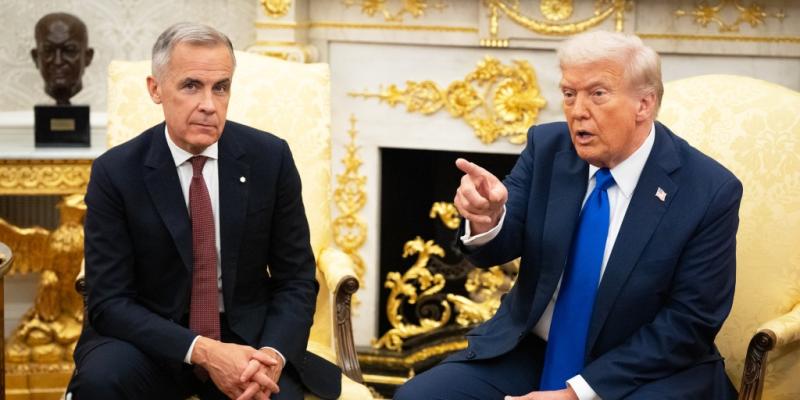
Canadian Prime Minister Mark Carney on Saturday morning called steep new U.S. tariffs on a wide swath of his country's goods "a miscalculation" after trade talks with Canada collapsed late Friday night.
The 50% duties went into effect at the stroke of midnight. Carney blamed the breakdown of talks on what he said were the Trump administration's "uneconomic" and "unfair" demands.
"In recent days, the United States proposed new terms that were uneconomic, unfair, and undermined the net benefits for Canada, and called into question the reliability of any deal. In short, they asked too much, and they offered too little," Carney told reporters at a press conference.
After weeks of talks, Carney on Fridayannounced that while important progress had been made, "that progress has not been enough to meet our objectives for Canadians."
"As a result, this evening, I have decided to suspend trade negotiations with the U.S. and have directed Canada's negotiators to return to Ottawa," Carney said in an emailed statement minutes before the deadline.
On Saturday, he thanked the negotiators, saying, "They've worked hard in good faith, right up to the last minute, to defend the interests of Canadians," but ultimately they had to reject what he said was "a bad deal."
The tariffs affect about $20 billion worth of U.S. imports from Canada, according to the U.S. trade representative's office. The import taxes will hit everything from hockey sticks to some building materials, liquors and certain kinds of clothing.
Carney said in Friday's statement that Canada will immediately retaliate against the U.S., matching "those tariffs dollar for dollar to protect our workers and businesses."
On Saturday, the prime minister said Canada was pursuing a "focused response," with tariffs on the U.S. "concentrated in sectors such as steel, dairy, appliances, agricultural equipment, pulp and paper, and electronics." The duties would take effect Sept. 8, he said.
Asked at the news conference why it felt like Carney was "going to war," the prime minister responded, "Because we were attacked."
The White House did not immediately respond to NBC News' request for comment.
The failure by American and Canadian trade negotiators to reach a deal came after nearly two weeks of furious talks. It was also a dramatic reversal from Tuesday, when President Donald Trump paused the tariffs for three days, writing on social media that the two sides "have a DEAL!"
Officials on both sides had seemed optimistic about a deal up until the very last moment. On Thursday, the Canadian minister responsible for U.S. trade relations met with U.S. Trade Representative Jamieson Greer for several hours.
"We're very close, we continue to make progress and we're going to stay here and do the work that is necessary until we get to that point," Dominic LeBlanc told reporters as he left Greer's office late Thursday.
Canadian negotiators met again with their U.S. counterparts on Friday and talks stretched until the final hours of the day. Officials remained at the U.S. trade representative's office past 10:30 p.m. ET Friday. But ultimately, the two sides were unable to reach a compromise.
In his statement on Friday, Carney said "last-minute changes in the U.S. proposed terms were unfair, uneconomic, and called into question the reliability of any deal."
"We have recognized from the beginning that America has changed, and that we will not return to our old relationship," Carney said. "Canada has what the world wants. And we will not allow any nation to determine our future."
In a press conference Saturday, Carney elaborated on the "last-minute changes" that the U.S. requested to be made to the deal. He said one change was that Americans wanted to limit tariffs "to autos only [and] ... not include medium and heavy duty trucks, which is a big change."
Carney also said the U.S. introduced "in the last hours efforts to restrict our ability to have other trade deals," noting that such proposals would have affected trade and security agreements Canada had struck with other countries. He added that American negotiators also sought "to restrict our protections of our language, our culture, and in effect, our sovereignty," but he did not provide details on the issue.
The last-minute changes weren't the only reason Carney said he directed Canadian negotiators to withdraw, but, "it was also a cumulative aspect, as I mentioned in my remarks, about the willingness in total to enter into a true economic partnership."
Greer said in a statement early Saturday that Canada "declined to finalize the trade deal under the terms agreed earlier this week."
"Despite the U.S. offer to Canada to receive the best treatment of any major exporter to our market, new demands and walk backs of other commitments by Canada have upended the careful balance reached in the past days," he said.
"We don't have new talks planned with the Canadians," Greer added in a Saturday-morning interview on Fox News. "We've said enough, and so we've taken countermeasures." He also said the U.S. would "respond to Canadian retaliation."
Greer said that a point of contention was Canada continuing to maintain its retaliation against the United States "including, among other things, flat-out prohibitions on certain American goods and services." Those bans, introduced by Canada's provinces on the sale of American alcohol, were introduced in 2025 in retaliation for earlier waves of Trump's tariffs on Canada.
As talks wore on this week, Carney's government faced some pushback from premiers of Canada's provinces back home.
Manitoba Premier Wab Kinew said the Canadian federal government should "fight" Trump.
A particular sticking point was a request from Carney to provincial premiers to lift their bans on American alcohol sales.
Quebec Premier Christine Frechette said Thursday that she was still "analyzing" the request, the CBC reported. Other premiers, such as Ontario's Doug Ford — who leads the country's most populous region — did not make any public remarks on Thursday or earlier Friday.
However, Ford wrote on X after Carney's announcement, "The prime minister has my full support for a strong response — tariff for tariff, dollar for dollar." Ford said Canada "needs to stand together more united than ever before."
"We didn't ask for this, but we'll keep fighting for as long as it takes," David Eby, the premier of British Columbia, said on X.
"No one benefits from a trade war," Alberta Premier Danielle Smith wrote on X. "Alberta will continue to advocate for a strong tariff free relationship between Canada and the U.S. and I will be urging the federal government to restart negotiations as soon as possible."
The prime minister had previously said Trump's threatened tariffs would amount to a "direct violation" of the United States-Mexico-Canada Agreement, which Trump had negotiated and signed during his first term.
The U.S. Chamber of Commerce warned in a statement this week that "higher tariffs would damage both economies, drive up costs for U.S. families, further disrupt critical supply chains, and risk the 13 million American jobs that depend on" the North American trade pact.
After Carney's announcement on Friday, the Canadian Chamber of Commerce seemed to agree, calling it "a body blow to North American competitiveness in this self-defeating trade saga."
"Americans will see their costs go up, and Canadians will see customers, investment and small businesses disappear," said Candace Laing, the president and CEO of the Canadian Chamber of Commerce.
The new tariffs were imposed under Section 338 of the Tariff Act of 1930, which has never been deployed before.
The law allows the White House to implement duties of up to 50% on any foreign trade partner that "discriminates" against U.S. commerce.
Nonetheless, the new Canada tariffs are all but certain to be challenged in court.
Canadian officials had been hoping to convince the White House to drop the Section 338 tariffs entirely. In addition to that goal, they had also been looking for a lower tariff rate on industrial products such as steel and aluminum that were imposed under Section 232 of the Trade Act, CBC News and Bloomberg have reported.
On Wednesday, Bloomberg reported that American negotiators had agreed to lower the current tariffs on cars and metals from 25% to 15%.
In his statement early Saturday, Greer said that the U.S. had offered "significant tariff reductions on steel, aluminum, autos, and lumber," without providing specifics. "This is a missed opportunity for Canada to partner with the United States," he said.
Spokespeople for Canadian officials involved in the talks have repeatedly declined to provide additional details about the negotiations to NBC News.
But Greer previously said that the new 50% duties on Canada were effectively payback for Ottawa's retaliation against prior tranches of Trump's tariffs.
"The policy basis for those duties are related to measures that Canada took against the United States," Greer said last week. "So I've got two countries in the world that have retaliated against the United States for trade measures: the People's Republic of China and Canada. That's not the kind of company you really want to be running in."
Last year, Trump briefly responded to China's retaliation by raising tariffs into the triple digits. Talks between Treasury Secretary Scott Bessent and China's vice premier over months eventually defused the tensions and tariffs were lowered.

Tags
Who is online
68 visitors
Carney said in Friday's statement that Canada will immediately retaliate against the U.S., matching "those tariffs dollar for dollar to protect our workers and businesses."
Seems like carney and trump agree about what tariffs accomplish and that they hurt the country they are imposed on and not the country that puts them in place.
IMO tariffs imposed by a nation will bounce back to cause a tax on the people of the nation that imposed them..
I generally agree, but it appears Trump and Carney think otherwise.
You cannot impose taxes on foreign countries or businesses, you can only tax your own.
The word "tax" has more than one definition - an example being "burden"..
There is a difference - Trump thinks imposition while Carney thinks retaliation.
Canadians are the ones hurt by carney’s tariffs, not Americans , if you believe what you wrote.
Of course, but at least the Canadian government cares about it because it becomes necessary to punish those whose aim is to hurt them.
A long-winded repetition of what I've already posted.
This is how the American negotiaters tried to screw Canada at the last minute of the negotiations, causing Canada to walk away from the table.
LINK ->
IMO just the American government being able to control which nations Canada is entitled to trade with is enough to tell Trump to stick his deal up his ass.
You know, it absolutely amazes me that there are actually people, some of whom are members of this NT social news site, who STILL support Trump, a.man who has been capable of destroying the centuries long friendly cooperative brotherly mutually supportive and trusting allied relationship as neighbours sharing the longest mostly unguarded border in the world. Even when that piece of shit is gone it will take years to set things back, but it will never again be what it was.
Another example of how unfair he is, notwithstanding the arrangement concerning the sharing of the tolls betwwn both sides of the Gordie Howe bridge, wherein the tolls first reimbuse Canada for what it cost to build the bridge, and Canada paid the whole cost of it, HE doesn't agree with that and demands that the tolls start being shared from day one. What a fucking pig.