
Middle East Respiratory Syndrome (MERS)


Middle East Respiratory Syndrome (MERS) is viral respiratory illness first reported in Saudi Arabia in 2012. It is caused by a coronavirus called MERS-CoV. Most people who have been confirmed to have MERS-CoV infection developed severe acute respiratory illness. They had fever, cough, and shortness of breath. More than 30% of these people died.
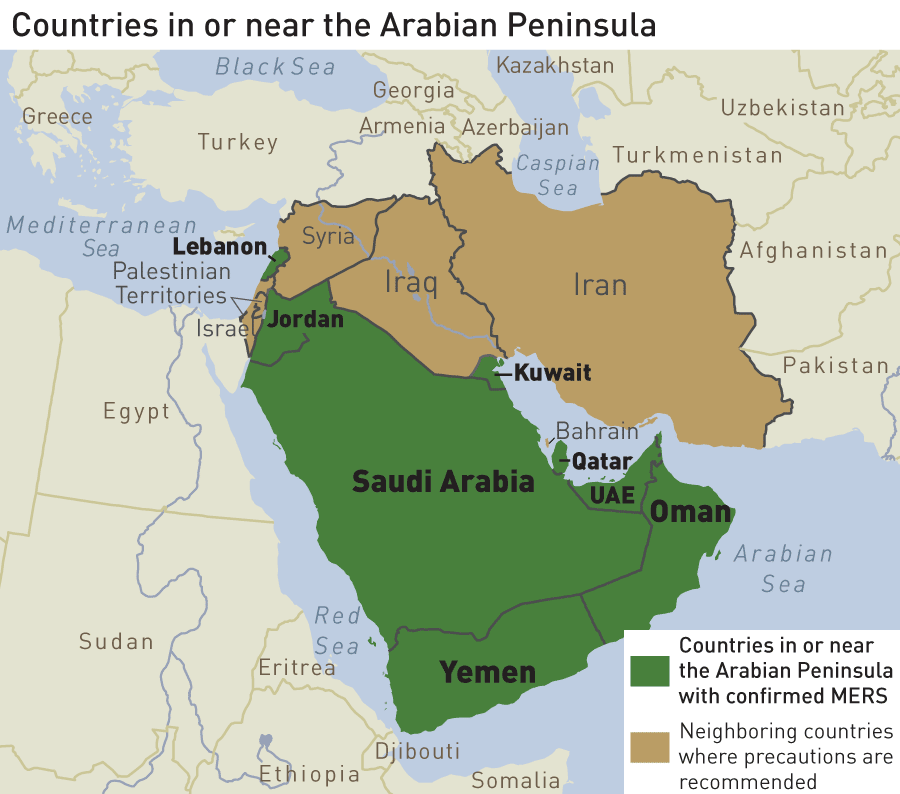 So far, all the cases have been linked to countries in the Arabian Peninsula. This virus has spread from ill people to others through close contact, such as caring for or living with an infected person. However, there is no evidence of sustained spreading in community settings.
On May 2, 2014, the first U.S. case of MERS was confirmed in a traveler from Saudi Arabia to the U.S. The traveler is considered to be fully recovered and has been released from the hospital. Public health officials have contacted healthcare workers, family members, and travelers who had close contact with the patient. At this time, none of these contacts has had evidence of being infected with MERS-CoV.
On May 11, 2014, a second U.S. imported case of MERS was confirmed in a traveler who also came to the U.S. from Saudi Arabia. This patient is currently hospitalized and doing well. People who had close contact with this patient are being contacted. The two U.S. cases are not linked.
CDC and other public health partners continue to investigate and respond to the changing situation to prevent the spread of MERS-CoV in the U.S. These two cases of MERS imported to the U.S. represent a very low risk to the general public in this country.
CDC continues to closely monitor the MERS situation globally and work with partners to better understand the risks of this virus, including the source, how it spreads, and how infections might be prevented. CDC recognizes the potential for MERS-CoV to spread further and cause more cases globally and in the U.S. We have provided information for travelers and are working with health departments, hospitals, and other partners to prepare for this.
Tags
Who is online
80 visitors
Questions & Answers about MERS
For information about the virus, how it spreads, symptoms, prevention tips, and what CDC is doing, see Frequently Asked Questions & Answers .
On May 11 2014, the second imported case of MERS was confirmed in a traveler to the United States.
CDC feature, MERS Imported to US
See CDC Press Release , May 12, 2014
See CDC Press Briefing Transcript , May 12, 2014
Information for Specific Groups
Interim guidance, case definitions, infection prevention and control recommendations, home care guidance, and checklists to help providers and facilities prepare for potential importations of MERS...
Interim guidance, case definitions, and tools to collect data on patients under investigation...
Guidelines for collecting, handling and testing clinical specimens, and lab biosafety guidelines...
Travel Guidance
CDC does not recommend that anyone change their travel plans because of MERS.
More
Countries with Lab-Confirmed MERS Cases
Countries in the Arabian Peninsula with Cases
Countries with Travel-associated Cases
*This includes 1 case reported by Greece, 2 cases reported by Jordan, and 2 cases reported by the U.S., as the cases are residents of Saudi Arabia.
en espaol
For information about cases and deaths by country, visit World Health Organization (WHO)
Related Materials
MERS information in Spanish and in Arabic
Materials for general public, healthcare professionals, and laboratories, including photos , scientific articles, and resources related to MERS.
More
I read somewhere that they believe it is spread from camels ... no joke .
That wouldn't surprise me at all.
Saudi Arabia warns of MERS risk from camels
Kingdom's agriculture ministry tells people to exercise caution, as death toll since outbreak reaches 142.
Saudi Arabia has warned its citizens to wear masks and gloves when dealing with camels as health experts said the animal was the likely source of the Middle East Respiratory Syndrome (MERS) coronavirus.
The Saudi Agriculture Ministry urged people who come in contact with camels to "exercise caution and follow preventive measures," after scientific studies commissioned by the Health Ministry proved a connection between camels and the virus that causes MERS.
"It is advisable to wear protective gloves, especially when dealing with births or sick or dead [camels]," state news agency SPA reported on Sunday.
The link between human cases and camels has been the subject of extensive study among scientists abroad, but has been relatively absent from much of the official domestic debate.
Saudi Arabia also reported three deaths from MERS on Sunday, raising the death toll from the disease since it first appeared in thecountry in 2012 to 142.
The Health Ministry said in a statement on its website it had identifiedthree new cases of the coronavirus, pushing the total number of infections to 483.
The rate of infection in Saudi Arabia has surged in recent weeks, with the total number nearly doubling inApril and rising by a further 25 percent in May.
The recent increase has raised concerns over the influx of visitors expected to convene in the holy cities of Mecca and Medina in July during the Muslim fasting month of Ramadan, and again during the annual Hajj pilgrimage in October.
The disease has spread across the region, with MERS cases reported in the Lebanon, Egypt , Qatar, Malaysia, Italy, Britain and the United States .
MERS is considered a deadlier but less-transmissible cousin of the SARS virus that erupted in Asia in 2003 and infected 8,273 people, nine percent of whom died.
LInk
Just another reason the U.S. should allow no immigration from Muslim countries, not even for tourism or students.
It actually jumped from bats to camels to humans. Viruses that are capable of intraspecies jumps are particularly dangerous because it means that the virus is highly adaptable. This particular form of the coronavirus is dangerous since it mimics less dangerous diseases, but the upside is that it doesn't spread easily as opposed to the more scary version which is SARS.
Mike,
The problem is that in our ever shrinking world, this will come to us if not from the ME but from somewhere else, the benefit of air travel.
poker--
The only two US cases thus far have been from American healthcare workers returning from service in the ME. Should we tell US doctors, nurses, armed forces members, diplomats and businessmen "if you go to that part of the world, don't come back"?
My reasoning was not simply to prevent the spread of MERS but to quarantine the U.S. from the troublesome problems of the virus called Islamism prevalent and growing throughout the Middle East and elsewhere in the Muslim world.