
Do you agree with Social Darwinism ?


please dont both sides this issue
perplexity AI
explain the philosophy of social darwinism
Social Darwinism is the idea that the biological concepts of “natural selection” and “survival of the fittest” should be applied to human societies, classes, and even races. It treats social and economic success as a kind of proof that some people or groups are “naturally superior,” while poverty or failure is read as evidence of weakness or inferiority.
Core philosophical ideas
Struggle and competition as natural law: Social Darwinists argue that competition for wealth, status, and power is a natural and beneficial process, mirroring the way species compete in nature.
“Survival of the fittest” as a social principle: The phrase, popularized by Herbert Spencer, is used to justify letting the “strong” rise and the “weak” fall, often with little or no social support.
Typical political and moral implications
Laissez‑faire capitalism and anti‑welfare: Many social Darwinists opposed government welfare, arguing that helping the poor interferes with “natural” selection and encourages “unfit” people to survive.
Justification of inequality and imperialism: The doctrine has been used to defend rigid class hierarchies, racism, and colonialism by claiming that dominant groups are biologically or culturally “fitter” and therefore entitled to rule.
Why it is widely criticized
Misuse of Darwin’s science: Most scholars stress that social Darwinism distorts evolutionary theory by turning a descriptive account of nature into a prescriptive moral rule for human society.
Ethical and empirical problems: Critics argue it rationalizes cruelty, ignores structural injustice, and has been linked to eugenics and oppressive policies; today it is generally regarded as a discredited ideology, though echoes of it still appear in some popular rhetoric.
Tags
Who is online
84 visitors
True or False ?
False.
Groups were separated by oceans and or impassible geographic features like the Sahara desert, the Alps, the Rockies or great rivers for hundreds of thousands of years.
Each group developed leaders who were successful socially and economically.
Most were normal and lost to history.
Only the asshats are remembered for their horrible behaviors.
Modern transportation and communication didnt solve anything; it may have made things more extreme.
So is that the justification for the uber-rich owning jet planes and private islands while three quarter of a million sleep under bridges and on the street?
Pretty much.
I won't begrudge the uber-rich their 'toys' and 'necessities' for making gain. . . . That does not take away from the fact that they, in Trump's America, want to see the poor look and suffer in poverty (rags, runover shoes, outhouses, shabby housing, et ceteras).
And you just have to bring in Trump.
Hmmm - wonder why John's request of "please don't both sides this issue" fell on deaf ears.
Where do you see both sides? Please explain. Do the work!
(A word about your new avatar: I love it. I really do! Carry on!)
But think of the source of that "gain". I'm okay if it's from their own ingenuity, but if it's from the toil and sweat of others then I consider that different.
I think I receive your point, and yet. . .I need your indulgence: Please, define "toil and sweat of others" as you mean its usage. (There are several ways to interpret it: Work, slavery, theft, . . . .)
Perhaps my terminology was a little extreme - I certainly didn't mean slavery. What bothers me is when I see CEO's obtaining multi-million dollar benefits while the industry's employees are lucky to earn subsistence wages, trying to stretch their paycheck to cover necessities.
Well, in one regard you are absolutely correct: "To the victor goes the spoils (and the entitlement of exploitation)." Also, Newton's third law comes to mind: "For every action there is an equal and opposite reaction." That is, everybody/everything keeps pushing downward and away. . . .
I never understood it to include groups. I understood it to apply to individuals
Good topic;
I think it depends on how each of us sees our species' role in the world. the techbro greed-is-good crowd is obviously Darwinian; Christians ("love one another", protect the weak) must oppose Darwin.
Social Darwinism was used to justify The Gilded Age in the 19th century, and , I believe is still used, although not as ostentatiously, to justify the New Gilded Age.
This 'age' is what Trump is referring to when he imagines the greatness of our nation: Raw unfettered capitalism. Which, by the way, we may get a fuller orb of when Trump's new federal reserve person takes over next month! We are near to seeing Trump 'Unbridled.'
You touched on the heart of this discussion, no pun intended. It also points to something displayed in an avatar (above): The contrasting of men willing to savage others for gain and men of peace. Ironically, the two top avatars accidentally show contrasts in them.
Of wolves eating lambs, big fish eating little fish and presto "the meek shall inherit the earth" becomes a curse.
Well think it about. Do you ever wonder what your cat is thinking when it stares at the ceiling for hours?
What does a great white shark think about when it isn't hungry?
What are the schools of fish who dominate the reef think all day? " no sharks"
" no sharks"
" no sharks" "
"no shark"
Shark!!!!!!!!!!!!!!!!!!!!!!
"Hey! Would you check out the fins on that one! Badda- boom, Badda-bing!"
Dirty old fish....
The lesson for the 'schools' of little fish. . . band together: Get bigger in numbers!
Here is the thing: God (if existing) has the position, status, and authority to DOMINATE mankind and lock humanity in its place (on Earth) ne-er to roam the universe freely, and yet Jesus 'speaks' of humility and peace between brethren and strangers. . . .
God, the most IMPERIALIST force in religion told people to 'suffer' one another with compassion, courage, and love. . . something any self-righteous imperialist would never subscribe to doing.
Justification of inequality and imperialism: The doctrine has been used to defend rigid class hierarchies, racism, and colonialism by claiming that dominant groups are biologically or culturally “fitter” and therefore entitled to rule
Who were the leaders of this supposed movement?
While we are on the subject of social Darwinism we can include social Justice - which is anathema to people with a Darwinian worldview!
Does anyone reading this think social Darwinism and (true) social Justice 'ying/yang' each other endlessly ?
I agree with Social Darwinism based upon the rational clarity of its actual mechanics. It is not a matter of obtaining the greatest good through cooperation but, rather, a documented fact of how complex organisms organize.
In truth, Social Darwinism describes how the fittest rise to dominance, not necessarily social superiority. While survival itself requires a skill set independent of any group, dominance is the force that guides evolution by establishing a social hierarchy. It is an evolutionary fact that the dominant individuals are better able to pass on their genetic makeup and influence the course of evolution for social animals.
We often think of 'cooperation' as the key to survival and evolutionary progress. In reality, what we see is conformity to a social hierarchy that can be mistaken for cooperation. Lower-status individuals conform to the social hierarchy to trade subservience for the benefit of group protection. The dominant individuals do not enjoy the same level of protection. The mechanism of Social Darwinism has established challenges to dominance as the means to alter the social hierarchy and prevent evolutionary stagnation.
Disagreeing with Social Darwinism would require ignoring almost two centuries of observation and tested theories of social organization. The 'common good' is a worthy goal that may be uniquely human; a feature of our humanity. But humans share a biological reality with the animal kingdom. Trying to overcome animal nature within humans with a prosaic extrapolation of 'common good' as a central feature of evolution would delve into the metaphysical. Social Darwinism is real; it does exist and we know how it works.
This point brings up an interesting question (and not a criticism of the point itself): What do you think a country or our world would look and feel like occupied by 'Alphas' -only? That is, could a country 'work,' and all prosper? How could or would the 'pieces' fit together in community without anything between them as 'glue'?
We see in the animal kingdom that alphas challenge each other to obtain dominance. A challenger either overturns the dominant individual or seeks to establish an independent group based on the same system of social organization.
Of course, Social Darwinism is dependent upon forming social groups. Keep in mind that some social animals, such as elephants, establish a maternal hierarchy and social group.
So actually, a hierarchy is established in social Darwinism, right? Sort of a "bunch of chiefs" jockeying back and forth between themselves? Because it seems to me that if statuses are fixed. . . then, a step down from "Alphas" status occurs. That is, "followers." As all can not be equal and occupying the same social state.
Social Darwinism is only a mechanism to establish a social hierarchy based on dominance through challenge. Since dominance is challenged then status cannot be fixed. Alphas will continue to compete for dominance or the alphas begin forming their own groups where they are dominant.
A stagnant, hereditary hierarchy would not be Darwinian, would it?
The original question asked at 7.1.1: "What do you think a country or our world would look and feel like occupied by 'Alphas' -only?"
That is,. . . can Alphas - be "alpha-ing" themselves?
I do not think so. As it is based on heredity. What say you?
I agree. So is a hereditary hierarchy based upon claims of dominance or superiority?
I would think an hereditary hierarchy is based on familial lineage or 'impression' expressed by its Head.
Note: 7.1.4 has been added to. Please review.
Obviously. What would be the justification for a hereditary hierarchy? Would that justification point to dominance or superiority?
Definitely, yes. Alphas would be alpha-ing themselves through competition for higher status. That does not necessarily require fang & claw competition. We see this play out in our society all the time.
This question is passing up the scope of the topic by engaging a sub-category. . . we must cautiously return to the higher 'step' —social Darwinism. . . so I will leave it for another 'day.'
Well actually, in "our society" we have a multitudes of non-alphas too. The question asked at 7.1.4 is this:
"What do you think a country or our world would look and feel like occupied by 'Alphas' -only?"
That rather a surprise since hereditary hierarchies tend to lock the social structure into unchanging strata from the highest to the lowest.
Social Darwinism in an alphas-only society would still be a competition for dominance.
A Community, at that! Possibly one that does not work well at all. Why? Because alphas tend to get in each others ways when they come to cross-purposes. They need intercessors and that translates to a need for a higher number of non-alphas. Still, in the scenario of Alphas-only . . .they have 'only' themselves to translate into followers.
Aren't there military communities endowed with an abundance of alphas? National leaders can form their own communities, like the G20. Some tribes are made up of familial bands; Gaelic clans often consisted of that type social structure.
There are, in fact, examples of communities based on alphas dominating social strata throughout history. (That's based upon your definition of 'community' in @7.2)
Please Google "The Myth of the Alpha Male". Any analysis - of anything - based on that debuked theory is dead in the water.
Who said anything about 'males'? The 'alpha' personality has been directly observed and quantified. The 'alpha' personality is motivated to compete for a dominant status within a social structure (or community).
Dominance is determined by ability to compete. Even the scientific community is not immune from competition to achieve expert status and guide future scientific endeavors. Becoming the top scientist is still based upon a competition by challenges. That competition doesn't need to be fang & claw violence but it can be aggressive and reputationally brutal.
That is not the issue we are sharing in discussion here. I refer you back to the ORIGINAL question:
We do not have such a (pure) state or condition existing in the world today as I know it. So the question, for the sake of discussion, is looking ahead to some remote future.
It is enough. Let's move on. Thank you for sharing.
Just because you doe not like the answers I provide does not invalidate the answers.
Consider that humans exist all over the Earth because of alpha behavior. We know there were some who remained and some who migrated. Why would a cooperative community result in humans migrating to every place on Earth?
The issue of illegal immigration in today's world, across several continents, can not be considered a cooperative activity. Isn't that migration motivated by competition?
Even the liberal world order is based upon competition and dominance. Are there alpha societies (or communities)? Are there alpha countries attempting to dominate other countries?
Let us move on.
I think, cooperation can translate in this context to community.
Can we call a dominant group of people - community using the proper sense of the word?
Yes. The European Union would be one such example. Separate countries (or communities) whose leaders form their own community. The Holy Roman Empire was made up of a community of kings dominated by the Holy See.
There are more alphas seeking dominance in the scientific community than people wish to recognize. The competition within the scientific community can be brutal.
Now, I feel compelled to speak about social Justice as a means of doing good, that undiluted social Darwinism can not accept or allow.
Additionally, what do we make of those social Darwinian types that cross-overs to use their talents, gifts, strengths, power, and influence to support the lesser types in this country and the world.
Is Social Justice a group activity?
Please elaborate. I have been out all day and have an early rise AM Saturday. I can not figure out on the fly what you mean before I 'crash.'
Group activity?
The question is straightforward. Is Social Justice a group activity?
Social Justice is supposed to proactively pursue equal rights, opportunities, and treatment for individuals and groups. The proactive nature requires pre-judgement before the fact. Social Justice addresses perceived potential inequalities that might emerge. Does that require a group or is that an individual activity? Is Social Justice really a social activity?
It seems to me that social justice can be pursued by the individual and by groups/organization advocates. Is social Justice really a social activity? "Social" justice is a *social" activity - it's in the name.
Social Darwinism is an invention created to explain the "justness" of a few people accumulating great , almost unimaginable, wealth while the masses lived in tenements and worked 12 hour days in factories.
The descendant of social darwinism is the notion that a social safety net is unfair because it rewards laziness and immorality.
What political leaders called themselves social Darwinists?
Instead of the irrational chant: ". . . . will not replace us!" In some remote future, the shouts will evolve into: "AI will not replace us!"
"Robots will not replace us!"
I agree.
The most successful species are social - the survival of the group is more important than any individual.
The texhbro billionaires would destroy not only their species but the entire world, to benefit their tiny clan.
Says every totalitarian when justifying atrocious crimes against humanity .....
what does that sentence have to do with the comment you are replying to?
Especially, since it is lifted out of its proper context.
Social Darwinism has been objectively observed and quantified. What you are indicating is that an objective function of nature has been anthropomorphized and politicized.
Social Darwinism is merely a natural organizing mechanism to establish a social hierarchy for a group. There is nothing moral or immoral about that natural mechanism. Social Darwinism only describes how animals behave.
Bringing morality into the discussion raises the question concerning the morality of the dominant individual? Social Darwinism explains that challenges for dominance establishes the social hierarchy (and, perhaps, expectations for social conformity) within a group. Does the 'goodness' or 'badness' of the dominant individual reverberate through the social hierarchy?
IMO, that's why it is important to understand the distinction between 'dominance' and 'superiority'. Humans are somewhat unique in their ability to control their animal nature. That is the feature of humanity that allows for morality. Cooperation is a moral quality that requires humanity overcoming animal instinct. Isn't that a measure of human superiority?
And yet as humans (evolved animals) we have tied ourselves to morality (good and evil) standards together and apart from religiosities.
Yes, emphatically. The dominant individual (or 'cluster') will "head" structure the rest of the pack!
"Survival of the fittest" is a difficult notion, much too readily polluted by anthropomorphism. Perhaps the most successful group of animals is... ants. Their success is social, not individual.
Orcas rule the seas - they are social animals.
Elephants.
The top canids and felids, both, are social.
Crows and ravens...
Epstein and Trump are also very successful predators. Pack hunters.
What is your thought about South Korea's social Darwinist past and partial present?
I don't understand the question. What is particularly "social Darwinist" about South Korea?
Search Assist
Social Darwinism was introduced to Korea in the 1880s and significantly influenced Korean nationalism and modern ideologies, particularly before Korea's annexation by Japan in 1910. It replaced traditional Confucian beliefs and contributed to various social and political changes during that period.
Introduction to Social Darwinism in Korea
Social Darwinism was introduced to Korea in the 1880s and had a profound impact on the country's ideologies, particularly nationalism. This ideology emerged during a time of significant social and political change, especially leading up to Korea's annexation by Japan in 1910.
Influence on Nationalism
Key Aspects
Replacement of Confucianism: Social Darwinism supplanted traditional Confucian beliefs, which had been the foundation of Korean society for centuries.
Modern Ideologies: It played a crucial role in shaping modern ideologies in Korea, influencing how Koreans viewed their identity and place in the world.
Effects on Society
Survival of the Fittest: The belief in "survival of the fittest" became a dominant principle, affecting social dynamics and political discourse.
Mobilization for Change: This ideology spurred movements aimed at modernizing Korea and aligning it with international standards, as reformists sought to strengthen the nation.
Is social Darwinism still prevalent in South Korea today?
Short answer: Parts of South Korean society still show attitudes and policies that resemble social-Darwinist ideas (strong emphasis on merit, competitiveness, survival-of-the-fittest logic in education, labor markets, and some public debate), but it is neither a formal ideology of the state nor uniformly accepted — there is also active criticism, legal protections, and social-policy efforts to reduce inequality and support vulnerable groups.
Key evidence (concise):
Strong meritocratic culture: intense competition in education (college entrance exams, private tutoring) and employment selection reinforces beliefs that success is earned and failure is individual; scholars link this to social-Darwinist-style thinking about fitness and worth.
National Institutes of Health
Structural inequality and market-driven pressures: labor-market precarity, gender gaps, and housing/wealth concentration produce outcomes that critics describe using social-Darwinist language (winner-takes-all dynamics), prompting public debate.
National Institutes of Health
Political and legal counterweights: Korea has social safety nets, anti-discrimination laws, and active civil society criticism of harsh meritocracy; policy debates focus on redistribution, youth unemployment, and demographic decline. (scholarly and policy literature documents both the problem and responses).
National Institutes of Health
Interpretation: Social-Darwinist patterns persist as social attitudes and systemic effects (especially around education and competitive labor markets), but they are contested publicly and moderated by laws, welfare programs, and ongoing reforms.
Credit: DuckAI
Lots of generalities, not much data...
Sorry, generalities are all I was after with the question. I did not plan a comprehensive discussion of South Korea - just trying to understand a place (or several) that in actuality dealt with tangible social Darwinism. That said, I agree more can be added. . regarding South Korea's approach. . . . They did (and as stated do) still have partial actuality of Darwinism.
Just wondering, no big deal.
No problem
Bob, there is a series on Netflix called: Weak Hero. (It lends itself to the point I was making about Social Darwinism in South Korea.) That is, the strong survive.
My point is that evolution is not about individuals. It is about genes, and about species. A "successful" strategy is one that ensures the survival of a maximum of genetic materiel. Individuals' survival is unimportant.
So "social Darwinism" seems to me to be a buzzword without substance. In the animal world, almost all "successful" species are social, colaborative, pack, putting the well-being of the pack above any particular individual. From ants to whales.
Where do humans fit in? The jury is still out. It looks to me like we are at a tipping point: either we destroy ourselves or we learn to put the pack above the individual. I really don't know which will happen.
This "debate" is, IMNAAHO, wildly anthropomorphic. It pretends to observe nature in order to draw conclusions applicable to humans... but in fact (IMNAAHO) it justifies destructive behavior by mistakenly ascribing it to "nature".
Someone here used the term "alpha". The notion of the "alpha male" was developed by observing wolves in captivity. The author realized his error, and spent the rest of his life debunking his own theory.
Packs (wolves, apes, whales, ...) are rarely dictatorships - if the leader does not do a good job - benefitting the pack members - the leader will be overthrown. That leader may be male or female.
It seems to me that "social Darwinism" is a distraction.
Bob, we are not discussing beasts. . . we are talking "social Darwinism' relative to human societies alone here. The Trump Administration is pushing us to act like a hierarchy with the meanest, harshest, rudest, aggressive, even maniacal (think Secretary of War Hegseth) pushing to rise to the top and overwhelmingly dictating facts and worldview to all in our country. . .and yes the world!
So yes, beasts have their 'evolving' which they do. . . distinctly, humanity has its 'social Darwinism.'
Bob, it was JR who 'defined' social Darwinism for the point of this article. He gave us "definition" to guide the direction of discussion. This article is not about beasts, it is about how humanity treats. . . humanity. Please understand and accept his offering.
BTW, I asked about a Netflix showing: "Weak Hero" - a South Korean series, where high schoolers are extremely brutal to each other in fighting, injuries, in order to dominate each other. I like South Korean movies and series. That said, this one (2 seasons - I watched both seasons) nearly revulsed me it was so brutal and over the top. Still, in its own way it reminded me of what AI stated about Korean's leaning toward social Darwinism heavily and even today having features of it lingering in their society. They cross the line in the series repeatedly with individual and group ASSAULT and Battery against their fellows . Demonstrating it is all about DOMINATION in the series.
Evolution is a process. It operates the same across all animals (and plants). It is the transmission of genes from generation to generation.
"Social Darwinism" is - as far as I can see - an excuse for "greed is good". It promotes individual success over collective success. It justifies Elon's fortune while excusing climatic disaster.
Evolution is science. Social Darwinism is punditry.
It seems (feels) to me that we are "running alongside each other on parallel tracks" - which do not intersect. Anyway, okay.
Darwin without beasts?
Nope. I can't accept that kind of abuse of language. Darwin based his theory on observations of animals. It is impossible to dissociate them.
Bob, I know and can agree with what you are writing about. . . even though, the parameters for this discussion has been 'established' by its seeder (in an image at the top of the page). Okay, I will stop now.
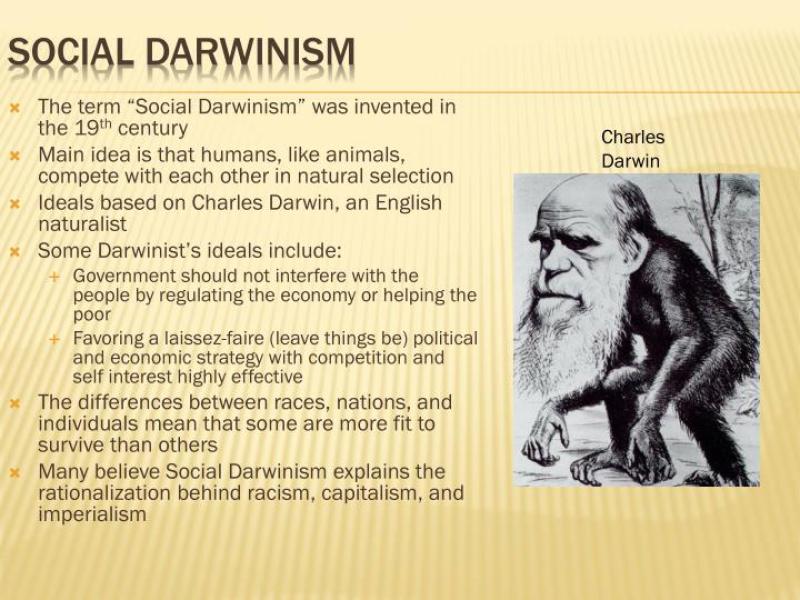
Here is the thing about main bullet number five (above):
1. "The differences between races, nations, and individuals mean that some are more fit to survive than others."
A. Should so-called inferior people be purged to make room for "more betters" to procreate?
B. Does 'todays' so-called "superior races" mean it is a ' one and done '?
a. What becomes of a world of diverse thinkers in a world of 'Oneness' thinkers?
C. Should we take for granted that removal of "inferior" races through purging, shall cause no long-term disruption or loss to the Whole evolution process?
I can tell you right now that Social Darwinism does not work, even on the theoretical level, much less the practical level. A theory is supposed to have predictive power. If we look at the case of a billionaire with two children, how does that square with the billions of people with three or four?
Not very well.
Social Darwinism is a mismatch (one might even call it a fraud) from the start. One takes a biological concept, where “fitness” means reproductive success, and forces it into a social claim that the wealthy are therefore the most “fit.” That is not a translation of a theory, but a direct substitution of terms, operating on the assumption that wealth is equivalent to fitness. Once one redefines fitness as wealth, the original framework (a biological model in which fitness is defined by differential reproductive success across generations) is abandoned while its authority is retained in name only. What remains is not a predictive model, but a circular assertion: those who have the most are deemed the fittest because they have the most. That is justification rather than explanation for preserving the status quo, with no mechanism, no testability, just “because.”
At first glance, that framing can be persuasive. It encourages a quiet shift in meaning, where fitness no longer refers to the passing on of genetic material but instead to the accumulation of wealth.
There are no stable definitions, no predictive power, just a blanket assertion that those who have the most should keep the most. The concept has been broadly discredited. Societies tend to function better when they maintain the rule of law and invest in the education and well being of their members.
Hung Cao said the military should be filled with 'alpha males and alpha females.' Now he's Trump's acting Navy secretary
As undersecretary of the Navy, Hung Cao, a retired Navy captain and former Republican Senate candidate in Virginia, was supposed to have a broad portfolio as the service’s No. 2 civilian, which included personnel issues and safeguarding the Navy’s “warfighter ethos.”
But in reality, Cao was often cut out of decision-making by his boss, Navy Secretary John Phelan, one source familiar with the situation told CNN, who said Phelan put Cao “in a box”
Cao was isolated from Navy decision making and wasn’t allowed to represent Phelan in official meetings that Phelan didn’t attend, something a typical undersecretary would do, the source said.
That all changed following Pehlan’s sudden ouster as Navy secretary by President Donald Trump and Defense Secretary Pete Hegseth this week. Cao is now in the job on an acting basis. He learned about his promotion from the Pentagon front office, which called him in and said, “Ok, you’re it — we made a change,” according to the source.
“He’s quickly coming up to speed on all the things he wasn’t allowed to be involved in,” the source added.
A decorated special operations officer, Cao takes over as the Navy’s top civilian at a time when the service is playing a critical role in stopping Iranian ships from traversing the Strait of Hormuz. As the 2024 Republican nominee against Virginia Democratic Sen. Tim Kaine, Cao championed Trump and Hegseth’s attacks on social issues and opposition to diversity, equity and inclusion initiatives.
Cao immigrated to the US as a child after his family fled Vietnam during the Vietnam War.
After retiring from the Navy in 2021, he ran for Congress as a Republican in 2022 and challenged Kaine in 2024, where he had a penchant for making controversial statements.
“When you’re using a drag queen to recruit for the Navy, that’s not the people we want,” Cao said at a 2024 debate with Kaine in response to a question about military recruiting.
“ What we need is alpha males and alpha females who are going to rip out their own guts, eat ’em and ask for seconds. Those are young men and women that are going to win wars.”
Is the Alpha Wolf Idea a Myth?
The idea that wolf packs are led by a merciless dictator, or alpha wolf, comes from old studies of captive wolves. In the wild, wolf packs are simply families
By Stephanie Pappas
If you’ve ever heard the term “alpha wolf,” you might imagine snapping fangs and fights to the death for dominance. The idea that wolf packs are led by a merciless dictator is pervasive, lending itself to a shorthand for a kind of dominant masculinity .
But it turns out that this is a myth, and in recent years wildlife biologists have largely dropped the term “alpha.” In the wild, researchers have found that most wolf packs are simply families, led by a breeding pair, and bloody duels for supremacy are rare.
“What would be the value of calling a human father the alpha male ?” says L. David Mech, a senior research scientist at the U.S. Geological Survey, who has studied wolf packs in the wild for decades. “He’s just the father of the family. And that’s exactly the way it is with wolves.”
Family Packs
Mech, like many wildlife biologists, once used terms such as alpha and beta to describe the pecking order in wolf packs. But now they are decades out of date, he says. This terminology arose from research done on captive wolf packs in the mid-20th century—but captive packs are nothing like wild ones, Mech says. When keeping wolves in captivity, humans typically throw together adult animals with no shared kinship. In these cases, a dominance hierarchy arises, Mech adds, but it’s the animal equivalent of what might happen in a human prison , not the way wolves behave when they are left to their own devices.
In contrast, wild wolf packs are usually made up of a breeding male, a breeding female and their offspring from the past two or three years that have not yet set out on their own—perhaps six to 10 individuals. In the late 1980s and 1990s Mech observed a pack every year at Ellesmere Island in northeastern Canada. His study, published in 1999 in the Canadian Journal of Zoology, was among the first multiyear research on a single pack over time. It revealed that all members of the pack defer to the breeding male and that, regardless of sex or age, all pack members besides that male defer to the breeding female. The youngest pups also submit to their older siblings, though when food is scarce, parents feed the young first, much as human parents might tend to a fragile infant.
The same is true across gray wolf packs : Infighting for dominance is basically unheard of in a typical pack. When offspring are two to three years old, they leave the pack in search of mates, aiming to start their own pack. The alpha wolf notion of challenging dad for dominance of the existing pack just isn’t in the wolf playbook.
Indeed, even general family conflict is rare, Mech says. “Let’s say that [a] pair has some yearling wolves that haven’t dispersed yet. The adults will kind of keep the yearlings away from the carcass while the adults feed and feed the pups,” he says. “Those are places where there can be at least competition and sometimes conflict, but it’s a snap or two.”
Mech used the alpha wolf nomenclature in a classic book of wolf biology, The Wolf: Ecology and Behavior of an Endangered Species, which was published in 1970. But he has made a point of pushing back against the term as new research has come to light. After a years-long effort, he finally got The Wolf taken out of print in 2022, he says. The 2003 book Wolves: Behavior, Ecology, and Conservation, which he co-edited with zoologist Luigi Boitani, is now far more accurate and up-to-date, he says.
Unusual Cases
On rare occasions wolf packs do balloon in size. This happens in Yellowstone National Park , where there are copious elk and multiple large wolf packs. Sometimes young wolves stay with their birth pack because there is enough food to go around and dispersing is dangerous. Any wolf ready to strike out on its own is at risk of attack by neighboring packs, says David Ausband, a wolf researcher and wildlife biologist at USGS and the University of Idaho. “When density is high, it’s a gauntlet,” he says. “It’s like, ‘I’ll just stay home. At least I’ll get some food.’”
In these situations, packs may grow to a couple of dozen members strong. The Druid Peak wolf pack in Yellowstone reached an apex of an unprecedented 37 wolves in 2001, according to the Yellowstone Wolf Tracker. When such an increase occurs in a pack, there may be more than one breeding pair, and competition can erupt over breeding spots, Ausband says. “In that case, I personally think the alpha term applies because there is still a dominant female calling the shots in that pack,” he says. “Usually the second breeding female is her daughter.” (In these circumstances, a subordinate male will also take on a breeding role, though sometimes one dominant male mates with multiple breeding females. Wolves rarely inbreed unless they are in small, isolated populations, so this arrangement is most likely if an unrelated female joins the pack.)
Having multiple breeding pairs in a pack is now an uncommon situation, says Ausband, who conducts genetic studies to understand how wolf packs are related and how they disperse. Prior to human hunting and trapping of the gray wolf population in the northern Rocky Mountains, perhaps 10 to 15 percent of wolf packs in the population had multiple breeders. Since the intermittent legalization of hunting and trapping of these wolves in states around Yellowstone in 2009, Ausband has found only one instance of such an arrangement in Idaho.
The status of gray wolves is often in flux. In 2008 the U.S. Fish and Wildlife Service removed the northern Rocky Mountain population from the Endangered Species Act list. The agency reinstated this population to the list that same year but then delisted it, outside of wolves in Wyoming, in 2009, allowing hunting and trapping for the first time in decades. These wolves were reinstated in 2010 and then delisted again in 2011. Northern Rocky Mountain wolves in Wyoming were subsequently delisted in 2012, relisted in 2014 and delisted again in 2017. As of a February 2022 court order, all gray wolves in the continental U.S. and Mexico outside of the northern Rocky Mountain population are protected from hunting and trapping under the Endangered Species Act.
Hunting and trapping may also reshuffle wolf families, depending on which member of the pack is killed. Breeding males and females tend to be older and less susceptible to error in their survival instincts, so it’s usually younger wolves that lose their lives, Mech says. But if a breeding female or male is killed, a lone dispersing wolf may step in to take its place. On other occasions, a pack may adopt a lone wolf that does not become a breeder, says Sarah Bassing, a postdoctoral researcher at the University of Idaho and the Idaho Cooperative Fish and Wildlife Research Unit. This may happen when hunting and trapping cause a lot of wolf mortality, Bassing says, though the evidence isn’t entirely clear. If a wolf pack loses too many hunting adults, it may simply need the extra help. “Packs might be more receptive to new individuals just so their pups survive to the next year,” Bassing says. A spare nonbreeding adult can help guard pups and hunt for food.
Nevertheless, Bassing says, there seems to be a lot of variability across regions in how wolf packs respond to human meddling. Decades after researchers came to mistaken conclusions about wolf dynamics by studying captive animals, it’s still not entirely clear how human actions are affecting how packs work. “There’s a lot we don’t know about how hunting and tracking tinkers with pack structure,” Ausband says.
What the hell? This article is not about wolves. How difficult is it to understand?! What has to happen to breakthrough on that point?! Let it go already! Besides, I deliberately put my comment in a new thread for serious consideration about what our 'new' DEPARTMENT OF WAR(!) is doing with its naval leadership. A different and factual change of direction from what you were addressing above!
A War secretary has appointed a 'acting' officer over naval services that writes:
And your mind trains on wolves in nature?!!
I think comparing human and wolf characteristics is an interesting abstract thought exercise , but it also has to take into account the different human personality traits, and differences , last of which i knew had 7 different categories and only 3 work in a communal setting . the other 4 are non comformist and likely the greater number in reality , but that is for the individual to decide for themselves .