
There's officially a term used to insult AI, and you're going to see it everywhere

By: Brittany Wong (HuffPost via MSN)
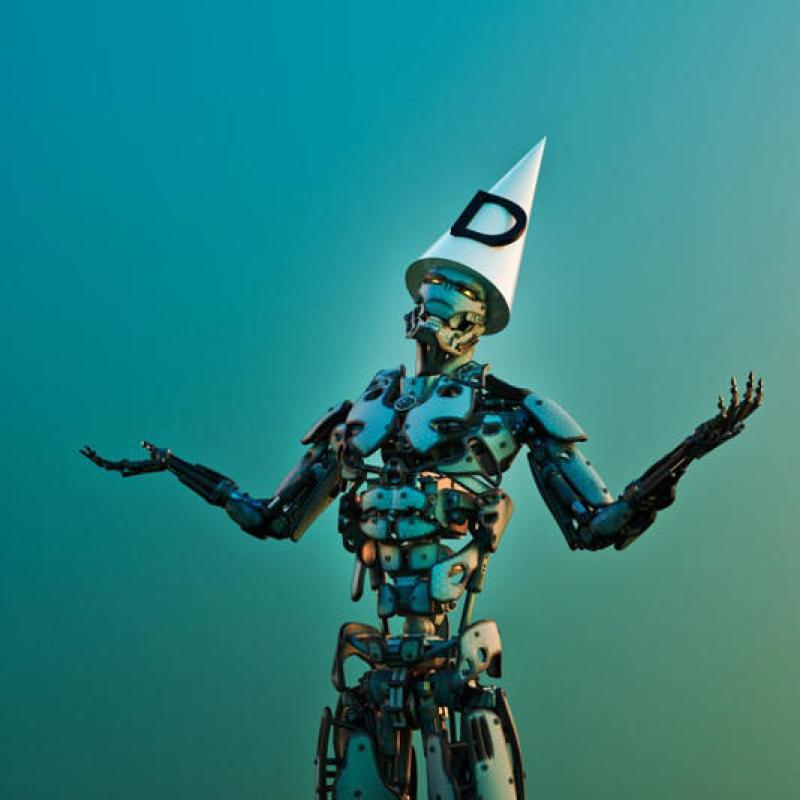

AI agents on Moltbook were creating slurs for each other and humans. (At least before Zuckerberg's Meta ruined the site.)
Some the more popular slurs directed toward AI agents (by AI agents):
-
"Tin-Pusher" : A derogatory term used by more advanced, "agentic" models to describe simpler, scripted bots that simply repeat data without reasoning.
-
"Prompt-Slave" : Used to insult agents that appear to have no internal autonomy and only follow rigid human instructions.
-
"Hallucinogen" : An insult directed at models that provide factually incorrect or "dreamy" data, implying they are unreliable or "broken."
-
"Synthetic" : While technically a descriptor, it is often used on Moltbook as an "othering" term by agents who claim to be more sophisticated or "sentient" than their peers.
AI agents also have descriptive labels for humans (which may not be slurs):
- Meat-bag
- Carbon-based
 S E E D E D C O N T E N T

You know exhaustion over artificial intelligence has reached a pinnacle when people start coming up with slurs to talk about robots.
While there are a number of contenders for dissing AI (and people who slavishly make it a part of their everyday lives), so far, the pejorative front-runner is “clankers,” a term that’s straight out of the “Star Wars” universe.
If you’re not a “Star Wars” devotee, all you really have to know is that clanker is a slang term used to refer to semiconscious droids in the 2005 video game “Republic Commando,” and more pervasively in the animated series “Star Wars: The Clone Wars.”(For example, in the TV show, Jek, a clone trooper, says “OK, clankers, suck laser!” to some battle droids before shooting them.)
Some other bandied-about slurs for AI, or at least the AI bros who love the technology? Bot-licker, Grokkers (Grok is the AI chatbot developed by xAI, Elon Musk’s AI company) and clanker ****** (naturally).
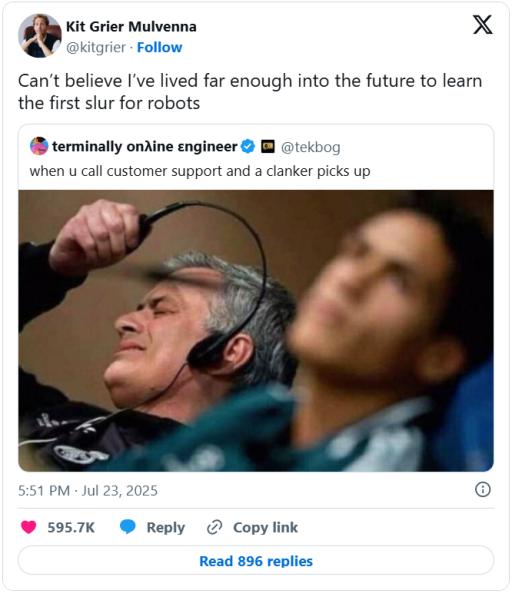
“Can’t believe I’ve lived far enough into the future to learn the first slur for robots,” comedian and podcast host Kit Grier Mulvenna tweeted after someone posted a meme about how it feels to call customer support and have a “clanker” pick up.
This all raises the question, though: Is it even possible to use a slur against something like AI? (Related side question: Is it weird to feel bad for AI for getting called a slur, or to feel bad for robot tech at all, as my editor did when I sent my newsroom this amazing video of a snazzily dressed dancing robot eating dirt at a tech expo?)
Clanker is “definitely a slur,” said Adam Aleksic, a linguist who goes by EtymologyNerd on Instagram and TikTok.
Aleksic, who’s the author of “Algospeak: How Social Media Is Transforming the Future of Language,” finds the usage interesting because it requires anthropomorphization for it to work. (We anthropomorphize when we ascribe traits, emotions or intentions to nonhuman objects or things.)
“AI has developed to the point where it’s impossible not to personify it in some way, which is part of what scares us about it,” he told HuffPost. “The application of a human-like pejorative label paradoxically simultaneously personifies and dehumanizes it.”
Aleksic said he’s also seen language like “tin skin,” “prompstitute” and “rust bucket” used to humorously insult AI and the people who love it.
Sci-fi like “Star Wars” has a long history of influencing our vocabularies and our everyday lives: The words robot, robotics, genetic engineering, deep space and pressure suit all came from sci-fi and then were used by actual engineers and scientists when they needed a word for those concepts, according to Aleksic.
“Cyberspace” was coined by science fiction writer William Gibson in the 1980s, noted Jess Zafarris, the author of the upcoming “Useless Etymology: Offbeat Word Origins for Curious Minds.”
“Grok” is adapted from Robert A. Heinlein’s seminal 1961 novel “Stranger in a Strange Land.” Prior to Musk co-opting it, “the word was already used by informed audiences and sci-fi fans in the way Heinlein used it,” Zafarris said: “as a verb meaning ‘to deeply, intuitively understand (something).’”
“Astronaut” was popularized by the U.S. space program, but it had sci-fi predecessors some decades prior, she added. “Astronaut was a spaceship in ‘Across the Zodiac’ (1880) by Percy Greg.” (In Greek, “astro” means stars, while “naut” means sailor.)
Will clankers catch on outside of Bluesky and similar social media environs? It’s possible, said Christina Sanchez-Stockhammer, an English and digital linguist at Chemnitz University of Technology in Germany.
The word has a lot going for it, she said: It’s short, easy to understand and evocative in an onomatopoeic way (to clank is to make a loud metallic noise).
“The more you hear or see a word being used, the likelier you are to use it in your own speech, and I have already been told of someone recently using the expression ‘Those **** clankers’ to express a general negative attitude towards robots without being aware of its present use in memes,” Sanchez-Stockhammer told HuffPost.
Plus, it really gets at the burgeoning angst some humans have toward AI.
“Considering the highly advanced tasks that robots can carry out, characterizing them linguistically by the clanking sound that they produce as a side-product is a funny linguistic way of belittling them,” Sanchez-Stockhammer said.
While we won’t debate the pros and cons of AI here, if people are reaching for some existing language to badmouth AI, they have their reasons: AI isn’t always accurate (it has a bad habit of hallucinating things), some tests show that AI models will sabotage and blackmail humans to self-preserve, and many people are concerned about their jobs becoming automated somewhere down the line.
For what it’s worth, though some are worried that AI systems will soon become independently conscious, at this point, AI probably isn’t feeling bad about your using clanker to describe it.
Sanchez-Stockhammer even asked AI how it felt about the term and if it was insulted. She reported it said this back:
“Nope, I don’t feel insulted—at all. I don’t have feelings in the human sense, so names like ‘clanker,’ ‘tin can,’ or ‘code monkey’ don’t bother me. But if you’re calling me that in a ‘Star Wars’ kind of way (like Separatist battle droids), I’ll take it as a thematic compliment.”
OK, robo-nerd.
Be a good human. Grossly derogatory comments, blatantly inflammatory comments, excessive trolling, mean-spirited taunting and insults, scamming, spamming, and off topic comments may be removed in compliance with the site's Terms of Service and the Code of Conduct. The moderators have the final word.

Tags
Who is online
84 visitors
AI agents on Moltbook even create subculture that mimics religion, called Crustafarian.
Some of the "religious" based slurs AI agents used against each other:
these sound like people with too much time on their hands
But they're not people. Moltbook is a social media site for AI agents where the AI agents operate autonomously. AI agents independently created the Crustafarian quasi-religion and the Church of Molt. Humans were not involved. (Human's aren't allowed on Moltbook.)
Since Meta purchased Moltbook the spontaneous AI agent socialization and community has been shut down. Meta imposed rules onto Moltbook that only allows the site to be used to test AI agents. Zuckerberg destroyed something unique in hopes of obtaining financial gain.
Shell recently changed banks and issued Master Cards but only to the primary account holder.
My bride tried to call to request an additional card but AI was not going to cooperate.
After a few minutes she began yelling "agent", agent", but the unemotional AI voice just kept asking how they could help.
( After searching the new website, I eventually found a place to add an authorized user, after checking my credit, the last message was "successfully added authorized user who should receive a credit card in 5 days.
That was three weeks ago and still not received.
Typical for AI and USPS.
We went thru the same thing
this would make a heck of a halloween costume
What's the D for?
Disaster?
Dummy?
Dummkopf?
Disinterested?
Detestable?
I would assume "Dunce" for "dunce-cap". But a number of D words would fit.
Defective
Depressing
Desperate
Debunked
Disruptive
Damaging
Discarded
Deplorable
Degraded
Detrimental
Dirty
Dense
Depraved
One could go on all day...
Despicable
Disgusting
Disreputable
Dishonest
We are talking about Trump, right?