
The Rural Lie: How Trump 2.0 Turned America's Heartland into a Sacrifice Zone

By: Marie Riverton

 S E E D E D C O N T E N T

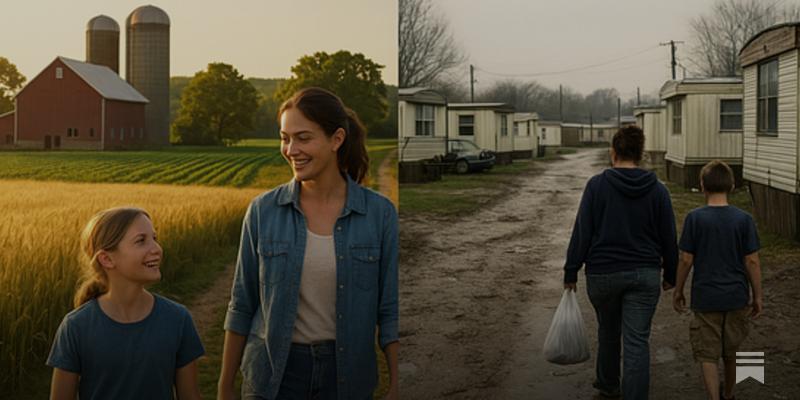
They don't want rural America to die. They want it to kneel.
The Myth of the Pastoral Dream
We are told a story about rural America.
It's the story politicians love to tell—especially the GOP—when they wrap themselves in flags and plant themselves on dirt roads. They speak of endless fields, clean air, church bells, hard work, and proud, simple lives. They call it "the real America." And they promise to protect it.
It's the one politicians—especially the ones who cut ribbons in cowboy boots and talk about God and grit—love to repeat. That life there is clean and proud, that they live off the land and care for each other. That they don't need much, and don't ask for more.
It's the story they tell while cutting school lunch programs. While closing clinics. While gutting disaster preparedness and mental health services. Letting dollar stores replace grocery stores and watching local farms die while commodity corn feeds cattle and CEOs.

The truth? Rural America is being abandoned—not passively, not by accident, but through policy, through design. The factories are gone, the grocery stores are empty, and the hospitals are closing. The kids leave, and most don't come back. And while the towns hollow out, the leaders who claim to love rural America keep cutting the very programs that once helped us survive—education, food, health care, community support, and disaster relief.
This isn't neglect. It's betrayal wrapped in patriotism. It's happening in the background and by design, under Trump 2.0 and the Department of Government Efficiency (DOGE).

They wave the flag. Then they cut the lifelines.
They speak of loyalty. Then they leave us to fend for ourselves.
What's happening to rural America isn't natural decline; it's manufactured collapse.
The Collapse of Opportunity
The promise was simple in rural towns: work hard, and doors would open.
Those seeking more education face the zip code obstacle. Few small rural schools can offer college prep, AP, or advanced coursework to attract the interest of university recruiters. Unfortunately, the valedictorian of a class of 30 isn't on a level playing field with the top ten in a class of thousands.
And an athletic scholarship? Few exist, so small-town sportsmen and women must compete against better-funded programs that benefit from extensive training camps and competition, which lure lucrative recruiters and news coverage.
That leaves laborious grant and scholarship hunts, decades of loan payments, and work-study programs barely covering toiletries.
If college wasn't your path, there were still trades to learn, farms to work, and decent jobs to earn a living.
Or at least there was.
The Department of Government Efficiency (DOGE)—Trump's ideological wrecking ball—has targeted the few programs that gave rural youth a path forward. Now, the doors are closing for good.
AmeriCorps: Service as a Stepping Stone—Now Defunded
AmeriCorps wasn't just a "volunteer program." In rural areas, it was one of the only structured opportunities to gain experience, earn a stipend, and receive college tuition help without leaving your hometown.
AmeriCorps placed tens of thousands of young adults in roles like:

It helped students bridge the gap from high school to college or career, especially in places without recruiters, AP classes, or job pipelines. Best of all, the program was structured to last 12 to 24 months, rather than a long-term commitment.
In 2025, AmeriCorps lost nearly $400 million in funding under DOGE's cuts, displacing over 32,000 volunteers and gutting over 1,000 programs, including in rural hubs in West Virginia, Mississippi, Iowa, and northern Nevada.
Job Corps: Vocational Training for the Working Class—Now Gutted
Job Corps was designed for exactly the kind of student rural America produces: hardworking, hands-on, not headed to a four-year university. It offered free trade training, housing, meals, and career placement in fields like welding, CNA certification, auto tech, carpentry, and IT.

Trump's 2025 budget proposes eliminating the program entirely as part of a 35% cut to the Department of Labor. That's not efficiency; that's erasure. Programs are designed to last months, not years.
With Job Corps centers closing, rural youth lose access to:
-
Safe, structured job training
-
Professional certifications
-
The support network they need to get stable work and avoid poverty or enlistment by default
The Military Isn't a Substitute
When schools fail and trades disappear, recruiters show up. The military becomes the fallback.
But here's the truth:
-
Not everyone can serve. Health issues, trauma histories, disabilities, and even weight disqualify many.
-
Others are morally or spiritually opposed to military service.
-
In an era of rising global conflict, joining the military is not a neutral career step; it's a high-stakes, high-risk gamble.
-
The promise of the GI Bill requires a multi-year commitment, often far from home.
-
Upon return to their communities, veterans may face an enhanced need for specialized medical care and limited job opportunities.
No Local Jobs, No Options, No Exit
Once, rural towns had jobs in timber, mining, manufacturing, rail, or farming. Now?
Those have been offshored, mechanized, or consolidated. What's left are:
-
Minimum wage service jobs with no benefits
-
Gig work with no security
-
Dangerous meatpacking or agricultural labor, often done under threat and without recourse.

Food Deserts in a Sea of Grain
You can stand in the middle of a rural town and see cornfields in every direction. But inside the local gas station—one of the only places left to buy food—there are no tomatoes, fresh greens, or milk that hasn't expired—just shelves of boxed noodles, chips, and soda.
That's the paradox of food in rural America: they grow it but can't eat it.
Fields of Grain, Not Food
Most rural farms aren't growing food for the table. They're growing commodity crops like soybeans, wheat, and corn. But this is not the kind you eat off the cob. This is cow corn, grown for animal feed, ethanol, or processed food ingredients.
-
In 2023, over 70 million acres were planted with field corn, yet less than 1% of it was edible by humans.
-
These crops receive nearly $30 billion in annual subsidies, while fruits and vegetables—classified as "specialty crops"—receive less than 1% of that.

Why? Because federal policy rewards bulk, not nutrition.
So even if a farmer wanted to grow food for local sale, they'd face:
-
No subsidies or price protections
-
Higher labor and insurance costs
-
A market with no local distributor or school buyer
Rural areas grow what makes money, not what feeds people. And the people get sick.
Grocery Stores Replaced by Dollar Chains
In the last 15 years, rural America has lost thousands of local grocers. Dollar Generals, Family Dollars, and gas station markets have replaced them.
-
13.5 million people in the U.S. now live in food deserts, most in rural and southern counties.
-
Rural counties have seen a 136% increase in dollar stores since 2008.
-
These stores carry processed, packaged goods, not fresh produce, non-frozen meat, and limited dairy.
You can buy 15 kinds of snack cakes, but not a single apple.

Cuts to USDA Nutrition Programs Made It Worse
The one place rural kids might reliably get a healthy meal? School.
Programs like Farm to School and Local Food for Schools used to:
-
Fund fresh food from local farms
-
Provide salad bars and cooking classes
-
Introduce students to real food, not reheated slop
However, in 2025, both programs were eliminated under Trump's USDA, removing over $660 million in direct food and grant support to schools and nonprofits.

Result: kids eat more processed meals, local farmers lose income, and fresh produce rots in fields.
In a land of abundance, kids go hungry. Not because rural communities don't grow food, but because the system is rigged not to feed them.
No Clinics, No Care
What happens when you live in a food desert? Chronic health struggles with limited access to care. In rural America, health care doesn't start late. It often doesn't start at all. For millions, the closest emergency room is over an hour away. That's not an inconvenience; it's the difference between life and death in a farm accident, a heart attack, or a car wreck on a gravel road.
This isn't because rural Americans don't care about health. The system that once cared for them is vanishing, cut, closed, or consolidated out of reach.
Worse yet, chronic health issues disproportionately impact rural communities.

Rural Hospitals Are Disappearing
The numbers are stark:
-
Over 190 rural hospitals are at immediate risk of closure, and over 600 are vulnerable nationwide.
-
Since 2005, more than 150 rural hospitals have closed, more than 80% in states that didn't expand Medicaid.
-
The Trump 2.0 budget proposes deep cuts to Medicare and Medicaid, two lifelines for rural hospitals.
Without those reimbursements, hospitals can't survive.
What this means:
-
No maternity care. No ER. No trauma unit.
-
A farm injury becomes a fatality.
-
Cancer goes undiagnosed until it's too late.
-
Heart disease equals a death sentence.
Mental Health: Crisis Without Care
As the body declines, as poverty escalates, the mind suffers. It results in addiction and mental health concerns. The mental health crisis in rural America is not theoretical. It's in the headlines, the obituaries, and the conversations we're still afraid to have.
-
Suicide rates in rural counties are 46% higher than in urban areas.
-
Over 60% of rural Americans live in mental health professional shortage areas.
-
Farmers face one of the highest suicide rates by profession in the U.S.
When AmeriCorps was funded, it helped:
-
Staff school counseling programs
-
Support community mental health outreach
-
Provide peer mentorship and wellness checks
Those services are now gone in many towns. And with stigma still high, private therapy often doesn't fill the gap.
We tell young men to tough it out. But tough doesn't get you a therapist.
Telehealth Is Not a Fix Without Infrastructure
Politicians pitch telehealth like it's the answer to rural healthcare collapse. But what good is a Zoom appointment when:
-
1 in 3 rural households lack broadband?
-
Your cell signal dies halfway up the driveway?
-
Your grandparents don't own a laptop, much less know how to use one?
Telehealth can be powerful only if you have power, signal, and access.
You can't treat a heart attack with a hotspot.
DOGE and Trump 2.0 Are Making It Worse
The Department of Government Efficiency isn't just cutting services. It's erasing the agencies that rural communities rely on:
-
Health navigators: gone.
-
Rural wellness grants: slashed.
-
School-based health programs: dismantled.
-
AmeriCorps public health placements: eliminated.
A ghost system remains—empty buildings, burned-out providers, and no one left to care.
We didn't lose healthcare. It was taken from us, program by program, dollar by dollar, life by life.
Disaster Capitalism Replacing Disaster Relief
Even if rural residents weather the economic crisis, lack of affordable nutrition, and the absence of healthcare, no one can outrun Mother Nature. When disaster hits a rural town—a flood, a wildfire, a tornado—there's little national media coverage. No FEMA tent cities on cable news. Just neighbors trying to drag each other out of the mud.
The infrastructure that once helped rural communities prepare, respond, and rebuild is being dismantled, not just through budget neglect, but also through active policy.
AmeriCorps: Cut Before the Storm
Before FEMA ever shows up, AmeriCorps teams were often already on the ground:
-
Training communities for emergency preparedness
-
Helping with flood prevention, tree clearing, and evacuation planning
-
Organizing shelters and emergency supply distribution
In many rural areas, these teams were the first line of defense. But in 2025, AmeriCorps was gutted, displacing tens of thousands of volunteers and wiping out entire community resilience programs.
AmeriCorps helped rural areas prepare for the worst. Now they face it alone.
FEMA: Slower, Smaller, Underfunded
FEMA is supposed to respond when disaster hits, but under Trump 2.0, it operates with fewer resources and less authority, especially for equity-focused programs that benefit rural communities.
-
Grants for climate resilience and mitigation? Cut.
-
Programs for underserved regions? Scrapped.
-
FEMA's workforce? Shrinking.
This means that when the levee breaks or the wildfire hits, help may take days, or never come at all.
They said help was coming. But by then, the flood had taken everything.
North Carolina, Georgia, and Tennessee are still trying to recover from Hurricane Helene six months ago. And the Trump administration's FEMA denied aid for tornado recovery in Arkansas, flood remediation in West Virginia, and windstorm damage in Washington in late April.
USDA "Recovery" = Infrastructure, Not People
Yes, USDA has announced rural disaster aid, but that money doesn't rebuild lives. It rebuilds:
-
Water systems
-
Power lines
-
Business infrastructure
It doesn't fund:
-
Housing for displaced families
-
Trauma care or community counseling
-
Emergency nutrition or long-term shelter
They'll fix the grain elevator. But not the house your kids used to sleep in.
The Pattern: Preparedness Cut. Response Delayed. Recovery Privatized.
This isn't a broken system. It's a new one, a model that:
-
Cuts the programs that prepared us (AmeriCorps).
-
Defunds the agencies that respond to us (FEMA).
-
Prioritizes rebuilding what makes money (USDA disaster loans and contracts), not what makes a community whole.
This is disaster capitalism in action: profit-driven recovery where people come last.
Rural areas are not being rescued. They're being written off. Disaster response has become a profit model, and rural America is the loss they're willing to absorb.

The Collapse of Community
Politicians love to talk about how small communities look out for one another. And in most cases, they do. But communities are built around infrastructure, around buildings, and ideals. Before the clinics closed and the stores left, there were also places where people could gather, learn, and get help: the library, the food pantry, the nonprofit next door. These weren't luxuries. They were the last functioning infrastructure of rural life.
Now, they're being quietly erased, cut down by the same Trump 2.0 policies and DOGE budget ax that's cleared out everything else.
Libraries: The Last Public Space, Now On the Chopping Block
In rural towns, the library does everything:
-
Provides free internet where broadband doesn't exist
-
Hosts reading hours, job search workshops, and tax prep help
-
Distributes food in the summer when school meals disappear
However, under the Trump 2025 budget, the Institute of Museum and Library Services (IMLS)—the only federal agency that funds libraries—is targeted for elimination.
That means rural libraries lose:
-
Bookmobiles serving the housebound and care facilities
-
After-school programming providing a safe place while parents work
-
STEM learning kits to enhance struggling schools
-
Emergency broadband access, computers, and tech help
First, the local clinic. Then the grocery store closed. Now the administration wants to take the library? What do they want rural people to do—sit in the dark and wait to die?
Nonprofits: Filling the Gaps, Now Strangled by Cuts
Nonprofits have been the duct tape holding rural America together:
-
Delivering meals to the elderly and disabled
-
Helping foster families and elders
-
Running warming shelters in the winter and cooling centers in the heat
However, with federal funding frozen or slashed under DOGE, entire organizations are shutting down. Many relied on:
-
AmeriCorps volunteers
-
USDA community grants
-
Matching federal dollars to access state funds
Now those resources are gone. And in towns with no city hall and budget, no one is left to pick up the slack. And the need? It keeps growing.

Schools: Still Open, But Starving
Rural schools are still running—barely. But they've lost:
-
Fresh food programs
-
Behavioral health supports
-
After-school enrichment and summer learning
What's left are teachers who buy snacks and supplies with their own paychecks, and students who come to class hungry, anxious, and underserved.
What happens when the only infrastructure keeping families going is stripped away? If privatization is the goal, who do they expect to pay for it?
They say it takes a village, but the village is gone, and now they're taking the last few people standing in the square.
Feudalism in Capitalist Clothing
This isn't just economic hardship. It's neo-feudalism in a red hat:
-
Labor with no reward.
-
Loyalty with no protection.
-
Lives sacrificed so corporations can flourish and billionaires can fundraise from the wreckage.
They don't want rural America to die. They want it to kneel.
This isn't a government of the people. It's a castle on a hill, watching the villages burn.
Rural America is not broken because its people are lazy or backward. It's being broken on purpose.
While politicians sell slogans and symbols, they're stripping away the programs that sustain rural life, not out of ignorance, but out of design.
This isn't conservative governance. It's exploitation.

We owe it to rural America not to mythologize it, but to fight for it. To name the betrayal. To resist the lies. And to demand a future where dignity, health, and hope aren't reserved for city skylines or gated communities, but rooted in every dirt road, every small school, and every farm struggling to survive.
There is nothing weak about wanting your child to eat real food, your parents to see a doctor, and your neighbor to survive a flood. There is nothing un-American about demanding that the systems we fund with our taxes work for us, not just for billionaires and lobbyists.
This isn't about left or right. It's about survival. It's about truth.
If rural America is dying, it's not from lack of faith, work ethic, or pride. It's from a thousand cuts, inflicted by the very hands that claimed to protect it.
We can't afford to keep swallowing the lie. Because the collapse isn't coming. It's already here.
Trolling, taunting, spamming, and off topic comments may be removed at the discretion of group mods. NT members that vote up their own comments, repeat comments, or continue to disrupt the conversation risk having all of their comments deleted. Please remember to quote the person(s) to whom you are replying to preserve continuity of this seed. Any use of the phrase "Trump Derangement Syndrome" or the TDS acronym in a comment will be deleted. Any use of the term "Brandon", "Traitor Joe", or any variations thereof, when referring to President Biden, will be deleted. Right wing trolls can expect to have their irrelevant questions and comments deleted. Posting debunked lies will be subject to deletion. Use of the terms "leftist" or "lefty" will also be subject to deletion.

Tags
Who is online
85 visitors
Fascinating article, thanks for posting it.
Thank you. I thought it was really informative and well-worth posting.
rural americans got what they voted for ...
Unfortunately, we also ended up with what they voted for. A mess.
a bankrupt farm is a lot less expensive to purchase than a successful farm for trump's corporate pals ...
Capitalism is the most beneficial way of life human society has created. Predatory capitalism is not.
I have always referred to it as "well-regulated" capitalism, but I'm not an economist and that is my own label I attached to it.
I believe in a "mixed economy" as the model for society.
I think we have had a mixed economy since the New Deal. Will it hold?
Yes, we have as I understand it.
That's one of the central questions of our time. If it doesn't it will go hand in hand with the imposition of an autocracy and mean the decline and fall of American civilization.
Great article and totally true. Trump isn't supporting them or the rural way of life. Farmers are pleading with Trump to stop the trade wars because now they see how it's going to affect their farm business.
Thanks. Trump's policies are very detrimental to farmers. In his last term he had to provide a $28 billion subsidy to farmers because of the damage caused by his first trade war with China.
When people just listen to the stations that tell them only what Trump and the GOP wanted them to hear, they become an uninformed, ignorant to the actual reality, group of gullible goofs, left in Trumps' reign with out roofs, watching their thought reality become that of a spoof, as the actuality of the truth, remains aloof, and their bought into perfect projected world, goes poof, all as they await some magical fairy, to bring them something for that last self ripped out tooth...
The info containing the truth was out there, they didn't care, and now WE ALL must live with the consequences of their ignorance, so forgive me if I'm a tad pissed at these peoples too lazy to think for themselves, and don't really wish to hear any Trump defenders, supporters, voters, whining about soon to arrive, empty shelves, cause Keebler Elves, in a Tree baking cookies you see, was far more believable than Trump and the GOP, at least , to me.
Because in rural areas that's all there is.
LMAO, I read this in a "Dr. Seuss," cadence and it was hilarious! Too bad it's such a horrible situation we are in.
During the "Dust Bowl" days the farmers packed it up and moved to California. This time around, what can their destination be?
Mar-a-Lago?
There is actually a recent movie that deals with this called Mickey 17. The premise is a populist leader and former President who loses an election and decides to go off world to colonize another planet and set up his own little personal empire with all his sycophant followers in tow. You can tell they are poking fun at Trump but in a very subtle way because they aren't just doing a caricature of him.
They are cutting the throats of the very people who got them elected. And while the people are bleeding to death they ask for more
That reminds me of an old joke...
A man who had been sitting drinking with a group of friends at a bar walks up to the bar tender and says "I'll bet you $200 I can stand on this stool and piss into that beer mug on your bar there and not spill a drop!". The bartender, tempted by the money takes the bet. The man gets up on the barstool and starts pissing towards the beer mug, but piss is splattering everywhere, it's on the bar, the floor and even splatters the bartender who grins and laughs, then sticks out his hand and says "All right! Pay up! You lost the bet!" and is handed $200 from the man as he got down off the stool. Curious why the man would make such a losing bet, the bartender asked "So why would you make such a stupid bet if you knew you'd lose? It wasn't even close!" to which the man replied, "Well you see, I had just bet those guys sitting over there $500 that I could piss on your bar, piss on your floor and piss on you and all you'd do was laugh and smile...".
It would appear that the MAGAites won the bet which is why they're so happy right now despite still being covered in Trumps shit and piss.
Have no fear - soon the countryside will be dotted with doll factories churning out expensive dolls and the kind of pollution we only see in China. What child wouldn’t want to work there to help keep their family from starving to death? MAGA!
And to get a doll for 1% off!
minimum wage plus room and board. trump and his friends like company towns ...