
Kissinger suggests Biden not abandon Trump's 'brilliant' Middle East policy

By: Just The News

 S E E D E D C O N T E N T
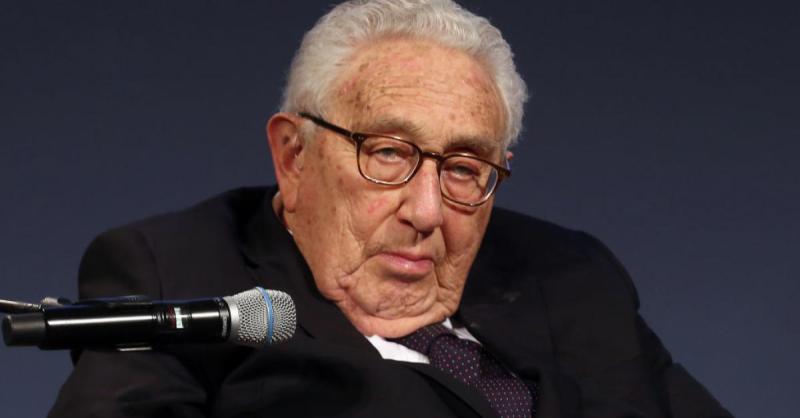
Former Secretary of State Henry Kissinger is suggesting the Biden administration continue with former President Trump's Middle East policy, which he called "brilliant."
"I think that one of the great successes of the previous administration was ... they had achieved two things in the Middle East," Kissinger said Tuesday in a speech. "One, to separate the Palestinian problem from all of the other problems so that it did not become a veto over everything else.
"Secondly, of lining up the Sunni states in actual or potential combination against the Shiite states, which is Iran, that was developing a capacity to threaten them," he continued.
"I think that this was a brilliant concept," Kissinger also said. "We were just at the beginning of it."
Kissinger gave a speech about his role in the transition from the Johnson to the Nixon administration at the Nixon Seminar, a monthly talk about conservative foreign policy.
He also said: "So, in the current situation, it is important that we don't slip into diluting this pattern that has been created and which ... at an appropriate moment can even lead to discussions with Iran. We should not give up the pressures that exist on Iran until we know where they are heading."
Kissinger continued" "And I think that is something that we need to consider carefully with current period. If we break out the Iranian issue from the overall Middle Eastern issue, we run the risk of losing the two achievements namely of separating the Palestinian issue, which removes it as a veto over everything else and the Sunni cooperation with Israel, which is unique in its openness. So, that is how I would handle that."

Tags
Who is online
57 visitors
AKA New and Bold.
Henry, I doubt it.
Good ol' Henry is 19 years older than good ol' Joe. /S
He looks like a blob that needs to be slapped awake.
sheesh, I thought all the nixon excrement had dried up and blown away a decade ago ...
I had him filed under "People I kinda thought were dead."
For those who don't seem to know (or care):
"O n September 16 the editorial board of the New York Times did the impossible. It said something nice about President Trump. “The normalization of relations between Israel and two Arab states, the United Arab Emirates and Bahrain, is, on the face of it, a good and beneficial development,” the editors wrote . They even went so far as to say that the “Trump administration deserves credit for brokering it.” I had to read that sentence twice to make sure I wasn’t dreaming. Perhaps the world really is ending.
Or perhaps the Times cannot avoid the reality that the “Abraham Accords” between Israel, the UAE, and Bahrain are a historic achievement. It is the first advance toward peace in the Middle East since Israel signed a treaty with Jordan in 1994. By exposing the intransigence and corruption of the Palestinian authorities, and thereby removing them from the diplomatic equation, the Trump administration reestablished the “peace process” as a negotiation between states. And because the states in the region face a common foe — Iran — they have every incentive to band together. This is textbook realpolitik. The world is better off for it.
Just as remarkable as the deal itself is the bipartisan applause that greeted it in the United States. No one needs reminding that domestic politics is polarized and paranoid. Each party is convinced that the other one will extinguish democracy at the first opportunity. The past three presidencies have been jarringly discontinuous in style, temperament, and policy. But the same Democrats who sometimes appear eager to remove Donald Trump from office by any means necessary treated this foreign-policy accomplishment with equanimity and acquiescence. “It is good to see others in the Middle East recognizing Israel and even welcoming it as a partner,” Joe Biden said in a statement, adding that “a Biden-Harris administration will build on these steps.” Senator Chris Coons of Delaware told Jewish Insider that the agreement is “a very positive thing.”
The irony is that Trump’s opponents are ready to accept this “very positive thing” despite warning against and objecting to the policies that contributed to it. Through his personal relationship with Israeli prime minister Benjamin Netanyahu, Trump reaffirmed that there is “no daylight” between the United States and Israel after an eight-year caesura. He defied conventional wisdom when he moved the U.S. embassy to Jerusalem, when he withdrew the United States from the Iran nuclear deal, when he cut off aid to the Palestinians, when he recognized Israeli sovereignty over the Golan Heights, and when he ordered the lethal strike against Qassem Soleimani. But the catastrophes that the foreign-policy establishment predicted would follow each of these measures never materialized. What emerged instead were the Abraham Accords and a growing alliance against Iran.
It is in the realm of foreign policy that Trump’s deviations from political norms have had the most positive and irreversible consequences. If he becomes president, Joe Biden may mistakenly try to revive the chances for Palestinian statehood by getting tough on the Israelis. He may attempt to resuscitate the moribund Iran deal. But it is highly doubtful that he will rescind the Abraham Accords, or withdraw recognition of Israel’s Golan sovereignty, or return the U.S. embassy to Tel Aviv. He won’t have the support for such decisions. And he won’t have any good reason to make them. Anyone who has read the news lately understands that a strong and engaged Israel is good for security. Her enemies are our enemies.
By establishing inescapable facts on the ground over the ceaseless objections of critics, President Trump overrides the often meaningless verbiage that constitutes international diplomacy and ends up changing the very terms of the foreign policy conversation. Nowhere has this dynamic been clearer than in U.S. relations with China.
Beginning with his surprise call to Taiwanese president Tsai Ing-wen in December 2016 and continuing through his resumption of U.S. Navy freedom of navigation operations in the South China Sea the following year, his tariffs on Chinese goods in 2018, his and his administration’s rhetorical barrage against China beginning in earnest in 2019, and culminating in his multiple actions against China this year, from limiting travel to canceling visas to forcing the sale of TikTok to tightening the vise on Huawei to selling an additional $7 billion in arms to Taiwan, Trump has reoriented America’s approach to the People’s Republic. No longer is China encouraged to be a “responsible stakeholder.” It is recognized as a great-power competitor.
Resistance to this proper understanding of China’s position in the international system remains strong. But it is unquestionably the case that both Republicans and Democrats are starting to see China more as a threat than a partner. And it is Donald Trump who is behind this clarification of vision. (Xi Jinping and the pandemic helped too.) Whatever a President Biden might do about China — and he seems far more interested in repairing our alliances in “Old Europe” than in tackling this paramount challenge of the 21st century — he would operate within the constraints Trump established and on the intellectual terrain Trump landscaped.
There is no greater measure of presidential significance than a chief executive’s ability to transform not just his own but also the opposing party. When it comes to the Middle East and China, the Democrats are closer to Donald Trump today than they were at the outset of his term. That they find themselves in accordance with someone whom they despise is evidence of Trump’s ability to realign politics at home and abroad. This is no small feat.
Some might say it’s worthy of a prize."
Congrats, you managed to find and post an article that didn't use the usual slurs against Democrats. [DELETED]
Alas for the National Review, it's not a daily policy.
It is wise to ignore Kissinger, who is a war criminal.
Henry Kissinger is almost 98 years old
I dont care what he says about the Middle East and I dont think anyone else should either, but I have to give him credit for still giving public speeches at that age. He's also starting to look more like Dr Strangelove too, since I think Kissinger is mainly wheelchair bound now.
His 'policies' in Central America under Reagan are responsible for the deaths of tens of thousands including hundreds of Catholic Priests and Nuns.
I am not commenting on his politics, just his long lived-ness.
Perhaps he will be lucky and that is what he will be remembered for---his long lived-ness.
It would be petty and stupid to just shitcan everything Trump did on the sole basis of "I hate Trump." The same is true for Obama's policies or any other president. Biden appears to be capable of some thoughtfulness (I wouldn't say it's 100%, though) in this regard, which is a good thing. His willingness to basically continue what Trump set up on Covid is an example.
And so to be fair, I think we have to acknowledge that some things have been going relatively well in the Middle East the last few years, at least from the perspective of the US. It's smart to keep the things that are working.