
Six Facts the Left Doesn't Want You To Know About Global Warming

By: David Simon
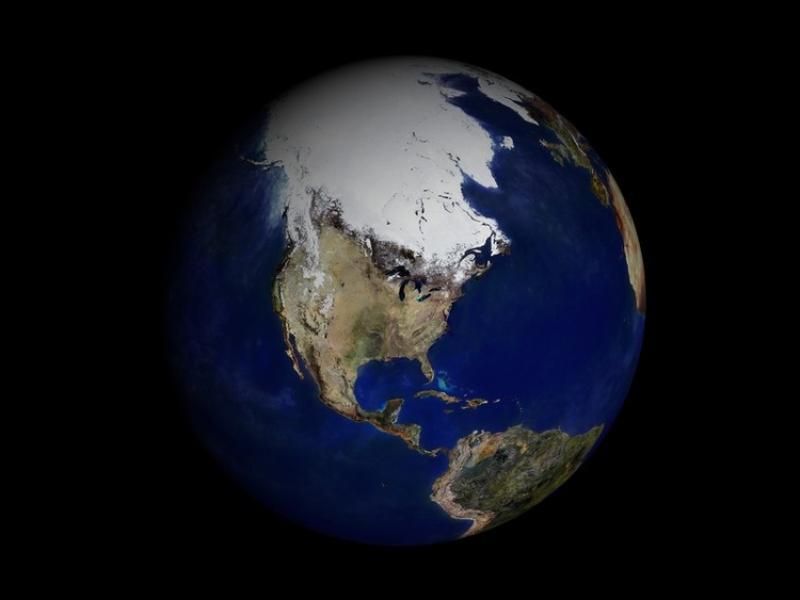


A great article. It exposes the fanatical cult of the progressive green left. Global warming is a hoax. Climate change is a giant fraud. Tree huggers are simply using the environment as a tool to impose socialism. Green on the outside and commie red inside. It’s great to fly in the face of so called environmental science “consensus” and mock its advocates to their faces for their unscientific rigidity and lack of curiosity about alternatives and economic reality.
 S E E D E D C O N T E N T
Six Facts the Left Doesn't Want You To Know About Global Warming
President Biden implores us that climate change is an “existential threat” to humanity. Special Presidential Envoy for Climate John Kerry preaches to us that “[t]he climate crisis as a whole is a national security threat because it is disruptive to the daily lives of human beings all over the world.” Congresswoman Alexandria Ocasio-Cortez warns us that in 2030, “the world is going to end … if we don’t address climate change.”
Hold on to your wallet. The Left’s global warming Chicken Littles insist that the sky is falling but don’t want you to know six key facts.
First , in his new book “Unsettled,” Obama Administration Department of Energy chief scientist Steven Koonin shows that the models relied upon by the Left to predict future global warming are so poor that they cannot even reproduce the temperature changes in the 20 th century.
If these models cannot reproduce past temperatures already known when the models were developed, how can they possibly reliably predict temperatures decades into the future?
Second , Koonin’s book also documents that the United Nations Intergovernmental Panel on Climate Change’s own analysis indicates that any negative economic impact that global warming eventually may have will be so modest that it warrants no action.
Third , the National Oceanic and Atmospheric Administration and the UN IPPC do not claim that a link has been established between global warming and natural disasters.
In 2020, the NOAA stated: “it is premature to conclude with high confidence that increasing atmospheric greenhouse gas concentrations from human activities have had a detectable impact on Atlantic basin hurricane activity,” and “changes in tropical cyclone activity … are not yet detectable.”
The UN IPPC, the Wall Street Journal reported, “says that it too lacks evidence to show that warming is making storms and flooding worse.”
Fourth , as the earth’s temperature has risen, natural disasters have become far less deadly.
Since 1920, the planet’s temperature has risen by 1.29 degrees Celsius and world population has quadrupled from less than two billion to over seven and half billion – yet EM-DAT, The International Disaster Database, reports that the number of people killed by natural disasters has declined by over 80 percent, from almost 55,000 per year to less than 10,000 per year.
Fifth , some of the world’s best scientists believe that global warming will be beneficial rather than harmful.
In 2017, a group of eminent scientists – such as Richard Lindzen of MIT, William Happer of Princeton, and Judith Curry of Georgia Tech – wrote that “[o]bservations [over the last] 25 years … show that warming from increased atmospheric CO2 will be benign.”
Carbon dioxide, they noted, “is not a pollutant but a major benefit to agriculture and other life on Earth.”
Sixth , global warming saves lives. A study published in 2015 by the British medical journal The Lancet found that cold kills over 17 times more people than heat.
This study by 22 scientists from around the world – which examined over 74 million deaths in Australia, Brazil, Canada, China, Italy, Japan, South Korea, Spain, Sweden, Taiwan, Thailand, the United Kingdom, and the United States in 1985-2012, “the largest dataset ever collected to assess temperature-health associations”– reported that cold caused 7.29 percent of these deaths, while heat caused only 0.42 percent.
And small changes in the temperature matter: “moderately hot and cold temperatures” caused 88.85 percent of the temperature-related deaths, while “extreme” temperatures caused only 11.15 percent.
We must not let the Left bully us into draconian action with unfounded claims of a looming climate catastrophe. Know the facts. Global warming is not a problem.
Tags
Who is online

323 visitors
Nothing to see here. Some garbage blog site or something without any actual links to actual studies and cherry picked stats lacking any context.
And of course, global warming is good because more people die from cold weather than heat? Is that including all those who die from starvation, and conflict due to drought? What a ducking stupid thing to add.
[Deleted] posts this garbage the west is breaking heat records left and right and drying up so fast some climate scientists are considering upgrading us from mega drought to full on aridificarion.
Lake Mead is being devastated. Never been that low in its history.
It's hot because it's summer.
The record high at Death Valley was set over a hundred years ago, and the 30's had some very hot years.
Not a shred of evidence this hot spell is linked to "climate change"
"This hot tub is really nice" said one frog to the other.
We the people, the real American people, are rightfully concerned about the severe damage being caused by the climate change disaster. No one is fooled by the lies and propaganda spread by ignorant Trumpist fascists in the service of the forces profiting off the disaster.
So let's get this straight. The people who are making these claims have no vested interest but we're supposed to believe that #1 Global warming isn't actually happening and it's all a hoax, and #2 if it is happening "any negative economic impact that global warming eventually may have will be so modest that it warrants no action", and three "the NOAA have no proof that a link has been established between global warming and natural disasters" and 4th, "as the earth’s temperature has risen, natural disasters have become far less deadly." So wait, which is it, is there no connection or are the Exxon scientists claiming there is a connection and that it has made natural disasters "less deadly"?
What kind of dipshit thought process created such hysterical bullshit idiocy? That fact is completely irrelevant in regards to global warming and has exactly ZERO relevance regarding the change in climate. Anyone who thinks that is a somehow a cogent response is most like mentally disabled and should be assigned someone who can manage their health care needs.
Wow, what a load of utter rubbish. Here is the actual study:
You are kind of missing the context of what was written:
Two frequently asked questions on global warming and hurricanes are the following:
The IPCC AR5 presents a strong body of scientific evidence that most of the global warming observed over the past half century is very likely due to human-caused greenhouse gas emissions. But what does this change mean for hurricane activity? Here, we address these questions, starting with those conclusions where we have relatively more confidence. The main text then gives more background discussion. “ Detectable ” change here will refer to a change that is large enough to be clearly distinguishable from the variability due to natural causes. Our main conclusions are:
Likelihood Statements
The terminology here for likelihood statements generally follows the conventions used in the IPCC assessments, i.e., for the assessed likelihood of an outcome or result:
Where was that picture taken. Could it be from Death Valley where it was hotter than that almost 100years ago?
I absolutely do.
There are several facts that are glossed over, dismissed, or simply ignored. Even by the seeded article.
Human greenhouse gas emissions include much more than just carbon dioxide. Human emissions include artificially produced gases that are thousands of times more potent than carbon dioxide. There aren't records available to estimate how much artificially produced greenhouse gas has been emitted. That's why the models are screwy and there's no way to fix the models.
Water vapor can also act as a greenhouse gas. Humans emit water vapor when fossil fuels are burned. That water vapor is not the result of feedback evaporation; the water vapor is chemically produced. Emitted water vapor will change absolute humidity, requiring more heat to evaporate standing water and reducing the cooling effect of evaporation.
Warming in the Arctic (and now Antarctic) are skewing the global average temperatures. The fairly large increases in temperature in the Arctic (and Antarctic) really does suggest the planet is warming significantly. But the link between polar warming and carbon dioxide emissions is not as clear cut as has been suggested. Polar warming can certainly be attributed to human impact but that impact is the result of many human activities affecting both the atmosphere and oceans. Fossil fuels, alone, isn't responsible for polar warming.
Global warming is far more complex than the human impact on the ozone layer. There isn't a single smoking gun for global warming as there was with the ozone layer. That's why the Montreal Accord isn't a suitable model for addressing global warming.
Is the climate warming?. Probably. Has it been warming since the last ice age? Yes with a slight reversal here and there. Are humans responsible for the warming? Very doubtfull.
Steven Koonin is another of a handful of physicists trying to capitalize on their supposed 'expertise' in climatology. Here's an quote from an article in the Scientific American which takes Koonin's book to task:
For a military perspective: