
Self-Driving Uber Car Hits And Kills Pedestrian In Arizona. Testing Halted.

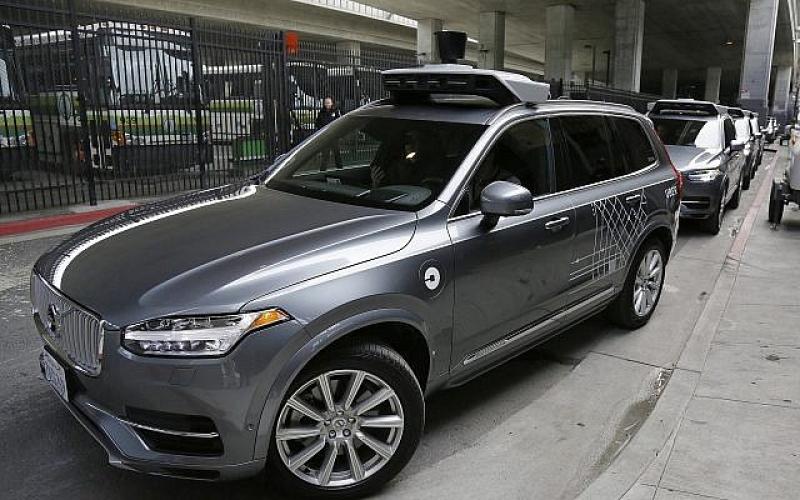

FLAGSTAFF, Arizona (AP) — A self-driving Uber vehicle struck and killed a pedestrian in a Phoenix suburb in the first fatality involving a fully autonomous test vehicle, prompting the ride-hailing company Monday to suspend all road-testing of such autos in the US and Canada.
Depending on who is found to be at fault, the accident could have far-reaching consequences for the development of self-driving vehicles, which have been billed as potentially safer than human drivers.
The Volvo was in self-driving mode with a human operator behind the wheel when a woman walking outside a crosswalk in Tempe on Sunday night was hit, police said. The woman, identified as Elaine Herzberg, 49, died at a hospital.
Uber suspended all of its self-driving vehicle testing in the Phoenix area, Pittsburgh, San Francisco, and Toronto.
The testing has been going on for months as automakers and technology companies compete to be the first with the technology.
Uber CEO Dara Khosrowshahi expressed condolences on his Twitter account and said the company is working with local law enforcement on the investigation.
The federal government has voluntary guidelines for companies that want to test autonomous vehicles, leaving much of the regulation up to states.
But Transportation Secretary Elaine Chao has said that technology and automobile companies need to allay public fears of self-driving vehicles, citing a poll showing that 78 percent of people fear riding in autonomous vehicles
The number of states considering legislation related to autonomous vehicles gradually has increased each year, according to the National Conference of State Legislatures. In 2017 alone, 33 states introduced legislation.
California is among those that require manufacturers to report any incidents to the motor vehicle department during the testing phase. As of early March, the agency had received 59 such reports.
https://www.timesofisrael.com/woman-struck-and-killed-by-self-driving-uber-vehicle/
"Self-driving with a human operator behind the wheel"
There is an oxymoron in there somewhere.
only 78% fear these things?
however, I would like one so I could got to the bar and have it drive me home
I think these self driving vehicles should not be allowed on the roads without a popular vote of the State that they are being proposed to be used in. Here in California I would vote HELL NO!
Have you seen human drivers? Give me the driverless vehicles any day.
Yes there are some terrible human drivers on the road. That aside human beings can think and have decision making powers because they can think and driver-less cars can not. Until they make a driver-less car that can think, I don't want to be on the road with one. I don't trust the technology yet. It's in it's infant stage and not nearly ready, IMHO. Beside, there is no satisfaction in flipping off a diver-less car.
I thought these cars were suppose to brake if they got within a certain distance of a person, or any other physical object.
The accident absolutely WILL have far-reaching consequences. Self-driving vehicles have probably been put back 10 years because of this.
The actual circumstances at this point are irrelevant. The only thing people will note is that a human being was killed by an autonomous vehicle.
I wouldn't be surprised if this case ends up being similar to the one where a Tesla owner unwittingly let his car drive itself into the side of a truck at 70 mph, where the lack of optical contrast effectively overrode the radar ranging data and prevented the collision avoidance system from engaging. Plus the nominal "driver" was busy watching Harry Potter at the time. Poof!
Ford Motor company had experimented with automated braking technology in the 80s but were concerned that drivers would start to habitually depend upon it so they wisely did not take it to market. Your link illustrates Ford's nightmare scenario.
The problem with technology (not just autonomous vehicles but technology in general) is that people expect perfection (and in cases of human safety we demand it). But perfection is extraordinarily difficult to achieve. It takes only a few missteps with pioneering concepts such as autonomous vehicles to generate market killing skepticism. I would not invest in autonomous vehicle technologies at this point.
Note: automated braking technology is an established market that is not likely to dry up. But the closely related market of autonomous vehicles is quite fragile. It will take a major effort by proponents to push through the very likely growing skepticism.
Every "new" technology needs to be improved and sometimes the exposure of its limitations comes at a cost. Does anyone freak out when they get on the automated train at the airport, ride on an elevator or switch on cruise control. We adapt. A few Tesla Autopilot indicated accidents have shown the system wasn't in use but was the excuse. Crash proof cars are the future and the technology will be emerging probably for decades, they will still be safer than Billy bob driving with something on his mind or Mary sue texting her BFF.
Are you under the impression I am against the technology?
No, I was just pointing out the inevitable progression. Skeptics have voiced opposition with every advance, when a train was going to go 60 MPH the skeptics said all the air would be sucked out and everyone would die, I always hear that people would refuse to ride in an autonomous vehicle, we adapt.
Okay. Yes of course we adapt. My original comment was not that this is the end of automated vehicles but rather that this is a blow to a fragile (fledgling) market. Not that the market is dead but rather that the promoters will now have to use even more effort to grow / mature this market to viability. Ergo, this is not a great time to invest in this technology. Eventually automated vehicles will be as common (and accepted) as mobile devices. It is just that 'eventually' is now a longer period of time (unless mitigated by much more effort in the present).
The stock in those companies will take a hit but that might make it a great time to invest, right?
One issue I can see while the technology is being developed is that a human "backup driver" will necessarily become bored and distracted with little or nothing to do, and unless they're actively engaged in driving they won't respond quickly enough in an emergency. It's a basic human factors issue and I'm sure that these companies have thought a lot about it but I wonder what they're actually doing to avoid the problem. It wouldn't even be sufficient to have the human actively "drive" all the time but have the system ignore that input unless a panic switch is hit, because the human would know that his non-emergency input is meaningless.
Hmm, I don't know that it will set the tech back THAT far. Frankly, the market demand for it is strong and will only continue to grow as companies continue to seek ways to reduce costs.
I hope not, but this is a human life / human safety technology that is easy for people to understand. Robot car kills human. That is what they understand. The optics are horrible. Besides, this death should never have happened so I personally would not support this particular technology for prime time.
And IMHO that is exactly what they should note. I believe we are rushing into this tech before it is ready and to many more people will die needlessly if we head down this path. It seems to me it needs a LOT more off road testing.
You will get your wish. IMO.
Also, I believe you are correct - a lot more testing will ensue. Note that the technology is currently awesome. The problems these folks have already solved is damn impressive. But when it comes to human life (and this does come to that) 99% is not good enough.
Not only from a moral perspective, but based on the optics. A 'robot' (and that is what these are) killing (and that is most will understand) a human being is an extraordinarily bad optic. There is a lot of money invested in these technologies and the companies will work overtime to keep the public cool (lots of damage control). And that will work to a degree. But not being able to assure the public that autonomous vehicles will never kill a human being (when it could have been avoided it) is (in this realm) a monster problem.
The victim was a homeless woman with an arrest history for drug and drug paraphernalia charges.
She tried to cross two lanes from a median while walking her "10 speed bike" in the dark at least 60 yards from an intersection.
Police stated there were no visible signs that the Volvo braked suddenly - not enough to leave skid marks.
The Volvo has several cameras recording the trip as well as many modules recording data.
No story yet, as to what the human operator was or was not doing at the time.
So the police need the coroners lab report, the report from Uber and supporting data from Volvo.
Eventually...maybe.
I like the idea. I passed a woman, eating from a bowl, as she was driving down the interstate last week. I don't know how good the technology is, but seriously? Can't you grab a lara bar or something?
I'm amazed what people think they can do while driving, everything from reading a book or watching a movie to putting on eye makeup at 75 mph.
I am still far more concerned about other drivers than I am driverless vehicles.
Right? Eye make-up is the most common thing I've seen, excluding the obvious...texting, which still amazes me. For those that find it difficult to refrain, at least use the voice to text function. My phone interprets my redneck accent quite well.
As for eating with a fork, nothing about my morning drive, particularly on this stretch of road, gives me even a moments thought of having breakfast on the go, damn sure nothing that requires the use of both hands and utensils.
The thing that's a bit scary and interesting is that from a neurological perspective it's not just distracting visual tasks which are a problem but all kinds of auditory tasks including hands-free cell phone use, which apparently has the same distracting effect as holding the phone to your ear during the conversation. For some reason conversations with people in the car aren't quite as bad.
In the past I did some consulting for GM using vibratactors integrated into the driver's seat to alert the driver to road hazards and their relative location, and to override exactly these kind of attention distractions. These tests of self-driving cars need to do something like that if they aren't doing so already.
Granted I used to read the morning LA times on the 405 North on my why home back up to the valley when I worked 3rd shift in South central about 25 years ago, but I was completely stopped in traffic when doing it and just inching along anyway.
Lived in Dallas a stretch, and I can see doing something while sitting idle or even creeping along.
I'm pretty sure I saw a similar system at work this morning. Either auto brake, or reflex after getting vibrated.
I've heard that hands free talking districts people. I guess I can see that. It doesn't impact my driving. Or, maybe I've just not had the opportunity to have such a deep conversation, while in transit, to make me lose focus.
It's hard to really say what impact this accident will have on the market. I'd be curious to see what the final investigation reveals.
In the long run, this technology will be perfected. Until then, this will probably not be the last death involved.
I have only read one article talking about this, but it made it sound like she kinda stepped out in front of the vehicle, and suggested that where the vehicle was and where she stepped into the road, that there was no way the vehicle could have stopped in time. If that is the case then I do not see this as being any sort of issue in terms of further development of this inevitable technology. It is a completely unreasonable standard to expect any automated vehicle to be able to anticipate and react appropriately to every human error.
Although there are a lot of articles about this story
there doesn't seem to be a lot of front page headline stories like you might expect given the topic.
I wonder if corporate America is circling the wagons.
I suppose we will just have to wait for the various investigations to conclude before we know what really happened and whether this was avoidable (on the part of the vehicle).
Someone is dead. A self-driving car hit her with a driver behind the wheel. Who’s liable? The driver will say it’s a system defect that he couldn’t compensate for quickly enough. The system designer will say the driver is liable just as if there were no system because that’s why he’s there. Uber will say it’s either the system or the driver but they have no control over either.
This is a screen shot of video taken from inside the self driving car. The white spots on the road are the pedestrians feet. The walker becomes visible about 2 seconds before the car hit her.
Here is a response from a reader on on The Hill site. Seems pretty spot on to me.
There is another, sort of disturbing aspect to this , it seems to me.
The woman is walking fairly slowly, or at least not visibly hurrying across the road. Was she operating under the belief that any oncoming driver would see her and slow down? not anticipating a car without a driver to make that decision?
Now I'm just spitballing this but, I think, that with all the commercials promoting the automatic breaking systems in some new cars that this one would operate like those commercials. I don't know if this particular car was equipped with that technology or if that was even what she was thinking.
At the same time, the video makes it appear that the car was moving too fast to stop as you quoted in #11.1. I work as a Master Driver and that exact thing is something that I go over many times during training.
She also does appear to be walking slowly as well. I'm not sure about anywhere else, but here in NC there seems to be a lot of pedestrians hit lately. And I'm really not surprised. Most in this area are dressed like this lady was, dark clothes at night, not crossing at intersections and in dark areas.
Seeing this video, it is pretty clear that the woman was foolish to try and cross a dark road.
Having said that, the headlights did not illuminate far enough to allow a driver to stop in time. The car is clearly at fault.
But driverless cars dont need conventional headlights, do they?
I really don't know. I don't see why they would be exempt from the established DOT standards. If anything I would think they would require something a bit stronger to help the computer system identify hazards and obstacles in the roadway.
The Volvo has standard High Intensity lights, in an area where high beams might have made a differrence
but the woman is obviously wearing dark clothing and bike lacks wheel/spoke mounted reflectors.
As I posted earlier, wait for the toxicology report before jumping to judgement; she has an arrest record for multiple drug violations.
Or maybe she just had the flu... and could not focus on safety......
The car's headlights did not illuminate a distance sufficient for the car to be able to stop considering its rate of speed.
I agree the woman is foolish but the car is clearly at fault.
JR, please, the car was within the speed limit and has the Federally mandated lighting.
She was effectively 'jaywalking' across a busy 4 lane road with a median in the dark, wearing dark clothing.
Why? That is the question.
Why not wait for the police and coroner reports before jumping to conclusions?
Because the issue with a driverless car is not the conduct of the victim.
But THERE WAS a human behind the steering wheel also
and HE/SHE TOO failed to brake in time.
Sometimes the victim's contributions to an accident are important.
The human being in the car was not watching the road at the time of the accident.
Then he/she was negligent, as that is specifically what they were hired to do.
The story with the video says the human being in the car had their head down, monitoring some function of the automatic driving process within the vehicle.
The human driver, or a human driver not driving a driverless car should have been able to think and swerve to avoid her while braking. No she should not have been there, but it is an example of a computer not being able to think like a human can and until they make a driverless car with a computer that can think and react like a human brain they do not belong on the road.
a bit more information
Will the car be charged with a driving offence?