
San Francisco had the 1918 flu under control. And then it lifted the restrictions.

Category: News & Politics
Via: perrie-halpern • 6 years ago • 46 commentsBy: Alex Navarro (NBC News)

 S E E D E D C O N T E N T
By Dartunorro Clark
When the clock struck noon, the masks came off.
It was Nov. 21, 1918, and San Francisco residents gathered in the streets to celebrate not only the recent end of World War I and the Allies' victory, but also the end of an onerous ordinance that shut down the city and required all residents and visitors to wear face coverings in public to stop the spread of the so-called Spanish flu.
A blaring whistle alerted gratified residents across the city and, as the San Francisco Chronicle reported at the time, "the sidewalks and runnels were strewn with the relics of a torturous month," despite warnings from the health department to maintain face coverings. As celebrations continued and residents flocked to theaters, restaurants and other public spaces soon thereafter, city officials would soon learn their problems were far from over.
Now, amid the coronavirus pandemic, as some states, such as Georgia, move to resume normal business even as new cases emerge, how officials acted during the 1918 flu pandemic, specifically in cities such as San Francisco, offers a cautionary tale about the dangers of doing so too soon.
Alex Navarro, the assistant director of the Center for the History of Medicine at the University of Michigan, which detailed historical accounts of the 1918-19 flu pandemic in 43 cities, told NBC News in a phone interview that officials often acted quickly at the time but restrictions were eased to varying degrees.
"There was a lot of pressure in pretty much all of these American cities to reopen," said Navarro, whose research was done in conjunction with the Centers for Disease Control and Prevention. "When they removed those restrictions too soon, then many cities saw a resurgence in cases."
The center's research found that cities that used "early, sustained and layered" practices such as social distancing, closing public events and stay-at-home orders "fared better than those that did not."
'A lot of stock in masks'
Just two months earlier, in September, the first case of the so-called Spanish flu was identified in San Francisco and city health officials sprung into action.
Dr. William C. Hassler, the city's health officer, ordered the local man who apparently brought the disease to the city after a trip to Chicago into quarantine to stop the disease from finding another human host, according to the center's research of reported accounts.
Let our news meet your inbox. The news and stories that matters, delivered weekday mornings. Sign Up
But it was too late as the virus had already begun to make its way through the city. By mid-October, the cases jumped from 169 to 2,000 in just one week. Later that month, Mayor James Rolph put in place social distancing practices and met with Hassler, other health officials, local business owners as well as officials from the federal government to discuss a plan to close the city.
Some officials demurred at the idea, worried about damage to the city's economy and the risk of causing public panic. Eventually, on Oct. 18, the city voted to shut down "all places of public amusement."
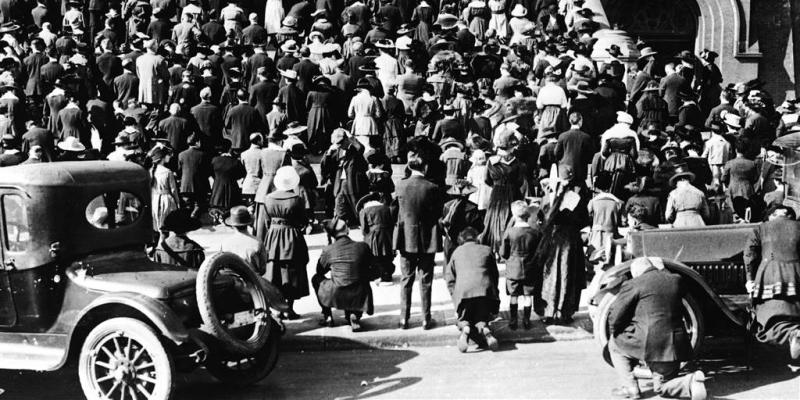
The congregation praying on the steps of the Cathedral of Saint Mary of the Assumption, where they gathered to hear mass and pray during the influenza epidemic, San Francisco, California, 1918.Hulton Archive / Getty Images file
City officials also strongly advocated for face coverings, which were at first optional and soon required by a mayoral order — the country's first at the time, Navarro said.
"They were the one city that put a lot of stock in masks," he said.
With the pandemic still raging across the globe during World War I, the mask also became a symbol of "wartime patriotism."
"The man or woman or child who will not wear a mask now is a dangerous slacker," a public service announcement from the American Red Cross said at the time, according to Navarro's research.
That, however, did not stop people from defying the order — 110 people were arrested and given a $5 fine in one day in October shortly after the measure went into place, improperly wearing a mask or not wearing one entirely, according to the center's research. Over time, the jails were overcrowded with people failing to adhere to the rules. However, most cases were later dismissed.
By the end of October, there were 20,000 cases and more than 1,000 deaths. However, as the days went on, the city saw a dip in newly reported cases, which prompted officials to begin to reopen the city and rescind the mask order. By the end of November, officials believed the city had stabilized.
Court is held in open air during the influenza epidemic in San Francisco, 1918.Bettmann Archive / Getty Images file
'They were flattening that curve'
But three weeks after that celebration of removing their masks, the city saw a dramatic resurgence. Officials at first rejected the idea of reopening the city and suggested residents could voluntarily wear face coverings.
But shortly after the New Year in 1919, the city was hit with 600 new cases in one day, prompting the Board of Supervisors to re-enact the mandatory mask ordinance. Protests against the mandate eventually led to the formation of the Anti-Mask League. The detractors eventually got their way when the order was lifted in February.
San Francisco's ambivalence to quarantine measures ran counter to other U.S. cities, though. Navarro said Los Angeles, for instance, implemented strict social distancing and face coverings about a week before San Francisco did and its measures stayed in place for weeks longer.
Navarro said that many cities often became complacent once they saw a dip in cases, and when a resurgence happens residents often question the public health guidance.
"They were flattening that curve; they just weren't realizing it," Navarro said. "A lot of people thought, 'Well, what did we go through that for? It did have an impact, they just didn't know it."
As Dr. Anthony Fauci, the nation's top infectious disease expert, put it in March, "If it looks like you're overreacting, you're probably doing the right thing."
Back during the Spanish flu, San Fransisco's failure to take swift action and the decision to ease restrictions after only a few weeks had huge ramifications. With 45,000 cases and more than 3,000 deaths, the city was reported to have been one of, if not, the hardest-hit big city.
Roughly a century later, the San Francisco Bay Area imposed the nation's first stay-at-home order and other restrictions when coronavirus cases were rapidly growing, placing a spotlight on its pandemic response again. Those aggressive actions are credited with saving lives, avoiding the scale of the tragedy found in New York City.
Mayor London Breed said she took heed of history and implemented an order last week requiring anyone setting foot on the streets of San Francisco, outside their homes, to wear a face covering.
Starting today, people in San Francisco are required to wear face coverings at essential businesses, in public facilities, on transit, and while performing essential work.
This is not a replacement for staying home and physical distancing, but it is an important step for safety.
— London Breed (@LondonBreed) April 17, 2020
Breed told MSNBC's Chris Hayes in an appearance in mid-April that she has considered the city's history with past pandemics, such as the HIV/AIDS crisis and the Spanish flu when deciding to ease restrictions.
"Just because San Francisco is being praised for flattening the curve, we're not there yet," she said. "And so we cannot let up just because for some reason we believe that we're in a better place."
Tags
Who is online
125 visitors
A lesson that Americans still have not learned. On American and Canadian internet news sites today, and on the local English language cable news station CGTN, I watched videos of Californians defying the guidelines and all I could do was shake my head in disbelief. Do Americans not realize why their infection and death numbers are so astronomical? Where I am, in a city-state of 32 million, there were only 579 cases, 6 deaths, the rest now recovered and no new cases for at least 6 weeks, so after having been locked down from mid-January to mid-March everything has slowly reopened except the schools (which I expect will reopen any time now) and although people are now out and about almost everyone is STILL wearing masks and exercising social distance. What made the difference in numbers? NO DEFIANCE. The people voluntarily locked themselves down and followed the guidelines. Nobody needed to be arrested. In the news video I watched, Californians were being arrested for defying the guidelines. I just can't believe it.
Santayana's statement about ignoring history sure as hell is being ignored.
Good Morning, ( here )
I just saw a 5 day old comment somewhere praising Mr Trump for the EO banning immigration for 60 days.
What a crock.
We are the hottest virus spot in the world. Every other country should be banning us from traveling.
smh
That's simply false.
Most countries have travel bans put in place.
POS/POTUS effectively stranded my son's peruvian citizen FIL here past the end of his visa. it cost a shitload of cash to get it extended and screwed up the alternating free daycare that he and his wife have been providing my grand daughter. my DIL has now been waiting almost 3 years for her final immigration interview. if the DC diktater moves the goalposts before this process is complete, I won't be exercising much personal restraint around his supporters.
Oh good grief Sean, almost 1 million of the 3 million cases worldwide have been in CONUS, over 32%
Italy is 2nd place with 8%
81 out of 195 would be many, not most.
Imagine not using per capita infections to determine what country is a hot spot. Belguim, for instance, has an infection rate that is about 25% higher than the US. So, if your example a country wanted to bar travel victims based on the likeliohhd they were infected, the US would be well down the list. It's also amusing to think someone believes all the countries in the world are even attempting to accurately capture the number of corona infections in their country.
The US isn't close to the hottest virus spot in the world, let alone among those countries that are trying to capture the number of infections. People who use the gross number of reported infections without reference to population size reveal a lot about themselves.
81 out of 195 would be many, not most.
Over 90% of the world lives in a country with travel restrictoions. I have no idea where you get your numbers from.
Not according to Johns Hopkins:
These numbers are the current numbers for 4/27/20.
Most cases, most dead in raw numbers.
Well, what you say is right, if you take out the NY tri state area.
Which I find amusing.
Since most of the time, everyone complains about having to include us in the US. Please make up your mind.
It's right and includes the NY Tristate area, so I have no idea what you are trying to say.
The rate of infection for the entire USA is 2,992 people per million.
For Belgium, as an example, it is 4,028 per million.
becuz y'all gots all them furnurz there...../s
Well, we are about as hygienic as Texas is, and we have less fake boobs, so we even have fewer fungal infections.
You have to stay on top of these numbers.
And I am an Ivory Girl.
That would only be if we were suffering from The Plague. We are having neither.
It doesn’t matter how hot any spot is - the trailing complacency after ‘having won’ guarantees a flare-up if there is no barrier.
LOL. So was Marilyn Chambers.
I don't know if you believe we can put the Genie back in the bottle but I don't think we can it's out there and it will come around again. In America we set out to "Flatten the Curve" and we've been successful so far. There are still many questions about this virus like do antibodies provide immunity some say yes, some say no, some say there is no proof they do. This is probably the most important thing we need to know right now and we need to know it quick because it bears on how we move forward. As far as reopening this country can not afford to remain shutdown so aside from the vulnerable once the medical shortages are over we need to reopen. Of course areas that weren't hit very hard may see an uptick in infections and need to be at least partially shut down again but that's something we're just have to deal with. Masks, Hand Sanitizer, and Social Distancing are going to be with us for a while, it will probably start to feel like Masks and Social Distancing are a normal part of life before it ends. If antibodies do provide immunity in most of us we still have a long road ahead but if not we'll be praying for a cure. For the foreseeable future managing the pandemic and flattening the curve in hotspots will be the new normal because shutting down till it goes away is not feasible. It's not economically feasible nor is it realistic to believe we can avoid catching it perpetually, we need to reopen where we can and be prepared to reclose areas if it gets hot. I really don't know why people in America are arguing about reopening unless the fundamental mission has changed, we wanted to flatten the curve and we've done that so if an area's hospitals are not overwhelmed and we have addressed the shortages then that area can be reopened if not then we stay closed (I haven't heard much on the actual state of the shortages). I also think maybe a partial reopening in many places might be better like open stores and most workplaces but keep eat in restaurants and bars closed or any other place or event where people cluster together needlessly like sporting events, concerts, parades, or carnivals. The schools being shut down till fall seems like a done deal in most of the country so that's no problem for now.
Therein lies the rub. The Administration doesn't want to talk about the shortages. We can have a billion tests available but if we don't have the supplies needed to conduct those test they're useless. Trump and Pence talk about testing capacity but avoid the lack of swabs, reagents and specimen tubes. They bought 29 million doses of Hydroxycloroquine but they still haven't used to DPA to product the supplies that have been in high demand and low supply from months.
Everything that you talk about hinges on testing for the virus and that just isn't happening in the US.
One of the wonderful things about the USA is despite our Governments best efforts a certain amount of DEFIANCE against the government is still seen as Patriotic. Different groups and political parties may disagree about should be defied and when but they all have something they're passionately against and they see Defiance as a virtue.
Hey, I don't criticize your right to defy your government. But you are misinterpreting what I said. By "defiance" I meant defiance against the common sense rules to prevent the further spreading of the virus - not defiance of the government.
And you also think it's safe to not follow the guidelines that are necessary to prevent the spreading of the virus, which is what I meant?
Seems like it should be common sense, doesn't it? Unfortunately, common sense isn't so common anymore.
I'll say. And a lot of comments on this site prove it.
San Francisco is a city in the state of California. Comparing the city of San Francisco to the state of Georgia is an apples and oranges comparison. Such an inappropriate comparison reveals an entrenched attitude influencing our politics. Cities matter, rural areas don't. The political game is a numbers game and obviously the numbers are bigger for cities than for rural areas. So, political attention is focused on cities while rural areas are politically ignored. That's why we end up with political labels like 'deplorables'.
Norm,
The principle still applies. Flattening any viral infection works the same way, whether it is a state or a city. It just needs fine tuning for the area.
Many areas of the country have not experienced a curve that needs flattening. What has been lacking are means of isolating urban areas to avoid spreading the virus.
That's the thing Rural areas have less people but they also have less hospital beds. Most rural areas rely on a nearby major city for serious health issues so all that has to be taken into account. You can't act like it's no problem just because the infection rate is low in your area if the healthcare facilities you'll be relying on if your area gets hot are located in a city that's already hot. I'm not worried about testing because there seems to be a huge percentage of infected that never get seriously ill and an even larger group that never gets sick at all. I think the guiding factor has to be the hospitals and their capacity, NYC didn't need to test everyone they knew trouble was brewing when the beds started filling up and that's what other areas are going to have to do and they can use what we learned in NYC as a guide. I agree with to shutdown in mostly unaffected areas short term because of shortages of medical supplies but we can't stay shut down. State Governments are going to have to assess their resources Vs. their populations in regions of their state and then they will need to modulate the shutdown to balance the need for economic activity against the spread of the virus to prevent overwhelming the healthcare system in that area. I think we need to switch to protecting the vulnerable while accepting the fact that most of us will eventually catch the virus because I believe that is what will happen whether you hide in the house or go back to work, we just have to keep the curve flattened and recognize spikes as they are forming so we can use our resources where they're needed when they're needed. I just don't see any value at all in shutting down areas that are stone cold because it wastes resources when they're unneeded. We need to stick to the "Flatten the Curve" plan because we can't hide and wait this out, it's not a rainy day we'll be lucky if it's only a rainy year.