
America's Fading Car Culture / Millenials Cannot Afford Cars


Young Americans are no longer all that interested in automobiles, the Washington Post's Marc Fisher wrote in a big article over the weekend. The smartphone has replaced the car in their affections; they now connect with friends over social media instead of at the drive-in. And so on.
As somebody who wonderedin a column last week whetherpeople in developed countries were perhaps learning that they no longer needed as much stuff as they used to, and whetherthis mightlead to big shifts in the global economy, I read on with great interest. Then I was pulled up short by this:
"This is all actually economics, not preferences," says Sean McAlinden, chief economist at the Center for Automotive Research , a nonprofit group funded by government and industry grants. When the cost of owning a car drops below 10percent of income, "young people will stop telling pollsters they can do without cars. You say you're not interested in owning something if you can't afford it," he argues.
Of course Sean McAlinden, a lifelong car guy, would say that. But what if he's right? What if millennials justconvince themselves they aren't into cars -- or houses, or other trappings of 20th-century middle-class life in the U.S. -- because they can't afford them anyway?
It is certainlytrue that young men in the U.S.don't have as much money as they once did. I compared the inflation-adjusted incomes of the25-to-34 age cohort to male workers of all ages, and the shift over the past half century is pretty striking:
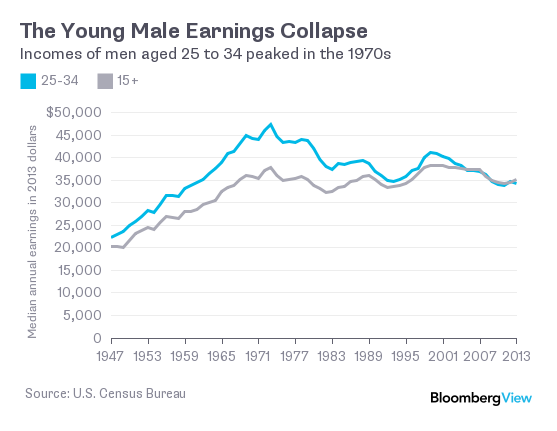
In the U.S. economy of the 1960s and early1970s, in which manufacturing was still a really big deal, able-bodied men in their 20s and 30s earned a premium over other workers. That premium collapsed after 1973, recovered a little in the late 1990s, and is now completely gone.
For women aged 25 to 34, itwasa different story as they entered theworkforce in big numbers in the 1960s through 1990s. But their incomes, too, have been falling since 2007, even as older women's have begun to recover slightly.
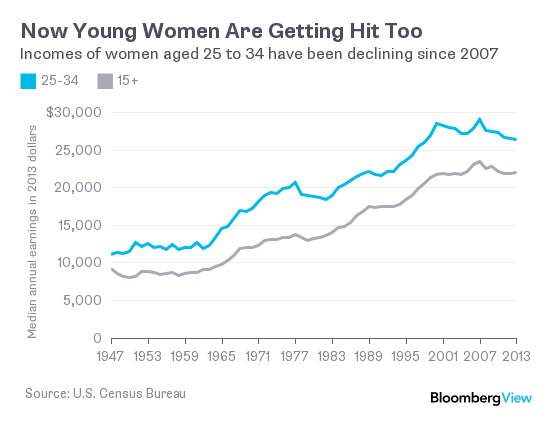
Thedeclines for both sexes since 2007may partly bethe aftereffect of entering the workforce in the middle of the worst recession in 75 years, which can have a permanent negative effect on a generation's incomes . Part of it may be that, after decades of male-dominated jobs being rendered superfluous by technology, this is starting to happen to women, too.There are lots of other possiblereasons-- changing demographics, rising income inequality, even parents with larger homes and more willingness to house their adult offspring in them.
The upshot is that McAlinden's argument is correct, in one sense. The changesin young adults' consumption habits haveclearly been influenced byeconomic forces. But economic forces shape societal attitudes, too. I also don't see much sign that these economic forces are about to reverse. Both these things can betrue: The median 25-to-34-year-old has less to spend, and is less interested in spending it ona car.
http://www.bloombergview.com/articles/2015-09-08/millennials-can-t-afford-cars-and-are-fine-with-that
Tags
Who is online

87 visitors
Much of the emotional meaning of the car, especially to young adults, has transferred to the smartphone, says Mark Lizewskie, executive director of the Antique Automobile Club of America Museum in Hershey, Pa.
Instead of Ford versus Chevy, its Apple versus Android, and instead of customizing their ride, they customize their phones with covers and apps, he says. You express yourself through your phone, whereas lately, cars have become more like appliances, with 100,000-mile warranties.
At the Cruise-In, 30miles outside Washington, Mecca and a cluster of other collectors, all men past the half-century mark, trade laments for the days when cars had more fanciful designs, for what they fear will be the loss of the Washington Redskins team name, for their childrens lack of interest in cars.
The worlds changing too fast for me, Mecca says. Id like to be back in the 50s. The old guys conversation turns to blemishes not on the sparkling cars before them, but on their own, less painstakingly preserved bodies. Its benign, thank the Lord, Mecca says of the spot on his scalp.
This is what we talk about, says Gary Fanning, 58. He tried to give his son his 65 pickup. Gift declined; not interested.
" In the near future, cars will control the driver instead of the other way around, says John Heitmann, a historian at the University of Dayton who studies Americans relationship with automobiles. (He also is restoring a 1971 Porsche 911T Targa.) And the way we live now, especially on the coasts, its a bother to own a car. For young people, and not just the urban elite, theres not even a desire to drive.
Americans drive fewer miles per year down about 9 percent over the past two decades. The percentage of 19-year-olds with drivers licenses has dropped from 87 percent two decades ago to 70 percent last year. Most teens now do not get licensed within a year of becoming eligible, according to a study by the AAA Foundation for Traffic Safety."
Our area is rural, so a car is a necessity for all. Two kids, (we are friends with their parents) graduated from Missouri State and settled in Springfield. Neither has a car and live in the part of the city being regenerated. The idea of a car only spells debt to them, and their not interested.
The cost of autos, even a decent used one, is very high. Add to that maintenance , insurance, fuel etc and it seems to be a wise decision for them.
Your correct in that it doesn't bode well for our economy Feronia. 70 % of our GDP is consumer spending, and auto's are a critical part of that.
My girls didn't get their licence until their 1st year of college. They don't own a car. During summers they use ours. But then again, they don't commute to school. I think a lot of the lace of car ownership is 1. they don't commute and 2. on campus, they can get Zip Cars, something that is fairly new.
My daughter's boyfriend, who does commute to school, has a car.
I am not sure if the lack of car purchases is due to lack of income, because they all seem to have the high tech gadgets that they want. I think they are spending differently.
It could be a sign that Millenials are rejecting debt altogether.
Which is a good thing, for them. And in the long run for the nation.
But it's going to make the banks scream.
Finally. some good news for a change.
"Finally. some good news for a change."
"?????????????????????"
_____________________________
If you add up all of the total negative consequences of car culture, what is the cumulative negative impact? How does it compare with the benefit s?
As far as purchase price goes, I rarely bought or leased a new car. A good, mechanic-checked used one served the purpose and required a lot less investment. Of course the cost of insurance, maintenance, fuel do add up, but in my generation back in those days the thought of not having a car would have been considered odd. These days, if one lives in an condo apartment, the purchase of a parking space can be a very big expense, and it seems that anywhere near downtown the parking fees are excessive. I think I can, however, understand the feeling of the present young generation in considering alternatives.
In China small electric cars are getting to be quite popular ... I have read .
Young people here are used to electric motorbikes, and charging them up with electicity is commonplace, so I guess they graduate to an electric car. Most buses and taxis use natural gas.
How do they charge ? Is it by the mile or the time used ?