
What We See When We Look at Two Centuries of American Board Games


 S E E D E D C O N T E N T
“USA250 : The Story of the World’s Greatest Economy” is a yearlong WSJ series examining America’s first 250 years. Read more about it from Editor in Chief Emma Tucker.
In 1822, F. & R. Lockwood, a small cartography firm in New York, published what historians today believe was the first of its kind: a board game invented and marketed in America.
Travellers’ Tour Through the United States was a novelty that featured a hand-colored map of the then-24 states, peppered with towns and landmarks. Players would make their way across the map by naming geographical facts, with the winner being the first to reach New Orleans.
The game’s price and the number sold are lost to history. In hindsight, though, F. & R. Lockwood gave birth to an industry. Board games in the U.S. in 2024 generated almost $4.6 billion in revenue, according to the market-research company Imarc. Charting that growth—and looking at some of the most popular games in the past two centuries—reveal much about the nation’s evolving attitudes and values.
Board games, of course, were popular in North America long before 1776. Card games reigned in taverns. Colonists played chess, checkers, dominoes and backgammon, among other diversions. These games, though, had their roots in Europe, Africa and Asia. The Travellers game was something new: a homegrown product, one that seemed to reflect the American psyche.
“There’s this huge national pride going that has never really stopped,” says Matthew W. Sivils, a professor of English at Iowa State University who has studied Travellers and owns more than 800 tabletop games himself. “Manifest Destiny gets coined as a term, and you had this nationalist, expansionist mindset.”
Expansionist—with a healthy dose of puritanism. By the mid-1800s, Salem, Mass., became a hub of early game development aided by European printing technology that had made its way across the Atlantic. There, in 1844, brothers William and Stephen B. Ives released the Game of Pope and Pagan, or Siege of the Stronghold of Satan, by the Christian Army. In the game, players act as missionaries attacking (as the title makes clear) Lucifer, the pope and pagans, reflecting both the tight-laced culture of the day and antipathy toward Catholicism and immigrants.
Indeed, a moral message was central to many board games of the era. Among the most popular: the Checkered Game of Life, created by game pioneer Milton Bradley in 1860. Profoundly religious and an early advocate of the kindergarten movement in America, Bradley developed his game for children as much as their parents. Players navigated a board with spaces identifying the highs of life—College, Success, Happy Old Age, among others—and several frightening lows, including Ruin, Disgrace and Suicide.
Follow the money
As the 19th century drew to a close, a growing middle class found itself with disposable income, shorter workweeks, mail-order catalogs and department stores, all of which helped board games evolve into consumer products. The railroad boom of the 1880s fueled the games industry, which became increasingly focused on capitalism in addition to moral uplift.
Starting in 1886, a series of games derived from the Horatio Alger books—with titles like From Log Cabin to the White House—caught the public’s fancy. A boy (always a boy) popularized the rags-to-riches fantasy, pulling himself up by his bootstraps toward wealth and respectability. Women, however, frequently received a different message. In one called Marriage Auction, a popular game from the early 1900s, card values laid out a bride’s worth, noting that “the bridesmaids have no value, however they rank.” The rules note: “Marriage they say is a gamble, one thing very certain is that money plays an important part.” Both types of games centered on economic survival, but only one offered agency.
As the Gilded Age rolled on, one female game designer subverted the script. Lizzie Magie was an impassioned follower of Henry George, a popular political economist and author of the bestselling book, “Progress and Poverty.” George believed that taxing land, and only land (a “single tax”), was the path to a more just world.
In 1904, Magie received a patent for her Landlord’s Game, which millions know today as Monopoly. What most people don’t know: Her game was created to teach about the ills of concentrated wealth. For decades, Magie’s creation spread as a folk game including to Quakers in Atlantic City, N.J. It was a version of that game, complete with Atlantic City place names like Ventnor Avenue and Boardwalk, that was taught to Charles Darrow, who pitched it to game maker Parker Brothers as his own invention. It wasn’t until economist Ralph Anspach became entangled in a legal battle with the game maker in the 1970s that the true story and Magie’s brainchild came to light.
Depression fantasies
From the 1900s through the 1930s, financial games gained favor. The games Finance, Inflation and others thrived during the Great Depression as a fantasy of an American Dream far out of reach for most homes. Magie also published Bargain Day, a 1937 game in which players move through a store making purchases by trying to save the most. The player who shops most thriftily wins.
After World War II, strategy games like Risk, in which players seek to capture territories across the world, reflected Cold War anxiety. Candyland was designed in 1948 to brighten spirits of children in hospital wards. By now, board games were a nostalgia lifeline, an intergenerational pastime that brought people together and reminded them of times before the war.
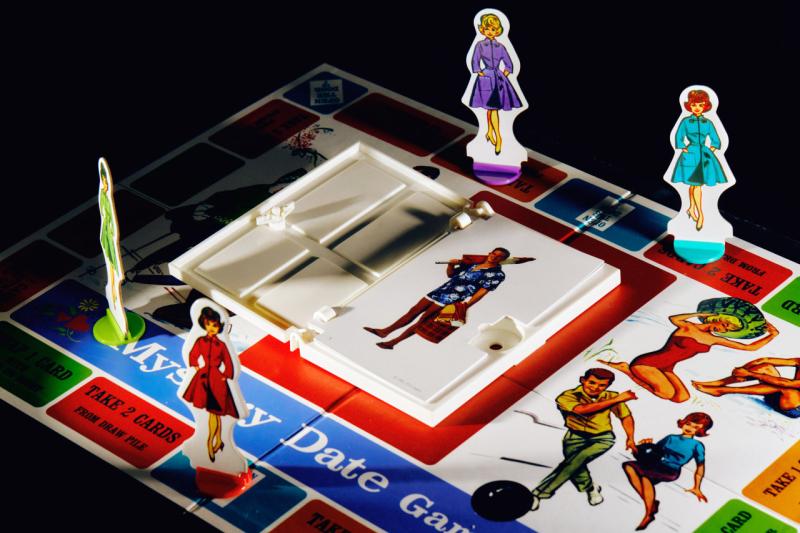
And the act of playing games reinforced wholesome, suburban-family values. Consider the 1965 game Mystery Date, in which girls try to land a dreamy date and avoid the sloppily dressed “dud” guy. The game was developed by Marvin Glass & Associates, a Chicago toy-design firm whose other hits included Simon, Rock ’Em Sock ’Em Robots, Operation and Mouse Trap. Glass understood that the 1960s represented a new era for the industry. Designs shifted to plastic and away from wooden and metal pieces. TV provided a pipeline that could market wares directly to children rather than just through their parents. In 1966, Twister became a phenomenon and challenged sexual norms, while a revamped version of Milton Bradley’s Game of Life—complete with plastic automobiles and destinations including Millionaire Acres—pushed the postwar suburban fantasy.
Today, even with the rise of videogames, board games in the U.S. are more than holding their own. Thanks to Kickstarter, the crowdfunding platform, lower costs of production and online communities, players can enjoy hits like Settlers of Catan, Wingspan, Exploding Kittens and Ticket to Ride, a modern game about railroads that brings the capitalist theme of the 1800s full circle.
People still play physical games because “they’re totally different experiences,” U.K.-based game historian David Parlett says. “Digital games have only extended the range of games available, not replaced it. Many people prefer to maintain the real-life experience of handling traditional materials in a communal, real-life setting.”
Tags
Who is online
88 visitors
The only boardgame I played was Chess and by my mid 30s with a thorough study of I. A. Horowitz's 'Chess Openings: Theory and Practice', had achieved a level of conscious incompetence ... it was time to quit.
My stepfather would never play chess with me. He always claimed I was never good enough. In the 80's he got one of those first home computers and eventually a chess game with it where one could play against the computer on multiple levels. When I surpassed the level he kept getting beat on he wouldn't even talk to me for two weeks. He never mentioned chess again either. I left home for the Army not long after that... lol.
I've always liked Monopoly. My cousins and I had a marathon game where we went into the wee hours of the morning. Gramma made us quit and go to bed
nobody in my family will play a board game if I'm a participant, especially monopoly or risk ...
That says something about you not them
you mean besides knowing the rules backwards and forwards and being stupid-lucky rolling dice?
you mean creating your own rules and using trick dice?
knowing the rules better than anyone else you're playing and not needing any trick dice ...
sure....
the only added rule we had was what to do with the assets of somebody that quit playing mid-game ...
I'm going to have to side with TG on this one. The debate is clearly in her favor.
At a certain age Monopoly started getting boring (to a large degree it was luck, not skill).
In college a small group of friends played lots of board games. And card games!
My favouite game of all time was Risk! Emotions ran high-- on more than one occasion when a person was eliminated they ran out of the room and said things like:
I HATE THIS GAME I'M NEVER GONNA PLAY IT AGAIN!!!
Occasionally, after an hour or two passed, they would timidly come back into the room and say something like:
Anyone up for a game of Risk?
it's not my fault I excelled at playing board games and played to win. but no worries, I switched to playing poker where my uncanny luck and a grasp of mathematical odds, versus my opponents ignorance of the rules, usually became very expensive for them.
Lots of types of Poker.
And one really intriging one called "Indian Chief".
(Has anyone ever played that one?)
Speaking of unusual games, has anyone ever played Milles Bornes? IIRC its a Canadian card game. Its an auto race , there is a picture and one or more words on each card--in French.
May that's true of Monopoly. But Risk inherently brings out the worst in some folks-- its a fun game!
Thank-you!
Let's play poker
I remember doing marathon Monopoly & Risk games with my friends. It was always a treat for me.
financially incentivizing free parking or adding another continent connecting line to the risk board would draw my ire ...
ok we can't play Monopoly. Free Parking is a source of income
We would pile money into free parking, but we never messed with the Risk board.
ugh, that's what landing on the community chest is for, you slippery magatard wannabe ...
The best you do on community chest is 200 bucks! And then sometimes you have to pay!
I can rake in 2000 bucks landing on Free Parking
call me a magatard wannabe again...I dare ya
I knew that would get your attention ...
Risk was fun.
So what's wrong with that? (Of course its not real money)
True story: my wife will not play monopoly anymore because she had the perfect game. She won so extremely that she had all the money and all the properties. We were literally writing IOUs from the bank when we passed go because she had everything. It was an extraordinary win and I don’t blame her for retiring from the game. Mic drop.
Does she do the same thing with all of your personal finances?
My strategy is to get all the railroads and utilities. You can bankrupt somebody with those properties
Ny brother, his best friend and I used to play Monopoly but eventually what we did was combine it with another paper money game, Stock Ticker, so we would roll all the dice together and make moves on both games. That made us wheelers and dealers in both real estate and the stock market.
Parcheesi
I have a phone app for this game.
Chinese checkers!
Wow, someone improved on the game. The one we had used marbles and had indentations, one bump of the table or board and you had to start over.
Ours was metal and we had marbles. Yeah...it could be hazardous and it was usually me getting yelled at by my mom because I'm so clumsy
We had Sorry! at home we played a lot. Also Uno, but of course that's not a board game. We also played Easy Money which was a cheap rip-off of Monopoly.
My family has to play Uno when we get together. It gets ugly
the last board game I played was with the family 2 xmas's ago at the suggestion of son #2's girlfriend. fortunately, I didn't need to produce a dictionary to question the correct spelling of some words being played, I used my smart phone. I used to play high stakes poker decades ago where if you made a mistake, you matched the pot and got out of the hand, and if you didn't you had to leave the game, usually very quickly.
I'm surprised no one has mentioned Clue-- that was very popular at one time.
Clue was a great game. We played it a lot when we were kids.
And what about Mah Jongg!
My favorite was always Trivial Pursuit.
My sister found one a few years ago called Rummikub that the whole family likes to play. Apparently, it's been out for a while, but I had never heard of it before she bought it.
And, of course, there's always Uno, which really lets you stick it to somebody just for the hell of it.
I used to play that long ago. We used to play as individfuals, but then we played with teams of two, Intereting variation.
I was an "expert" in geography, I don't think I ever mssed a geography question. But I usually mised every sports question. So paired up with a person who was pretty much the opposite was almost unbeatable!
Trivial Pursuit is a much more recent game, invented by some hippies who lived in a commune in rural Ontario. It was one of my favourites, as was Scrabble. Problem is, I no longer have anyone to play Scrabble with here except when my stepdaughter visits - she speaks English and German as well as her mother tongue. I'm not really interested in getting involved with playing Scrabble over the internet.
I used to beat Mr Giggles at TP all the time...then somewhere along the way our brains fused. I became dumber and he became smarter. Now he beats me all the time
We each had our favorite topic. Dad's was sports. Mom's was entertainment. Mine was science, with literature a close second. My sister's was science. My brother's was history. So we were pretty evenly matched, but in different areas.
I was good at the science, literature, and history. Didn't do badly on geography. I suck at sports and that was the category Mr G always gave me when I landed in the middle
Has anyone here ever played "CAH" (Cards Against Humanity)?
Some people probably think its an "evil" game-- but its so much fun!
(Some of the expansion packs are really quite . . . bizarre!)
My absolute favorite game. When it's my turn to pick the winner of the round I can't get thru it without giggling hysterically
Never got much into board games , except RISK, enjoyed that one for a short time .
mostly card games with a standard deck of cards or a dice game .
one dice game i like is 10,000 played with 6 dice , and that can be played solo.
These days I'm limited to Microsoft Klondike Solitaire (and, of course, NT) to keep my brain alive.