
Canada Shifts From Peacekeeping to Building a Strong Military

 S E E D E D C O N T E N T

When I left with Prime Minister Mark Carney on what is expected to be the last of his overseas tours for a while, the Royal Canadian Air Force Airbus carrying the traveling party took a very indirect route from Ottawa to Norway. We first dropped in at an airplane hangar in Yellowknife, in the Northwest Territories.
There was a connection. Unlike most of Mr. Carney’s recent globe-trotting, this trip was more about military alliances than diversifying trade in the turmoil of the Trump administration.
Ahead of his visit to a NATO training exercise in Norway, Mr. Carney said that the government would spend 32 billion Canadian dollars to build three military bases in the northern territories and to make improvements at an existing base in Labrador.
Mr. Carney has been prime minister for just over a year. And from the beginning, rebuilding and expanding the Canadian military has been one of his priorities.
The government’s focus on expanding the armed forces follows a long shift in Canadians’ thinking about what they want from their military.
In 2010, as Canada was preparing to pull its troops out of deadly combat in Afghanistan, 52 percent of respondents in a Nanos poll said that U.N. peacekeeping was an important role for the armed forces. But only 21 percent of them said they valued overseas combat missions.
Last year, in a survey by Nanos and the University of Calgary , 30 percent of respondents said they saw Canada’s role in the world as that of a peacekeeper. But 65 percent said that a strong military was necessary for Canada to be an effective player internationally.
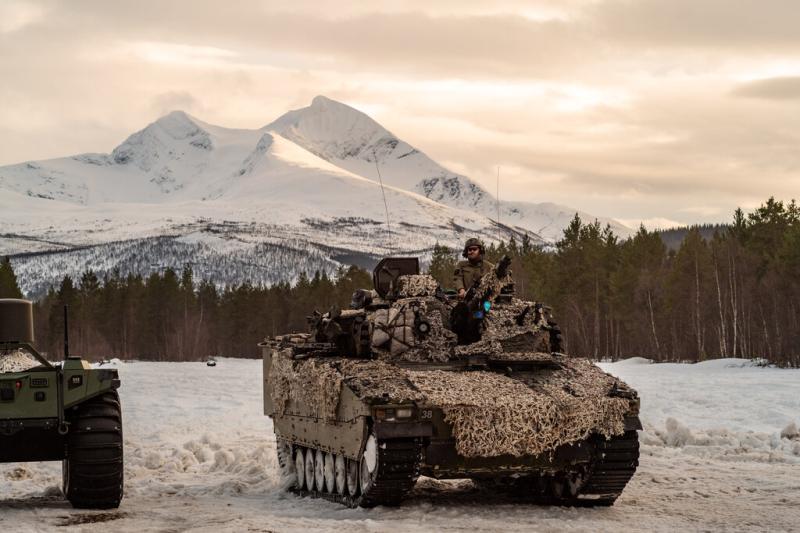
When the Airbus landed in Oslo, everyone was soon shuffled over to a Hercules aircraft for a noisy, two-hour flight to Bardufoss to look at NATO’s “Cold Response” exercise above the Arctic Circle.
The weather was disappointingly not arctic as we waited for Mr. Carney, Prime Minister Jonas Gahr Store of Norway and Chancellor Friedrich Merz of Germany to arrive in an armored vehicle. The temperature was about freezing, and it was lightly raining.
Drones buzzed overhead, tanks roared and fired ammunition, an autonomous vehicle drove itself around, and best of all, strings of Norwegian ski troops were pulled behind large snow machines with ropes making them vaguely resemble children being walked from a day care.
The military met the trade side of Mr. Carney’s roadshow when the three leaders held their news conference in the drizzle. Germany and Norway are pushing to sell Canada their jointly developed new submarine made by ThyssenKrupp Marine Systems.
They’re up against a similarly aggressive bid from Hanwha Ocean of South Korea.
The review of the two pitches is just beginning. Citing the independence of that procurement process, Mr. Carney avoided answering a question about which way the government was leaning.
Mr. Store, however, characterized a potential submarine with Norway and Germany as a way to boost collective security in an uncertain world.
“Investing together in these kind of very comprehensive capacities is about more than the capacity,” Mr. Store said after mentioning Norway’s cooperation with Germany on tanks as well as submarines. “It means also a very strong political integration between mature and trusted allies.”
On Sunday at Mr. Store’s official residence in Oslo, Mr. Carney met another military ally looking to close a major military sale: Prime Minister Ulf Kristersson of Sweden.
He was among the leaders of the five Nordic nations who had gathered to meet Mr. Carney.
The topic of Sweden’s suggestion that Canada buy fighter jets from Saab rather than U.S.-made F-35s didn’t come up — at least publicly. But there was effusive praise for Mr. Carney and his call in January at the World Economic Forum in Davos, Switzerland, for middle powers to band together on specific issues.
Speaking with a pronounced, if idiosyncratic, American accent she picked up while studying and working in the United States, Prime Minister Kristrun Frostadottir of Iceland said that political leaders and citizens of countries around the world “are very thankful for the leadership Canada has shown over the past few months.”
From Norway, Mr. Carney went to London to meet with his British counterpart, Keir Starmer, for the seventh time in the past year. Neither leader spoke to reporters afterward. But on Thursday, Canada joined Britain, France, Germany, Italy, the Netherlands, Japan and other countries in a joint statement expressing their “readiness to contribute to appropriate efforts to ensure safe passage” of ships through the Strait of Hormuz, which Iran has largely blocked since the start of its war with Israel and the United States. What the statement will mean in practical terms was not spelled out.
Finally, Mr. Carney visited King Charles III, before starting a week’s vacation in Britain.
When Mr. Carney took office, Canada was largely isolated as it grappled with President Trump’s attacks on its economy and sovereignty. Mr. Carney’s global travel before and after Davos appears to have succeeded in winning new friends for Canada and reinvigorating old alliances.
Tags
Who is online
85 visitors
One link at a time PM Carney is shattering the now frozen umbilical cord that once tied us to our southern ‘colleagues’. Also this week Carney told Trump to stuff it when it came to trade.
Meanwhile the conservative denizens in dumbfuck Wexit Alberta are moaning about not staying where we belong, on our knees ... @!@
Did you know that the UN Peacekeeping force was created by the late Canadian Prime Minister Lester Pearson? At least Trump can't change the name of Toronto's Lester Pearson airport.
It is hard to believe that by the end of WWII Canada had the third largest navy in the world. Now they talk of "a potential submarine with Norway and Germany."
When a nation dedicates itself to things like health care for all, from cradle to grave, there isn't much money for national defense.
... fourth largest navy and a far smaller population than the other three to maintain it.
The collapsing birth rate and emigration of Canada's best and brightest to America will no doubt make that easier.....
Best stayed in Canada to pair with Banting in order to give insulin to the world.
In its 250th year, is America, land of immigration, becoming a country of emigration?
Last year the U.S. experienced something that hasn’t definitively occurred since the Great Depression: More people moved out than moved in. The Trump administration has hailed the exodus—negative net migration—as the fulfillment of its promise to ramp up deportations and restrict new visas. Beneath the stormy optics of that immigration crackdown, however, lies a less-noticed reversal: America’s own citizens are leaving in record numbers, replanting themselves and their families in lands they find more affordable and safe.
Given keeping unwanted people out of the country remains a massive issue I think we'll be fine...Canada's plan to lose its top performers while importing masses of low skilled workers however.....
That's quite a brain drain. Thanks.
It's a 2-way street Sean.
Health care should only be for people who can afford it, right? If you can't afford it you're SOL. That must be the "conservative" point of view.
Oh no, we should devote the entire GDP of the nation to "health care." / S
It's the new Christian point of view
Nice dodge. Meaningless, but you have confirmed my point. From the "conservative" point of view, if you can't afford health care you are SOL. We should end Medicare, too, shouldn't we?
There is no greater expense
Of course you will never sign up for Medicare.
pretty shitty when the ME generation screams about Medicare and Medicaid because they're rich enough to buy their own insurance. Fuck all you all who can't.
And when a country devotes everything to being the world's policeman
and attempting to achieve national purity tests, deporting or incarcerating millions
there isn't squat left for health care for a third of its citizens, the same third they are considering drafting for another military misadventure.
Good for Canada. Time to put on their big boy pants.
The only time we don't wear shorts is in July.
skeeters, right?
We ride bikes
that looks a wee bit uncomfortable but more power to ya!
"Good for Canada. Time to put on their big boy pants."
LINK -> Service Files of the Second World War - War Dead, 1939-1947 - Library and Archives Canada
They weren't wearing short pants. And remember that Canada has around a tenth of the population of the USA.
Does that include the 1600 merchant mariners?
I don't know. I saw another source that put the Canadian deaths at more than 45,000.
You go, Canada