╌>

Trump signs Greenland deal giving U.S. broad military authority on the island - CBS News

  
Via:  Freewill  •  2 months ago  •  31 comments

By:   Kathryn Watson (CBS News)

Trump signs Greenland deal giving U.S. broad military authority on the island - CBS News
The U.S., Denmark and Greenland signed a new security agreement bolstering the United States' military and security presence on the island.

Leave a comment to auto-join group Critical Thinkers

Critical Thinkers

Interesting that this has not been bigger news.  We have discussed this topic here several times before, and despite the President's previous childish threats last year it would appear that mutually beneficial progress was made.  The result is one I expected, just odd the path it took to get there.   What are your thoughts on this?


S E E D E D   C O N T E N T


By Kathryn Watson Kathryn Watson Politics Reporter Kathryn Watson is a politics reporter for CBS News Digital, based in Washington, D.C. Read Full BioKathryn Watson

Updated on: September 22, 2026 / 3:21 PM EDT / CBS News

Add CBS News on Google

Washington — The U.S., Denmark and Greenland on Tuesday signed a new security agreement bolstering the United States' military and security presence on the island in the North Atlantic, the culmination of years of tensions over the future of the Danish territory.

President Trump, Greenland Premier Jens-Frederik Nielsen and Danish Prime Minister Mette Frederiksen signed the security agreement on the sidelines of the United Nations General Assembly in New York. The White House released the text of the deal shortly after the signing ceremony.

The agreement reaffirms the sovereignty of Greenland, which is part of the Kingdom of Denmark, but gives the U.S. broad access to the island's airspace and territory.

The plan allows the U.S. to expand the existing Pituffik Space Base, the northernmost U.S. military installation which serves as an early-warning system for incoming missiles. The agreement also says the U.S. can establish additional bases at the sites known as Narsarsuaq and Mestersvig, which are roughly 950 miles apart. Any of the three parties can propose more "defense areas" as needed, subject to approval by the others.

The deal, which has no expiration date, also blocks non-NATO countries from establishing bases on the island without agreement from the parties. The agreement persists even if Greenland eventually becomes independent from Denmark. It intensifies screening for foreign investment from non-NATO and non-European Union members, a move aimed at blocking influence from China and Russia.

The leaders of Greenland and Denmark emphasized that the deal was a reflection of the changing security landscape in the Arctic. Mr. Trump has long toyed with the possibility of acquiring Greenland, by force if necessary, drawing criticism from NATO allies.
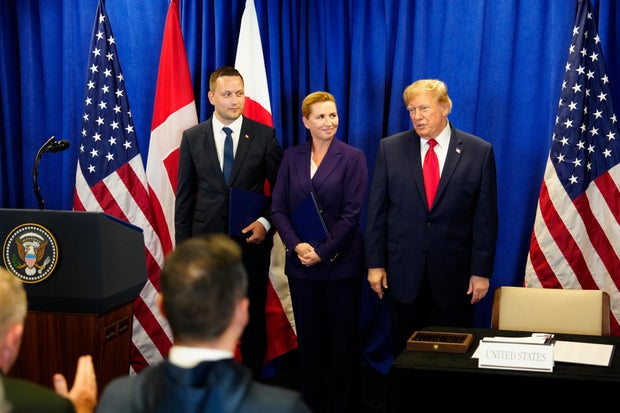
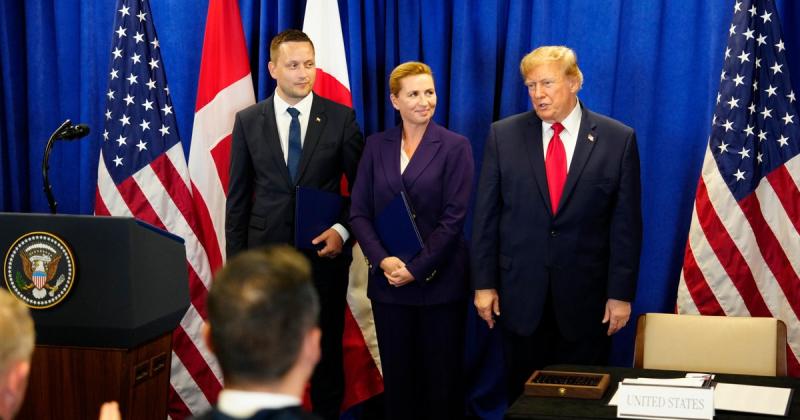
ap26265563379686.jpg Greenland Premeir Jens-Frederik Nielsen, Danish Prime Minister Mette Frederiksen and President Trump at the signing ceremony of a security deal on Tuesday, Sept. 22, 2026. Mads Claus Rasmussen/Ritzau Scanpix via AP

"We're going to have a tremendous relationship, a secure relationship, and we look forward to it," Mr. Trump said. "We'll be working very hard and very much in conjunction with each other, and it's just a real honor to be here."

Nielsen said the "world has changed a great deal since 1951," referring to a previous security pact that the new deal amends. Nielsen said the people of Greenland "recognize the long-term security threats that you, Mr. President, have rightly spoken about."

"This agreement should put to rest any doubt today and in the future about where Greenland's loyalty lies," Nielsen said.

Frederiksen said the deal respects the "territorial integrity of the Kingdom of Denmark, as well as Greenland's right to self-determination."

In his speech before the U.N. General Assembly immediately prior to signing the deal, Mr. Trump said the agreement allows for the U.S. to build two new bases in Greenland. The U.S. already has an active military base in Greenland.

"This agreement, made with the Kingdom of Denmark, an incredible, beautiful country, and the Greenland people itself, gives the United States permanent control over security and all other needs on that territory," Mr. Trump said. "We will have the complete ability to do what is necessary to defend the American continent and also Europe and other places. No U.S. adversary will ever be permitted to establish a military presence in Greenland anymore, or make sensitive investments there without our express written approval."


Red Box Rules

Y'all be cool now, ya hear?


Tags

jrGroupDiscuss - desc
[]
 
Freewill
Junior Quiet
1  seeder  Freewill    2 months ago
The deal, which has no expiration date, also blocks non-NATO countries from establishing bases on the island without agreement from the parties. The agreement persists even if Greenland eventually becomes independent from Denmark. It intensifies screening for foreign investment from non-NATO and non-European Union members, a move aimed at blocking influence from China and Russia. Nielsen said the "world has changed a great deal since 1951," referring to a previous security pact that the new deal amends. Nielsen said the people of Greenland "recognize the long-term security threats that you, Mr. President, have rightly spoken about."

Amazing what can be done once one dispenses with the childish threats and gets down to mutually beneficial business.


TᵢG
Professor Principal
1.1  TᵢG  replied to  Freewill @1    2 months ago

Trump does not know how to negotiate as a reasonable adult.

It is amazing that this got done with him in charge.


Sean Treacy
Professor Principal
1.2  Sean Treacy  replied to  Freewill @1    2 months ago

Or it's the outrageous demands and starting from an extreme ask that allows a favorable settlement that would otherwise have been out of reach. 


JohnRussell
Professor Principal
1.2.1  JohnRussell  replied to  Sean Treacy @1.2    2 months ago

LOL. He's a genius. Turning much of the world against the United States on a regular basis is a mastermind plan. jrSmiley_18_smiley_image.gif


TᵢG
Professor Principal
1.2.2  TᵢG  replied to  Sean Treacy @1.2    2 months ago

Even now you attempt to defend Trump??


Sean Treacy
Professor Principal
1.2.3  Sean Treacy  replied to  TᵢG @1.2.2    2 months ago

The agreement, indisputably, is much better than what we had.  Can you acknowledge that? 


TᵢG
Professor Principal
1.2.4  TᵢG  replied to  Sean Treacy @1.2.3    2 months ago

Of course.   Did you not read what I wrote @1.1?

Why do you try to defend Trump's outrageous trolling of other nations as some kind of a positive negotiation tactic?

It is childish and counterproductive; can you acknowledge that??


Freewill
Junior Quiet
1.2.5  seeder  Freewill  replied to  Sean Treacy @1.2    2 months ago
Or it's the outrageous demands and starting from an extreme ask that allows a favorable settlement that would otherwise have been out of reach. 

I don't think it would have been otherwise out of reach, and I think Trump started out on the right path in his first term with welcomed diplomacy, reopening the consulate in Nuuk, and supporting investment in Greenland projects.  Where he went off the rails, in my opinion, is the threats he made early in his second term.   I think this deal would have been made in any case with rational diplomacy and without putting relationships with Denmark, Greenland, and NATO at risk with unreasonable demands.  

I asked Google AI about your theory and here is the response:

If Trump had not made outrageous demands would the current Greenland deal have been made?

Whether the trilateral Arctic security agreement signed on September 22, 2026, would have been made without Donald Trump's aggressive, outrageous demands remains a point of debate among foreign policy analysts, but the general consensus is that an agreement updating Arctic defense was highly likely, though it would have taken a vastly different, less crisis-driven path.
1. The Deal Was Already Accessible via Standard Diplomacy
Critics and mainstream political analysts point out that the U.S. and Denmark have been close NATO allies for decades. The framework for American military access to Greenland was established long ago by the 1951 Defense of Greenland Treaty . Because both Denmark and Greenland recognized the growing strategic threat of Russian and Chinese ambitions in the Arctic, they were already open to modernization. [ 1 , 2 ]
Many experts argue that the U.S. could have secured these expanded basing rights through standard, quiet diplomatic channels without causing a multi-year geopolitical standoff or threatening the stability of the NATO alliance.
2. The Case for Trump's Brinkmanship
Conversely, proponents of Trump’s negotiating style argue that his "outrageous demands"—including public threats of economic coercion, annexation, and military force—served as a necessary disruption. From this perspective, by artificially escalating the situation into an international crisis, Trump forced Denmark and Greenland to the negotiating table with a sense of extreme urgency. [ 1 , 2 , 3 , 4 ]
The resulting agreement, which grants the U.S. the right to open two new military bases and implements strict screening mechanisms to block adversarial foreign investments, is viewed by his supporters as a direct victory achieved through high-stakes pressure. [ 1 , 2 ].
3. A Strategic Compromise, Not a Sale
Ultimately, Trump’s demands for total ownership or annexation of Greenland were entirely rejected by the Danish and Greenlandic governments, as well as the local population. The 2026 deal represents a significant climbdown from Trump’s initial demands . Rather than buying the island, the U.S. settled for an expanded military footprint while explicitly codifying and respecting Danish sovereignty and Greenlandic self-determination. [ 1 , 2 , 3 , 4 ]
In short, while Trump's aggressive tactics dictated the dramatic timeline and the specific optics of the standoff, an updated security pact was always the most logical outcome of shared U.S.-NATO Arctic defense interests. [ 1 , 2 ].
I think this is a fair assessment.


Thomas
Professor Guide
1.2.6  Thomas  replied to  Freewill @1.2.5    2 months ago

Just to be fair, I think we could have gotten to the same ends, and maybe much sooner, had we stuck with the standard diplomacy stuff. 

Trump never makes a deal permanently. He makes a deal until he thinks he sees a better one. If we were wanting to forge a deal to secure Greenland and it's minerals, it's territory, why did we not just state that at the outset? 

IMO, all of this could have been achieved, and at less cost, by following the normal diplomatic channels. 


TᵢG
Professor Principal
1.2.7  TᵢG  replied to  Thomas @1.2.6    2 months ago
Just to be fair, I think we could have gotten to the same ends, and maybe much sooner, had we stuck with the standard diplomacy stuff. 

No doubt in my mind.


Freewill
Junior Quiet
1.2.8  seeder  Freewill  replied to  Thomas @1.2.6    2 months ago
Just to be fair, I think we could have gotten to the same ends, and maybe much sooner, had we stuck with the standard diplomacy stuff. 

Agreed!  Do recall that Greenland was actually a bit disappointed that the Biden Administration did not continue with the same vigor the diplomatic and investment progress Trump had made in his first term.  We discussed that awhile back in another thread   HERE and HERE   .  Why Trump all of the sudden started out his second term with threats rather than continued diplomacy is beyond me.  Makes no sense. 


Thomas
Professor Guide
1.2.9  Thomas  replied to  Freewill @1.2.8    2 months ago
Why Trump all of the sudden started out his second term with threats rather than continued diplomacy is beyond me.  Makes no sense. 

From my estimation, he started with bluster because his overarching goal was to disrupt the systems of laws that the world had achieved post WWII with a "take it if you can" style of might-makes-right foreign and domestic relations: We are strong so we can take it from you. Ironically, he has been taught that deterrence only acts as a weapon when it is not used. The second he actually had to prove our strength through action is precisely when the US started to lose the protection of its perceived strength.

He has exposed the country's weakness against non-symmetrical actions, squandered the goodwill of the world and the treasure of the nation in an attempt to further consolidate power and wealth so it can be divided up by those whom he sees fit to bear it. 

He is not a leader, he is a baby swaddled in silk diapers who never got the message that it is, in fact, bad to be bad.


Freewill
Junior Quiet
1.2.10  seeder  Freewill  replied to  Thomas @1.2.9    2 months ago
From my estimation, he started with bluster because his overarching goal was to disrupt the systems of laws that the world had achieved post WWII with a "take it if you can" style of might-makes-right foreign and domestic relations: We are strong so we can take it from you.

Sure.  Could be.  I certainly did not like that approach with his threats of buying or taking over Greenland and not immediately ruling out the military aspect that he later softened on.  You don't do that to allies.

However, do you see any value in this line of thought:

Since WWII the U.S. has spent trillions on rebuilding and defending not only our allies, but even those countries who were our enemies as well.  We did not simply conquer and take over like many who had won wars in human history have done.  After all this time though, is it really that unreasonable to expect some of these sovereign nations to kick in a bit more to defend themselves and their allies, and rely a little less on the U.S. for that? 

I think that is at least worth some level of discussion without immediately characterizing it as the U.S. "taking" anything from our allies, especially considering all we have given. Does that make sense? 


Thomas
Professor Guide
1.2.11  Thomas  replied to  Freewill @1.2.10    2 months ago
Since WWII the U.S. has spent trillions on rebuilding and defending not only our allies, but even those countries who were our enemies as well.  We did not simply conquer and take over like many who had won wars in human history have done.  After all this time though, is it really that unreasonable to expect some of these sovereign nations to kick in a bit more to defend themselves and their allies, and rely a little less on the U.S. for that? 

I have no problem with the idea that if a nation says it is going to contribute a currency amount certain to its defense that it should contribute that amount. That is a reasonable expectation to hold. 

The reason that we spent the money on all that rebuilding was to help in the creation of wealth: Creation of stable economies with stable consumers on both the country level and the personal. This stable economy in turn would spur the further creation of wealth.

Since WWII the U.S. has spent trillions on rebuilding and defending not only our allies, but even those countries who were our enemies as well.

Are those same countries our enemies now? Are they productive? Are they busily buying and selling products and boosting our economy? That is why we made the investment. There iks a saying that one must spend money to make money. I think that the post-war era was a great boon to not only the economy, but to democracy, peace, and stability. One of the primary reasons is (besides a general consensus around the world to stop fighting) the investments we made during the Marshall Plan. 

I had ChatGPT play around with the Obama cadence for this one, just because I liked him, his philosophy, and his steadiness. I never knew that ten years could make this much difference in our countries standing in the world. (Even though it is his cadence, these are my thoughts, filtered):

Yes, our allies should contribute to their own defense. When a nation makes a commitment, we are entitled to expect it to keep that commitment. I have no quarrel with that.

But we should remember why the United States helped rebuild the world after World War II. We did it because we had seen what economic collapse, political instability and war could cost. We helped former enemies recover because a prosperous Germany or Japan could become a trading partner instead of the center of another catastrophe. Stable economies meant jobs, consumers and markets abroad. They meant opportunity and security here at home. That was a choice made in America’s interest, too.

We did not simply wait for those outcomes to emerge from an unregulated marketplace. We invested in reconstruction. And after the League of Nations failed to prevent another world war, nations built institutions through which they could settle disputes and organize their common defense. Those institutions have never been perfect. Their purpose was to give countries another way to deal with conflict before it became a war.

So let us ask our allies to carry their share. Let us be clear about what they have pledged and hold them to it. But let us also be honest about what America gained from helping build a world in which our allies could prosper and defend themselves. We made those investments because the peace and prosperity of other nations mattered to our own.

It seems to me that far to much is made of any perceived slight. The countries in question are now mostly paying their own way in the expectation that DJT will blow off another of his many feet.


Thomas
Professor Guide
1.2.12  Thomas  replied to  Thomas @1.2.11    2 months ago

Underlying this is the theory of friendship vs the theory of enemy. (I just made those names up on the fly, so search for them at your peril.) 

The Theory of Friendship says that you help those whom you wish to be your friends. By helping them, they in turn can help you.

The Theory of Enemy says that you treat everyone as your enemy unless they concede something to you.

I think the Theory of the Friend gets more positive response than the Theory of the Enemy. There is no question that DJT, being a transactionalist, is espousing the Theory of the Enemy: He looks at the first iteration of the transaction and if he sees no gain, he fights because the interlocutor is the enemy. I really do not think that he sees much more than this level.

If he approached events and people from the Theory of Friendship, he would ask. What do you need? What do you want? How can we, together, make this work? Instead he just throws an immediate hissy fit. 
I had a point here... Help me out Chat GPT

You did have a point. The defense-spending argument treats the first transaction as the whole relationship. It asks what America paid for other countries, then leaves the accounting there. Your point is that helping a country recover can create an ally, a trading partner and a source of mutual security. Those returns arrive over years, often in forms that do not appear on the original bill.

That does not mean friends get a free pass. You can expect an ally to meet its commitments because the relationship is reciprocal. Your “Theory of Friendship” asks, “What can we build that benefits both of us?” Your “Theory of the Enemy” asks, “What can I make you give me before I do anything for you?” The second approach can win a concession while damaging the trust that makes future cooperation possible.

That is the point you were reaching for: America’s postwar policy was an investment in relationships, not a string of isolated favors for which we are still waiting to be repaid. Your criticism of Trump is that he appears to judge the immediate exchange and miss the value of the relationship it could create or destroy. That last part is your interpretation of his conduct, rather than something we can know about what he sees internally.

Me: It was something both more specific and more basic.

Yes. I missed the most direct point: the countries that had been our enemies are the clearest example of your theory.

We helped rebuild Germany and Japan because we wanted former enemies to become friends. We gave them a stake in a relationship that could benefit them and us. That is why “we even helped our enemies” is such an odd way to frame it. Their becoming peaceful, prosperous partners was the point.

And that brings it back to the present: if you want allies to do more alongside you, treating them as partners gives them a reason to do it. Treating every request as a confrontation may extract a concession, but it makes the partnership harder to sustain.


JohnRussell
Professor Principal
2  JohnRussell    2 months ago
What are your thoughts on this?

Trump sucks. 


JohnRussell
Professor Principal
2.1  JohnRussell  replied to  JohnRussell @2    2 months ago
COPILOT
Public reporting shows that Donald Trump made several critical or disparaging comments about Denmark and Greenland during his push to acquire the territory.

Key Reported Remarks About Denmark

According to multiple news sources, Trump made several statements portraying Denmark negatively:
  • Claiming Denmark “fell to Germany after just six hours” in WWII and was “totally unable to defend either itself or Greenland”
    1
    .
  • Calling Denmark “ungrateful” for U.S. support during WWII
    2
    .
  • Saying the U.S. was “stupid” to give Greenland back to Denmark after the war
    2
    .
  • Suggesting Denmark has no real defense capability , joking that Greenland’s defense amounted to “two dog sleds”
    1
    .
  • Questioning Denmark’s legal right to Greenland , saying there were “no written documents” proving ownership — a claim fact‑checkers identified as false
    2
    .
  • ODF._HXsElmSIgIoDCpc_9aE9A?w=16&h=16&c=10&o=6&pid=genserp&rm=2
    ODF.EQntUmF0mCaUvz1PESJOrQ?w=16&h=16&c=10&o=6&pid=genserp&rm=2
    5 Sources

Key Reported Remarks About Greenland

Trump also made dismissive or belittling comments about Greenland itself:
  • Referring to Greenland as a “piece of ice” while demanding U.S. ownership
    2
    .
  • Repeatedly confusing Greenland with Iceland , even while threatening Denmark over the issue
    1
    .
  • Claiming Greenland was surrounded by Russian and Chinese ships , a statement contradicted by available evidence
    1
    .
  • Saying the U.S. needs “right, title, and ownership” of Greenland because “you can’t defend it on a lease”
    1
    .
  • ODF._HXsElmSIgIoDCpc_9aE9A?w=16&h=16&c=10&o=6&pid=genserp&rm=2
    ODF.5lm8QPi7UYlDHj9WBg8F2Q?w=16&h=16&c=10&o=6&pid=genserp&rm=2
    4 Sources

Summary

The remarks reported across the sources include criticisms of Denmark’s military history, accusations of ingratitude, dismissive characterizations of Greenland, and false claims about sovereignty and security. These statements contributed to diplomatic tensions between the U.S., Denmark, and Greenland.
If you need a timeline or context for these remarks, I can help with that as well.


Split Personality
Professor Participates
2.2  Split Personality  replied to  JohnRussell @2    2 months ago

So while Hegseth threatens to withdraw all troops from NATO and the EU,

Trump wants to build bases on the rocks and glaciers of Greenland to protect us from China & Russia.

Even the GOP are chomping at the bit to Impeach Cabinet Members to save the country.


JohnRussell
Professor Principal
2.2.1  JohnRussell  replied to  Split Personality @2.2    2 months ago

Follow the money. 

President Donald Trump bragged to the United Nations General Assembly Tuesday about looting Venezuela—and threatened that Cuba may be next.

“Last month, we signed the largest oil deal in history, covering 65 billion barrels of oil which will benefit both Venezuela and the United States enormously and help drive down the cost of energy all over the world,” Trump said .

“So it’s perhaps the biggest deal—it was a war, but it is perhaps the biggest deal ever made. ‘To the visitor belong the spoils,’ you’ve all heard that.”

It seems that Trump may mean that literally. Americans and Venezuelans have no idea what’s happened to the billions of dollars in revenue from oil that the Trump administration stole from Venezuela.

Trump brags about looting another country in bonkers UN address


JohnRussell
Professor Principal
2.2.2  JohnRussell  replied to  JohnRussell @2.2.1    2 months ago

Trump-linked figures set to profit from Greenland’s minerals | Global Witness

Trump staffers and billionaire backers buying into Greenland’s minerals

Critical Metals Corp is far from the only company making the most of Greenland’s potential and further muddying the lines between Washington’s minerals policy and the interests of individuals connected to the government.

The network mapped by Global Witness includes companies like GreenMet, which was part of a US delegation to Greenland in 2025 alongside Critical Metals Corp. Two beneficial owners of the company are former Trump employees or staffers, while a former Trump administration aide is its CEO.

In the same month as the delegation, GreenMet also partnered with Tanbreez. Its other partners include a battery developer that the company claims is central to the Trump administration’s critical minerals strategy.

Increasing media attention has been paid to Trump-aligned billionaires investing in Greenland.

Leading tech executives – and contributors to Trump’s inauguration – Jeff Bezos , Sam Altman and Bill Gates invest via a fund founded by Gates in Kobold Metals , an AI mining company that retains royalties in eventual production from a nickel-copper-cobalt project in West Greenland.

Kobold is also backed by venture capital firm Andreessen Horowitz , whose founders donated millions to a Trump-supporting Super PAC during the most recent election.

Kobold is closely aligned with the US administration’s push for minerals access. In the Democratic Republic of Congo (DRC), US Secretary of State Marco Rubio directly facilitated the company’s entry into the Congolese lithium sector in the same month that it sold its Greenland stake .

Other Trump allies becoming prominent investors in Greenland include billionaire Ronald Lauder , who is credited for inspiring Trump to acquire Greenland. Lauder is reported to hold investments in the island via his participation in US consortium Greenland Development Partners .

His business partners in the venture include two politically-connected Greenlanders with local mining interests.


Freewill
Junior Quiet
2.2.3  seeder  Freewill  replied to  Split Personality @2.2    2 months ago
So while Hegseth threatens to withdraw all troops from NATO and the EU

I had not heard this so I asked my friend Google AI about it and here is that response:

Is this true? Hegseth threatens to withdraw all troops from NATO and the EU.

No, it is not true that U.S. Defense Secretary Pete Hegseth has threatened to withdraw all U.S. troops from NATO and the EU. [ 1 , 2 ]
🔎 What is actually happening
  • Targeted reductions, not total withdrawal: The Pentagon is currently weighing a potential reduction of roughly one-third (between 25,000 and 40,000) of the estimated 68,000 to 80,000 U.S. troops stationed in Europe, largely affecting countries like Germany, Italy, and Spain. [ 1 , 2 , 3 ]
  • The ongoing force review: Hegseth announced a six-month European force posture review to push European allies to take primary responsibility for their own conventional defense and meet defense spending targets. [ 1 , 2 , 3 ]
  • Timeline and decisions: A final recommendation from this military review is expected on November 6, 2026, and no final decisions on large-scale troop cuts have been officially finalized yet. [ 1 , 2 ]

So that part of your premise appears to differ with the facts.

Trump wants to build bases on the rocks and glaciers of Greenland to protect us from China & Russia.

Yep.  And Greenland and Denmark appear to agree that is a worthy endeavor, hence their signature.

Even the GOP are chomping at the bit to Impeach Cabinet Members to save the country.

Yeah, not so sure about that my friend.  Again Google A.I. explains the facts:

No, it is not true that the GOP as a whole is "chomping at the bit" to impeach Cabinet members. In fact, Republican leadership has actively moved to block recent attempts to do so. [ 1 ]
The rumor likely stems from a highly unusual piece of intraparty warfare involving a single, outgoing Republican lawmaker. [ 1 ]
The Root of the Claim
  • The Rogue Push: Representative Thomas Massie (R-KY) introduced eight articles of impeachment against Defense Secretary Pete Hegseth . Massie accused Hegseth of high crimes and misdemeanors, notably arguing that the ongoing conflict with Iran violates the War Powers Resolution of 1973.
  • The Leadership Shutdown: Far from embracing the effort, House Republican leadership was caught entirely off guard and immediately shut it down.
  • Fleeing the Vote: Because Massie introduced the impeachment as a privileged resolution, the House would have been forced to vote on it within two days. To avoid a messy public vote right before the midterm elections, Speaker Mike Johnson (R-LA) abruptly cut the legislative session short, canceled scheduled votes, and sent lawmakers home early for recess. [ 1 , 2 , 3 , 4 , 5 , 6 ]
The Broader Context
Speaker Johnson publicly defended Secretary Hegseth, calling Massie’s impeachment push a “publicity stunt” and stating that Congress should not be "playing games with national security." Massie, a long-time administration critic who lost his primary earlier in the year to a Trump-backed challenger, acted independently rather than as part of a broader GOP strategy. [ 1 , 2 , 3 ]
While the GOP previously united to impeach Homeland Security Secretary Alejandro Mayorkas, the current push against a Republican Defense Secretary is an isolated effort by a lone lawmaker that party leaders actively suppressed.


JohnRussell
Professor Principal
2.2.4  JohnRussell  replied to  Freewill @2.2.3    2 months ago
Yep.  And Greenland and Denmark appear to agree that is a worthy endeavor, hence their signature.

I think they just want to try and get Trump out of their hair. There's a limit to how much craziness people should be expected to subject themselves to. 


Split Personality
Professor Participates
2.2.5  Split Personality  replied to  Freewill @2.2.3    2 months ago

I think it is very clear where this Administrations loyalties lie and it isn't with our European allies.  They are panicked by the fact that this Administration would even talk about this being a possibility.

25,000 US Troops Out Of Europe? Pentagon Weighs Major Military Drawdown: Report | Times Now

Almost unbelievably, the US is planning to pull large numbers of troops out of Europe

At the same, dear leader has not only invited his war crimes buddy Putin to come to Florida for the next G20

and be a guest at Mar-a-Lago. I suppose that sense to Trump who apparently thinks Ukraine brought this war on themselves,

just like Venezuela did.

The Danish agreement was done at gun point and specifically to rattle NATO.

INMHO it can be challenged as an illegal contract if and when the Danes choose to do so.

Otherwise they are just another puppet state of some country I recognize less and less.

Shades of the 1930's again


Freewill
Junior Quiet
2.2.6  seeder  Freewill  replied to  Split Personality @2.2.5    2 months ago
The Danish agreement was done at gun point and specifically to rattle NATO

Nah, not at gunpoint but certainly with some additional pressure given Trump's rhetoric.  And it clearly was not aimed at rattling NATO as they welcomed it stating that, " it directly enhances the collective security of both Europe and North America ".  Again, Google A.I. summarizes:

The U.S.-Denmark-Greenland security agreement , signed on September 22, 2026 , was not done at gunpoint, nor was it designed to rattle NATO. Instead, the accord was explicitly crafted to strengthen NATO’s role in Arctic security and defuse a severe diplomatic crisis between the United States and its European allies . [ 1 , 2 , 3 , 4 ]
The context surrounding the negotiations and the actual purpose of the pact involve several key factors:
Demands and Strained Relations
The agreement followed months of intense pressure from U.S. President Donald Trump, who repeatedly proposed acquiring the semi-autonomous territory of Greenland and openly refused to rule out the use of military or economic force to secure U.S. control. While critics and European officials widely condemned these threats as aggressive, destabilizing, and highly unusual for interactions between NATO allies, the eventual pact was achieved through months of quiet, behind-the-scenes diplomatic negotiations. [ 1 , 2 , 3 ]
The Agreement Safely Protected Sovereignty
Despite initial fears of a forced annexation or a loss of independence, Danish Prime Minister Mette Frederiksen and Greenland Prime Minister Jens-Frederik Nielsen confirmed that the signed accord fully respects and protects Greenland's sovereignty and territorial integrity. The final text explicitly prevents the transfer of any land or ownership to the United States. [ 1 , 2 , 3 ]
Reinforcing NATO Rather Than Rattling It
Far from seeking to undermine or rattle NATO, the trilateral pact actually institutionalizes and deepens the alliance's presence in the Arctic region . [ 1 , 2 ]
  • NATO Co-Responsibility: Danish Foreign Minister Lars Løkke Rasmussen emphasized that the deal ensures responsibility for Arctic security is handled collectively through NATO, rather than being left strictly to bilateral U.S.-Danish oversight. [ 1 ]
  • Exclusion of Non-Allies: The treaty specifically bars any nation that is not a member of NATO from building military installations or maintaining a persistent military presence in Greenland. [ 1 ]
  • Allied Approval: Following the signing ceremony, NATO Secretary General Mark Rutte officially welcomed the deal on behalf of the alliance, stating that it directly enhances the collective security of both Europe and North America. [ 1 ]
Ultimately, while the pact substantially expands America's military footprint—allowing for the construction of two new military bases and the implementation of a missile defense system—it was structured as a compromise to ease international tensions and bind Arctic defense directly to the North Atlantic Treaty Organization (NATO) . [ 1 , 2 , 3 ]
Just trying to separate exaggeration and political animus from the actual facts with respect to this new Security Agreement.  I certainly understand the disdain for Trump and distrust in his motives for anything he does, but this article is about the actual Agreement, what it accomplished, and what it means to all involved.  Remember that Trump was not the sole driver of the direction this Agreement took, nor the sole beneficiary.  


Ozzwald
Professor Quiet
2.3  Ozzwald  replied to  JohnRussell @2    2 months ago
What are your thoughts on this?
Trump sucks. 

With his track record, odds are that this will turn out to be a very minor and insignificant change to the current agreement.


Freewill
Junior Quiet
2.3.1  seeder  Freewill  replied to  Ozzwald @2.3    2 months ago
With his track record, odds are that this will turn out to be a very minor and insignificant change to the current agreement

I certainly understand the concern about Trump's track record, but in this case the new agreement went considerably further than the previous agreement in terms of the allowable extent and locations for U.S. military presence on the island, as explained in this and several other articles.  It blocks other non-Nato countries from establishing bases there as well.  Also, unlike the 1951 agreement, this "agreement persists even if Greenland eventually becomes independent from Denmark". 

Lastly, and quite importantly, "It intensifies screening for foreign investment from non-NATO and non-European Union members, a move aimed at blocking influence from China and Russia."  Any projects or investments involving critical minerals and other Greenlandic resources must be carefully screened and approved by the U.S., Greenland, and Denmark.  This is not a minor feature of the new agreement.


Split Personality
Professor Participates
3  Split Personality    2 months ago

Dollars to donuts, the first sign of pushback and the dumpster imposes 100% tariffs on all of Greenland's exported seafood

and tries to stop exports to Europe and Asia.


Thomas
Professor Guide
4  Thomas    2 months ago

What do I think? I think that I don't trust anything the President says or does because it is his operating principle to discard agreements thought of as settled for any or no reason whatsoever.

Look at trade relations. NAFTA? Sorry. USMCA? Nah! We're not going to honor that either. In fact, we're going to put bumble-fuck-headed tariffs on everyone.

What about foreign policy? What foreign policy? He's just run around being a world-public embarrassment and sucking up as much money and kickbacks as he can con people out of. 

IMO, he's a scum-sucking son of a bitch who's word isn't worth a piece of used toilet paper. Sign a deal with him? Only if you are the devil.


evilone
Professor Guide
5  evilone    2 months ago

So, how does this effect my gas and grocery bill? /s


devangelical
Professor Principal
5.1  devangelical  replied to  evilone @5    2 months ago

it's going up, and the beatings will continue until morale improves ...


Buzz of the Orient
Professor Expert
6  Buzz of the Orient    one month ago

Greenland/Denmark allowed Trump/America to control what nations Greenland can deal with.  That demand, along with requiring Canada to change its language laws, was one of the main reasons why Canada walked away from the table when the American negotiators pulled that one on Canada at the last minute of the negotiations. . 


Who is online


86 visitors