╌>

Congressman Repeatedly Asks Pro-Choice Advocates ‘Does Abortion Kill?’ He Says Defiant Reaction Reveals ‘Devastating’ Truth

  
Via:  XXJefferson51  •  5 years ago  •  131 comments

By:   Billy Hallowell

Congressman Repeatedly Asks Pro-Choice Advocates ‘Does Abortion Kill?’ He Says Defiant Reaction Reveals ‘Devastating’ Truth
But Johnson wasn’t backing away from his quest for definitive responses. At one point he asked, “When you dismember something in the womb, is that a human being or not? It’s a living being, yes or no?” According to Fox, no one seemed to directly answer these questions – or other similar curiosities Johnson posed.

Leave a comment to auto-join group Americana

Americana

The congressman was correct to ask these questions in that congressional hearing.  I’m glad that he did.  The discomfort of the pro aborts was plain for all to see.  The clear and obvious answer to all of his questions is yes.  


S E E D E D   C O N T E N T


Congressman Repeatedly Asks Pro-Choice Advocates ‘Does Abortion Kill?’ He Says Defiant Reaction Reveals ‘Devastating’ Truth


Billy Hallowell November 11, 2021


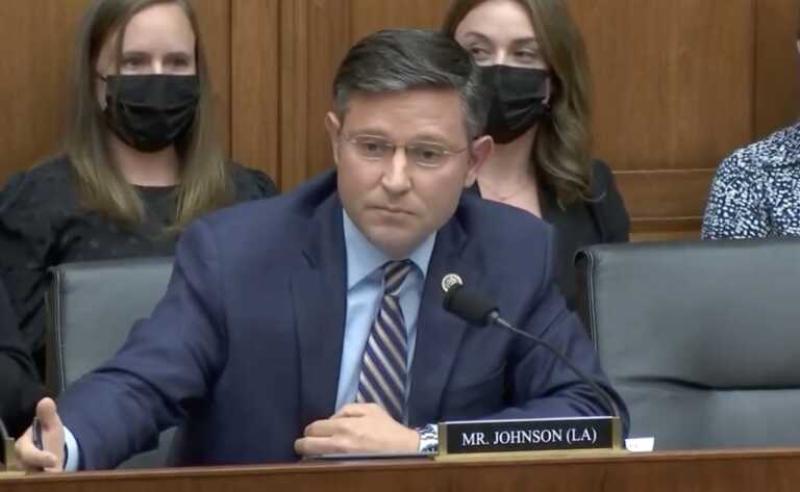
Abortion advocates again and again declined to respond to a congressman’s seemingly simple questions about the unborn last Thursday during a hearing before the House Judiciary Committee.

Rep. Mike Johnson’s (R-La.) inquiries were straightforward, yet the reactions they sparked made for some truly awkward moments in the hearing room.

His questions to Stephanie Loraine Piñeiro, co-executive director of Florida Access Network, and Dr. Ghazaleh Moayedi, an OB-GYN, didn’t go over too well.

Here’s an example: After Johnson asked, “Does abortion kill something that’s alive – take the life of something that’s alive?” Moayedi responded by citing issues she believes his questions could cause, Fox News reported .

“Sir, the way that you’re asking these questions actually intentionally invite violence and harassment to both of us – to all of us,” she said.

But Johnson wasn’t backing away from his quest for definitive responses. At one point he asked , “When you dismember something in the womb, is that a human being or not? It’s a living being, yes or no?”


According to Fox, no one seemed to directly answer these questions – or other similar curiosities Johnson posed.

At another point, the congressman asked, “Is it OK to murder a 10-year-old child?” to which he was still unable to get a “yes” or “no” response.

The exchange left Johnson tweeting afterward that he believes the dialogue and failure to answer actually helps pro-lifers in the midst of the ongoing ideological battle over the unborn.

The silence, he said, exposes an overarching refusal to honestly address the reality of what happens during an abortion.


“When confronted with simple, direct questions about whether abortion takes a human life, Democrats never give a straight answer, because the truth is devastating to their cause,” he wrote. “We will continue to expose them. This is how we will win the abortion debate.”

In another tweet, he added to his claim that “abortion advocates” decline to answer because they know the reality at hand.

“They can’t admit the simple truth: that abortion takes a baby’s life,” he said.


Tags

jrGroupDiscuss - desc
[]
 
bbl-1
Professor Silent
2  bbl-1    5 years ago

Another yawner.  Need more welfare/unwanted/disabled babies, right?


MrFrost
Professor Guide
4  MrFrost    5 years ago

If you don't like abortions, don't get one. Pretty simple. 

The party of, "more personal freedoms" apparently doesn't want those freedoms to apply to women. They are pro-birth, not pro-life because they could not care less about babies. 

512


charger 383
Professor Silent
4.2  charger 383  replied to  MrFrost @4    5 years ago

Abortion should be free and without Question, You should have to pay for your rifle


charger 383
Professor Silent
4.2.2  charger 383  replied to  XXJefferson51 @4.2.1    5 years ago

Yes, the Hyde amendment adds cost burden to all taxpayers.  Why should all taxpayers have to pay for costs of kids their parents can't afford?  That does not seem fair.  

This keeps generational poverty going on, more unwanted kids having more unwanted kids  and dragging down society    


Gordy327
Professor Participates
4.2.3  Gordy327  replied to  XXJefferson51 @4.2.1    5 years ago
You really believe that the Hyde amendment should be withdrawn

Yes!

and that pro life people should have to pay for evil with our tax dollars over our objection?

Yes! Besides, we generally have no say over where out tax dollars are spent. 

That doesn’t seem fair at all.  

It's not fair if tax dollars are spent to support an unwanted child for 18 years. But then, life isn't fair, is it?


Gordy327
Professor Participates
4.2.4  Gordy327  replied to  charger 383 @4.2.2    5 years ago
Why should all taxpayers have to pay for costs of kids their parents can't afford?  That does not seem fair.  

Indeed. Eliminating the Hyde Amendment is more economically practical and will be less of a tax burden to people in the long run.


CB
Professor Guide
6  CB    5 years ago
76

The Constitution does not explicitly mention any right of privacy. In a line of decisions, however, going back perhaps as far as Union Pacific R. Co. v. Botsford, 141 U.S. 250 , 251 , 11 S.Ct. 1000, 1001, 35 L.Ed. 734 (1891), the Court has recognized that a right of personal privacy, or a guarantee of certain areas or zones of privacy, does exist under the Constitution. In varying contexts, the Court or individual Justices have, indeed, found at least the roots of that right in the First Amendment , Stanley v. Georgia, 394 U.S. 557 , 564 , 89 S.Ct. 1243, 1247, 22 L.Ed.2d 542 (1969); in the Fourth and Fifth Amendment s, Terry v. Ohio, 392 U.S. 1 , 8 -9, 88 S.Ct. 1868, 1872-1873, 20 L.Ed.2d 889 (1968), Katz v. United States, 389 U.S. 347 , 350 , 88 S.Ct. 507, 510, 19 L.Ed.2d 576 (1967); Boyd v. United States, 116 U.S. 616 , 6 S.Ct. 524, 29 L.Ed. 746 (1886), see Olmstead v. United States, 277 U.S. 438 , 478 , 48 S.Ct. 564, 572, 72 L.Ed. 944 (1928) (Brandeis, J., dissenting); in the penumbras of the Bill of Rights, Griswold v. Connecticut, 381 U.S., at 484 - 485 , 85 S.Ct., at 1681-1682; in the Ninth Amendment , id., at 486, 85 S.Ct. at 1682 (Goldberg, J., concurring); or in the concept of liberty guaranteed by the first section of the Fourteenth Amendment , see Meyer v. Nebraska, 262 U.S. 390 , 399 , 43 S.Ct. 625, 626, 67 L.Ed. 1042 (1923). These decisions make it clear that only personal rights that can be deemed 'fundamental' or 'implicit in the concept of ordered liberty,' Palko v. Connecticut, 302 U.S. 319 , 325 , 58 S.Ct. 149, 152, 82 L.Ed. 288 (1937), are included in this guarantee of personal privacy. They also make it clear that the right has some extension to activities relating to marriage, Loving v. Virginia, 388 U.S. 1 , 12 , 87 S.Ct. 1817, 1823, 18 L.Ed.2d 1010 (1967); procreation, Skinner v. Oklahoma, 316 U.S. 535 , 541 -542, 62 S.Ct. 1110, 1113-1114, 86 L.Ed. 1655 (1942); contraception, Eisenstadt v. Baird, 405 U.S., at 453 - 454 , 92 S.Ct., at 1038-1039; id., at 460, 463465, 92 S.Ct. at 1042, 1043-1044 (White, J., concurring in result); family relationships, Prince v. Massachusetts, 321 U.S. 158 , 166 , 64 S.Ct. 438, 442, 88 L.Ed. 645 (1944); and child rearing and education, Pierce v. Society of Sisters, 268 U.S. 510 , 535 , 45 S.Ct. 571, 573, 69 L.Ed. 1070 (1925), Meyer v. Nebraska, supra.

77

This right of privacy, whether it be founded in the Fourteenth Amendment 's concept of personal liberty and restrictions upon state action, as we feel it is, or, as the District Court determined, in the Ninth Amendment 's reservation of rights to the people, is broad enough to encompass a woman's decision whether or not to terminate her pregnancy. The detriment that the State would impose upon the pregnant woman by denying this choice altogether is apparent. Specific and direct harm medically diagnosable even in early pregnancy may be involved. Maternity, or additional offspring, may force upon the woman a distressful life and future. Psychological harm may be imminent. Mental and physical health may be taxed by child care. There is also the distress, for all concerned, associated with the unwanted child, and there is the problem of bringing a child into a family already unable, psychologically and otherwise, to care for it. In other cases, as in this one, the additional difficulties and continuing stigma of unwed motherhood may be involved. All these are factors the woman and her responsible physician necessarily will consider in consultation.

78

On the basis of elements such as these, appellant and some amici argue that the woman's right is absolute and that she is entitled to terminate her pregnancy at whatever time, in whatever way, and for whatever reason she alone chooses. With this we do not agree. Appellant's arguments that Texas either has no valid interest at all in regulating the abortion decision, or no interest strong enough to support any limitation upon the woman's sole determination, are unpersuasive. The Court's decisions recognizing a right of privacy also acknowledge that some state regulation in areas protected by that right is appropriate. As noted above, a State may properly assert important interests in safeguarding health, in maintaining medical standards, and in protecting potential life. At some point in pregnancy, these respective interests become sufficiently compelling to sustain regulation of the factors that govern the abortion decision. The privacy right involved, therefore, cannot be said to be absolute. In fact, it is not clear to us that the claim asserted by some amici that one has an unlimited right to do with one's body as one pleases bears a close relationship to the right of privacy previously articulated in the Court's decisions. The Court has refused to recognize an unlimited right of this kind in the past. Jacobson v. Massachusetts, 197 U.S. 11 , 25 S.Ct. 358, 49 L.Ed. 643 (1905) (vaccination); Buck v. Bell, 274 U.S. 200 , 47 S.Ct. 584, 71 L.Ed. 1000 (1927) (sterilization).

79

We, therefore, conclude that the right of personal privacy includes the abortion decision, but that this right is not unqualified and must be considered against important state interests in regulation.

Jane ROE, et al., Appellants, v. Henry WADE.

Adding a little historical background to this discussion can go a long way. Abortion has been argued since time immemorial. Considered homicide, murder, misdemeanor activity, and/or legal under law.


CB
Professor Guide
7  CB    5 years ago
Johnson asked, “Does abortion kill something that’s alive – take the life of something that’s alive?” 
Of course, using whatever proper terminology one chooses - the "transaction" in the womb stops and ends before 'threshold' delivery . That is inarguable. Everybody knows this. The question following :

A. Why do it?
B. Why is there a need for a 'universal' policy in law for abortion?  

These are several questions our legal realm resolve.
2

We forthwith acknowledge our awareness of the sensitive and emotional nature of the abortion controversy , of the vigorous opposing views, even among physicians, and of the deep and seemingly absolute convictions that the subject inspires. One's philosophy, one's experiences, one's exposure to the raw edges of human existence, one's religious training, one's attitudes toward life and family and their values, and the moral standards one establishes and seeks to observe, are all likely to influence and to color one's thinking and conclusions about abortion.

3

In addition, population growth, pollution, poverty, and racial overtones tend to complicate and not to simplify the problem.

4

Our task, of course, is to resolve the issue by constitutional measurement, free of emotion and of predilection. We seek earnestly to do this, and, because we do, we have inquired into, and in this opinion place some emphasis upon, medical and medical-legal history and what that history reveals about man's attitudes toward the abortion procedure over the centuries.

Jane ROE, et al., Appellants, v. Henry WADE.


Who is online


91 visitors