
Hand stencil made almost 68,000 years ago is the oldest cave art ever found

By: Jennifer Jett (NBC News)


 S E E D E D C O N T E N T
The world's oldest known example of cave art, dating back at least 67,800 years, has been discovered by researchers studying handprints in Indonesia.
The find, along with others recently made in the Southeast Asian country, helps scientists trying to determine when and where early humans first learned to make art and at what point their art became more complex.
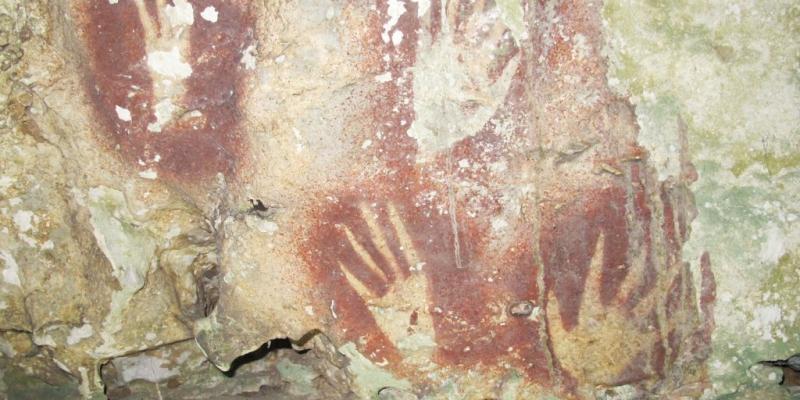
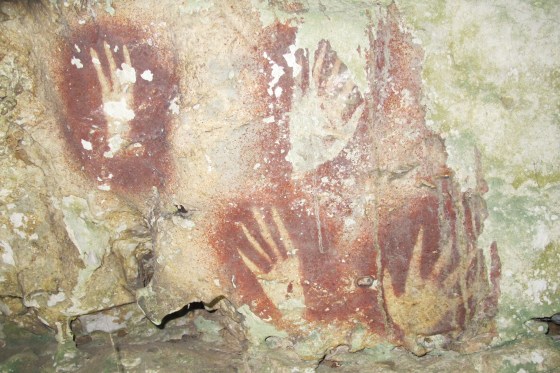
The reddish hand stencils, though faded and barely visible, were found in the Liang Metanduno limestone cave on Muna, an island off the larger eastern Indonesian island of Sulawesi. One of them was found to be at least 67,800 years old.
Indonesian and Australian researchers said the stencils were made by blowing pigment onto a hand pressed against the rock surface, leaving an outline. Fingertips reshaped to appear more pointed suggest that the hands were those of humans, possibly connected to the ancestors of the first Australians.
The paintings were dated by analyzing mineral crusts that had gradually formed on top of them.
The finding "is pretty extraordinary, because usually rock art is very difficult to date and it doesn't date back to anywhere near that old," said Adam Brumm, a professor of archaeology at Griffith University in Brisbane, Australia, and a co-author of the study, published Wednesday in the journal Nature.
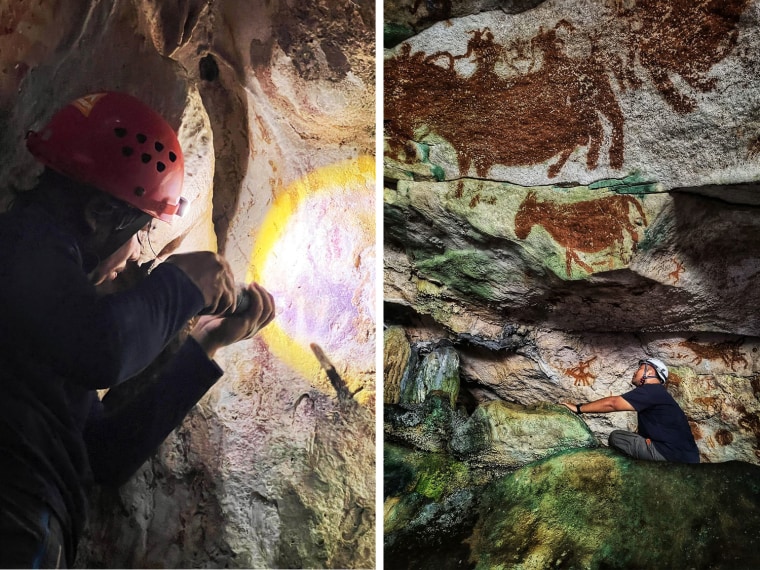
Indonesian scientists Adhi Agus Oktaviana, left, and Shinatria Adhityatama studying handprints on the walls of the cave.Maxime Aubert via AP
The hand stencil is more than 15,000 years older than a painting in another cave on Sulawesi that the same team dated in 2024. That painting, which depicted three humanlike figures interacting with a pig, is thought to be about 51,200 years old.
"I thought we were doing pretty well then, but this one image just completely blew that other one away," Brumm said.
"It really just shows how long people have been making rock art in that part of the world," he said. "It's a very long time."
Researchers hope to find even older art, including storytelling art, in and around Indonesia, much of which remains archaeologically unexplored, he added.
Liang Metanduno is a well-known site for cave art that is open to tourists. But most of the art found so far is paintings depicting chickens and other domesticated animals that are thought to be much more recent, about 4,000 years old.
In 2015, Indonesian rock art specialist Adhi Oktaviana, the paper's lead author, noticed faint images behind more recent ones that he thought could be hand stencils.
"No one had ever observed them before. No one even knew that they were there," Brumm said. "But Adhi spotted them."
For generations, researchers studying Ice Age cave paintings in places like France and Spain, which are about 30,000 to 40,000 years old, "thought, wow, this is really where true art began, true modern human artistic culture," Brumm said.
Recent discoveries in Indonesia, he said, show that humans outside Europe were making "incredibly sophisticated" cave art tens of thousands of years earlier, "before our species ever even set foot in that part of the world."
Prehistoric cave paintings in Sulawesi.Maxime Aubert / AFP - Getty Images
Brumm said the discovery was also interesting because it may shed light on when the first humans arrived in his home country, Australia.
Though Aboriginal peoples are widely accepted as having been in Australia for at least 50,000 years, one archaeological site in the country is said to be 65,000 years old.
"Now that we're finding rock art dating to 67-68,000 years ago on the island of Sulawesi, which is essentially on Australia's doorstep, it does make it considerably more likely that modern humans indeed were in Australia at least 65,000 years ago," Brumm said.
RED BOX RULES: AN IMPORTANT REMINDER
From time-to-time, I should remind all members of NT, etc., that when posting photos, artwork, etc., it's important, when posting, that you own, and/or legally represent the licensing, copyright, etc., of what you post, and TO PROTECT YOUR WORK, TO INCLUDE YOUR COPYRIGHT SYMBOL/INFORMATION; and/or, WHEN POSTING COPYRIGHTED PROPERTY BELONGING TO PARTIES OTHER THAN YOURSELF, TO …
• BE SURE YOU HAVE PERMISSION TO POST, TRANSMIT, etc, SUCH PROPERTY, and,
• IF/WHEN SUCH PERMISSION HAS BEEN GRANTED, TO PROPERLY AND CLEARLY ATTRIBUTE THE COPYRIGHTS TO THEIR RIGHTFUL OWNER(S).
VERY IMPORTANT … IN THE FUTURE, I WILL REMEMBER TO POST THIS CAVEAT REGULARLY.
Thanks, A. MAC

Tags
Who is online


126 visitors
Other amazing examples of ancient cave art include the following:
Chauvet Cave, France - estimated to be created about 30,000 to 32,000 years BP
Cave of Altamira, Spain - dating back to 35,500 years
Kakadu National Park, Australia - estimated to be over 20,000 years old
Nawarla Gabarnmang, Australia - radiocarbon-dated it at 28,000 years old
Lascaux, France - 17,000-years-old
Apollo 11 Cave, Namibia - radiocarbon dated to 27,500 to 25,500 years BP
Tassili n’Ajjer, Algeria - estimated to be ‘only’ about 10,000 years old
Cumberland Valley Caves, United States - estimated to be about 6,000 years old
Serra da Capivara National Park, Brazil - thought to be over 25,000 years old
Caves of Arcy-sur-Cure, France - Radiocarbon dated at up to 29,000 years old
Kapova Cave, Russia - Estimated to be 17,000 years old
You can read more about these examples of ancient cave art, and others, at this link:
I've always found it interesting that this type of ancient art can be found all over the world, especially the hand stencils made with red ochre. The exact same things made exactly the same way in so many different places, New World and Old.
I think the affinity for red ochre started with Homo erectus, and it probably went with them as they made their way around the globe, and then everyone who came later, from Neanderthals to modern humans, could have inherited it from them. So this whole art form might have started before Homo sapiens were even a thing.
So, if the first two humans were created between 6,000 and 9,000 years ago, who painted all this stuff 60,000 years earlier? /s
What's really crazy is that there are a lot of people out there who think these are Satanic deep fakes.
what's crazier still is that those same people have influence at the highest levels of our government ...
Does Ol Scratch really have that kinda time? We evil people don't keep him busy enough?
The fact that there are likely tens if not hundreds of thousands or more young earth Christians out there voting for and supporting those who enable them to continue believing obvious nonsense makes me think an old Reagan quote needs updating, "The trouble with many of our conservative Christian friends is not that they're ignorant; it's just that they know so much that isn't so.".
Many Christians, but especially conservative evangelical Christians, believe they 'know' when and how the universe was created and by whom. They claim to know the future based on prophecies from 3000-year-old herders. They claim to know what's best for other women's bodies, they claim to know about magical invisible immortal 'souls'. And they claim to know how the magical invisible creator of the universe, that says they're special and chosen so you better respect them, wants all humans to live.
And those folk represent millions of votes in our elections. I don't see much difference between them and Ancient Alien believers, or Muslims, or any other religion for that matter, they all invent their own truth and then act as if that truth defines them. It seems very sad to me that they're not willing to just stand up and say "I don't know" when it comes to many of the mysteries in our universe, and because so many refuse to be humble and admit they don't know something, it will take an eternity to make any real progress in uncovering those mysteries.
there's a reason why religious wackos are more likely to die in mass casualty events ...
When I look at such artistry from tens of thousands of years ago, I can't help but wonder how many tens of thousands of years it will take for humanity to become civilized.
Wishful thinking.
LOL
I read something not long ago speculating that humans have already passed peak intelligence. The future might not be nearly as great as we tend to imagine.
That theory is starting to make sense to me.
that's a sobering thought
Bring on the Idiocracy
it's here
There has been a dumbing down in society for the past few decades.
I think the quality of the art is outstanding and really gives a detailed idea of what their lives were like. Now I'm going to say something nutty. The hands don't look human. I have used this method to make prints with my students, and they don't come out with pointy fingertips.
are you an "ancient astronauts" believer ?
Not sure. Can't rule it out. Read "Chariots of the Gods"... lots of stuff not explainable by our current knowledge base.
I read that back in the early 80s and found it interesting, but I'm pretty sure it's all been debunked now.
If aliens were able to travel to our planet, I doubt that their artworks would be so primitive.
Swiss Family Robinson?
Marooned?
LOL. Whichever movie you prefer.
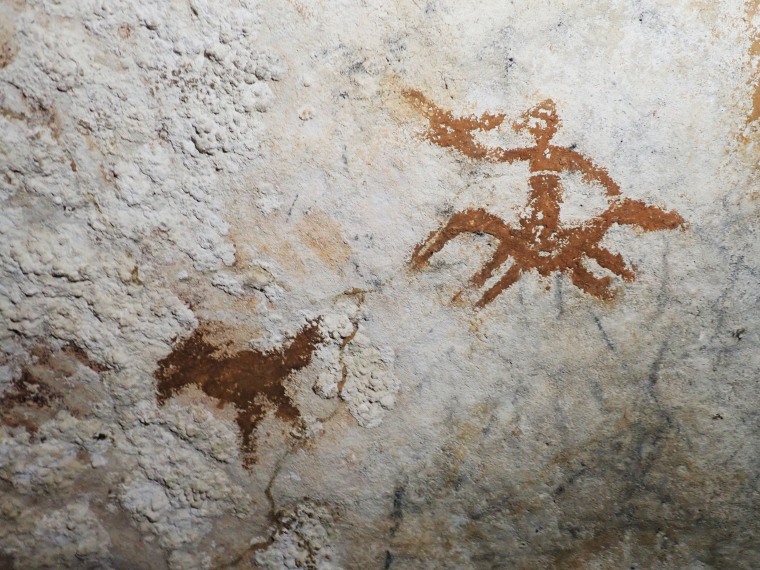
What does the last photo look like to you?
Horses and elephants... probably mastodons.
I meant the last picture in the seed. Not the clicks after.
I was wondering about that, too. At first I thought it was a guy with 6 legs, then I thought it was a guy riding a horse or something, but the domestication and riding of horses started far too recently compared to the age of the cave art.
I have no idea what it's supposed to be.
That image is often shown on 'Ancient Aliens' and as you can see, the implications are hair raising...
People riding horses.
I'm sure it is. Try doing spray art with your hands, and you'll see it doesn't look like that.
LOL. Is it really shown on Ancient Aliens? What do they claim it is?
Okay...
Me neither.
What do you see?
The figure on the upper right is obviously a human figure, probably holding a raised weapon, and possibly standing behind an animal the human figure is hunting and about to kill. I don't know that the other figure on the lower left is necessarily related to the hunting scene. It may have even been painted at a different time by a different artist. If it is part of the same scenario it could represent an animal escaping, possibly the animal the man was hunting.
It looks that way to me, too.
I think Dig is correct that the painting pre-dates the domestication of horses.
Specifically, the caption refers to "paintings" which seems to indicate they are unrelated. Maybe.
I poked around a bit, and I think that Dig is right, too. So then, what are we looking at?
What I said in my Comment 3.2.11. A hunter and his prey. You seemed to agree with that. I doubt that the people at the time had developed any mythology around people riding on other or mythical animals. Possibly. I haven't seen anything authoritative describing that image. It will remain a mystery, for now.
It's clearly evidence of contact between ancient people and 'star men' or ancient aliens who seeded our planet possibly to produce workers for harvesting something from our planet, or so say Ancient Alien theorists. Or it could be ancient people experimenting with spray art. If you're a fan of Occam's razor, then it's hard to see it as anything but the latter.
Pretty much what GSquared described. A human figure holding what looks to be a firearm type weapon standing on or behind a creature of some type. To me the creature looks to be two legged with long arms and what look like wings to me. The animal in the lower left looks to me like a deer or antelope being hunted.
It could not be a "firearm type weapon" from 68,000 years ago. It's most likely a club of some sort being used as a weapon.
The first firearm was the fire lance which was invented in China in the 10th Century. Gun powder was invented in China in the 9th Century. That's only about 1,200 years ago, about 66,500-67,000 years after the cave painting we're discussing.
Of course not, anymore than it could be a 2 legged creature with long arms and wings...
Just describing how the image looks to me.
Maybe, seems like pretty good definition of human features for ancient people experimenting with art on such an ancient drawing. Maybe it's just mold in the cave.
I did some further research. I submitted the photo to Google, and AI Overview is calling that painting a human figure riding a horse. Google AI Overview isn't necessarily correct, of course. If so, it's not 68,000 years old. I believe that only the hand drawing is considered to be 68,000 years old.
AI Overview
Further AI Overview
A tale of prehistoric horses in South Sulawesi
Unfortunately, the photos referred to in the article above do not show for some reason. Maybe someone else will have better luck.
THE GHOST STALLIONS OF MUNA ISLAND, SULAWESI
These kinds of images are always tested for mold and are taken in their entirety, so I am going to go with the idea that these are purposeful, even if we don't understand what they are trying to depict.
That is a little strange. Maybe they were blowing it through a straw from different angles, trying to make sure they did a good job, and it got blown under the fingertips a bit.
If not, then cue up the X-Files theme, lol.
Did they have a manicure?
LOL, very true.
No, I mean if you're blowing it on with a straw (which is how I think it was done) and you do it from the sides as well, not just straight on over the top, then you can probably blow it under or around the fingertips in a way that makes them look pointy.
I'm just speculating, of course, but maybe that's what happened.
But that is what my students did, and you still get rounded tops of your fingers. Just telling you what happened from my experience.
We have to ask ourselves just who was making these silhouettes and why were they making them? Was it everyday, average denizens of the ancient world just blowing red ochre around their hand for enjoyment? Were these caves easily reached?
I think that possibly these hand reliefs were done by someone higher up in the social structure. Being higher up may have led them to be able to grow long nails and thusly create a more prominent pointing of the fingers.
All good questions.
As for who were these people?
Why were they making them is probably a question that can never be fully answered although I am looking for any authoritative theories as to why.
From what I am reading they are described as "relatively easy to reach" via "an easy-to-moderate on-foot journey. We don't know what the people who created the art had to do to reach the caves. It probably required a trek through the jungle.
As for your other point -
That's a theory. Another theory as expressed by "researchers" is:
there's a lot of primitive art on the canyon walls throughout utah and arizona, but it's closer to 800 to 1200 years old ...
I've read that in Utah they've dated some back 10,000 years and in Arizona 13,000 years. There is fossilized evidence of humans in the Western Hemisphere much earlier than that.
As we can see from some of the examples in Comment 1 above, prehistoric art is found all over the world. I prefer to refer to it as prehistoric rather than primitive although prehistoric generally connotes pre-written history. Some of the art of ancient people post-dates that, although maybe not in their cultures, so in that instance, reference to it as prehistoric is not necessarily orthologically correct. Primitive art also sometimes refers to art by artists who were not trained as artists in the classical sense, and whose work may not employ some of the formal artistic elements.
Art created before 3,000 B.C. is generally considered to be "prehistoric", I believe. Under that usage, art that is 800 to 1,200 old possibly might not be considered "prehistoric". Semantics.
since most of that canyon wall art is on sandstone, if it isn't protected from the ravages of time and weather, it disappears.
Did your students take in a mouthful of paint and with a little air from their lungs spray the paint onto the paper? Using the mouthful method you had to be close and move back and forth causing the "paint" to go underneath each side resulting in pointy finger images.
My students used non-toxic paint (meant for this) and sprayed all over their hands with paper underneath their hands. This produced various kinds of prints, but none had pointy fingers.
To me, the hand silhouettes look like birds feet. Did birds have some sort of spiritual meaning in that culture?
I did a search and came up with speculation that the artists brushed pigment onto the hand prints to make the fingers pointy. Apparently the shape had some special meaning for the people who made them.
See Comment 3.3.5 above and the seeded and other linked articles.
Interesting article in Nature. Thanks for the link.
Here's a photo of that strange painting from their paper on Nature .
It looks like the original article above was trying to show us the much older hand stencils under the things that looks like a horse and rider and some kind of animal, which might be exactly that, if they're recent enough.
I also read in other articles that the pointy fingers we've been talking about were made to look like that deliberately to resemble animal claws or something. I don't know if they're really sure about that, though.
Seen at that angle it does look like a human figure riding a horse while chasing an animal, very possibly with a bow and arrow.
AI Overview responding to the question did they use bows and arrows on prehistoric Sulawesi.
The World's Oldest Hunting Scene - discovered at Bulu Sipong 4 on the island of Sulawesi
The animal being hunted might be something like a Shoebill Stork:
Modern Shoebills are from Africa, but maybe there was something similar in Indonesia when the image was created. It also might have simply been a poor attempt to draw a chicken, since chickens are mentioned in the article, and chickens originated with wild Red Junglefowl in southeast Asia, including Indonesia. I don't know why they would be hunting chickens, though, if they were already domesticated.
The object in the figure's hand looks a lot like a bird to me. Think falconry – a hunter with a domesticated bird of prey of some kind. But that's probably not what it is.
I haven't been able to find an estimate of the age of those particular drawings. I wish I could find that out.
Or maybe a spear thrower.
A distinct possibility. Those things were everywhere and greatly predated archery. They were quite effective and easy to use with experience. I played around with them years ago when I was obsessed with flint knapping and other stone age tech, but I didn't get anywhere near as good as this guy...
I'm also not able to peg an estimated approximate date for that particular painting. From the information in my Comments 3.2.22 and 4.1 it could be anywhere from 48,000-39,500 to only 4,000 years ago. I will keep trying to find something more specific.
I also haven't found any information yet about prehistoric falconry on Sulawesi.
It could definitely be a spear. The information I found mentioned in Comment 4.1 above said prehistoric hunters on Sulawesi used bows and arrows, spears and nets.
Notice something in the right hand picture. Definitely the same artist and clearly a man on a horse using a spear.
At first I thought that the picture was depicting the perfect hunting spot to ambush prey, but seeing this, one was using a spear and the other bow and arrow or some other type of throwing weapon.
Also, at the time these depictions were drawn, horses were already domesticated.
As I draw your attention to the painting of the animal towards the top, it has four legs and an additional, ahem, appendage back towards the hind legs with a, um, bulge closer to between the legs and it looks like reigns around the neck. The painting is not of a bovine, the bovine's additional, well um, appendage would be closer to the belly button area, while the equine's is just ahead of or even with the front of the hind legs as this painting depicts.
those are probably dinosaurs being ridden ...
Lol