
China Is Our Last Diplomatic Hope for North Korea


China Is Our Last Diplomatic Hope for North Korea
by John R. Bolton, Gatestone Institute (Formerly published in The Hill), August 13, 2017 at 1:00 pm
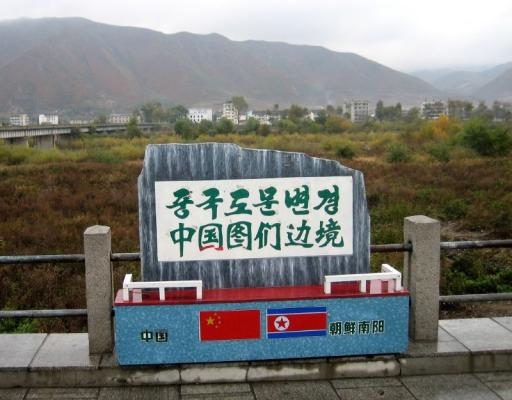
An inscription stone marking the border of China and North Korea, in Jilin. (Image source: Prince Roy/Wikimedia Commons)
Former National Security Advisor Susan Rice acknowledged last week that America's policies regarding North Korea's nuclear-weapons program over the last three administrations had failed. She said, rightly, "You can call it a failure. I accept that characterization of the efforts of the United States over the last two decades."
Former Vice President Al Gore said much the same. They should know. They served under President Bill Clinton, who started things rolling downhill with the Agreed Framework of 1994. This misbegotten deal provided Pyongyang 500,000 tons of heavy fuel oil annually and two light-water nuclear reactors in exchange for the North's promise to abandon its nuclear-weapons efforts.
Pyongyang violated its promise before the ink was dry. In 1999, former Secretary of State James Baker denounced Clinton's approach as "a policy of appeasement." Baker's characterization also applies to much of the subsequent U.S. diplomacy. North Korea has always been willing to promise to abandon its nuclear ambitions to get tangible economic benefits. It just never gets around to honoring its commitments.
After 25 years of failure, we need not tarry long (or at all) on more diplomacy with Pyongyang. Fred Ikle once characterized the North as capable of "boundless mendacity." He was being charitable. Talking to North Korea is worse than a mere waste of time. Negotiations legitimize the dictatorship, affording it more time to enhance its nuclear and ballistic-missile capabilities.
Today, only one diplomatic option remains, and it does not involve talking to Pyongyang. Instead, President Trump should urge President Xi Jinping that reunifying the Korean Peninsula is in China's national interest. This is a hard argument to make, requiring reversal of decades of Chinese policy. It should have been broached years ago, but it is still doable. There is now growing awareness in China that maintaining the two Koreas, especially given the current nuclear crisis, does not benefit China long-term.
Historically, the Korean Peninsula's 1945 partition was always intended to be temporary. Kim Il-Sung's 1950 invasion of South Korea and three years of ultimately inconclusive war resulted in hardening the bifurcation into its current manifestation. Beijing has backed the status quo, believing that North Korea provided a buffer between Chinese territory and U.S. military forces.
Maintaining its satellite, however, has been expensive and risky. China has long supplied more than 90 percent of the North's energy needs, and vast quantities of food and other assistance to sustain Pyongyang's gulag. China has also expended enormous political and diplomatic energy, costing it precious international credibility, to protect the North's erratic regime.
Initially, China saw the North's nuclear and ballistic-missile programs as a problem for America, Japan and South Korea rather than itself. That notion has disappeared, however, under the harsh prospect that today's nuclear crisis will be merely the first of many with North Korea. Moreover, Japan is now increasingly likely to seek its own nuclear capability, a nightmare for China in some respects more troubling than America.
Confronted by this new, deeply threatening reality, Beijing's views on Korean reunification are ripe for change. China has never applied its uniquely strong economic leverage on Pyongyang because it feared so doing could cause catastrophic collapse of the North's regime. That would in turn produce two unacceptable consequences: massive Korean refugee flows across the border into China, and American and South Korean troops crossing the DMZ and quickly reaching the Yalu and Tumen Rivers.
The answer to China's fear of uncontrolled collapse is a jointly managed effort to dismantle North Korea's government, effectively allowing the swift takeover of the North by the South. China can start by quietly bribing the Kim regime's top military and civilian officials, offering political asylum and a safe exile for them and their families in China, while simultaneously cutting off energy and other supplies to the North. Seoul can also offer inducements to key North Korean leaders, reminding them what life could be like in a post-Kim world.
Simultaneously, massive information efforts should be launched throughout the North to spread word quickly on what is happening. The population may lack cell phones and the Internet, but they are far more aware of the outside world than conventional stereotypes. The end of North Korea, and hence the end of its nuclear threat, would be inevitable. The process will undoubtedly be dangerous and somewhat chaotic, but far less so than a completely uncontrolled collapse. And whatever the risks, they pale before the risks of nuclear conflict emanating from the erratic Kim regime.
Washington can offer Beijing two assurances to assuage its concerns. First, we would work closely with China to prevent massive refugee flows either into China or South Korea. Our common interests here are clear. Second, as the North begins to collapse, allied forces would necessarily cross the DMZ to locate and secure Pyongyang's nuclear, chemical and biological weapons stockpiles and to maintain civil order.
These forces would ultimately reach China's border, but we can commit to Beijing that Washington will not station troops there for a sustained period. Instead, we would pledge to base virtually all U.S. military assets near Pusan at the Peninsula's southern tip, to be available for rapid deployment around Asia. They would not constitute a watch on the Yalu.
The alternative to this last available diplomatic play is military force. The imperative of protecting innocent American civilians from the long-term threat of North Korea's nuclear capability dictates that we should be willing to strike those capabilities pre-emptively. But before that, who will argue against this one last realistic diplomatic effort?
John R. Bolton, former U.S. Ambassador to the United Nations, is Chairman of Gatestone Institute, a senior fellow at the American Enterprise Institute, and author of "Surrender Is Not an Option: Defending America at the United Nations and Abroad".
Tags
Who is online
73 visitors
Looking at it from inside China, I have to say that I find some of Bolton's concepts somewhat inexpert. He suggests placing troops at China's border, supposedly to assist China in preventing a mass flow of refugees. He has to be kidding. How would America feel if Mexico or Canada became rogue nations and China were to station troops on America's borders? He speaks of unification of the Koreas - so with what government? Does South Korea want to become part of a China-managed Korea? Would China want a US-friendly and protected state on ITS border?
Previously, as this issue has been discussed on NT before, I was of the opinion that the only logical step to be taken by China would be to depose the present regime and install its own puppet in place. At least that way, there will not be a maniac in control. Bolton does have some suggestions as to how that could be approached.
I don't post red box rules, but if all I see is criticism of the author's or the news source's reputation, rather than discussion of the issue, I wll red flag it and ask a moderator to delete it. I am looking for opinions of how NT members feel the problem can be solved, or at least mitigated.
08/13/17 08:46:56PM @buzz-of-the-orient: so with what government? Does South Korea want to become part of a China-managed Korea? Would China want a US-friendly and protected state on ITS border?
I believe you stated it well, we need to differentiate propaganda, from reality, and reality is that China, wants and needs a " Buffer Zone " and that NK is seen more then just that, it is also a " Lightning Rod " to the world media.
Now lets look World Wide, and take the last 40 Years as a guide line which Nation was the more active in overthrowing Governments? Which one has the most " Foreign Military " bases? Who has more Vetoes in the UN and on what issues?
That is just for a start :-)
Buzz
These forces would ultimately reach China's border, but we can commit to Beijing that Washington will not station troops there for a sustained period. Instead, we would pledge to base virtually all U.S. military assets near Pusan at the Peninsula's southern tip, to be available for rapid deployment around Asia. They would not constitute a watch on the Yalu.
Why not let Chinese forces do the work?
China has the manpower, yet, believe it or not, China just might also be sypathetic to the refugee seekers, but China does not need to increase its population.
08/13/17 11:28:00PM @buzz-of-the-orient: but China does not need to increase its population
I can hazard a guess, that they might be willing to relocate some to those Islands, that would make the UN, more placid, right?
Excellent thought, EA.
Buzz
China has the manpower, yet, believe it or not, China just might also be sypathetic to the refugee seekers, but China does not need to increase its population.
There's no reason China should be expected to take in any North Koreans. Wouldn't Chinese forces moving into NK reduce the likelihood of refugees, at least those heading toward China?
08/13/17 11:38:46PM @another-fine-mess:
They might be good neighbours and friends... but...well lets put it another way, would you allow your Neighbours and Friends' to take over your house?
Buzz
They Might Be Good Neighbours And Friends... But...Well Lets Put It Another Way, Would You Allow Your Neighbours And Friends' To Take Over Your House?
No, however if I were out the way, my brother might for a price.
08/14/17 12:08:19AM @another-fine-mess:
Did Buzz, say that or shall we like " Good Neighbours and Friends " just pretend that he did??
E.A
I believe he suggested something very similar in the article.
Buzz knows me from his days on Newsvine
08/14/17 12:26:29AM @another-fine-mess:
OK Good to hear!
E.A
I think I've figured out where the E.V came from, I've been awake now for 31 hours, it's being to show badly.
Do you know I've only just figured out what you meant by "Did Buzz, say that" I got the entirely wrong end of the stick.
No hard feelings, I have no issues admitting my mistakes.
The answer to China's fear of uncontrolled collapse is a jointly managed effort to dismantle North Korea's government, effectively allowing the swift takeover of the North by the South. China can start by quietly bribing the Kim regime's top military and civilian officials, offering political asylum and a safe exile for them and their families in China, while simultaneously cutting off energy and other supplies to the North. Seoul can also offer inducements to key North Korean leaders, reminding them what life could be like in a post-Kim world.
Simultaneously, massive information efforts should be launched throughout the North to spread word quickly on what is happening. The population may lack cell phones and the Internet, but they are far more aware of the outside world than conventional stereotypes. The end of North Korea, and hence the end of its nuclear threat, would be inevitable. The process will undoubtedly be dangerous and somewhat chaotic, but far less so than a completely uncontrolled collapse. And whatever the risks, they pale before the risks of nuclear conflict emanating from the erratic Kim regime.
He makes it sound like this would be a fairly smooth process, which seems quite unrealistic. Is the NK regime supposed to say "oh look , everything's falling apart" and just throw up their hands in despair? I think they might be more proactive in trying to keep their grip on power intact.
"He makes it sound like this would be a fairly smooth process, which seems quite unrealistic."
As I first pointed out, he appears inexpert suggesting that. I believe it will take WORLD pressure on China to take decisive action in this matter, not just America.
trump wrote (co wrote) "The Art of the Deal"
Maybe he should have read; How to win friends and influence people.
Cause, pissing off world leaders probably isn't the best way to start new relationships, like he seems to have done with many of them. Including China.
Although Trump is not mentioned in the article, and this problem has obviously been exacerbated over the years by successive American administrations, it would be obvious to most world leaders, and certainly to Xi Jinping, that there is cause to be wary of what Trump might do.
China has already unofficially stated it will NOT intercede with North Korea on behalf or at the behest of America, but if America should take aggressive action against North Korea then China will become involved ON THE SIDE OF NORTH KOREA against America.
"...if America should take aggressive action against North Korea then China will become involved ON THE SIDE OF NORTH KOREA against America."
Do you have a reliable source for that conclusion?
I believe China's preference would be to have the problem solved throught the United Nations. As I said above, it will take more than America to push China.
A voice of the Chinese Communist Party has offered a glimpse of the sides Beijing could take if fighting breaks out on the Korean peninsula.
Although China has long been a sworn supporter of its neighbour, if North Korea fires first on the United States, Beijing should not provide the regime any backing in whatever fighting ensues, daily Chinese newspaper Global Times wrote in an editorial Friday.
However, if “the U.S. and South Korea carry out strikes and try to overthrow the North Korean regime and change the political pattern of the Korean Peninsula, China will prevent them from doing so, ” the newspaper said.
from The Globe and Mail
NORTH KOREA
China mulls loyalties as Trump ‘locked and loaded’ for North Korea
NATHAN VANDERKLIPPE
Beijing — The Globe and Mail
Published Friday, Aug. 11, 2017 7:22AM EDT
Last updated Friday, Aug. 11, 2017 6:40PM EDT
Good article. The source article from China does most likely indicate China's position in this issue at this time.
Thus, the proverbial rock and the hard place.
Former National Security Advisor Susan Rice acknowledged last week that America's policies regarding North Korea's nuclear-weapons program over the last three administrations had failed. She said, rightly, "You can call it a failure. I accept that characterization of the efforts of the United States over the last two decades."
Using what criteria? Who, precisely, has NK attacked over the last couple decades? How many dead?
... Oh, that's right... no attacks, nobody dead...
Rice's opinion, considering all that she accomplished in her time in government ( ) is of little interest to anyone, I hope!
The only person stirring the east-Asia pot is Donald Trump, whose bellicose language outstrips even Kim Jung Un's!
Notwithstanding America's policies and the UN's resolutions, NK has continued along the road of development of ballistic missiles and nuclear arms. Although America may have become known as the World's policeman, it's had no success in preventing the development and NK's belligerant moves. Forget the rhetoric.
08/14/17 08:09:37AM @buzz-of-the-orient:
If they had another option, I would like to hear it. lets see Vietnam, Cambodia, Laos, which one has fared better?
Are their people starving? Have those other countries built their mililtary stregths and advancement anywhere near what NK has done?
You are right, Buzz.
... ... and... ??
Yes, Buzz...
... and...??
08/14/17 08:05:00AM @bob-nelson:
The only person stirring the east-Asia pot is Donald Trump, whose bellicose language outstrips even Kim Jung Un's!
Those in front of the cameras, are not the power, they are the puppets, this " teaching " has been going on for a lot longer then Trump.