
“The Dogma Lives Loudly Within You”


 S E E D E D C O N T E N T
The Senate Democrats are attacking Christians again.
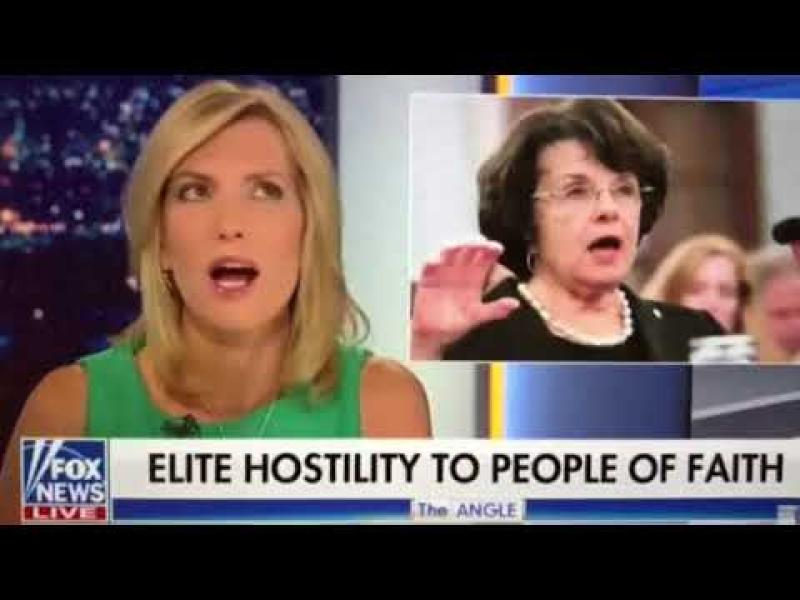
During Amy Coney Barrett’s confirmation hearing before the Senate Judiciary Committee in September 2017, Senator Dianne Feinstein pointedly told the then-nominee, “the dogma lives loudly with in you, and that’s a concern.” The “dogma” to which she referred was Barrett’s Catholic faith, and Feinstein’s not-so-subtle suggestion was that an observant Catholic could not also be a fair and impartial judge.
While this is certainly the most notorious instance of a nominee being grilled about his or her Christian faith, it is far from the only one, as Senate Democrats have continually engaged in questioning that test the limits of the Constitution’s Article VI prohibition on “religious tests” for holding government office.
Their latest target is Brian Buescher, a federal district court nominee from Nebraska. Following Mr. Buescher’s November 2018 nomination hearing, Senators Mazie Hirono and Kamala Harris submitted questions for the recordinterrogating Buescher about his affiliation with the Knights of Columbus—a fraternal service organization of the Catholic Church that claims two million members worldwide.
The Knights are an arm of the Church and one of the world’s great charities, having made billions of dollars in charitable contributions and given millions of hours of volunteer service. Their mission includes aid to the poor, support for people with physical and developmental disabilities, and assistance to victims of natural disasters.
Mr. Buescher joins a growing list of Trump nominees who have been quizzed about their Christian faith:
- In November 2018, Senator Feinstein submitted written questions for the record to Paul Matey (Third Circuit) asking about his affiliation with the Knights of Columbus.
- In October 2018, Senators Feinstein, Leahy, Blumenthal, Whitehouse and Harris submitted written questions for the record to Allison Jones Rushing (Fourth Circuit) asking about her involvement with Alliance Defending Freedom, a Christian nonprofit organization “that advocates for the right of people to freely live out their faith.”
- In May 2018, Senator Sheldon Whitehouse submitted written questions for the record to Peter Phipps (W.D.P.A.) asking about his affiliation with the Knights of Columbus.
- In March 2018, Senator Feinstein submitted written questions for the record to Michael Scudder (Seventh Circuit) noting his membership in the St. John the Cross Parish and asking about his involvement with the parish’s efforts to establish a residential crisis pregnancy center as cited in a parish bulletin.
- In June 2017, Senator Whitehouse(D-RI) submitted written questions for the record to Trevor McFadden (D.D.C.) about his personal views on issues of same-sex marriage and abortion in light of his church membership.(My NRO colleague, Ramesh Ponnuru, detailed that line of inquiry here.)
And the church bashing has not been exclusive to the Senate Judiciary Committee: during a nomination hearing before the Senate Budget Committee in 2017, Senator Bernie Sanders accused Russell Vought—a Christian and President Trump’s nominee for Deputy Director of The White House Office of Management and Budget—of being an “Islamaphobic” on account of his religious views.
These inquiries directed to Christians violate the spirit if not the letter of Article VI, which provides that “no religious test shall ever be required as a qualification to any office under the United States.”
In a letter to the Senate Judiciary Committee following the Amy Coney Barrett’s nomination hearing, Christopher Eisgruber, President of Princeton University, urged the Committee to “refrain from interrogating nominees about the religious or spiritual foundations of their jurisprudential views.” A constitutional law scholar who clerked for Justice John Paul Stevens, Eisgruber argued that Article VI’s prohibition on religious tests was a “bold endorsement of religious freedom.” Eisengruber explained that “[b]ecause religious belief is constitutionally irrelevant to the qualifications for a federal judgeship, the Senate should not interrogate any nominee about those beliefs.”
Nearly 16 months later, Senate Democrats persist in questioning nominees about their Christian faith. At its core, the questioning reveals the anti-religious bigotry motivating the modern day Democrats. The inescapable irony is that some of the great lions of the Democratic Party, such as John F. Kennedy and Al Smith, were once victims of the very same bigotry that their party now perpetuates.
So why are today’s Democrats so suspicious of Christians? The unfortunate truth is that progressives no longer believe there is a place for people of genuine faith in public service. This stands in sharp contrast to the Founders, who universally recognized the role that religion plays in undergirding our civil society and freedom (although not all of the founders were men of faith themselves).
Borrowing from Alexis de Tocqueville’s observations in Democracy in America,author and intellectual Os Guinness “the golden triangle of freedom” as consisting of these three mutually reinforcing values, each fully dependent on the others: freedom, virtue, and faith. Guinness argues that freedom requires virtue, virtue requires faith, and faith requires freedom.
James Madison illuminated the concept in his speech to the Ratifying Convention on June 20, 1788, asking: “Is there no virtue among us?” Assuming the answer, Madison continued, “If there be not, we are in a wretched situation. No theoretical checks—no form of government can render us secure. To suppose that any form of government can secure liberty or happiness without virtue in the people is a chimerical idea.”
Their message? If we don’t like what you believe, we think you are unfit for judicial service.
Sure sounds like a religious test to me.
Tags
Who is online


120 visitors
James Madison also said this,
and this,
And this too.
James Madison also wrote the landmark work on the subject of separation of church and state known as Memorial and Remonstrance Against Religious Assessments.
The full work he wrote.... ( to the General Assembly of the Commonwealth of Virginia )
He's talking about a bill in the Virginia State House concerning Pay for the ministers of religion, namely the christian religion)
A man's religion is inviolate, government is not a hindrance to nor an obstruction on a man's duty to his maker.
Religious government is slavery!
You allow an establishment of religion, what prevents subsequent legislation establishing other establishments? What prevents such an establishment from mandating complicity?
Making an establishment of religion in any way shape or form places government over god.
Once an establishment of religion is created, religion can become civil policy or be cited as civil policy, also it makes man in the form of government establishment, the arbiter of salvation instead of the creator.
Well, if you can understand the meanings here, I'll put it in 25th century language..... "Why does god need a starship?" -- Captain James T Kirk, stardate 2465
History proves that when religion is given administrative power over it's flock, the flock always yearns for a return to the days of when it wasn't so. When the church had no such administrative power. When the church was at it's greatest in their view.
An establishment of religion in civil authority throuout history has been shown to either bring forth tyranny or be it's willing helper.
Creating an establishment of religion will be viewed amongst the persecuted of the worls as a purveyance of intolerance rather than as a beacon of freedom.
In fact such establishment will be a driving force to drive people out of this nation rather than welcome them, as history has also shown.
Complete religious liberty destroys the ability of various religions from extracting and exhorting there adherents to violent bloodthirsty purges of the citizenry in pursuit of their versions of Peace Love and Charity.
Instead of spreading the truths of the creator, such an establishment would serve only to wall it off to those that most need it.
Once such an establishment is created, it will be difficult, nee impossible to enforce any law the establishment holds to be invalid. What would be the effect on government if it was seen to be ineffectual in defending it's laws against the establishment?
The will of the people, upon fair & open consideration of the establishment will reverse the will of the representatives in the legislature or the leaders of the several counties.
Madison, praying to god, that he open these representatives eyes to the truth of freedom and wish that they vote down any establishment of religion in any degree.....
Seems to me that Madison was against even such a small establishment as setting a stipend for ministers in the State of Virginia as a clear statement of the extent of his belief in the exclusion of any religious establishment in the governing of this nation.....
In 20th century language?...
Not only no but HELL NO!
I would go as far as to argue that James Madison would have been opposed to the tax free status for churches because that is a state support of religion by proxy.
He certainly didn't support have Chaplains on the government payroll.
Well, I think you are correct. (it's a reasonable assumption given his position on the relationship between man, god and government)
In fact in this little argument he clearly states that the christian religion survived and grew during some of the greatest repressions ever foisted against a people....
That's why I quoted "Why does god need a starship", by extension, "Why does god need a government?"
In case anyone objects to my reading, I can provide linkage to Washington, Jefferson, Adams & Hamilton all making the exact same argument.....
When your right, your right. I play no favorites...
There is never any good for a free and stable government by allowing the government and religious belief to mix. They saw what happened in Europe when religion gained the power of the state so they went as far as they could to build a wall between church and state that was impenetrable so it would not and could not happen in the US.
Religious conservatives and those who claim to support a literalist/originalist interpretation of the Constitution will deny all of this because these words didn't appear verbatim in the US Constitution, despite the fact that the idea was very clear and the funding fathers never suggested otherwise. Scalia went so far as to claim that there is no separation of church and state.
NO, they get stuff others have to pay for free
congress decides who gets taxed and how much.
Be very careful here in criticizing their interpretation by doing the exact same thing they do. Don't be an absolutist cause none of the founders were.
Me I cannot take one little sentence and claim that is what they meant in their entirety. Jefferson's little "WALL of SEPERATION" statement has been blown all out of proportion by your side into something as absolute as the sun will shine tomorrow.
When it really wasn't.
I play no favorites and I do not take the founders lightly, nor do I pervert them to my own absolutist ends.....
I agreed with you here cause you are correct in so far as Madison was answering a bill to pay the clergy out of state funds..... that does not mean that Madison did not support religion.
And I know a lot more about it than most.....
So lets not take a good thing, and turn it into a bad thing....
ok?
This is so you. You just got through presenting James Madison as a champion of separation of Church and State and then immediately go against it by saying the Church should be subjected to the State. You want to tax Churches yet don't seem to know what that means. If you tax Churches, then Churches will have every reason to involve itself in government. No taxation without representation was a founding principle of this country. But worse, since in your world, Churches would be taxed, they would have every right to demand tax dollars that other entities enjoy. But of course, that works for you, too, because then you get to control how churches operate because now the government has the leverage of how taxes are used to control the Church.
She is not for the separation of Church and State. She is for the subjugation of the Church by the State she envisions. She only uses the Separation clause because it is a tool she feels she can use to prevent the Church from fighting back, while ignoring the limitations the clause puts on her side of the issue. Her goal is the elimination of religious expression outside one's own mind. One cannot even vote according to their religiously informed conscience without her believing that the separation clause has been violated. Her view is you can believe whatever you wish, but you must function day to day within society according to strictly humanist parameters. Your religiously held views must be put away when you leave your home or church grounds and you must act in her version of what she considers moral. In essence, she is epitome of what she claims to fight against. Someone who is forcing her moral views upon society. Somehow she thinks that's perfectly okay to do because, in her view, her views are not religious. She doesn't realize that they are. Religion, at it's simplest is your belief about what reality is.
Put more simply, it isn't so much a secular government she is concerned with but the enforcement of a purely secular society.
A tax-exempt status for churches is an example of proxy fiscal support by the state. Why should the state support churches? The tax on churches would be a sliding scale tax with larger churches paying a higher rate. Charity income that is spent on others would be tax exempt. Missionary spending is not charity.
All of the members of the church already have guaranteed equal representation so why should the church as a group also have representation when the church is not a citizen on its own. This idea is the problem with the Citizens United decision that creates corporate citizenhood.
That is nonsense. You have the guaranteed right to believe and worship as you wish. What you don't have is the right to is the state supporting that religious belief by paying for a bible or a church for you to worship in. As an atheist why should my tax dollars be spent on the religious beliefs of others? What secular social good does religion do for society to be worthy of that fiscal support? Shouldn't a church be self-supporting by it's members?
Churches need to pay property taxes, except on religious cemeteries. I'd even be willing to give them an exemption on the minister's salary up to $50,000.
Churches tax dollars would be exempt from military spending and be limited to public education, parks and the social safety net because most religions are pacifists.
My daughter went to a religious daycare but we paid for that by the week.
Churches didn't have the fiscal power in the 1790s that they do now. There was no such thing as televangelists and mega-churches with religious TV channels. I am forced to pay for 6 religious channels that I do not watch.
The Catholic church is a criminal organization and they get huge tax dollars for that nonsense because of their hospitals and the fact they are the adoption agency in many states.
President Harry Truman Speech on Our Laws
Address Before the Attorney General's Conference on Law Enforcement Problems.
February 15, 1950
The fundamental basis of this Nation's law was given to Moses on the Mount. The fundamental basis of our Bill of Rights comes from the teachings which we get from Exodus and St. Matthew, from Isaiah and St. Paul. I don't think we emphasize that enough these days.
If we don't have the proper fundamental moral background, we will finally wind up with a totalitarian government which does not believe in rights for anybody except the state.
Letter from John Adams to Benjamin Rush
John Adams
January 21, 1810
(Adams criticizes Paine's attack on Christianity and defends the truth of Christian faith and his own discipleship)
Thomas Paine's] political writings, I am singular enough to believe, have done more harm than his irreligious ones. He understood neither government nor religion. From a malignant heart he wrote virulent declamations, which the enthusiastic fury of the times intimidated all men, even Mr. Burke, from answering as he ought. His deism, as it appears to me, has promoted rather than retarded the cause of revolution in America, and indeed in Europe. His billingsgate, stolen from Blount's Oracles of Reason, from Bolingbroke., Voltaire, Berenger, &c., will never discredit Christianity, which will hold its ground in some degree as long as human nature shall have any thing moral or intellectual left in it. The Christian religion, as I understand it, is the brightness of the glory and the express portrait of the character of the eternal, self-existent, independent, benevolent, all powerful and all merciful creator, preserver, and father of the universe, the first good, first perfect, and first fair. It will last as long as the world. Neither savage nor civilized man, without a revelation, could ever have discovered or invented it. Ask me not, then, whether I am a Catholic or Protestant, Calvinist or Arminian. As far as they are Christians, I wish to be a fellow-disciple with them all.
Message from John Adams to the Officers of the First Brigade of the Third Division of the Militia of Massacusetts
John Adams
October 11, 1798
"we have no government armed with power capable of contending with human passions unbridled by morality and religion. Avarice, ambition, revenge, or gallantry, • would break the strongest cords of our Constitution as a whale goes through a net. Our Constitution was made only for a moral and religious people. It is wholly inadequate to the government of any other. "
From George Washington's Farewell Address 1796
"Of all the dispositions and habits which lead to political prosperity, religion and morality are indispensable supports. In vain would that man claim the tribute of patriotism, who should labor to subvert these great pillars of human happiness, these firmest props of the duties of men and citizens. The mere politician, equally with the pious man, ought to respect and to cherish them. A volume could not trace all their connections with private and public felicity. Let it simply be asked: Where is the security for property, for reputation, for life, if the sense of religious obligation desert the oaths which are the instruments of investigation in courts of justice ? And let us with caution indulge the supposition that morality can be maintained without religion. Whatever may be conceded to the influence of refined education on minds of peculiar structure, reason and experience both forbid us to expect that national morality can prevail in exclusion of religious principle."
Too bad the Constitution, with its separation of church and state, makes all that irrelevant.
For most of our nation’s history, the people wisely kept atheists out of elected office by their vote on election days. Only when we began our departure from the Christian values and principles did this nation begin its descent into depravity and the breakdown of government
Horse shit.
Show me in the constitution where it says "Separation of Church and State".
You can't cause it doesn't.....
Oh please! As if theists ran things smoothly or atheists are somehow incapable of governing. Your bias (or hatred) against atheists is quite apparent. Fortunately, the Founding Fathers were wise enough not to constitutionally exclude anyone from public service. Hence, ones religious affiliation, or lack of, is irrelevant. And this country was never governed according to "Christian principles," (whatever that is). It is governed according to the Constitution. What you seemean to prefer or advocate is a theocracy .
That's putting it mildly.
Do you think you have the right to prival or a fair trial? Those aren't explicitly in the Constitution either. Fortunately, the Founding Fathers were wise enough to recognize and acknowledge the necessity and inclusion of separation.
that doesn't mean that it's not inferred.
Jefferson's own letters and contributions to the First Amendment, the Establishment Clause and the Free Excercise of Religion clause bear that out.
Jefferson first used the metaphor in his letter to Dansbury Church and the SCOTUS has used it over and over again.
Not to mention the SCOTUS also deemed separation be in the Constitution.
Not at all. I would not want a theocracy.
what the founders and past presidents were saying (and I concur) is that only those holding to Christian values and principles along with a reverence for God have the proper foundation to represent the people and act in accordance with the Constitution.
they didn’t believe atheists had that character and neither do I
If the founders did not think atheists could not or should not govern (and there's no logical reason to assume they couldn't), then they would not have included the no religious test clause. But thanks for proving me right about your bias against atheists.
Times have change (which is a good thing)......nothing wrong with atheists. Rather an atheist than a Christian who would want to change separation of church and state.
Ah, okay. So you just want all legislators and elected officials, the President, Judges, teachers, cops, our civil servants, pretty much everyone to be "Christian" and do their jobs through the moral lens of their biblical upbringing and apply Christian virtues in every day life, create and vote on laws based on their Christian beliefs, but you definitely don't want a "theocracy"...
I'm curious, but what do you imagine "theocracy" to look like? Is it only a "theocracy" if it looks like some of the Muslim theocracies where blasphemy is punishable by death? Having an evangelical sitting on a court and passing judgment based on his biblical beliefs and not the law would be a clear violation of the establishment clause, as would any evangelicals creating, voting on and passing laws that are based on any religious beliefs like banning alcohol sales on Sunday or denying gay couples a marriage certificate. You have said before you don't think the government should regulate marriage at all and I agree to a point, but the fact is the government does regulate partnerships and has laws that apply, whether a business partnership or a personal partnership which have many legal questions that have to be defined. Who's allowed to sign the checks, who's allowed to make decisions if one partner is incapacitated, who gets control of all assets if one partners dies, all sorts of legal questions that have to be defined in both business and personal life. So the government has to regulate marriage up to the extent of defining the laws that would apply to it. Allowing Religion to decide what partnerships are or aren't allowed is an obvious violation of the establishment clause.
That's nice. I sort of feel the same way about Christians and other religious persons. Only a religious person could drown her 5 kids in the bathtub or be sick enough to justify the genocide of millions. Only by believing in a higher power could they believe that whatever that higher power tells them to do is justified no matter how vile and how deplorable, if their God told them to open fire on kindergartners then to them it's justified because their God allows them to shrug off any personal responsibility. This is why I will never allow a Christian around my children without a atheist chaperone.
"While in prison, Andrea Yates stated she had considered killing the children for two years, adding that they thought she was not a good mother and claimed her sons were developing improperly. She told her jail psychiatrist: "It was the seventh deadly sin. My children weren't righteous. They stumbled because I was evil. The way I was raising them, they could never be saved. They were doomed to perish in the fires of hell."
Yes, Christians with a reverence for God who have the proper foundation like a belief in invisible spirits, a flawed book full of contradictions and a loving God who torments his own creations for eternity if they failed their few minutes on earth. Yeah, those are the people we should all want making laws and deciding punishments for laws breakers... /s
Since there's only ever been one openly atheist mbr of Congress I gotta think the breakdown of government and descent into depravity would fall upon someone else's shoulders (possibly religion, possibly that politicians as a whole are simply POS's)
Wrong :
Well posted pat.....
So yes it does not say it, but....
" Separation of church and state " is paraphrased from Thomas Jefferson and used by others in expressing an understanding of the intent and function of the Establishment Clause and Free Exercise Clause of the First Amendment to the United States Constitution which reads: "Congress shall make no law respecting an establishment of religion, or prohibiting the free exercise thereof..."
The phrase "separation between church & state" is generally traced to a January 1, 1802, letter by Thomas Jefferson , addressed to the Danbury Baptist Association in Connecticut , and published in a Massachusetts newspaper. Jefferson wrote,
Yes I'm well aware of where it was said and who said it and why he said it.
And that most of the other founders completely agreed with it..... I also understand the why.
My thing is they claim it is a direct constitutional rule when it isn't. It is how they (the founders) believed the constitutional provision they wrote should be used/applied.
It isn't the law, it is the policy that the law embodies. And that is how the Supreme court has interpreted it and applied it.
my opinion, stop calling it something it isn't....
That comes from President Thomas Jefferson's letter to the Danbury Baptists that has been used by the SCOTUS as the meaning of the Establishment Clause.
Are you denying Thomas Jefferson's, John Adams', Thomas Paine's, and James Madison's historic, recorded views on Christianity and the U.S. government ?
This is absolute nonsense and you have been corrected many times and yet you still try to promulgate this lie.
Thomas Paine,
See my response @ 5.1.18
Five and a half hours ago when Perrie posted the same response to me.....
That letter is what the Establishment Clause means and how is to be interpreted by the courts. The US Constitution is not a verbatim listing of our rights. It is a statement of ideas and how the government is to be organized. If the Constitution were a verbatim statement of our rights it would dwarf War and Peace in length. We have the Supreme Court to interpret it on individual issues.
Jefferson's Virginia Statute for Religious Freedom and Madisons' Memorial and Remonstrance drives that same idea home very clearly.
So what your describing is these peoples views of the importance of personal morality which comes from their religious education.......
I agree with each of them, but one must remember they are talking about a moral people NOT A MORAL GOVERNMENT!
In that respect, you do the same thing they do......
Absolutism NEVER WORKS. it only brings more suffering and abuse.....
The government should NOT be religious, but it should be populated by men with morals, which are necessarily learned from religion.
And any morally honest man will recognize the truth of this absolutely..... Politics aside...
MORALS: Webster
a : of or relating to principles of right and wrong in behavior : ETHICAL moral judgments
b : expressing or teaching a conception of right behavior a moral poem
c : conforming to a standard of right behavior took a moral position on the issue though it cost him the nomination
d : sanctioned by or operative on one's conscience or ethical judgment a moral obligation
e : capable of right and wrong action a moral agent
Sorry, you do not have to be religious to be moral.
Also if you are deciding who is moral & who isn't does that not go against your "judge not" rule? YOU are judging whether people are moral or not - think that is a no-no for you guys.
I have to question the character and integrity of those who state one needs god/religion to be moral. Or the inverse where they state one cannot be moral without god/religion.
Can either one of you point specifically where I said one HAS to be religious to be moral?
So, now that you have read into my statements something I did not say, you feel justified in condemning me for my beliefs.....
Thank you both for a perfect example of being what your complaining against.
I was with you up till that line. Having a religious background doesn't mean a person has adopted and applied any moral code just as having an atheist background doesn't mean a person hasn't adopted a moral code. Religion and morality are not mutually exclusive. Besides, I'd wager that 99 out of 100 atheists were raised in one faith or another, very few atheists were actually raised as atheists. And the reality is, it's far more honest to admit we don't know what our origins truly are, no religion or faith has ever been proved, so after doing the research which concludes that very fact, to continue carrying water for an unproven belief just because you were promised a reward or fear a penalty is rather self serving and ridiculous.
Do you often post things you do not believe in? You posted this statement. If you do not believe it why post it? If it was not your statement where is the citation?
Judging - that is a sin - therefore you are not moral. As a Wiccan, I do not believe in sin so your words have no meaning to me. I am as moral as you are.
Religion is but one source, and it is the primary source, but not the only source....
So my statement is accurate and is not a claim that religion is the ONLY way.... (as seems to be claimed)
The rest of your opinion is of no value to me.....
It's is impossible to have a discussion of anything when one imputes their understandings or lack thereof onto another's statements......
I find that such is the normal line of discourse in today's forum environment.
Instead of inquiring as to the real point one automatically goes to ridicule.
a severe lack of open minds....
I think your reply was meant for Veronica. And I made no mention of your beliefs, whatever they are.
You said this... @ 5.2.3
It was said in response to her as support for her position questioning me.
So I responded to both of you. Your response to her is an insult to me over something I did NOT say.
That is the way I see it.
But that being said, thank you for the clarification of your intent and recognition of not knowing what position I take. So your statement is a general insult against anyone with a religious moral background and goes absolutist about it. got it....
Don't worry, I think they did too.
ridicule - huh, looks like you fall into it too.
I stand by my statement - it appears you do not.
Thank you for proving my point....
No further need to chase pointless semantics......
It was a response as an observation and personal experience. It was not an insult, nor was it directed at you.
Necessary: adjective - required to be done, achieved, or present; needed; essential.
Necessarily: adverb - as a necessary result; inevitably.
"The government should NOT be religious, but it should be populated by men with morals, which are necessarily learned from religion." - 5.2
If you claim morals "necessarily" come from religion, then you are claiming that is the only way to achieve them. If you intended to say "aren't necessarily" then I apologize for commenting on the mistake, but it appeared you were in fact claiming that man can only learn morality from religion, which is an obvious falsehood.
No I explained my reasoning....
I said:
Particularly in today's world..... But you can have it mean anything you want. I mean really it doesn't matter to me what you want it to mean. I made my position clear.
The Founders clearly believed that morals come predominantly from religious teachings. This is why on the one hand Religion has no place in government and on the other government has no place in religion. Religion is specifically preserved for the individual to determine how he is going to believe. They were all believers in god, yes even Thomas Paine believed in god. Most of them believed in some form of religion, with most of these very intelligent men believing that religion is the primary and in some cases the best way to inculcate morals in men. Therefore Religion was good for the nation and citizens.
There are two ideals on the philosophy of the Separation of Church & State, and they do not agree. They are called "Friendly Separation and Hostile Separation".
Let me explain....
Now that is a lot of reading, but yes there are two views on Separation of Church and State, the American view of cooperative separation, and the European view of Absolute Separation... (absolute being there is no public reference at all to religion, it is permissible in the individuals home of his church but otherwise no public recognition governmental or otherwise)
The cooperative view established during the American Revolution and the Hostile view established during the French revolution.....
In other words a republican view as the Founders of America expressed or a democratic view as the Jacobins of France expressed....
Seems to me that your arguing for the Jacobin interpretation being brought over here and established as de-facto. The complete destruction of religion in general public society.
And I oppose that completely with no reservations.....
Under the United States Constitution, the treatment of religion by the government is broken into two clauses: the establishment clause and the free exercise clause . Both are discussed in regard to whether certain state actions would amount to an impermissible government establishment of religion.
The phrase was also mentioned in an eloquent letter written by President John Tyler on July 10, 1843. [ Tyler wrote, "The United States have adventured upon a great and noble experiment, which is believed to have been hazarded in the absence of all previous precedent – that of total separation of Church and State. No religious establishment by law exists among us. The conscience is left free from all restraint and each is permitted to worship his Maker after his own judgment. The offices of the Government are open alike to all. No tithes are levied to support an established Hierarchy, nor is the fallible judgment of man set up as the sure and infallible creed of faith. The Mahommedan, if he will to come among us would have the privilege guaranteed to him by the constitution to worship according to the Koran; and the East Indian might erect a shrine to Brahma if it so pleased him. Such is the spirit of toleration inculcated by our political Institutions . … The Hebrew persecuted and down trodden in other regions takes up his abode among us with none to make him afraid . … and the Aegis of the Government is over him to defend and protect him. Such is the great experiment which we have cried, and such are the happy fruits which have resulted from it; our system of free government would be imperfect without it. ") quoted in Nicole Guétin, Religious ideology in American politics: a history (2009) p. 85 ]
During the 1960 presidential campaign the potential influence of the Catholic Church on John F. Kennedy's presidency was raised. If elected, it would be the first time that a Catholic would occupy the highest office in the United States. John F. Kennedy, in his Address to the Greater Houston Ministerial Association on 12 September 1960, addressed the question directly, saying,
And I supported that man during his election, wasn't old enough to vote, but was old enough to ring doorbells.
I'll go with him on this one, along with the Founders....
"The friendly type limits the interference of the church in matters of the state but also limits the interference of the state in church matters." [Maier 2004, p. 110 ]
"The hostile variety, by contrast, seeks to confine religion purely to the home or church and limits religious education, religious rites of passage and public displays of faith." [Maier 2004, p. 111 ]
Which variety does the denial of a tax paying law abiding citizen their right to a marriage license fall? Which type is represented by American citizens being denied service from public businesses?
I see very little "limit" to the "interference of the Church in matters of the State" as they stomp around demanding their right to put their commandments on court house steps, demand their right to discriminate against law abiding citizens, demanding their right to inject their religious holidays and traditions into the public square, into public schools and into local laws such as bans on alcohol sales on Sunday in many States.
I see reasonable, Christian, but secular leaning, American citizens questioning this virtually unrestricted injection of Christianity into Americas public spaces who are being attacked and vilified by other Christians falsely claiming the secular leaning Americans are "waging a war" on Christianity.
So the claim of any "hostile separation" against Christians is pure bullshit. The only "hostile separation" are the hostile feelings some Christians have as their fingers are peeled off the pedestal of privilege they have been enjoying for the last 200 years of American history.
" When You’re Accustomed to Privilege, Equality Feels Like Oppression "
But it is actually what your side is demanding of the courts and government. I don't agree with their side either cause they are demanding that religion take precedence over government, but that does not allow for your side to demand government over religion either....
So as your saying with your privileged argument is that religion has had a large influence on America, and that needs to end.
This should be a completely godless nation in which religion becomes the hidden oppressed stepchild of the revolution and creation of this nation.....
A typically progressive liberal stance, it is also the stance taken by almost every totalitarian regime man has established on the planet.
Political religion is mentioned in the details I posted, that is also a trending upwards line of reasoning, it's where a political ideology uses religious principles to advance it's tyrannical aims..... the government becomes the religion.
Hard to argue against the ideal that such is what is being revealed about the progressive democrats....
So really in essence it is just more hate.
Your last statement about "the Privileged" (meaning Christians) is a perfect example..... Most people in this nation are christians and have been since the creation of it. I guess that what your side intends is to eliminate that. By government mandate.
Placing government over religion just like your side want's to put government over everything.
Clearly Madison's exhortation to the Virginia Assembly states that is also not permissible under the Virginia articles nor this constitution.
Religion over government is a religious blasphemy, so is government over religion, both precepts are abhorrent in a free nation.
I, like the Founders, are against both. Which was the complete understanding of our system at least through the Kennedy administration.
Thank you for the discussion..... It is very revealing...... (fundamental change is the current mantra, if your side wants European ideals over here, give it up, and go move over there where you will be more happy)
When it comes to the law, YES! Government should be "over" religion when it comes to the laws that govern our nation. There are laws to prevent some people from acting on their belief that their religious rights trump others right to not be ruled by their religion, to stop those trying to legislate morality.
So we have secular laws that govern everyone, and then each faith be it Christian, Muslim, Hindu, Judaism, Buddhism can have their religious laws that they can choose to follow, or not. The secular laws only legislate actions for which the Supreme Court ruled was not violating religious freedom.
"The Court investigated the history of religious freedom in the United States and quoted a letter from Thomas Jefferson in which he wrote that there was a distinction between religious belief and action that flowed from religious belief . The former "lies solely between man and his God," therefore "the legislative powers of the government reach actions only, and not opinions." The court considered that if polygamy was allowed, someone might eventually argue that human sacrifice was a necessary part of their religion, and "to permit this would be to make the professed doctrines of religious belief superior to the law of the land, and in effect to permit every citizen to become a law unto himself." The Court believed the First Amendment forbade Congress from legislating against opinion, but allowed it to legislate against action."
So when Christians "act" on their faith by discriminating or actively injecting their religious traditions into the public square, into schools and court houses, that's when they've crossed the line. It's not "hostile" to stop someone from breaking the law and if they are doing so at the behest of their religion then they should take that up with the courts, not getting all butt-hurt at the people who tried to get them to follow the law.
Correct, the point your avoiding is it is supposed to work the exact same way for the secularists....
And your side is advocating for secularists to have a greater say than the religionists. Your side is doing the exact same thing you are claiming the religionists are.
NEITHER SIDE SHOULD HAVE ANY ADVANTAGE OVER THE OTHER!
And that is the problem in a nutshell.....
NO human being is qualified, nor has the right, to judge the morals of another human being. That is the exclusive right of the Creator.
And before any human being deems they have that right, let them look first in their own mirror and correct their own sin of trying to usurp the sole right of the Creator.
NO religion on earth gives anyone the right to judge another human being, as NO human being is without sin themselves.
My opinion.
AHHH and someone who actually gets it!
Good to see you sis and thank you for that!
Thank you my Brother. No one is born the right to judge others. However, there seems to be a lot of people in the world, including here on NT from all political spectrums who feel they have that right.
When it comes to politics and religion, there is no right of wrong side. Neither are without fault.
My opinion.
I have to believe that if this type of questioning had been directed at a Muslim, Jew, or even atheist, there would be a lot more outrage in the media.
It's not fair to interrogate a person about their religious beliefs or assume that they would be incapable of following the Constitution because of those beliefs. And if turns out in actual practice that they do have a problem reconciling those two, we already have remedies in place.
Religion (at least for the most common religions) should not be a litmus test for an office or a job. It is unfair and wrong to presume that a member of a particular religion is in any way less qualified than an irreligious person. The questions need to focus on qualifications and the ability of an individual to think critically / objectively on the job regardless of privately held religious views.
There shouldn't be a need for a religious litmus test, but I'm afraid there is such a need. Religious people are also unpredictable, you never know what event or words will trigger a full religious breakdown.
It varies of course, but I understand what you are saying. Personally I do not want someone with power making a decision based on faith. I think most religious politicians are ' safe ' in that regard (they -sadly- make decisions based on personal opportunity for the most part - another serious problem). An example of the faith-based decision making is George Bush 43. Bush purportedly attributed part of his war calculus to his faith: Bush: God told me to invade Iraq.
Was Gandhi moral?