
Scientists grow mini human brains to power computers

 S E E D E D C O N T E N T

It may have its roots in science fiction, but a small number of researchers are making real progress trying to create computers out of living cells.
Welcome to the weird world of biocomputing.
Among those leading the way are a group of scientists in Switzerland, who I went to meet.
One day, they hope we could see data centres full of "living" servers which replicate aspects of how artificial intelligence (AI) learns - and could use a fraction of the energy of current methods.
That is the vision of Dr Fred Jordan, co-founder of the FinalSpark lab I visited.
We are all used to the ideas of hardware and software in the computers we currently use.
The somewhat eyebrow-raising term Dr Jordan and others in the field use to refer to what they are creating is "wetware".
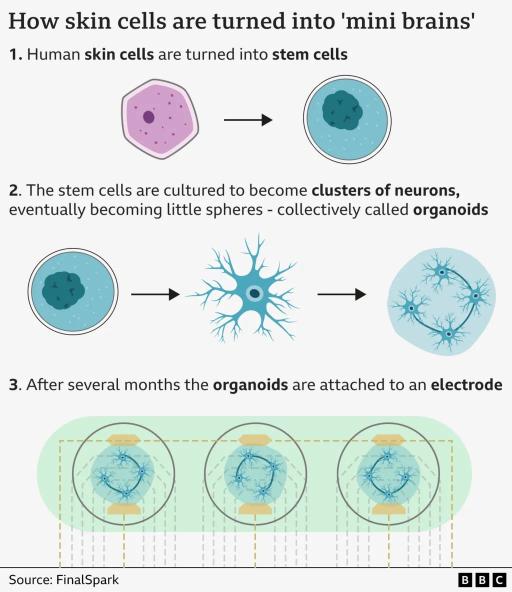
In simple terms, it involves creating neurons which are developed into clusters called organoids, which in turn can be attached to electrodes - at which point the process of trying to use them like mini-computers can begin.
Dr Jordan acknowledges that, for many people, the very concept of biocomputing is probably a bit weird.
"In science fiction, people have been living with these ideas for quite a long time," he said.
"When you start to say, 'I'm going to use a neuron like a little machine', it's a different view of our own brain and it makes you question what we are."
For FinalSpark, the process begins with stem cells derived from human skin cells, which they buy from a clinic in Japan. The actual donors are anonymous.
But, perhaps surprisingly, they're not short of offers.
"We have many people who approach us," he said.
"But we select only stem cells coming from official suppliers, because the quality of the cells are essential."
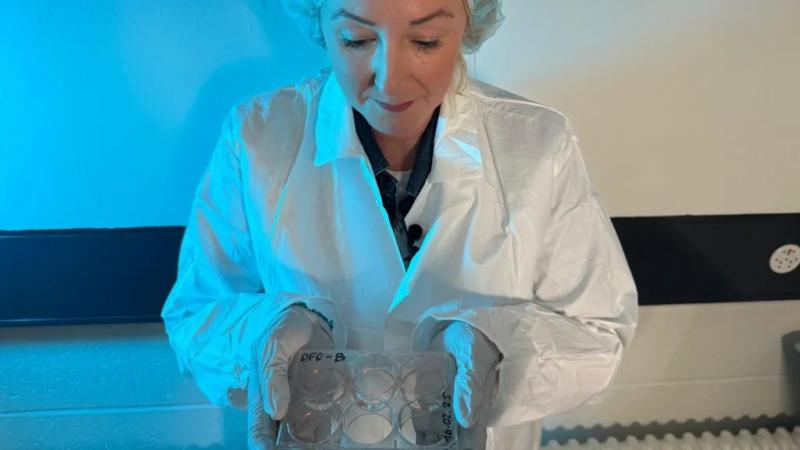
In the lab, FinalSpark's cellular biologist Dr Flora Brozzi handed me a dish containing several small white orbs.
Each little sphere is essentially a tiny, lab-grown mini-brain, made out of living stem cells which have been cultured to become clusters of neurons and supporting cells - these are the “organoids”.
They are nowhere near the complexity of a human brain, but they have the same building blocks.
After undergoing a process which can last several months, the organoids are ready to be attached to an electrode and then prompted to respond to simple keyboard commands.
This is a means for electrical signals to be sent and received, with the results recorded on a normal computer hooked up to the system.
It's a simple test: you press a key which sends an electric signal through the electrodes, and if it works (it doesn't always) you can just about see a little jump of activity on a screen in response.
What's on display is a moving graph which looks a bit like an EEG.
I press the key a few times in quick succession, and the responses suddenly stop. Then there's a short, distinctive burst of energy on the chart.
When I asked what happened, Dr Jordan said there was a lot they still don't understand about what the organoids do and why. Perhaps I annoyed them.
Electrical stimulations are important first steps towards the team's bigger goal of triggering learning in the biocomputer's neurons so they can eventually adapt to perform tasks.
"For AI, it's always the same thing," he said.
"You give some input, you want some output that is used.
“For instance, you give a picture of a cat, you want the output to say if it's a cat", he explained.
Keeping biocomputers alive
Keeping an ordinary computer going is straightforward - it just needs a power supply - but what happens with biocomputers?
It's a question scientists don't have an answer for yet.
"Organoids don't have blood vessels," said Simon Schultz, professor of Neurotechnology and Director of the Center for Neurotechnology at Imperial College London.
"The human brain has blood vessels that permeate throughout it at multiple scales and provide nutrients to keep it working well.
"We don't yet know how to make them properly. So this is the biggest ongoing challenge."
One thing is for sure though. When we talk about a computer dying, with "wetware" that is literally the case.
FinalSpark has made some progress in the last four years: its organoids can now survive for up to four months.
But there are some eerie findings associated with their eventual demise.
Sometimes they observe a flurry of activity from the organoids before they die – similar to the increased heart rate and brain activity which has been observed in some humans at end-of-life.
"There have been a few events when we had a very fast increase in activity just the last minutes or 10s of seconds [of life]," Dr Jordan said.
"I think we have recorded about 1,000 or 2,000 of these individual deaths across the past five years."
"It's sad because we have to stop the experiment, understand the reason why it died, and then we do it again," he said.
Prof Schultz agrees with that unsentimental approach
"We shouldn't be scared of them, they're just computers made out of a different substrate of a different material," he said.
Real-world applications
FinalSpark are not the only scientists working in the biocomputing space.
Australian firm Cortical Labs announced in 2022 that it had managed to get artificial neurons to play the early computer game Pong.
In the US, researchers at Johns Hopkins University are also building "mini-brains" to study how they process information – but in the context of drug development for neurological conditions like Alzheimer's and autism.
The hope is that AI will soon be able to supercharge this kind of work.
But, for now, Dr Lena Smirnova, who leads the research at Johns Hopkins University, believes wetware is scientifically exciting - but early stage.
And she said there is little prospect of it taking the place of the main material currently used for computer chips.
"Biocomputing should complement – not replace – silicon AI, while also advancing disease modelling and reducing animal use," she said.
Prof Schultz agrees: "I think they won't be able to out-compete silicon on many things, but we'll find a niche," he suggested.
Even as the tech comes ever closer to real world applications, however, Dr Jordan is still captivated by its sci-fi origins.
"I've always been fan of science fiction," he said.
"When you have a movie of science fiction, or a book, I always felt a bit sad because my life was not like in the book. Now I feel like I'm in the book, writing the book."
Tags
Who is online
86 visitors
What else does Pandora have in her cache? Hopefully something other than the offspring of Data and Lore.
I've read enough sci-fi to know that this never ends up well.
Especially Piers Anthony.
I don't know, hand out a few to the trump admin....I mean, can't make them any worse.
Uh-huh! Don't do that! Trump is already on the cusp of turning AI into Loki (The Norse God of Mischief) as it is. Soon, AI will be lying its 'bolts' and 'screenshots' off on a routine basis! We, our nation, the world is in SERIOUS trouble depending on who has control (and a Dare) of AI tools!
Or maybe "lowkey"?
"Low key" (or "lowkey") is slang meaning subtle, discreet, or secretly, often used as an adverb to soften a statement or express mild feelings rather than intense ones. For example, "I'm low key excited about the concert" or "AI doesn't impress me, I don't see it with a lot of gold, and you know, you have to have a lot of gold if you want to impress people. AI is just lowkey boring, I call it artificial impotence, maybe we can give it a blue pill or something and give it some real marketability. Marketability, its an amazing word I just made up, market-a-bility, an able market, but that's what AI needs. Something to make it manly, virile, or is it viral. Cialis with a chaser of penicillin is man's best friend, I'm just saying..." - Droopy Dong Don
This very well might be the extreme beginning of a science allowing your brain to be downloaded into a computer. Copying your brain into a normal computer may happen, but it would mostly just sit there as unused data.
Data is fine. Lore is a problem. But we're not even up to the level of B4 yet.
Spot seemed to like Data.
She did. But she hated Geordi.
Great article. BTW, can it grow me a new brain?
Sure, where would you like it implanted, and don't make me flag you? Oh, look at that, she who must be obeyed cannot be flagged.
Why? You're already smarter than anybody else.
Put me in for two....
Or can it replace damaged brain tissue caused by injury or disease?
Is that something like wanting a Huey Newton-styled "new drug"? Love you, Perrie!!!!
By this time, a music genius (Perrie) like you are. . . has processed that I blotched Huey's last name! OY! Huey Lewis (And The News)! Great song!
I need an extra brain and a spare one, too
My original one is full and I keep forgetting things
Perfect time to mythologise your life.
I want two.
Um, wasn't Dr. Frankenstein Swiss?
He is an Italianborn Swiss scientist who, after studying chemical processes and the decay of living things, gains an insight into the creation of life and gives life to his own creature (often referred to as Frankenstein's monster, or often colloquially referred to as simply "Frankenstein").
lactates...
??? Breast feeding?
Extreme activity uses up the oxygen in the blood and starves the muscles of oxygen causing cell death which is measured as lactate acids.
Heart Failure exacerbated by diabetes, or not, is also measured by testing the lactate levels in the blood. levels which are too high start to attack the kidneys and other organs starting a downward spiral.
Okay, thanks. All that is way beyond my knowledge.
Cheese? Yes.
There is a nation in the world where such advanced medical technology would never happen as long as its President and Secretary of Department of Health and Human Services remain in control.
I seeded something about this a couple years ago. This could help solve our energy and climate crisis if we can figure it out.
This is all I got out of the article -
This is what I got out of it. Our world is on a(n) disturbing-interesting trajectory. . . either we win or we will lose the 'game' with its prizes. Because ain't no going back from knowledge that for all intents and purposes will make 'ordinary' people at some point obsolete and sooner that that 'less-than' to the scheme of life!
I am thinking, bigger, better, faster, and critical - its that last listing that is going to cause a partisan politics meltdown!
What can go wrong with a 'mind' in a computer accessing data at astronomical speeds? Just let your mind be free and 'go there.' . . . .Will that mind determine there is a God? Will that mind wish to serve a 'higher being'? What would be a higher mind than a computer without its own 'appetites' to drain focus? If it has a mind. . .will it 'want' to THINK?!!!