
4,000-year-old ancient city discovered in Peru - The Art Newspaper - International art news and events

By: Maria Luisa del Rio - The Art Newspaper - International art news and events


 S E E D E D C O N T E N T
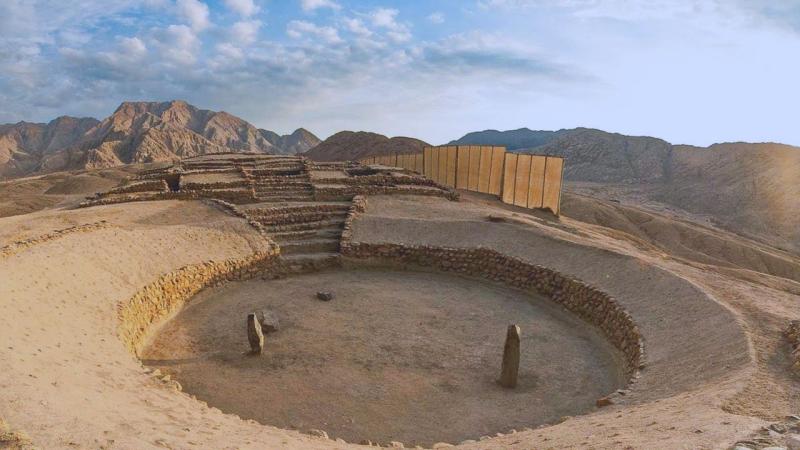
Penico opened to the public earlier this week, following eight years of research led by the archaeologist Ruth Shady

The ancient city of Penico in present-day Peru Photo: Andina Agencia de Noticias / Difusion
Located just 12 kilometres from the Sacred City of Caral-Supe in present-day Peru, Penico flourished between 1800BC and 1500BC—roughly concurrent with the Shang Dynasty in China and Ancient Egypt's Middle Kingdom. The ancient city's discovery, announced earlier this month, was the result of eight years of research led by the archaeologist Ruth Shady. The site opened to the public on 12 July, revealing its profound historical value as part of a crucial effort to grasp Peru's complex pre-Columbian societies and challenge deeply entrenched myths about them.
For centuries, it was mistakenly believed that pre-Columbian civilisations were unchanging, small, nomadic and culturally backwards. However, modern archaeological discoveries demonstrate the existence of complex societies with advanced agricultural and architectural systems, as well as extensive knowledge of ecology, astronomy and mathematics prior to the arrival of Europeans on the continent. Penico is a testimony to this sophistication.
The city's strategic location at 600 metres above sea level, on a geological terrace near the Supe River and surrounded by mountains, was not a coincidence. The site's architects, heirs to Caral's traditions, built it there to emphasise the monumental size of their structures, protect themselves from floods and landslides and, crucially, foster trade. This allowed Penico to function as a vital point of connection between the Peruvian coast and the highlands, joining together pre-Incan cultures as well as communities from the Andean-Amazonian territories and the region's high Andean zones.
Research suggests that the site flourished following the decline of the city of Caral, making use of the economic dynamics and networks of social interaction that had already been solidified in previous periods to achieve its own prestige. Shady, who also led the excavation of Caral more than 30 years ago, notes that Penico helps answer questions about the fate of the Caral civilisation following its decline as a result of climate change.
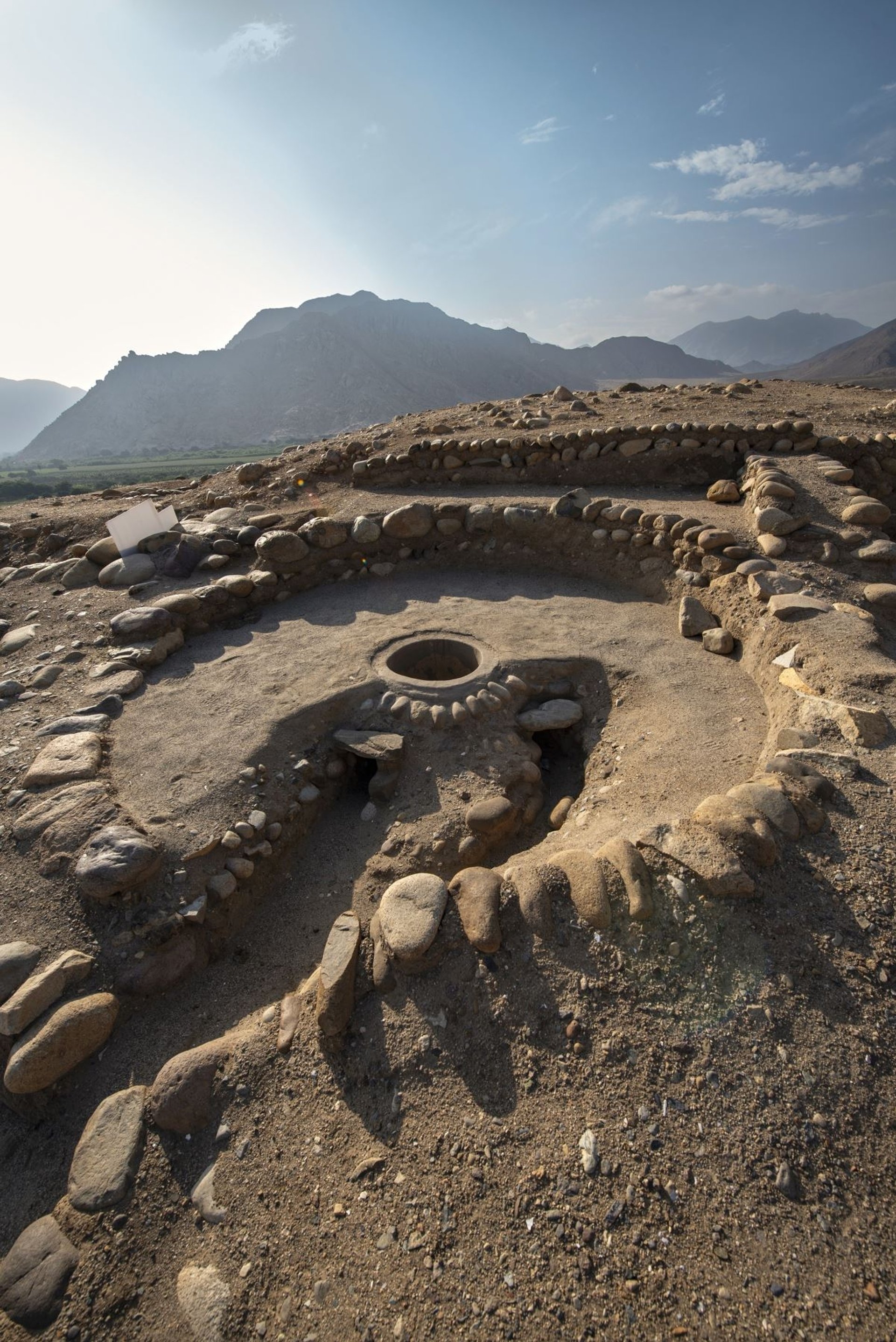
The ancient city of Penico Photo: Andina Agencia de Noticias / Difusion
Marco Machacuay, an archaeologist and researcher with Peru's cultural ministry, stresses the importance of Penico as a continuation of the Caral civilisation. Notable among the 18 structures identified at the site is a large public building dubbed B2, or the Ceremonial Hall of the Pututus. This quadrangular space is thought to have been the site of the most important administrative and ideological activities in Penico. Its reliefs and designs featuring pututus , musical instruments made from seashells that were used to call people to assemble or announce events, reveal its importance.
The presence of unfired clay sculptures (depicting human figures, animals and ritual objects), along with necklaces made from mollusc shells, gemstones like rhodochrosite and chrysocolla and animal bones, as well as stone tools, reveal a highly organised society with a constant flow of trade. The discovery of figurines of monkeys and other primates suggests a knowledge of the Amazonian region and its fauna, expanding the city's cultural scope.
Penico's economy was based on farming using sophisticated irrigation methods and trade. Its primary trade resource is believed to have been hematite, a mineral important in Andean cosmology that was used to make red pigment.
Research suggests that Penico was a vital hub in the early history of humankind in the Americas. It is a symbol of the resilience and cultural continuity that followed Caral, a civilisation that collapsed because of climate disasters such as droughts and floods. This new centre of trade prospered thanks to its inhabitants' ability to adapt their social and economic structures to survive and thrive in the face of environmental challenges.
Trolling, taunting, spamming, and off topic comments may be removed at the discretion of group mods. NT members that are known plagiarists, repeat comments, or continue to disrupt/deflect the conversation risk having all of their comments deleted.

Tags
Who is online
112 visitors
This is really interesting. New discoveries about ancient civilizations.
peruvians are the newest culture added to my family tree.
Cool. We had a Peruvian member of our extended family but he died early in the Covid epidemic. It was a tragic loss. We used to speak in Spanish with each other, which was a lot of fun for me because any time I get to practice speaking Spanish is a blast.
we lost several extended family members to covid in peru.
Ours lived here in L.A. as do all of his siblings. He got Covid visiting his daughter in Las Vegas Christmas 2019. His wife got Covid at the same time and was hospitalized for 10 days. Fortunately, she survived. One of his brothers also died during the pandemic. This was before there were vaccines.
my doctor thought I might have gotten the long haul version back in 2/20, since I was sick for almost 3 weeks. I was scheduled to get tested for it in 7/2, but a week before my DIL, her mom, and my granddaughter brought it back from a vegas wedding. took them out for 10 days. luckily I was up on my vax's and my 2nd time was like a 2 day flu.
Such fantastic discoveries are increasing as technology provides new and better instruments for finding them. The Terra Cotta Warriors were discovered only half a century ago, but needed no technology, they were discovered by farmers digging in their fields. Many new discoveries are happening in Egypt.
We went to Xi'an and saw the Terra Cotta Warriors. Apparently, they estimate that there are several thousand more that have not been excavated yet.
You and I both took a lot of photos in Xi'an. and yes, I saw that about more discoveries as well.
There's so much in Egypt.
If anyone's going to Egypt don't miss the boat ride down the Nile. It makes various stops at places with interesting sites-- Luxor is truly amazing!
Did that trip back in 06 and you're correct it was amazing. The history, sights, architecture, art were awe inspiring. The on board parties at night were good as well. The only thing I didn't like were the occasional bazaar trips, those vendors are relentless.
The tour guide did the same thing when I took a tour from Beijing to the Great Wall. The tour stopped at two or three different sale locations - pearls, jade etc.
What an amazing find! Because of technology, they keep finding these ruins... so much out there to still find!
And we are going to learn much much more about ancient peoples
Yes, we are. It is totally fascinating stuff.
I was on track to being a doctoral student in history at Berkeley, but then I made the mistake of going to law school.
lol
I don't think you made a mistake
It would have been a very different life.
I wanted to be a doctor, applied to Johns Hopkins Medical School, even got back a beautiful welcoming handwritten letter from its Dean, but ended up at University of Western Ontario Medical School, flunked calculas in my first year of pre-meds with the lowerst mark in the University's history, (at least I made my mark in the school's history), switched to Arts and ended up as a lawyer myself.
After 45 years, I'm retiring.
Good on ya..and you won't regret it... been retired 9 years myself and love it..
Especially these cold, wet and windy Winter mornings when I had to get up in the dark..my absolute pet hate..and I don't miss it one bit..🐨
My wife retired 9 years ago this September, and she has loved every minute of it. I'm more than ready.
After 37 years of lawyering, I did as well. But then after a bit of dabbling into other fields I found my greatest joy in teaching English and finding a fantastic new wife (and life) in China.
Oops -- It was October. 2016.
I can retire next month but I'm going to try and go for 30 years. Mr G plans to retire next spring. Then he will be on my case bugging me to retire, too
when all the blood thirsty oz reptiles are sluggish and lethargic ...
leaving you 2 career choices, academia or gov't. a friend has a phd in history and just retired from the gov't ...
I wonder-- is proficiency in Calculus correlated with being a good Doctor?
It would have been academia.
I didn't think so, but who knows, had I continued with Medicine I could have been another Norman Bethune.
It's amazing, isn't it?
Recently there have been a lot of amazing new discoveries in the Amazon
Rain Forest. There were made possible by technologies that enable people "seeing through" the canopies of trees:
Lasers reveal ancient pyramids and canals hidden in the Amazon
Living underground was cool. No, literally.
Ha!
The ancient Persians had a above ground system of "wind catchers" that apparently was pretty effective:
The city of Yazd in the desert of central Iran has long been a focal point for creative ingenuity. Yazd is home to a system of ancient engineering marvels that include an underground refrigeration structure called y akhchāl , an underground irrigation system called qanats , and even a network of couriers called pirradaziš that predate postal services in the US by more than 2,000 years.
Among Yazd's ancient technologies is the wind catcher, or bâdgir in Persian. These remarkable structures are a common sight soaring above the rooftops of Yazd. They are often rectangular towers, but they also appear in circular, square, octagonal and other ornate shapes.
I recently saw a show about building off the grid somewhere and they duplicated Persian windcatchers.
Windcatcher - Wikipedia
I can't figure out the second picture. Is it a partially excavated kiln or something?
That is a very good question. The photo caption only refers to "The ancient city", and there is nothing that I can determine in the article identifying what it is. I will try to research it further and see what, if anything, I can find.
based upon it's position, it looks like a ceremonial chamber, or a type of kiva ...
I researched it, and if my research is correct it's being referred to as the entrace to the Cantalloc Aqueduct.
If you hadn't already mentioned that you were a lawyer, the use of that phrase ( "if anything") gives it away.
It's the reason my answer to most questions I get asked is "It depends".
it's a lot harder to hit a moving target ...
Amazing find with hopefully many more to come. Kav would have liked this article too.
Yes, he would have.
Awesome story Gsquared! I watched a special on History Channel about the discovery of Göbekli Tepe in Turkey, said to date back as far as 9,500 BCE to 8,000 BCE! These ancient civilizations are fascinating to me!